
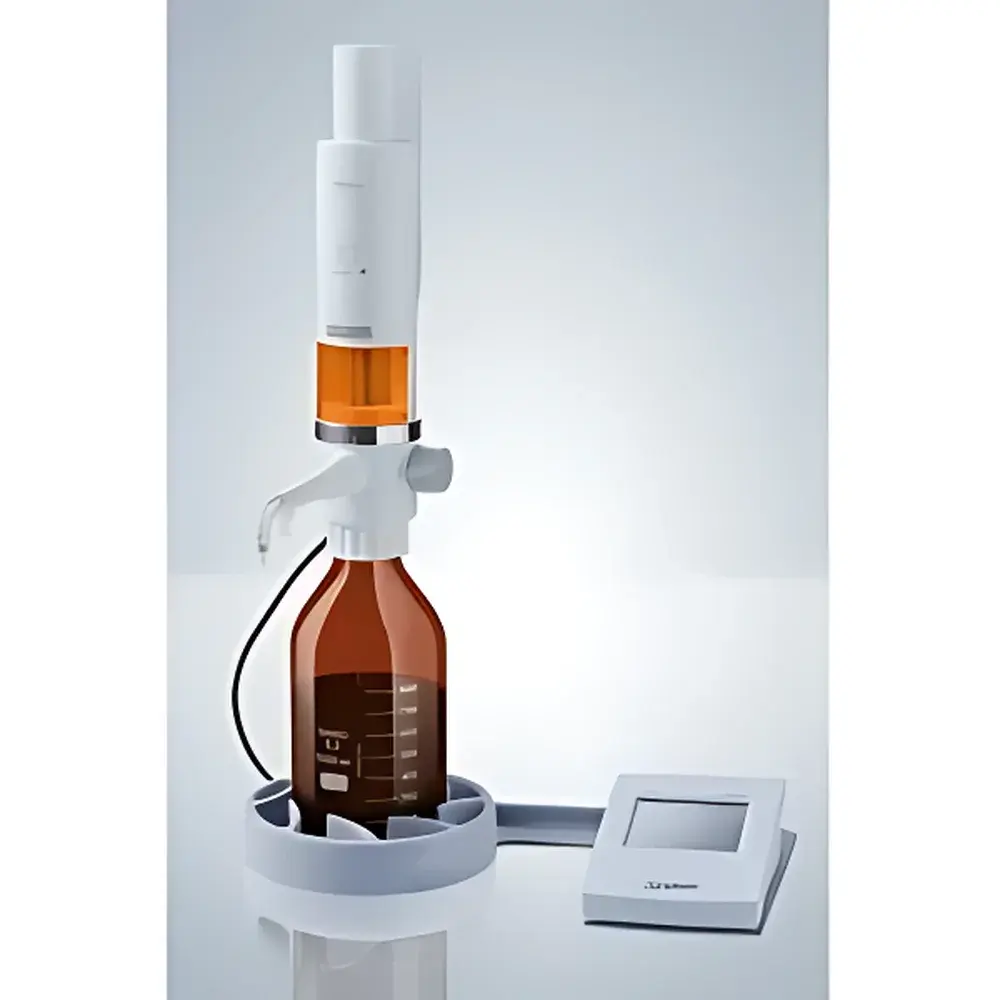
Hirschmann Opus 50 mL High-Precision Electronic Bottle Top Dispenser
| Brand | Hirschmann (Germany) |
|---|---|
| Origin | Germany |
| Model | Opus Dispenser 50 mL |
| Dispensing Range | 10 µL – 50 mL |
| Minimum Increment | 1 µL |
| Accuracy | ±0.6% |
| Coefficient of Variation (CV) | ≤0.2% |
| Display | 3.5″ TFT LCD Touchscreen (320 × 240 px) |
| Adjustable Dispensing Speed | 10 levels |
| Repeat Dispensing | 1–9999 cycles |
| Interval Timing | 1–9999 s |
| Stepwise Dispensing | Up to 10 programmable volumes per cycle |
| Rotation | 360° free swivel head |
| Compatibility | Compatible with Hirschmann Ceramus dispensers and standard GL45/GL32 bottles |
| Filtration Option | Integrated 0.2 µm hydrophobic filter in discharge tube |
| Sterile & Light-Sensitive Handling | Supported |
Overview
The Hirschmann Opus 50 mL Electronic Bottle Top Dispenser is an engineered solution for high-precision, repeatable liquid handling in regulated laboratory and production environments. Based on positive displacement piston technology with integrated electronic actuation and closed-loop volume control, the Opus delivers traceable, operator-independent dispensing across a wide dynamic range—from microliter-scale aliquots (10 µL) up to full 50 mL volumes. Its design eliminates reliance on manual force or gravity-driven flow, ensuring consistent volumetric delivery regardless of liquid viscosity, volatility, or surface tension. Unlike mechanical bottle top dispensers, the Opus integrates real-time position feedback from the stepper motor and pressure-compensated piston travel monitoring—enabling compliance with ISO 8655-3 (volumetric instruments) and supporting GLP/GMP workflows where auditability and reproducibility are mandatory.
Key Features
- 3.5-inch high-resolution TFT touchscreen interface with intuitive icon-based navigation—enabling rapid parameter entry, preset recall, and real-time status feedback without external software.
- 360° fully rotatable dispensing head with ergonomic tilt adjustment—facilitating access to narrow-neck or multi-position vessels while minimizing wrist strain during extended operation.
- Programmable stepwise dispensing: store and execute sequences of up to 10 distinct volumes within a single dispensing cycle—ideal for serial dilution, reagent plate filling, or multi-step assay preparation.
- 10-level adjustable aspiration and dispensing speed—optimized for viscous solvents (e.g., glycerol, DMSO), volatile organics (e.g., acetone, chloroform), or shear-sensitive biologicals (e.g., enzyme solutions, cell suspensions).
- Integrated 0.2 µm hydrophobic PTFE filter in the discharge tube—preventing aerosol formation and protecting internal components when handling corrosive, toxic, or sterile liquids.
- Modular compatibility with Hirschmann’s Ceramus dispenser accessories—including foot switches, calibration adapters, and sterilizable discharge tubes—supporting seamless integration into cleanroom or automated liquid handling platforms.
Sample Compatibility & Compliance
The Opus 50 mL dispenser accommodates a broad spectrum of liquid classes: aqueous buffers, organic solvents (including halogenated and low-surface-tension media), acids and bases (pH 1–13), light-sensitive compounds (via amber tubing options), and sterile preparations (when used with autoclavable components and validated aseptic procedures). All wetted parts comply with USP Class VI biocompatibility standards and EU Regulation (EC) No 1935/2004 for food contact materials. The device supports calibration traceability to national metrology institutes (e.g., PTB, NIST) and meets requirements for ISO/IEC 17025-accredited laboratories. Optional data logging (via RS232 or USB) enables alignment with FDA 21 CFR Part 11 for electronic records and signatures when paired with compliant LIMS or ELN systems.
Software & Data Management
While the Opus operates as a standalone instrument, its embedded firmware supports bidirectional communication via RS232 or USB virtual COM port. This allows direct integration with laboratory information management systems (LIMS), electronic lab notebooks (ELN), or custom automation scripts for remote parameter configuration, dispensing log export (CSV/TXT), and event-triggered calibration alerts. Audit trail functionality records all user actions—including volume changes, dispense events, error codes, and system resets—with timestamps and operator IDs (when configured with network authentication). Firmware updates are performed via secure signed packages, maintaining integrity throughout the device lifecycle.
Applications
- Quality control laboratories performing titrations, standard solution preparation, and reference material dilution per ASTM E200 or ISO 6497.
- Pharmaceutical R&D labs requiring precise solvent addition in HPLC mobile phase preparation or API crystallization studies.
- Clinical diagnostics facilities dispensing reagents into microtiter plates under CLIA or CAP guidelines.
- Academic research groups handling radioactive tracers, cytotoxic drugs, or photo-labile dyes where reproducibility and containment are critical.
- Contract manufacturing organizations (CMOs) validating dispensing processes per ICH Q5C and Q7A for GMP-compliant batch documentation.
FAQ
Is the Opus 50 mL dispenser suitable for use with aggressive solvents such as concentrated sulfuric acid or sodium hypochlorite?
Yes—the piston seal, valve seats, and discharge tubing are constructed from chemically resistant PTFE, FFKM (perfluoroelastomer), and borosilicate glass, enabling safe handling of strong oxidizers and mineral acids when operated within specified concentration and temperature limits.
Can dispensing data be exported for regulatory submission?
Yes—via RS232 or USB, the device outputs timestamped dispense logs including volume, cycle count, speed setting, and error flags; these files are compatible with CSV parsers used in regulatory submissions under FDA 21 CFR Part 11 when combined with appropriate system validation.
Does the Opus require routine recalibration?
No—it features self-compensating piston positioning and factory-traceable calibration stored in non-volatile memory; however, periodic verification per ISO 8655-3 is recommended at defined intervals (e.g., daily pre-use checks for critical applications).
Is sterile dispensing supported out-of-the-box?
Sterile operation requires optional autoclavable discharge tubes and a validated aseptic setup procedure; the base unit itself is not autoclavable but can be decontaminated using ethanol or hydrogen peroxide vapor.
How does the Opus compare to air-displacement pipettes for low-volume accuracy?
Unlike air-displacement systems, the Opus uses positive displacement with fixed-volume piston travel—eliminating humidity-, temperature-, and tip-dependent variability; at 10 µL, it achieves CV ≤0.2%, whereas typical air-displacement pipettes exhibit CV ≥1.5% at this range.



