
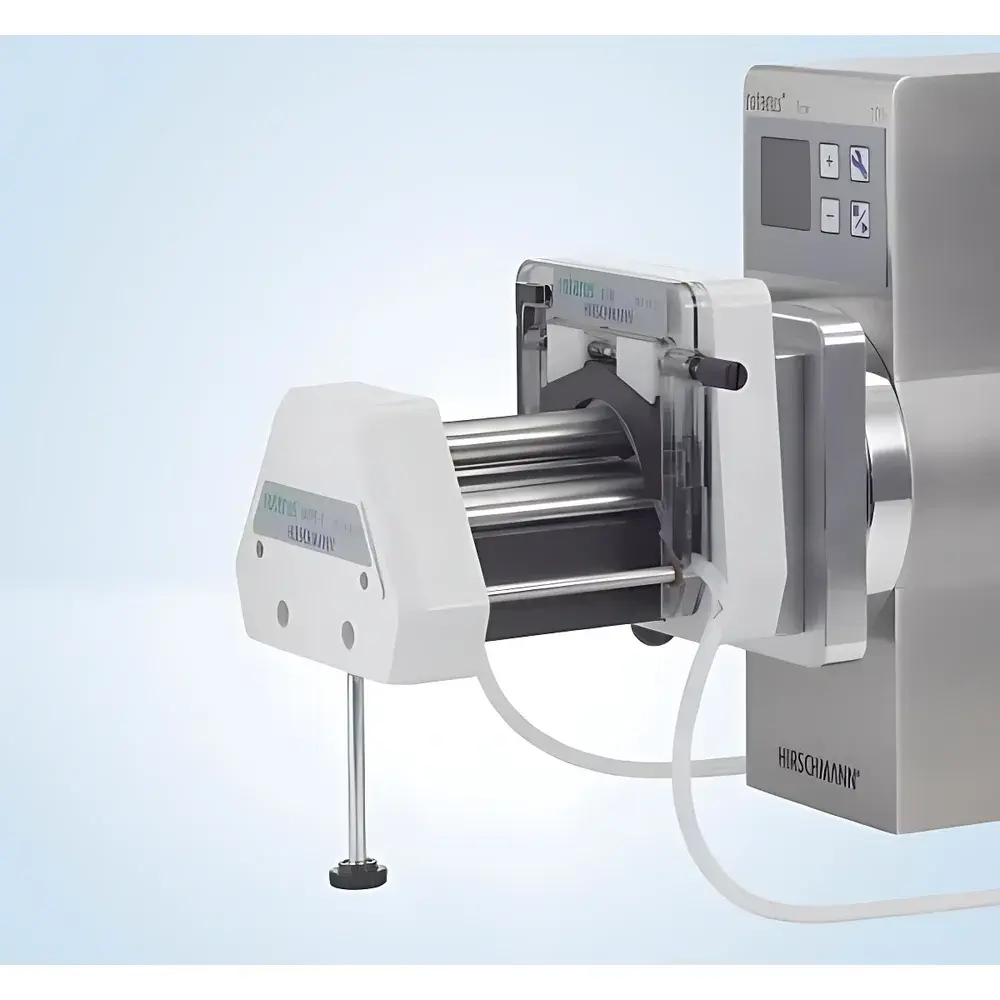
Hirschmann rotarus® volume High-Precision Smart Peristaltic Dispensing Pump
| Brand | Hirschmann |
|---|---|
| Origin | Germany |
| Model | rotarus® volume |
| Pump Type | Peristaltic Pump |
| Flow Rate Range | 0–2000 mL/min |
| Speed Range | 0.2–500 rpm |
| Motor Options | 50 W / 100 W |
| Intelligent Features | RFID-based pump head & tubing identification, real-time occlusion and leak detection, programmable dispensing protocols, built-in calibration and method storage |
| Enclosure Options | Lab-grade (IP20) and industrial-grade (IP65) |
| Control Interface | Integrated front-panel controls + optional external TFT touchscreen controller |
| Pump Head Compatibility | Tool-free single/multi-channel head installation |
| Compliance | Designed for GLP/GMP environments |
Overview
The Hirschmann rotarus® volume is a high-precision, microprocessor-controlled peristaltic dispensing pump engineered for reproducible, traceable liquid handling in regulated laboratory and light-industrial settings. Operating on the principle of positive displacement via roller compression of flexible tubing, it delivers volumetric accuracy without fluid contact with internal mechanical components—ensuring contamination-free transfer of sensitive, viscous, or shear-sensitive media. Unlike conventional peristaltic pumps, the rotarus® volume integrates embedded intelligence to monitor system integrity in real time, including tubing occlusion, leakage, and mechanical wear—enabling predictive maintenance and reducing experimental downtime. Its modular architecture supports both benchtop laboratory workflows and ruggedized industrial deployment, with dual enclosure variants meeting distinct environmental protection requirements (IP20 for standard lab use; IP65 for dust- and splash-resistant operation).
Key Features
- Two motor power options (50 W and 100 W) enabling precise speed control from 0.2 to 500 rpm—optimized for low-flow precision or high-throughput dispensing up to 2000 mL/min.
- RFID-enabled pump head and tubing recognition: automatically identifies installed components, prevents mismatched configurations, and recalls calibrated parameters associated with each tubing batch.
- Real-time tubing integrity monitoring: detects abnormal pressure signatures indicative of partial occlusion, full blockage, or wall rupture—triggering audible/visual alerts and automatic pump halt.
- Dual-control architecture: integrated front-panel interface for immediate parameter adjustment; optional external TFT touchscreen controller for advanced programming—including multi-step sequences, variable-speed cycles, and ramped dispensing profiles.
- Tool-free pump head mounting system: accommodates single-channel, multi-channel, or custom-configured heads; compatible with select third-party pump heads via mechanical and electrical interface adapters.
- Built-in calibration routine and method storage: supports user-defined calibration curves (e.g., volumetric vs. rotational speed), saves up to 100 dispensing protocols with timestamped version history.
Sample Compatibility & Compliance
The rotarus® volume handles aqueous solutions, organic solvents, suspensions, cell culture media, and highly viscous liquids (up to 50,000 mPa·s) without degradation of accuracy or tubing lifespan—provided tubing material is chemically compatible (e.g., PharMed® BPT, silicone, or Viton®). Its design adheres to IEC 61000-6-2/6-4 for electromagnetic compatibility and meets CE marking requirements for safety and performance. For regulated environments, the system supports audit-trail generation when paired with validated software platforms compliant with FDA 21 CFR Part 11, ISO/IEC 17025, and EU GMP Annex 11 guidelines. All firmware updates are digitally signed and logged, ensuring data integrity throughout instrument lifecycle.
Software & Data Management
While the rotarus® volume operates autonomously via its embedded controller, optional PC-based configuration software enables centralized method deployment, remote diagnostics, and export of dispensing logs in CSV or XML format. Each dispensing event records timestamp, speed profile, total volume dispensed, tubing ID, pump head ID, and system status flags (e.g., “occlusion detected at t=142 s”). Raw data files include SHA-256 checksums for tamper-evident archiving. The system supports integration into LIMS or ELN platforms via RS-232, USB Virtual COM, or optional Ethernet module (TCP/IP Modbus RTU), facilitating automated data capture within quality management systems.
Applications
- Automated reagent dispensing in clinical chemistry analyzers and ELISA workflow stations.
- Precise media filling in bioreactor inoculation and fermentation scale-up processes.
- Volumetric dosing of polymer solutions, adhesives, or ceramic slurries in materials R&D labs.
- Continuous sampling in inline process analytical technology (PAT) setups with feedback-controlled flow modulation.
- Calibration standard preparation requiring sub-milliliter repeatability across varying viscosities.
- GMP-compliant buffer exchange in downstream purification skids where tubing change verification is critical.
FAQ
Does the rotarus® volume support gravimetric calibration?
Yes—users can perform gravimetric calibration using an analytical balance and the built-in calibration wizard, which calculates correction factors based on actual mass dispensed versus target volume.
Can multiple rotarus® volume units be synchronized?
Synchronization is achievable via external TTL trigger signals or master-slave configuration over RS-485, enabling coordinated multi-pump dispensing in parallel processing systems.
Is tubing lifetime tracked automatically?
Tubing usage hours and cumulative revolutions are logged per RFID-tagged tube set; alerts notify users when predefined service thresholds are approached.
What validation documentation is provided?
Each unit ships with a Factory Acceptance Test (FAT) report, IQ/OQ protocol templates, and a Certificate of Conformance traceable to national standards (DIN EN ISO/IEC 17025-accredited calibration lab).
How is firmware updated?
Firmware updates are delivered as encrypted .bin files via USB stick; the update process includes pre-flash integrity verification and automatic rollback on failure.



