
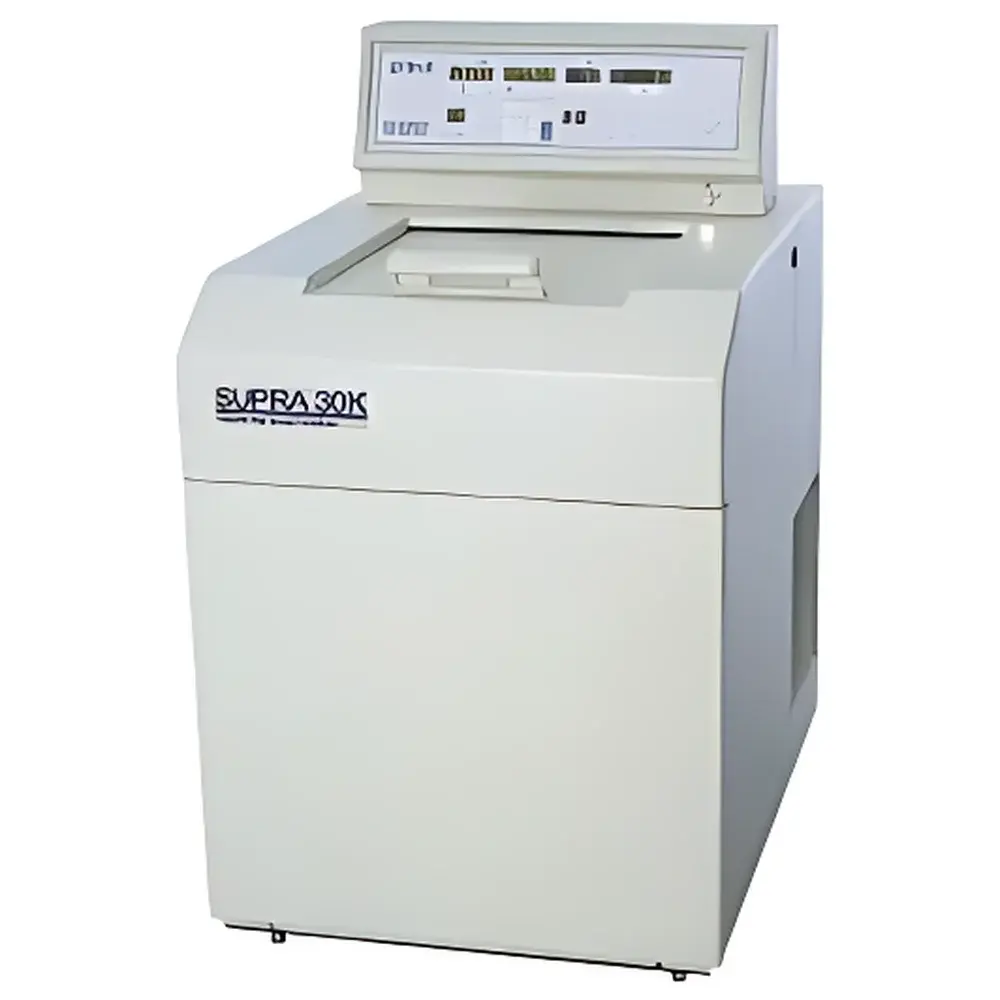
Hanil Supra 30K High-Speed Refrigerated Centrifuge
| Brand | Hanil |
|---|---|
| Origin | South Korea |
| Model | Supra 30K |
| Max Speed | 30,000 rpm |
| Max RCF | 98,608 × g |
| Max Capacity | 4 × 1000 mL |
| Temp Range | −20 °C to +40 °C |
| Temp Set Range | 0 °C to ±30 °C |
| Time Range | 0–99 h 59 min 59 sec + Hold mode |
| Acceleration Curves | 10 |
| Deceleration Curves | 10 |
| Stored Programs | 20 |
| Rotor Types | 15 compatible rotors |
| Effective Rotor Radius Range | 0.1 mm to max radius |
| Display | Digital panel showing RPM, RCF, time, temperature, temp limit, program ID, acceleration/deceleration profile, rotor ID, rotor radius, safety status |
| Power Supply | 220 V, 60 Hz, single-phase, 3.9 kW |
| Dimensions (W×D×H) | 710 × 1000 × 1260 mm |
| Weight | 330 kg |
Overview
The Hanil Supra 30K High-Speed Refrigerated Centrifuge is an engineered platform for high-throughput, temperature-sensitive separation tasks in research, clinical, and industrial laboratories. Designed around a robust horizontal-axis drive architecture and active refrigeration system, it operates on the principle of sedimentation under controlled centrifugal force—enabling precise isolation of subcellular components, macromolecules, nanoparticles, and suspended particulates based on density, size, and shape. Its 30,000 rpm maximum rotational speed and 98,608 × g relative centrifugal force (RCF) support demanding protocols including viral pellet recovery, organelle fractionation, plasmid DNA purification, and large-volume cell harvesting. The integrated refrigeration maintains sample integrity across extended runs, with real-time thermal regulation between −20 °C and +40 °C and programmable setpoint stability within ±0.5 °C over the full operational range.
Key Features
- Microprocessor-based single-chip control system with embedded firmware for deterministic timing, torque management, and fault diagnostics.
- Universal rotor compatibility—including fixed-angle, swing-bucket, vertical, and continuous-flow rotors—ensuring method flexibility without hardware reconfiguration.
- Real-time RCF/RPM interconversion with automatic recalculation upon rotor ID recognition and radius input; eliminates manual conversion errors during protocol transfer.
- Programmable acceleration and deceleration profiles (10 each), enabling gentle pelleting of fragile samples or rapid spin-down for time-critical workflows.
- Automatic rotor identification via encoded interface; validates mechanical limits and enforces safety-critical parameter constraints (e.g., max speed per rotor geometry).
- Digital control panel with multi-parameter readout: RPM, RCF, elapsed/remaining time, chamber temperature, user-defined temperature limit, active program number, selected acceleration/deceleration curve, rotor ID, effective radius, and real-time safety status.
- Integrated feedback-controlled vacuum system maintaining partial atmospheric pressure to reduce windage heating and improve thermal stability at high speeds.
- Comprehensive safety monitoring: detects and halts operation upon imbalance >5 g, overspeed, overtemperature, door interlock breach, or vacuum failure—each condition logged with timestamp and error code.
Sample Compatibility & Compliance
The Supra 30K accommodates standard laboratory vessels—including 15 mL, 50 mL conical tubes, 250 mL–1000 mL bottles, and specialized continuous-flow cartridges—across its 15 certified rotor configurations. All rotors are manufactured to ISO 15197 and IEC 61010-2-020 standards for mechanical integrity and electrical safety. Temperature control meets ISO 17025 calibration traceability requirements when paired with accredited thermistor validation. The unit supports GLP/GMP-compliant workflows through auditable event logging (including run history, parameter changes, and alarm triggers), aligning with FDA 21 CFR Part 11 expectations for electronic records when used with validated LIMS integration.
Software & Data Management
While the Supra 30K operates as a standalone instrument with local program storage (20 user-defined methods), its digital interface supports RS-232 and optional Ethernet connectivity for remote monitoring and data export. Run logs—including start/stop timestamps, final RCF, average temperature, rotor usage count, and fault events—are exportable in CSV format for audit trail reconstruction. Firmware updates are performed via secure USB interface with version-locking and checksum verification to ensure configuration consistency across multi-instrument deployments.
Applications
- Preparative ultracentrifugation of exosomes and extracellular vesicles (100,000–200,000 × g equivalent via k-factor optimization).
- Large-scale bacterial and yeast cell harvesting (4 × 1000 mL capacity enables batch processing aligned with bioprocessing scale-up).
- Clinical specimen preparation: serum/plasma separation, PBMC isolation, and pathogen concentration from blood or environmental samples.
- Material science applications: nanoparticle size fractionation, colloidal suspension stabilization studies, and polymer phase separation analysis.
- Quality control in pharmaceutical manufacturing: residual host-cell protein removal, vaccine antigen clarification, and sterile filtration validation support.
FAQ
What safety certifications does the Supra 30K hold?
It complies with IEC 61010-2-020 (safety requirements for centrifuges) and carries CE marking for EMC and Low Voltage Directive conformity. Rotors are individually certified to ISO 15197 for burst resistance.
Can the centrifuge maintain temperature stability during prolonged high-speed runs?
Yes—the closed-loop refrigeration system, combined with vacuum-assisted thermal isolation and feedback-controlled compressor modulation, sustains setpoint accuracy within ±0.5 °C even during 99-hour continuous operation at 25,000 rpm.
Is rotor calibration required before first use?
No. Each rotor contains an embedded identifier that auto-configures maximum speed, radius, and k-factor upon installation; however, periodic verification of temperature sensor drift and brake wear is recommended per ISO/IEC 17025 preventive maintenance guidelines.
How is data integrity ensured for regulated environments?
All operational events—including parameter edits, program executions, alarms, and shutdowns—are time-stamped and stored in non-volatile memory. Exported logs include digital signatures for chain-of-custody verification when integrated with validated laboratory information management systems.
Does the unit support continuous-flow processing?
Yes—compatible with Hanil’s CF-30 series continuous-flow rotors, enabling steady-state separation of large-volume feed streams (up to 10 L/h) with minimal shear-induced aggregation.



