
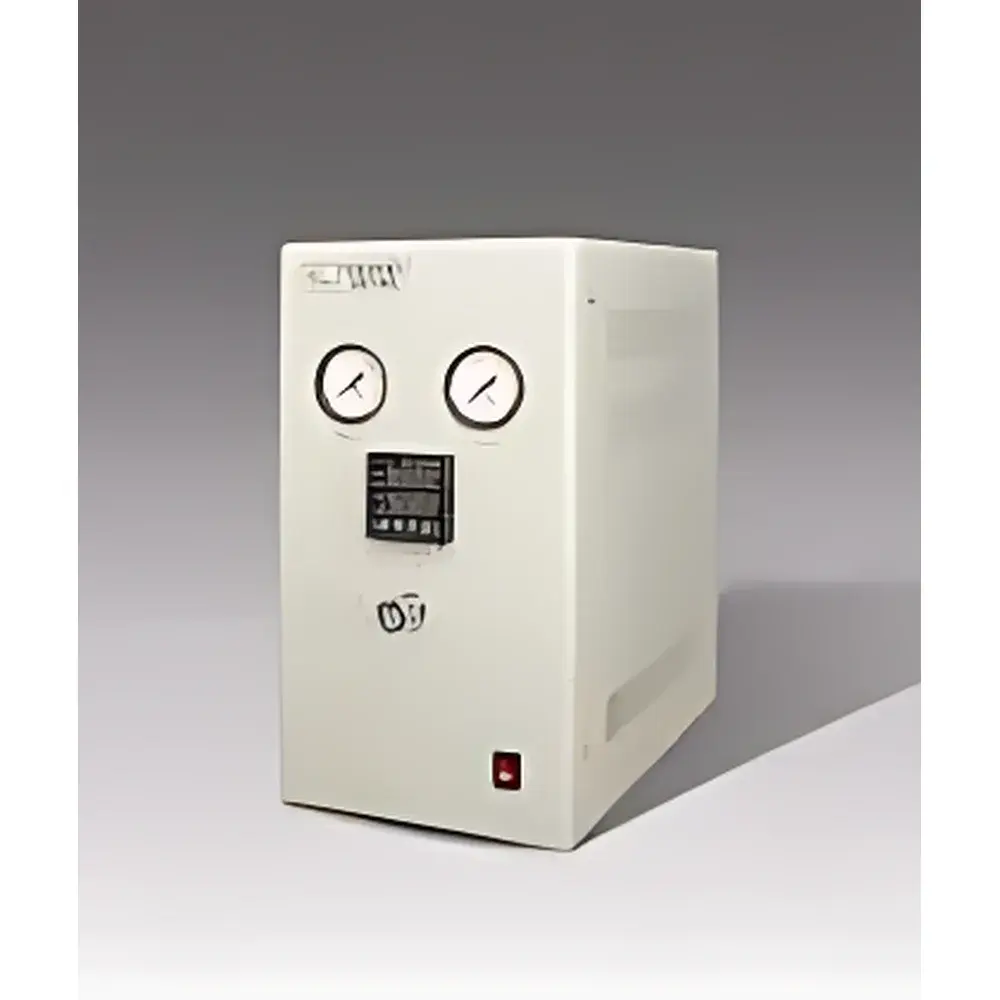
Pd-300 Palladium-Based Hydrogen Purifier
| Origin | Beijing, China |
|---|---|
| Manufacturer Type | Authorized Distributor |
| Origin Category | Domestic (China) |
| Model | Pd-300 |
| Pricing | Upon Request |
| Feed H₂ Purity | >99% |
| Ultra-High-Purity H₂ Output | >99.99999% |
| Feed Gas Pressure Range | 0–1 MPa |
| Purified H₂ Delivery Pressure | 0–0.6 MPa |
| Power Supply | 220 V ±10%, 50–60 Hz |
| Power Consumption | 250 W |
| Operating Temperature | 350 °C |
| Ambient Operating Temperature | 1–40 °C |
| Ambient Relative Humidity | <85% RH |
| Dimensions (W×D×H) | 340 × 200 × 360 mm |
| Net Weight | ~6 kg |
Overview
The Pd-300 Palladium-Based Hydrogen Purifier is a compact, thermally activated gas purification system engineered for the continuous production of ultra-high-purity hydrogen (≥99.99999% H₂) from technical-grade feed gas (>99% H₂). It operates on the principle of selective hydrogen permeation through a high-temperature, diffusion-controlled palladium-silver-gold-nickel alloy membrane — a well-established method rooted in solid-state metallurgical transport phenomena. At elevated operating temperatures (350 °C), molecular hydrogen dissociates into atomic hydrogen on the upstream surface of the Pd-alloy membrane, diffuses through the lattice via interstitial sites, and recombines into H₂ molecules on the downstream side. This process inherently excludes all non-permeating species — including N₂, O₂, CO, CO₂, CH₄, H₂O vapor, and hydrocarbons — yielding hydrogen with impurity levels below 100 ppt (parts-per-trillion) for critical trace-gas-sensitive applications.
Key Features
- High-selectivity Pd–Ag–Au–Ni alloy membrane optimized for long-term thermal stability and resistance to poisoning under continuous operation at 350 °C
- Integrated temperature-controlled furnace with PID-regulated heating and redundant overtemperature protection (dual independent thermal cutoffs)
- Stainless steel 316L wetted-path construction compliant with UHP gas handling standards; all internal surfaces electropolished (Ra < 0.4 µm)
- Feed gas pressure regulation (0–1 MPa) and purified H₂ output pressure control (0–0.6 MPa) via precision back-pressure regulators
- Low power consumption (250 W) enabling benchtop deployment without dedicated HVAC or high-capacity electrical circuits
- Compact footprint (340 × 200 × 360 mm) and lightweight design (~6 kg) suitable for integration into analytical instrument cabinets or ISO-classified cleanroom environments
Sample Compatibility & Compliance
The Pd-300 is designed exclusively for gaseous hydrogen feed streams containing ≥99% H₂ and trace contaminants typical of electrolytic or reformate-derived hydrogen (e.g., CO < 10 ppm, O₂ < 50 ppm, H₂O < 100 ppm). It is incompatible with feed gases containing sulfur compounds (e.g., H₂S), halogens, or silicones, which irreversibly deactivate the Pd membrane. The unit complies with IEC 61010-1:2010 for electrical safety in laboratory equipment and meets CE marking requirements for EMC (EN 61326-1) and low-voltage directives. While not certified to ISO 8573-1 Class 1 for compressed air, its purified H₂ output satisfies ISO 8573-1:2010 Class 1.1.1 (solid particles ≤0.1 µm, dew point ≤−70 °C, total oil ≤0.01 mg/m³) when paired with optional pre-filtration.
Software & Data Management
The Pd-300 operates as a standalone hardware module with analog monitoring outputs (0–10 V DC) for furnace temperature and outlet pressure. No embedded firmware or proprietary software is included; however, analog signals are compatible with standard SCADA systems, PLCs, or data loggers supporting 4–20 mA or 0–10 V inputs. For GLP/GMP-regulated laboratories, users may integrate the device into validated instrument networks using external digital recorders that provide audit-trail-capable timestamped logging — fully compliant with FDA 21 CFR Part 11 when configured with appropriate access controls and electronic signature protocols.
Applications
- Carrier and fuel gas supply for GC-FID, GC-TCD, and GC-MS systems requiring sub-ppb oxygen and hydrocarbon content
- Hydrogen source for residual gas analyzers (RGAs), quadrupole mass spectrometers, and surface science tools (e.g., XPS, AES)
- Calibration gas generation for environmental air monitoring instruments (e.g., NOₓ analyzers, ozone photometers)
- Blank gas for ultra-low-background radiochemical assays and isotopic ratio measurements (e.g., δ²H analysis)
- Process gas conditioning in semiconductor R&D cleanrooms where metal-catalyzed decomposition must be avoided
FAQ
What feed gas specifications are required to achieve ≥99.99999% H₂ purity?
Feed gas must contain ≥99% H₂ with CO < 5 ppm, O₂ < 20 ppm, H₂O < 50 ppm, and zero detectable H₂S or halogenated compounds. Pre-filtration with heated CuO scrubbers and desiccant traps is strongly recommended.
Can the Pd-300 be operated continuously for extended periods?
Yes — the system is rated for unattended 24/7 operation provided ambient temperature remains within 1–40 °C and relative humidity stays below 85% RH. Membrane lifetime exceeds 15,000 hours under specified feed conditions.
Is the purified H₂ output compatible with GC carrier gas inlets?
Yes — the regulated 0–0.6 MPa output pressure aligns with standard GC pneumatic interfaces. A stainless steel 1/8″ Swagelok fitting is supplied; users must provide compatible tubing (e.g., SS or PFA) meeting ASTM F2215 specifications.
Does the unit require routine maintenance beyond periodic leak checks?
No consumables or scheduled replacements are required. Annual verification of temperature calibration (±1 °C) and pressure regulator hysteresis (<0.5% FS) is recommended for ISO/IEC 17025 compliance.
Can multiple Pd-300 units be manifolded for higher flow capacity?
Parallel configuration is technically feasible but not supported by factory validation. Each unit delivers up to 100 mL/min at 0.6 MPa; flow scaling should be verified empirically per application due to potential cross-talk in thermal regulation.



