
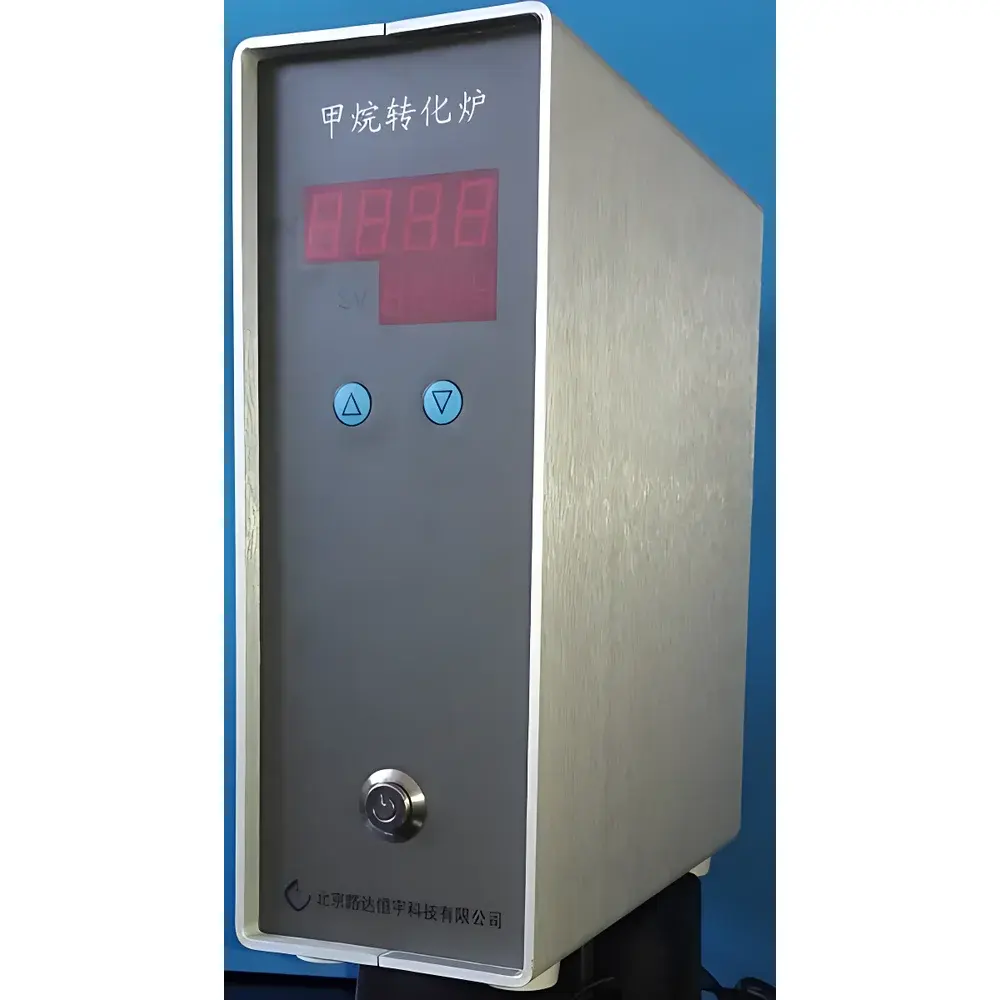
LUDAHY LD-MRF1700 Methanizer for Gas Chromatography
| Brand | LUDAHY |
|---|---|
| Model | LD-MRF1700 |
| Origin | Beijing, China |
| Heating Power | 300 W |
| Temperature Control Range | 0–400 °C |
| Methanization Temperature | 350–380 °C |
| Temperature Sensor | Thermocouple |
| Conversion Tube Configuration | U-shaped, 1/8″ or 1/16″ OD × 250 mm |
| Inlet/Outlet Fitting | 1/8″ or 1/16″ compression |
| Catalytic Efficiency | ≥98% |
| Catalyst Lifetime | ≥2 years (under sulfur- and oil-free sample conditions) |
| Minimum Detectable Concentration (CO/CO₂) | ≤0.1 ppm (when coupled with FID) |
| H₂ Requirement | ≥60% of total carrier gas flow (by volume) |
Overview
The LUDAHY LD-MRF1700 Methanizer is a precision post-column catalytic conversion device engineered for trace-level quantification of carbon monoxide (CO) and carbon dioxide (CO₂) in gas chromatography (GC) systems equipped with flame ionization detectors (FID). Unlike thermal conductivity (TCD) or methanizer-integrated TCD configurations, this unit leverages nickel-based heterogeneous catalysis under controlled hydrogen-rich environments to stoichiometrically convert non-FID-responsive CO and CO₂ into methane (CH₄) via the exothermic reactions: CO + 3H₂ → CH₄ + H₂O and CO₂ + 4H₂ → CH₄ + 2H₂O. The resulting CH₄ is then sensitively detected by the FID with sub-ppm sensitivity—enabling reliable analysis of impurity gases in ultra-high-purity (UHP) industrial gases (e.g., H₂, N₂, O₂, He, Ar), transformer oil dissolved gases (DGA), syngas streams, and air separation plant off-gases. Its design conforms to established GC auxiliary hardware standards for integration with both benchtop and process GC platforms.
Key Features
- High-efficiency nickel catalyst bed with ≥98% conversion efficiency for CO and CO₂ across the specified operating range (350–380 °C)
- Precision thermocouple-based temperature control with ±1 °C stability over 24 h, ensuring reproducible catalytic kinetics
- U-shaped conversion tube geometry (available in 1/8″ or 1/16″ OD × 250 mm) optimized for uniform radial heat distribution and minimal band broadening
- Integrated heating element and thermal insulation assembly to maintain isothermal zone integrity and suppress axial temperature gradients
- Robust mechanical construction compatible with standard GC pneumatic interfaces (1/8″ or 1/16″ Swagelok/VCR fittings)
- Hydrogen-safeguarded startup protocol: pre-purging with H₂ prior to heating prevents Ni oxidation (Ni → NiO), preserving long-term catalytic activity
Sample Compatibility & Compliance
The LD-MRF1700 is validated for use with hydrogen or nitrogen carrier gases—provided H₂ constitutes at least 60% of total flow by volume to sustain full catalytic reduction. It is not suitable for quantitative analysis of CO or CO₂ at percent-level concentrations due to catalyst saturation and potential methanation equilibrium limitations. Sample matrices must be free of sulfur compounds (e.g., H₂S, COS), hydrocarbons (e.g., C₂H₂, C₂H₄), halogenated species, or particulate/oily contaminants, all of which irreversibly poison the Ni catalyst. Applications align with ASTM D3612 (DGA analysis), ISO 8573-5 (compressed air purity), and IEC 60599 (transformer fault gas interpretation). While not inherently 21 CFR Part 11-compliant, its operation supports GLP/GMP workflows when integrated into validated GC systems with audit-trail-enabled data acquisition.
Software & Data Management
As a hardware-only auxiliary module, the LD-MRF1700 requires no embedded firmware or proprietary software. Temperature setpoints and ramp profiles are configured externally via the host GC’s oven controller or standalone PID temperature controller (e.g., Eurotherm, Watlow). All operational parameters—including actual temperature, heater status, and runtime—are logged through the GC data system alongside chromatographic peaks. When deployed in regulated environments, users implement instrument qualification protocols (IQ/OQ/PQ) per ISO/IEC 17025 and document catalyst replacement intervals, calibration verification runs (using certified CO/CO₂ standards), and carrier gas purity certifications (e.g., Grade 5.0 or better per ISO 8573-1 Class 1).
Applications
- Trace CO/CO₂ impurity analysis in high-purity hydrogen used in semiconductor manufacturing and fuel cell testing
- Dissolved gas analysis (DGA) of power transformer insulating oil per IEEE C57.104 and IEC 60599
- Quality control of synthesis gas (syngas) and ammonia plant feedstocks
- Offline purity verification of cryogenically separated industrial gases (N₂, O₂, Ar, He)
- Environmental monitoring of low-concentration combustion byproducts in stack emissions
- Research applications requiring sub-ppm detection limits where TCD sensitivity is insufficient
FAQ
What is the recommended carrier gas composition for optimal conversion efficiency?
Hydrogen must constitute ≥60% of the total carrier gas flow (v/v); nitrogen may serve as balance gas but cannot replace H₂ as the primary reductant.
Why does the methanizer require pre-heating under H₂ flow?
To prevent oxidation of active Ni(0) sites to inactive NiO during thermal ramp-up; H₂ also reduces any pre-existing NiO back to catalytically active Ni(0).
How often should the catalyst be replaced?
Under sulfur-free, oil-free operating conditions, typical service life exceeds 24 months; performance degradation is indicated by diminished CH₄ peak area for fixed CO/CO₂ standards.
Can this methanizer be used with helium carrier gas?
No—helium lacks reducing capability and cannot sustain the catalytic cycle; only H₂ or H₂/N₂ blends are functionally viable.
Is the LD-MRF1700 compatible with all FID-equipped GC systems?
Yes—mechanically and pneumatically, provided inlet/outlet tubing dimensions and pressure ratings match; electrical interface is limited to external temperature controller connection.





