
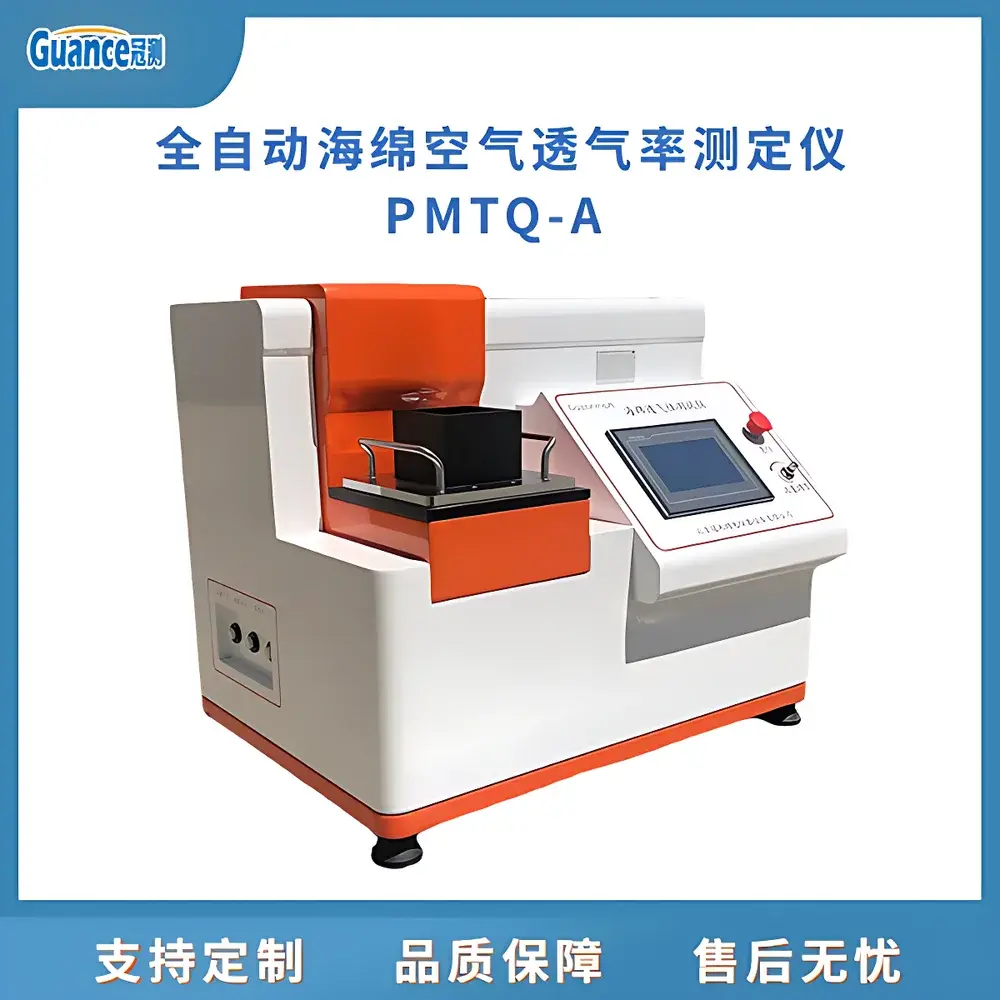
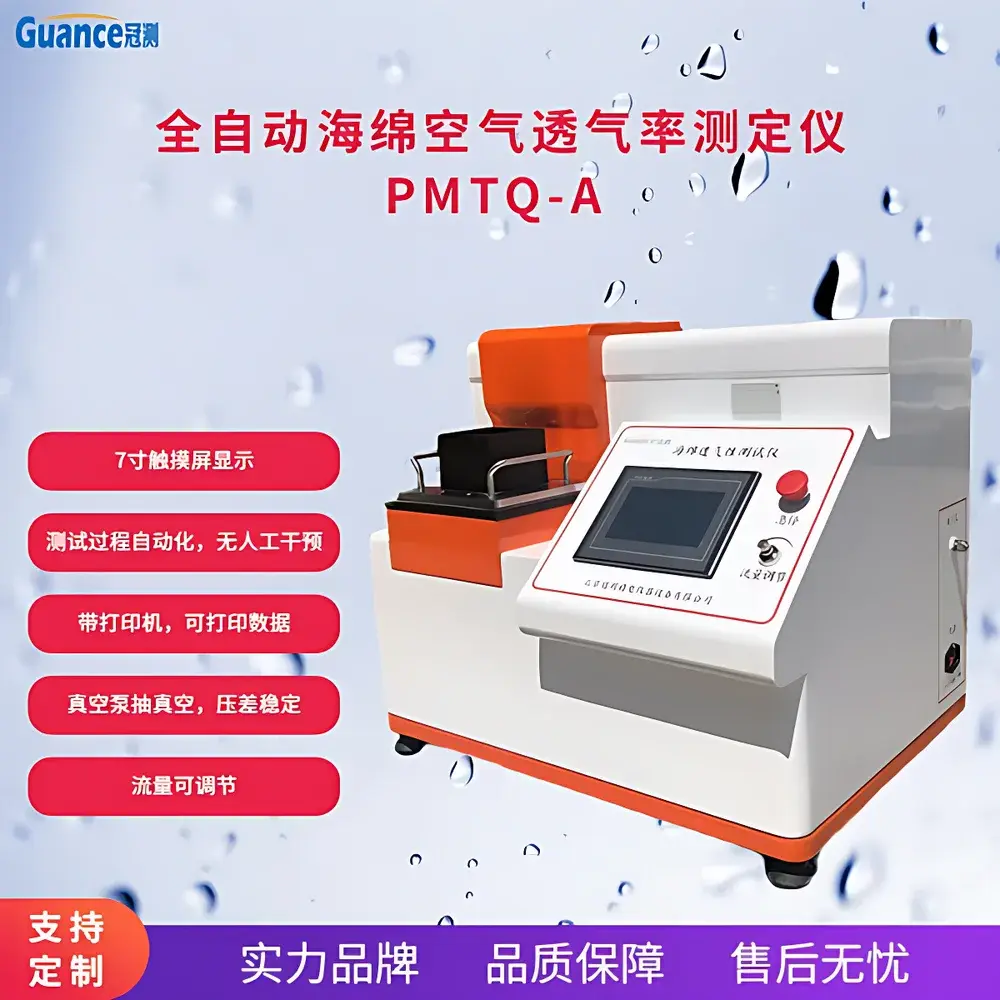
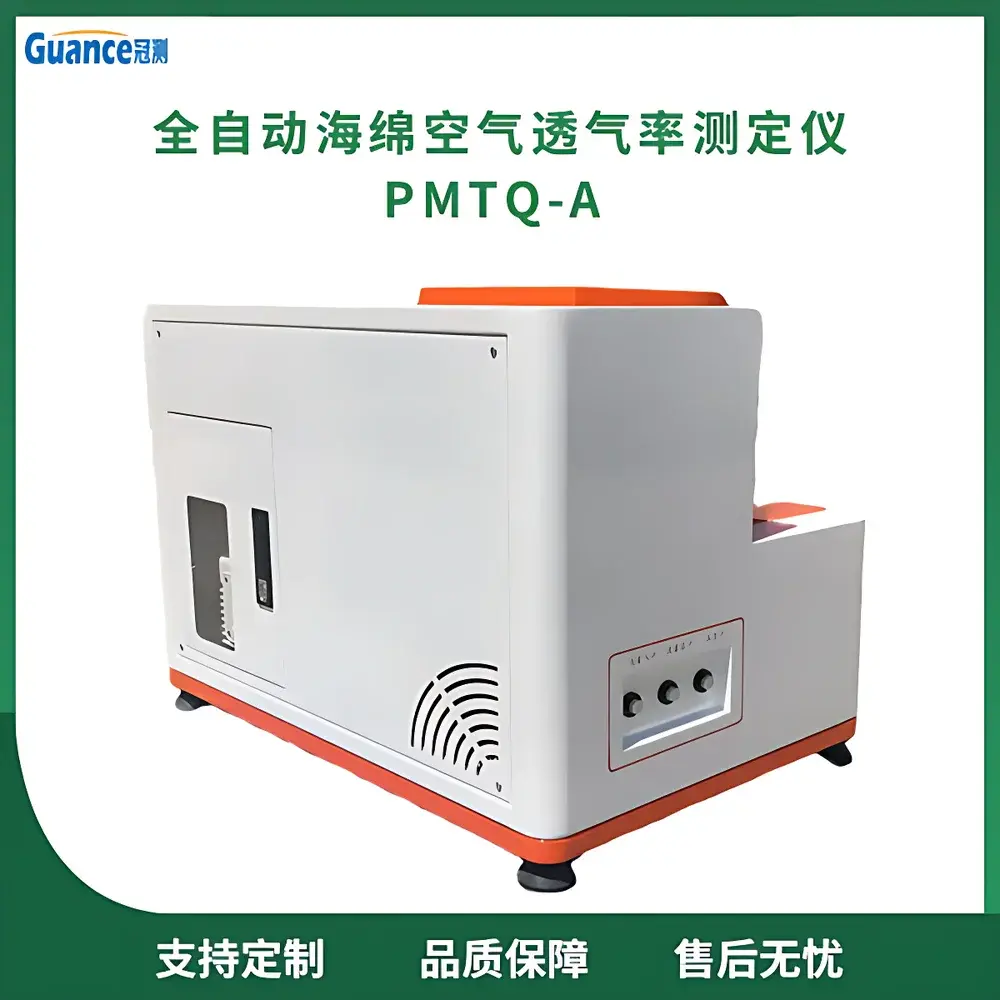
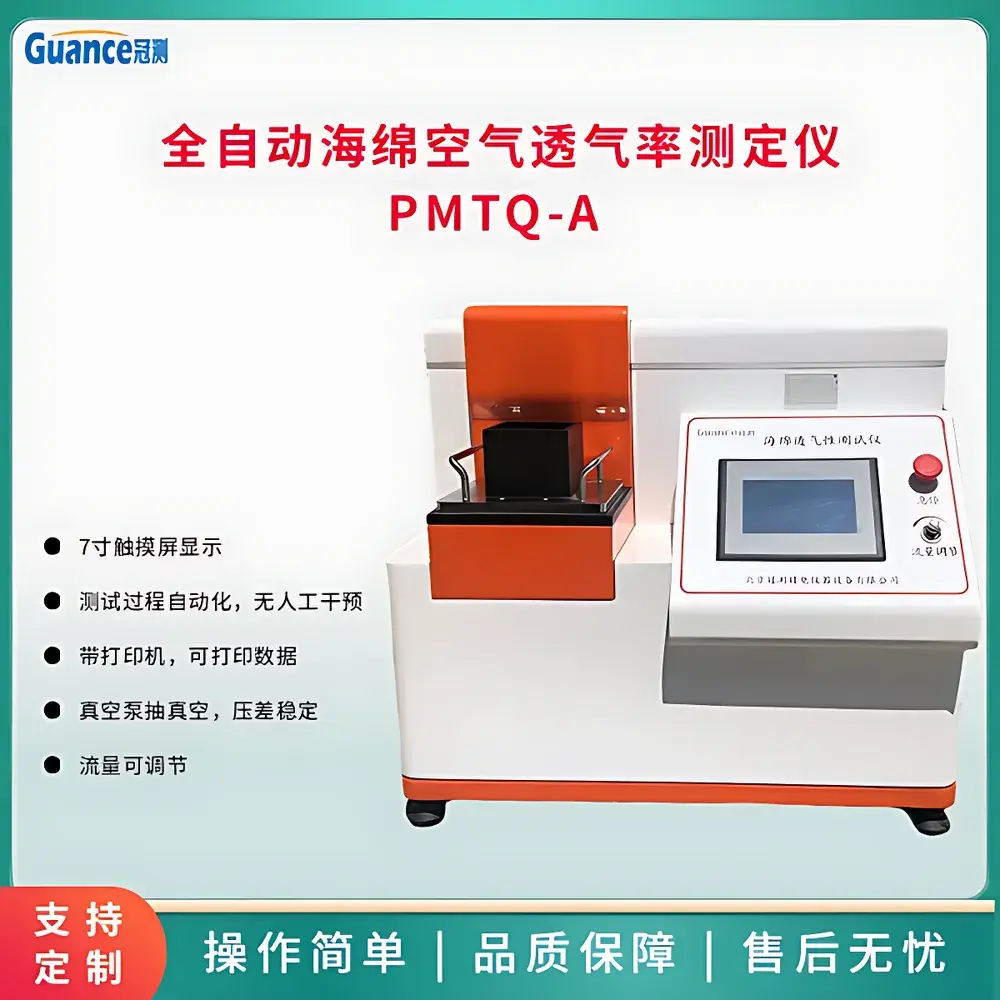
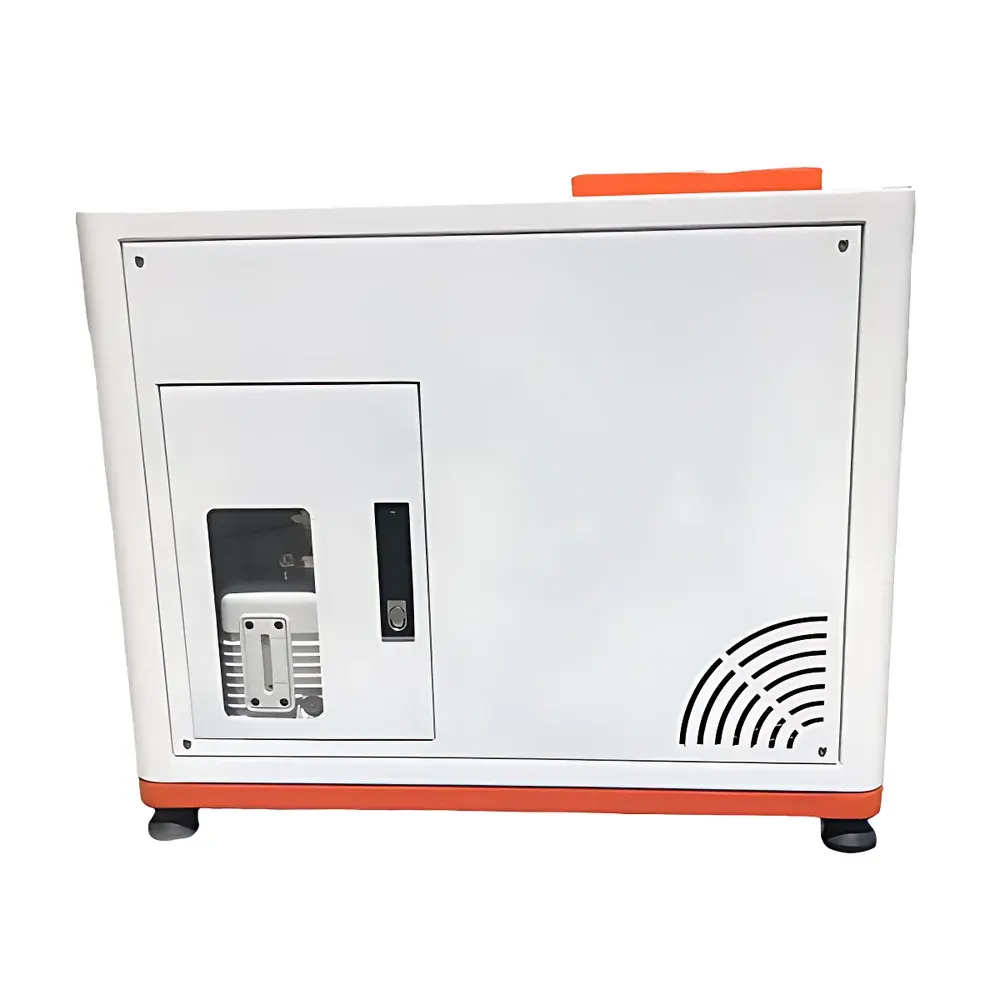
GuanCe Instruments PMTQ-A.4 Sponge Air Permeability Tester
| Brand | GuanCe Instruments |
|---|---|
| Origin | Beijing, China |
| Manufacturer Type | Authorized Distributor |
| Country of Origin | China |
| Model | PMTQ-A.4 |
| Price | USD 2,050 (FOB Beijing) |
| Vacuum Pump | 1.3 m³/h (4.8 L/s), Ultimate Vacuum: 5 × 10² Pa |
| Flow Sensor Range | 0–50 L/min |
| Differential Pressure Sensors | 0–400 Pa & 0–100 Pa (auto-switching) |
| Test Chamber Dimensions | 100 mm × 100 mm × 104 mm (L×W×D) |
| Specimen Size | 102 mm × 102 mm, Thickness: 0–100 mm |
| Air Permeability Range | 0–999.9 × 10⁻¹⁰ m² |
| Temperature Sensor | −40 °C to +80 °C |
| Chamber Material | 4 mm 304 brushed stainless steel |
| Safety Protections | Over-temperature, over-pressure, over-flow, and motor overload protection |
| Overall Dimensions | 800 mm × 630 mm × 700 mm (L×W×H) |
| Weight | 85 kg |
| Power Rating | 1 kW |
Overview
The GuanCe Instruments PMTQ-A.4 Sponge Air Permeability Tester is a fully automated, standards-compliant instrument engineered for precise measurement of air permeability in porous elastomeric polymer materials—primarily flexible polyurethane foams, sponge rubber, and related high-porosity cellular materials used in packaging cushioning, automotive seating, filtration media, and mining sealants. It operates on the principle of steady-state laminar airflow through a defined specimen area under controlled differential pressure, in accordance with Darcy’s law for gas flow through porous media. The system quantifies volumetric flow rate at regulated pressure differentials and calculates air permeability (in m²) using standardized geometric and thermodynamic corrections—including real-time temperature compensation of dynamic air viscosity per ISO 8503-2 and ASTM E1317. Designed as a direct functional replacement for the legacy RXQ-1 tester, the PMTQ-A.4 integrates dual-range differential pressure sensing, closed-loop vacuum control, and embedded thermal monitoring to ensure metrological traceability and repeatability across laboratory and quality control environments.
Key Features
- 7-inch industrial-grade capacitive touchscreen interface with intuitive HMI navigation—no external PC required
- Full test automation: single-button initiation, auto-ranging pressure sensor switching, and self-terminating measurement cycle (≤10 s typical duration)
- Dual differential pressure transducers (0–100 Pa and 0–400 Pa) enable high-resolution low-flow measurement and extended dynamic range without manual recalibration
- Integrated temperature-compensated airflow calculation: real-time acquisition of ambient chamber temperature adjusts kinematic viscosity (ν) in permeability derivation per ISO 4638 Annex A
- Comprehensive parameter output: differential pressure (Pa), volumetric flow rate (L/min), air permeability (×10⁻¹⁰ m²), linear flow velocity (m/s), specific flow resistance (Pa·s/m), and flow resistivity (Pa·s/m²)
- Robust 304 stainless steel test chamber (4 mm wall thickness) with precision-machined gasketed sealing surface ensures long-term dimensional stability and leak integrity
- Multi-layer safety architecture: hardware-level thermal cutoff, pressure relief valve, flow limiter, and motor overload detection compliant with IEC 61000-6-2 EMC immunity requirements
Sample Compatibility & Compliance
The PMTQ-A.4 accommodates specimens up to 102 mm × 102 mm × 100 mm—covering standard test coupons per ISO 4638:1984, GB/T 10655–2001, ASTM D3574–2005 (Test Method B), and AQ 1088–2011. Its modular clamping mechanism ensures uniform compressive loading (±0.5 kPa deviation) across variable foam densities (15–120 kg/m³), minimizing edge leakage and compression-set artifacts. The instrument meets essential regulatory expectations for GLP-compliant testing environments: all measurements are timestamped, non-editable, and stored with full audit trail metadata (operator ID, environmental conditions, sensor calibration status). While not FDA 21 CFR Part 11-certified out-of-the-box, raw data export (CSV/Excel) supports integration into validated LIMS or QMS platforms requiring electronic record retention.
Software & Data Management
Firmware v3.2 embeds deterministic real-time control logic with deterministic loop timing (<50 ms). All test data—including intermediate sensor readings and final derived parameters—are logged locally to internal flash memory (8 GB) and simultaneously mirrored to USB 2.0 storage. No cloud connectivity or remote telemetry is implemented, preserving data sovereignty. Exported files contain columnar headers aligned with ISO/IEC 17025 reporting requirements: “Test_ID”, “Specimen_ID”, “Date_Time”, “ΔP_Pa”, “Q_L_min”, “k_m2”, “T_C”, “v_m_s”, “σ_Pa_s_m2”. Batch statistical functions include arithmetic mean, standard deviation, CV%, and min/max for up to 99 repeated tests—outputting summary reports directly to printer or PDF.
Applications
- Quality assurance of polyurethane foam suppliers for packaging OEMs (e.g., electronics, medical device transport)
- R&D validation of porosity modifications in flame-retardant or hydrophobic-treated sponge formulations
- Regulatory conformance testing for coal mine sealants under AQ 1088–2011 airflow resistance thresholds
- Comparative analysis of aging effects (thermal, UV, compression cycling) on foam microstructure via longitudinal permeability drift
- Calibration reference for secondary airflow sensors in inline packaging line monitoring systems
FAQ
What standards does the PMTQ-A.4 explicitly support?
ISO 4638:1984, GB/T 10655–2001, ASTM D3574–2005 (Method B), and AQ 1088–2011.
Is external calibration required before first use?
Yes—users must perform initial zero-offset and span verification using NIST-traceable pressure and flow references; factory calibration certificate included.
Can the instrument operate continuously for production-line duty?
Designed for lab-based intermittent use (max. 8 cycles/hour); not rated for unattended 24/7 operation due to thermal management constraints.
Does it support custom test protocols beyond published standards?
No—firmware enforces fixed test sequences per referenced standards; no user-defined algorithm scripting capability.
What maintenance intervals are recommended?
Vacuum pump oil change every 500 operating hours; differential pressure sensor zero-check monthly; O-ring inspection quarterly.





