
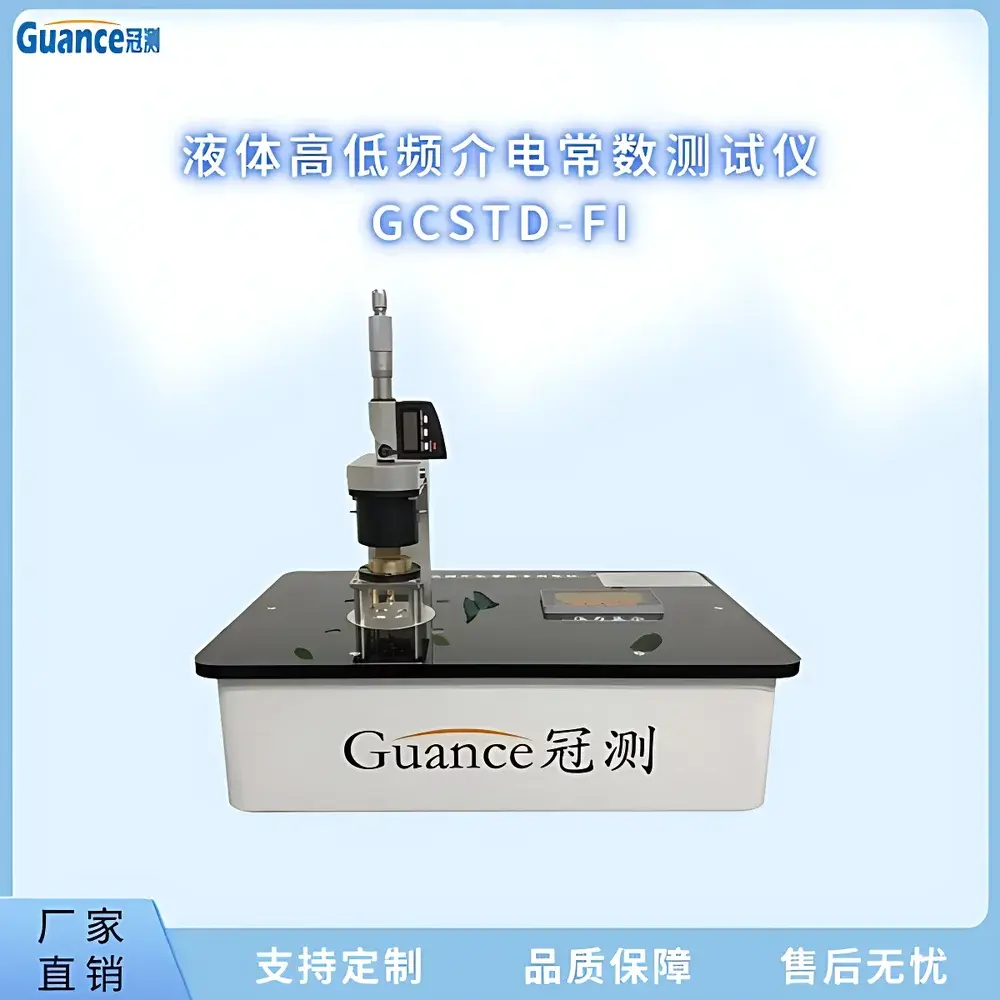
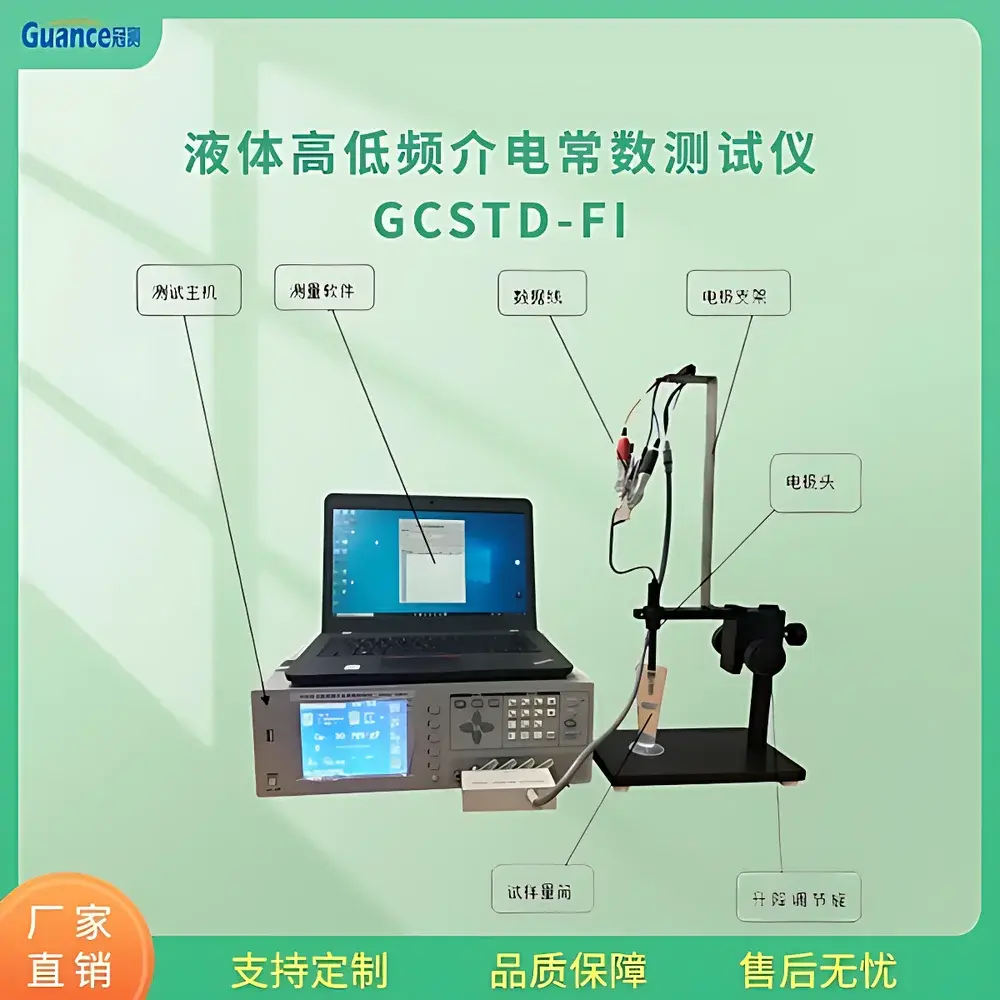
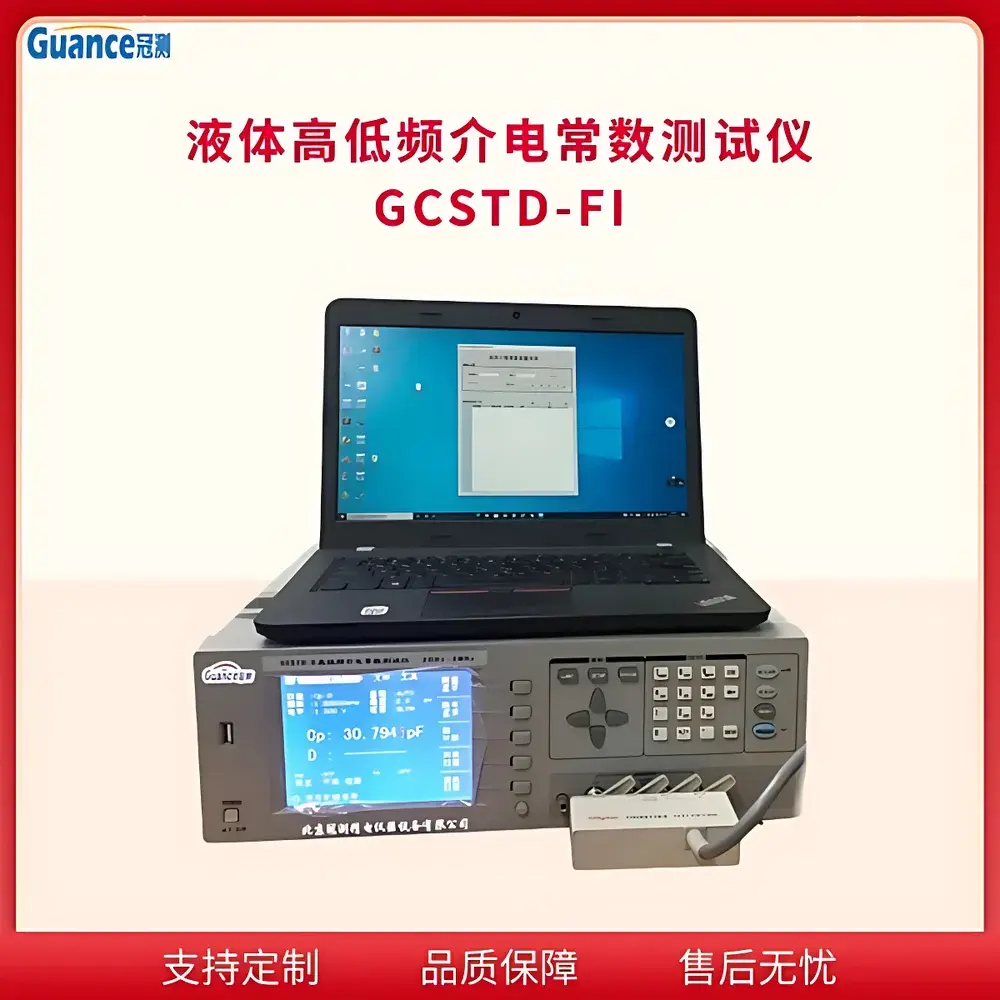
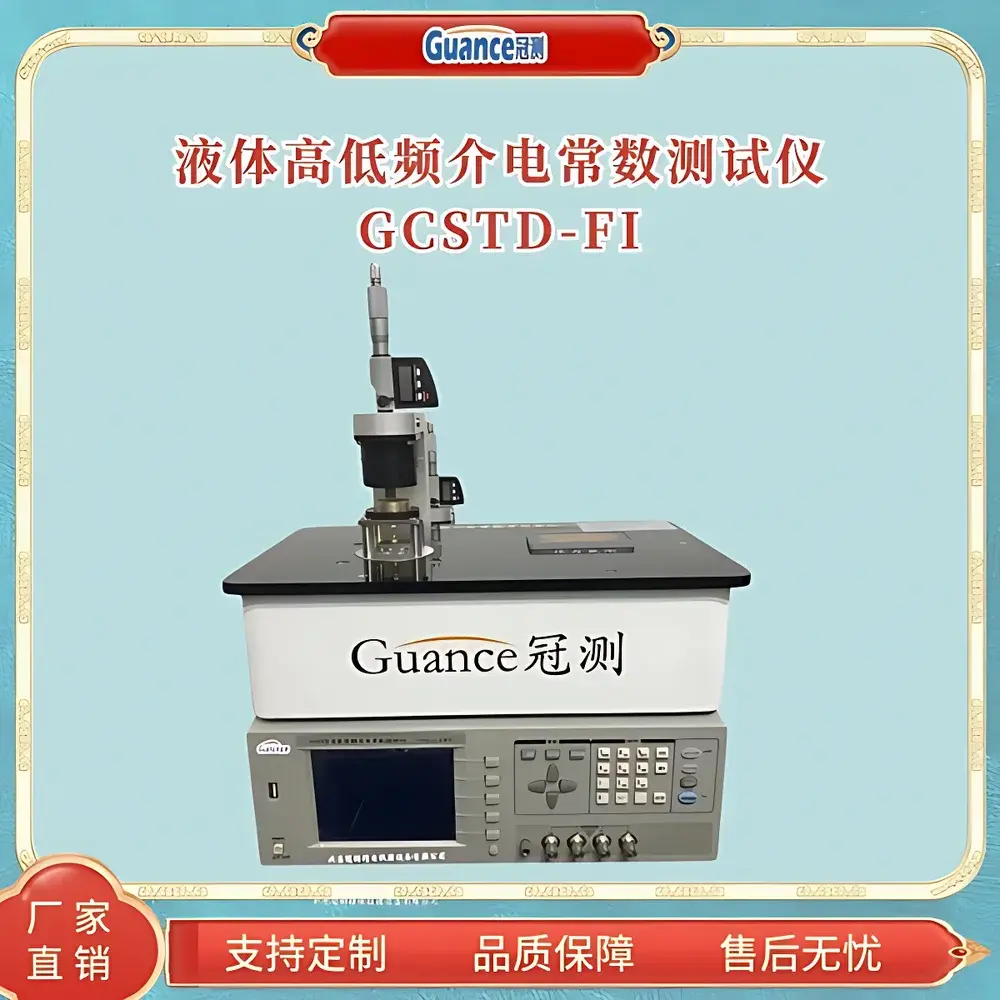
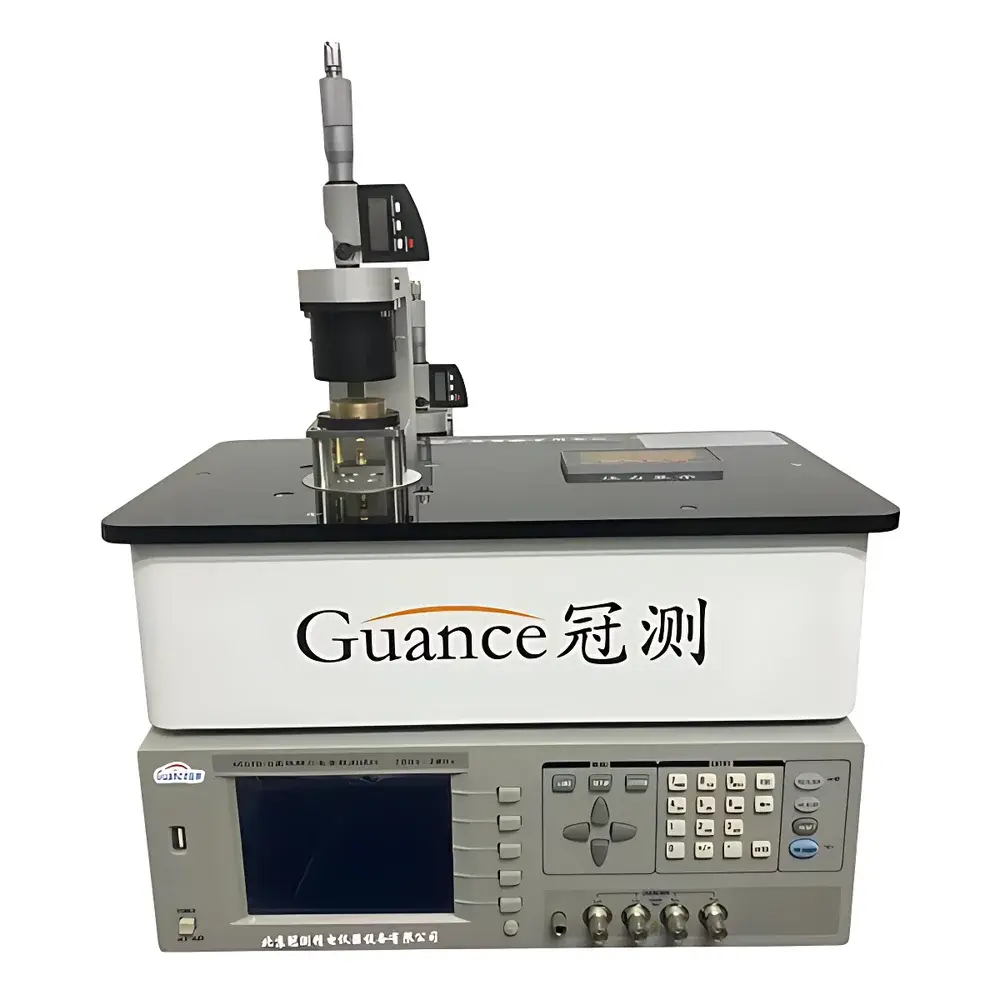
GuanCe Instruments GCSTD-FI.6 Liquid Dielectric Constant Analyzer
| Brand | GuanCe Instruments |
|---|---|
| Origin | Beijing, China |
| Manufacturer Type | Authorized Distributor |
| Country of Origin | China |
| Model | GCSTD-FI.6 |
| Price | USD 1,950 (FOB Beijing) |
| Measurement Principle | Two-electrode capacitance bridge method at fixed frequency |
| Frequency | 10 kHz sinusoidal excitation |
| Measurement Ranges | 1–20 and 1–200 (dimensionless relative permittivity, εᵣ) |
| Accuracy | ±2% of reading |
| Repeatability & Linearity | ±0.2% of full scale |
| Electrode Type | External coaxial cylindrical probe (316 stainless steel outer/inner cylinders, nylon spacers, PTFE-insulated) |
| Excitation Voltage RMS | ~7 V (range 1–20), ~0.7 V (range 1–200) |
| Compliance | GB/T 1409–2006, GB/T 5654–2007, GB/T 21216–2007, GB/T 1693–2007, GB/T 5594.4–1985 |
Overview
The GuanCe Instruments GCSTD-FI.6 Liquid Dielectric Constant Analyzer is a precision benchtop instrument engineered for the quantitative determination of relative permittivity (dielectric constant, εᵣ) and associated loss characteristics of liquid dielectric materials at a fixed frequency of 10 kHz. It operates on the principle of a two-electrode capacitance bridge configuration, where the measured liquid serves as the dielectric medium between concentric cylindrical electrodes. The system derives εᵣ from the ratio of measured capacitance to the geometric capacitance of the empty electrode cell—calibrated using reference standards traceable to national metrological institutes. Designed specifically for laboratory-based quality control and R&D environments, the GCSTD-FI.6 supports standardized evaluation of insulating oils, transformer fluids, silicone dielectrics, hydrocarbon solvents, and polar organic liquids under controlled temperature conditions (user-supplied bath or ambient). Its fixed-frequency architecture ensures high reproducibility and simplifies compliance with widely adopted Chinese national standards for electrical insulation characterization.
Key Features
- Coaxial cylindrical electrode probe constructed from 316 stainless steel, with precise inter-cylinder spacing maintained by six non-magnetic nylon spacers—ensuring dimensional stability and long-term calibration integrity.
- Open-structure electrode design enabling rapid, residue-free cleaning between samples; compatible with acetone, ethanol, isopropanol, and other common organic solvents—no disassembly required.
- Dual measurement ranges (1–20 and 1–200 εᵣ) optimized for low-εᵣ hydrocarbons (e.g., mineral oil, n-hexane) and higher-εᵣ polar liquids (e.g., ethylene glycol, DMF), each with dedicated excitation voltage levels (7 VRMS and 0.7 VRMS) to maintain signal-to-noise ratio and minimize electrode polarization effects.
- Fixed 10 kHz sine-wave excitation source with stable amplitude output and low harmonic distortion (<0.5%), minimizing frequency-dependent dispersion artifacts in low-loss dielectrics.
- Integrated analog front-end with auto-ranging capacitance detection and digital signal conditioning, delivering ±2% accuracy across both ranges and ±0.2% repeatability under controlled environmental conditions (23 ± 2°C, RH < 60%).
- Front-panel LED display with direct εᵣ readout; no external PC required for basic operation—ideal for routine QC labs with limited IT infrastructure.
Sample Compatibility & Compliance
The GCSTD-FI.6 is validated for use with electrically insulating liquids exhibiting volume resistivity >10⁹ Ω·m and viscosity 1 µm. The instrument meets the physical test methodology requirements of multiple GB standards: GB/T 1409–2006 (capacitance and dissipation factor at power/audio frequencies), GB/T 5654–2007 (liquid insulation testing including DC resistivity), GB/T 21216–2007 (conductance-capacitance dual-parameter analysis), GB/T 1693–2007 (rubber dielectrics), and GB/T 5594.4–1985 (ceramic dielectric loss testing). While not FDA 21 CFR Part 11–compliant out-of-the-box, raw data export via RS-232 enables integration into validated LIMS or ELN systems supporting GLP/GMP audit trails.
Software & Data Management
The GCSTD-FI.6 operates in standalone mode without proprietary software dependency. All measurements are displayed directly on the front-panel LED screen. For data logging and traceability, an optional RS-232 interface (standard on all units) supports ASCII-formatted serial output (9600 baud, N-8-1) compatible with third-party acquisition platforms—including LabVIEW, MATLAB, Python (pySerial), and commercial QC software such as SPC XL or Minitab. Output includes timestamped εᵣ values, active range identifier, and status flags. No internal memory or user-accessible firmware updates are provided; calibration constants are stored in non-volatile EEPROM and protected against accidental overwrite. Users performing regulated work are advised to implement external validation protocols per ISO/IEC 17025 clause 5.5.2 for equipment verification and periodic recalibration using certified reference liquids (e.g., air: εᵣ = 1.00054; distilled water at 20°C: εᵣ ≈ 80.1).
Applications
- Quality assurance of transformer oils and switchgear dielectrics per IEC 60296 and ASTM D877/D1816 specifications (via correlation with εᵣ trends).
- Batch-to-batch consistency monitoring of synthetic lubricants and heat-transfer fluids during manufacturing.
- R&D screening of novel bio-based dielectric coolants for electric vehicle battery thermal management systems.
- Stability assessment of functionalized nanofluids by tracking εᵣ drift over time under thermal aging conditions.
- Educational laboratories conducting fundamental studies on dipole relaxation mechanisms in polar solvents.
- Pharmaceutical excipient characterization where dielectric response correlates with moisture content or polymorphic form.
FAQ
Can the GCSTD-FI.6 measure dielectric loss tangent (tan δ)?
No. The instrument reports only relative permittivity (εᵣ) derived from capacitance magnitude. It does not resolve phase angle or conductance components required for tan δ calculation.
Is temperature control integrated into the instrument?
No. Temperature regulation must be achieved externally using a calibrated liquid bath or environmental chamber. Measurement uncertainty increases by ±0.1% εᵣ per 1°C deviation from 23°C.
What is the minimum sample volume required?
The coaxial probe requires full immersion of the active electrode length (35 mm), corresponding to ~8 mL for standard geometry. Smaller volumes may be accommodated using custom mini-probes (not supplied).
How often should the electrode be recalibrated?
Annual recalibration is recommended. More frequent verification (e.g., quarterly) using air and a certified reference liquid (e.g., n-hexane, εᵣ = 1.89 at 20°C) is advised for GMP-regulated operations.
Does the instrument support automatic temperature compensation?
No. Temperature correction must be applied manually using published εᵣ vs. T reference curves for the specific liquid under test.



