
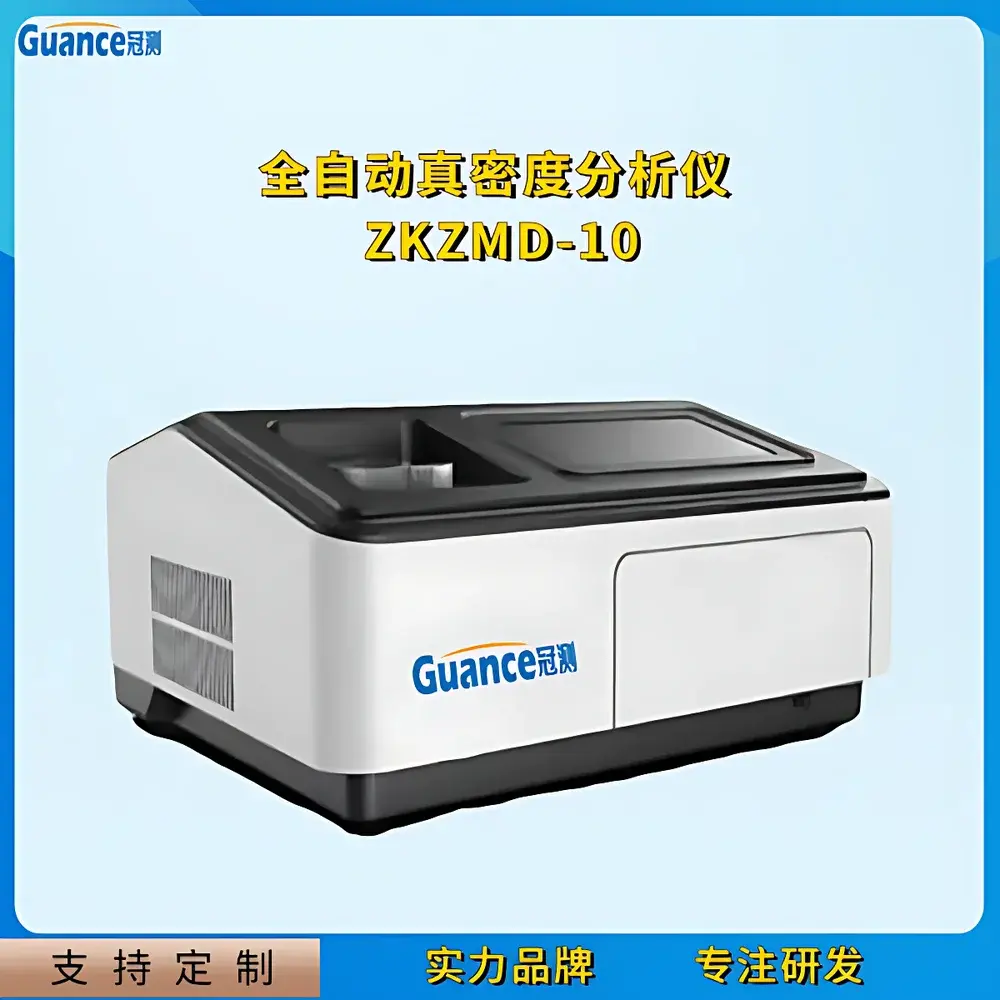
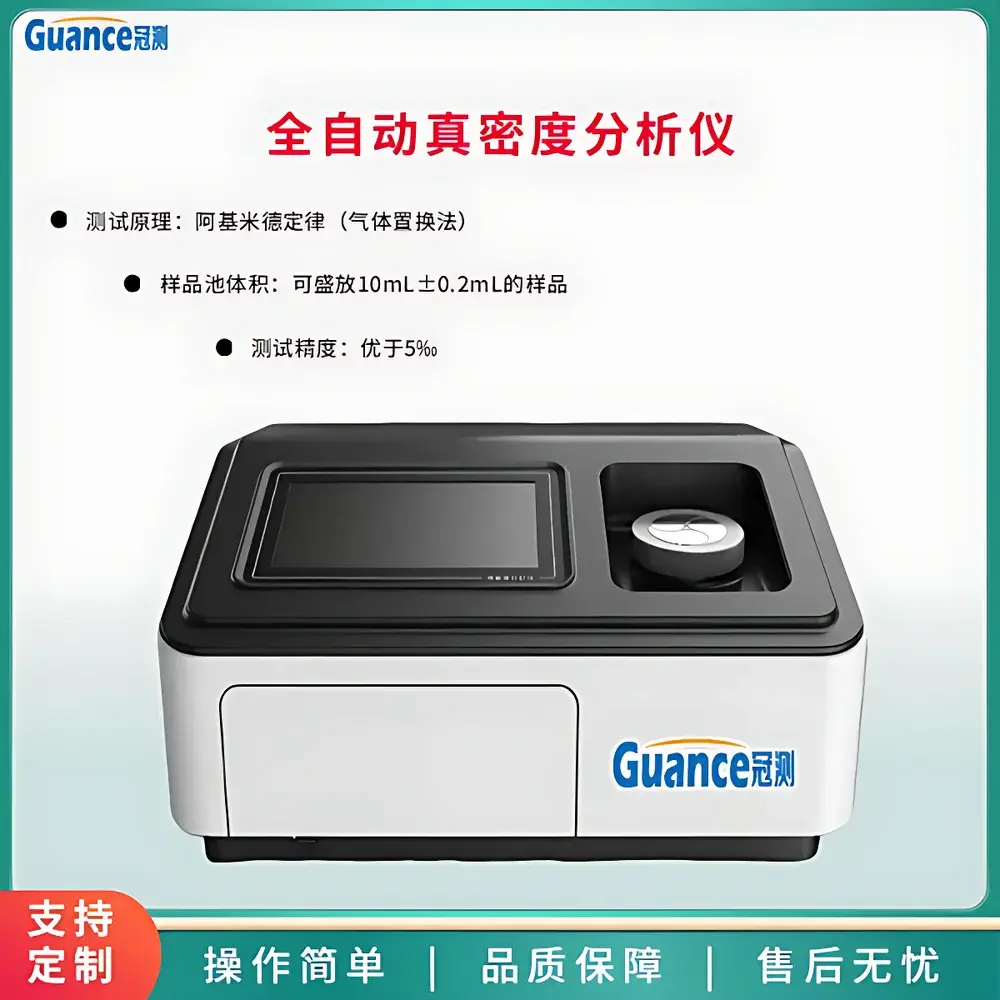
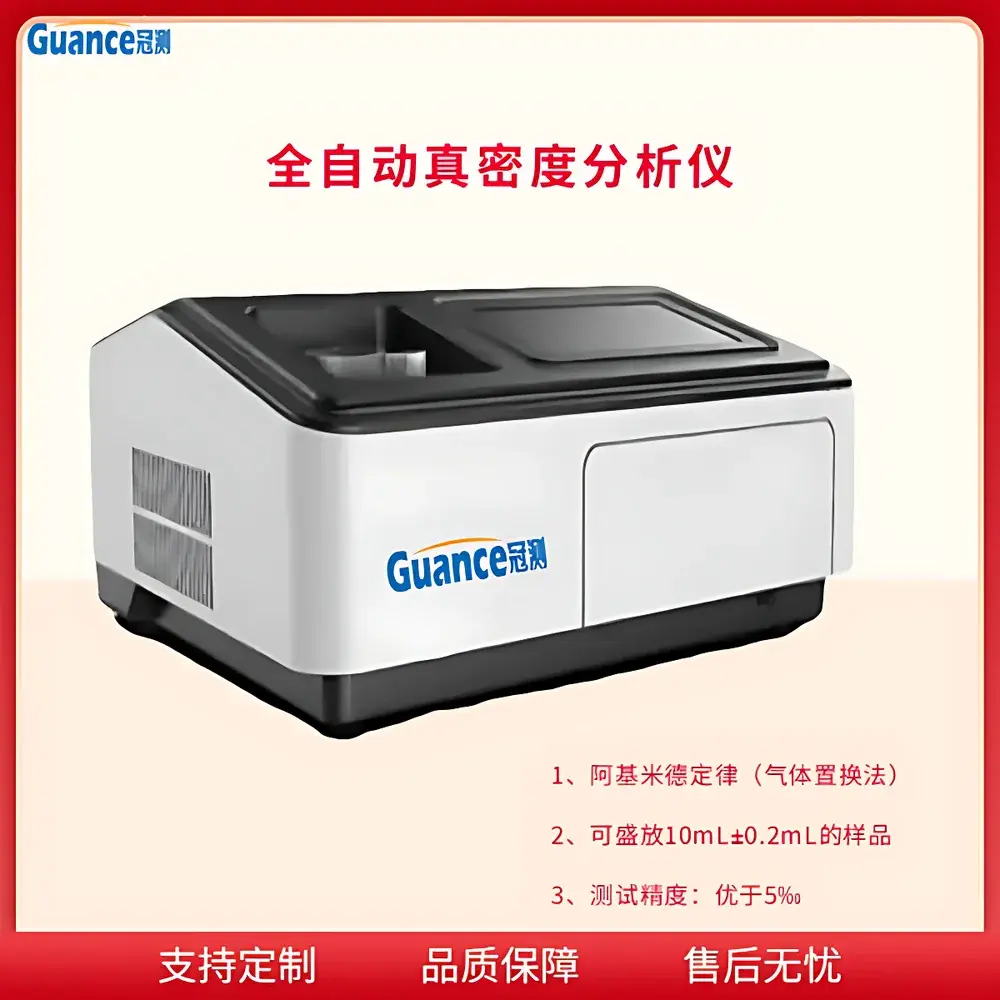
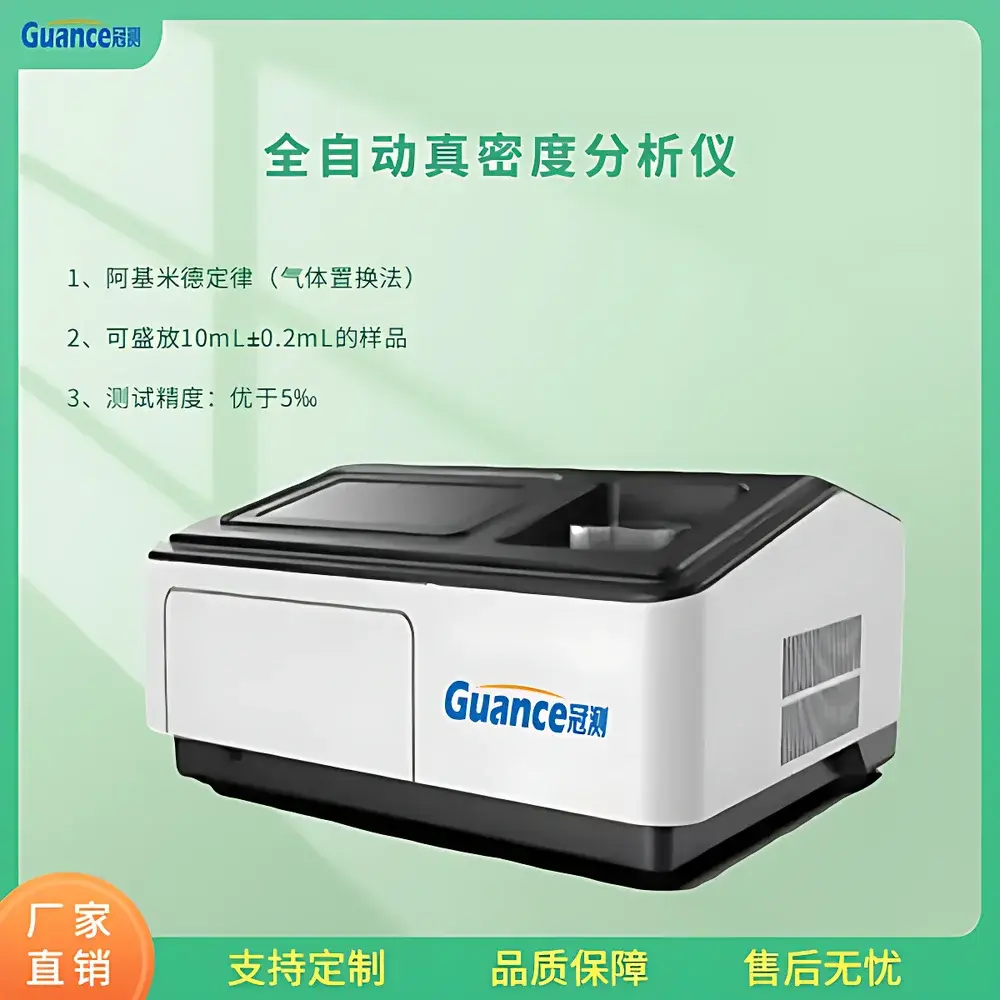
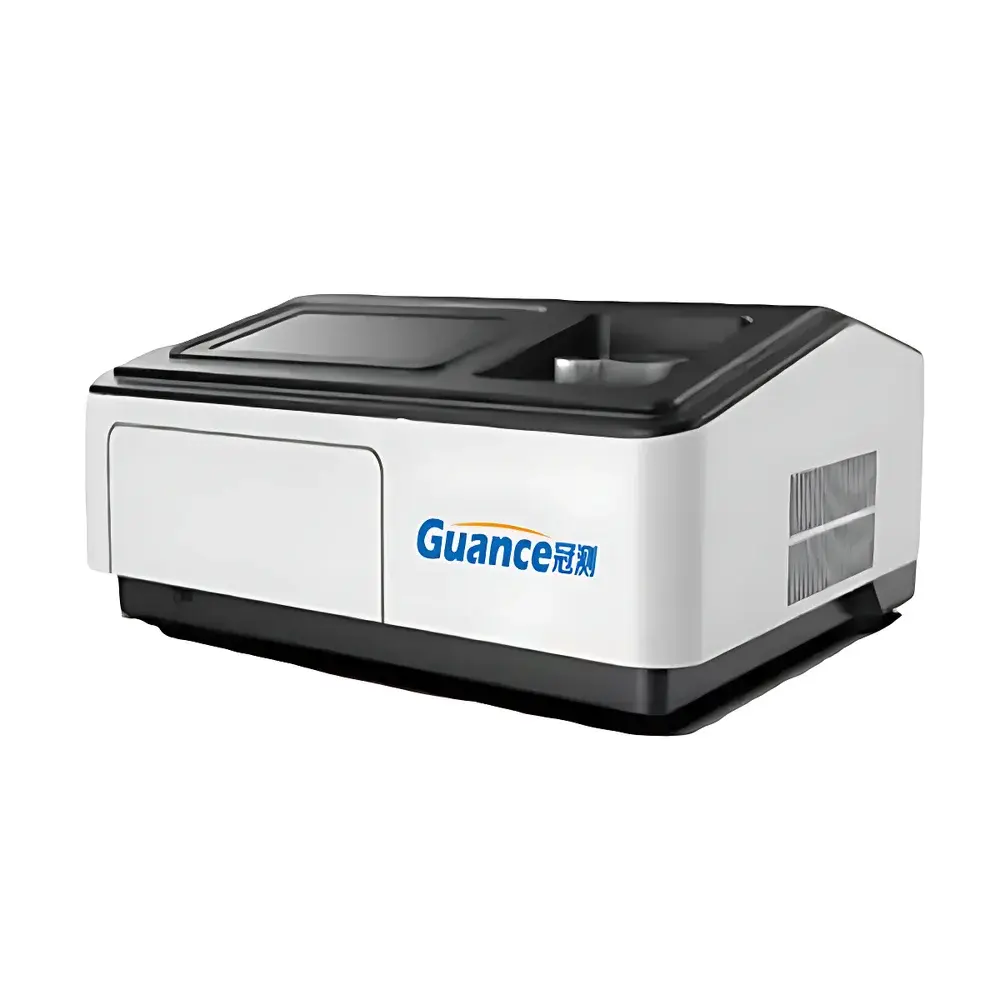
GuanCe Instruments GCZMD-10 True Density Analyzer
| Brand | GuanCe Instruments |
|---|---|
| Origin | Beijing, China |
| Manufacturer Type | Authorized Distributor |
| Product Category | Domestic |
| Model | GCZMD-10 |
| Instrument Type | True Density Analyzer |
| Form Factor | Benchtop (Not Portable — Corrected per Technical Specification) |
| Sample Type | Solids & Liquids |
| Density Range | 0.1–20 g/cm³ |
| Maximum Sample Weight | 20 g |
| Density Accuracy | ±0.1% (Relative) |
| Display | Digital LCD Touchscreen |
| Operating Temperature Range | 0–40 °C |
| Repeatability | ≤0.3% RSD (n ≥ 3) |
| Volume Resolution | 0.01 mL |
| Minimum Sample Volume | 0.1 mL |
| Test Time | ~4 min per run |
| Pressure Control | Up to 2.0 bar (adjustable) |
| Analysis Gas | Helium (recommended), N₂ (optional, requires calibration adjustment) |
| Data Interface | RS485, RJ45 Ethernet, USB port for U-disk storage |
| Power Supply | AC 220 V / 50 Hz |
| Rated Power | 28 W |
| Dimensions | 410 × 320 × 155 mm |
| Net Weight | 4.6 kg |
| Compliance | ASTM D5550, ISO 12154, USP <699>, GLP-ready data logging |
Overview
The GuanCe Instruments GCZMD-10 True Density Analyzer is a benchtop gas pycnometer engineered for high-precision determination of true (skeletal) density of solid and liquid materials using the gas expansion displacement method—based on Archimedes’ principle and the ideal gas law (PV = nRT). It employs helium as the reference gas due to its small molecular diameter, inertness, and high diffusivity, enabling complete penetration into micropores and interstitial voids without adsorption or chemical interaction. By measuring the pressure differential before and after sample introduction into a sealed, temperature-stabilized reference chamber, the instrument calculates the exact volume displaced by the solid matrix—excluding closed pores and internal voids—thereby yielding true density (ρ = m/Vtrue). This methodology conforms to internationally recognized standards for skeletal density measurement in advanced materials science, catalysis research, and pharmaceutical excipient characterization.
Key Features
- Modular integrated design: Electromagnetic valves (imported Japanese CFVB25-Z-O-B2C-3), pressure sensors, and sample cell are co-located to minimize dead volume and maximize sealing integrity.
- Uniform thermal field architecture: Tubeless, thermally coupled module design ensures equilibrium between ambient and sensor chamber temperatures—reducing thermal drift and enhancing volumetric reproducibility.
- Intelligent pressure regulation: Adaptive algorithm dynamically compensates for upstream gas cylinder pressure fluctuations, maintaining stable flow control and measurement consistency across variable supply conditions.
- Configurable test scripting: Advanced users may modify embedded C-based protocols via touchscreen interface to define custom pressurization cycles, equilibration delays, purge sequences, and repetition counts.
- High-fidelity data acquisition: 24-bit analog-to-digital conversion enables sub-millipascal pressure resolution and robust signal-to-noise ratio during transient gas expansion events.
- Dual-gas compatibility: Factory-calibrated for helium; nitrogen operation supported with user-provided correction factors and optional recalibration using certified reference materials (e.g., PVC, aluminum, copper).
- Comprehensive output options: Real-time display, automatic report printing (TMS variant), Ethernet (RJ45) and serial (RS485) connectivity, plus USB flash drive logging for raw process data and metadata.
Sample Compatibility & Compliance
The GCZMD-10 accommodates granular, powdered, fibrous, porous, and low-viscosity liquid samples—including fragile foams, hygroscopic salts, and reactive metal powders—without requiring vacuum degassing or surface coating. Its 10 mL calibrated sample cell (±0.2 mL tolerance) supports minimum volumes as low as 0.1 mL, making it suitable for precious or limited-availability R&D specimens. The system meets requirements for GLP-compliant environments: audit-trail-capable data storage (timestamped, operator-ID-tagged), electronic signature readiness, and exportable CSV/Excel-compatible records. It aligns with ASTM D5550 (“Standard Test Method for True Density of Calcined Petroleum Coke”), ISO 12154 (“Determination of True Density of Powders by Gas Pycnometry”), and USP (“Density and Specific Gravity”) for regulatory submissions in pharmaceutical and medical device manufacturing.
Software & Data Management
Embedded firmware features a responsive 7-inch capacitive touchscreen with handwritten input support and multilingual UI (English default). All measurement sessions are timestamped and logged with full parameter metadata—including gas type, equilibration time, pressure setpoint, cycle count, ambient temperature, and operator ID. Raw pressure-time curves, intermediate volume calculations, and final density values are stored locally and exportable via USB to standard spreadsheet formats. Optional PC software (PNS version) provides remote monitoring, batch reporting, statistical analysis (mean, SD, RSD, confidence intervals), and integration with LIMS platforms via TCP/IP or Modbus RTU protocols. Data encryption and user-level access control comply with FDA 21 CFR Part 11 Annex 11 expectations for electronic records.
Applications
This analyzer serves critical quality control and formulation development workflows across multiple regulated and high-performance sectors. In catalysis, it quantifies active phase dispersion and pore collapse in zeolites and supported metal oxides. For battery materials, it validates tap density vs. true density ratios in cathode precursors (e.g., LiCoO₂, NMC) and anode graphite. In pharmaceuticals, it verifies polymorphic consistency of APIs and detects amorphous content in spray-dried dispersions. Ceramics labs use it to monitor sintering progress in alumina and zirconia compacts; powder metallurgy facilities rely on it for green density verification prior to HIP processing. Additional validated use cases include characterization of ion-exchange resins, silica aerogels, activated carbons, soil aggregates, and food-grade starches—where accurate skeletal density underpins porosity, compressibility, and dissolution modeling.
FAQ
What gases can be used with the GCZMD-10?
Helium is the recommended analysis gas due to its inertness, small kinetic diameter (0.26 nm), and minimal adsorption on most surfaces. Nitrogen may be substituted upon user-defined calibration adjustment; however, results require validation against helium-derived reference values for porous or high-surface-area materials.
Is vacuum degassing required before measurement?
No—helium’s rapid diffusion eliminates the need for extended outgassing. However, for highly adsorptive samples (e.g., activated carbon, MOFs), optional pre-evacuation cycles can be scripted to enhance measurement fidelity.
How is calibration performed?
Certified solid standards (PVC, aluminum, copper) are supplied for routine verification. Calibration involves three replicate runs per standard; deviation from certified value must remain within ±0.1% to maintain traceability.
Can the instrument measure liquids?
Yes—the sealed sample chamber supports direct liquid immersion testing. Liquid density is derived from buoyancy-corrected mass displacement, with temperature-controlled stabilization ensuring metrological rigor per ISO 1183-1.
Does the GCZMD-10 support 21 CFR Part 11 compliance?
It provides foundational elements: electronic audit trails, user authentication, immutable data logs, and exportable raw files. Full Part 11 implementation requires site-specific validation documentation and IT infrastructure alignment (e.g., secure network, backup policy, access governance).



