
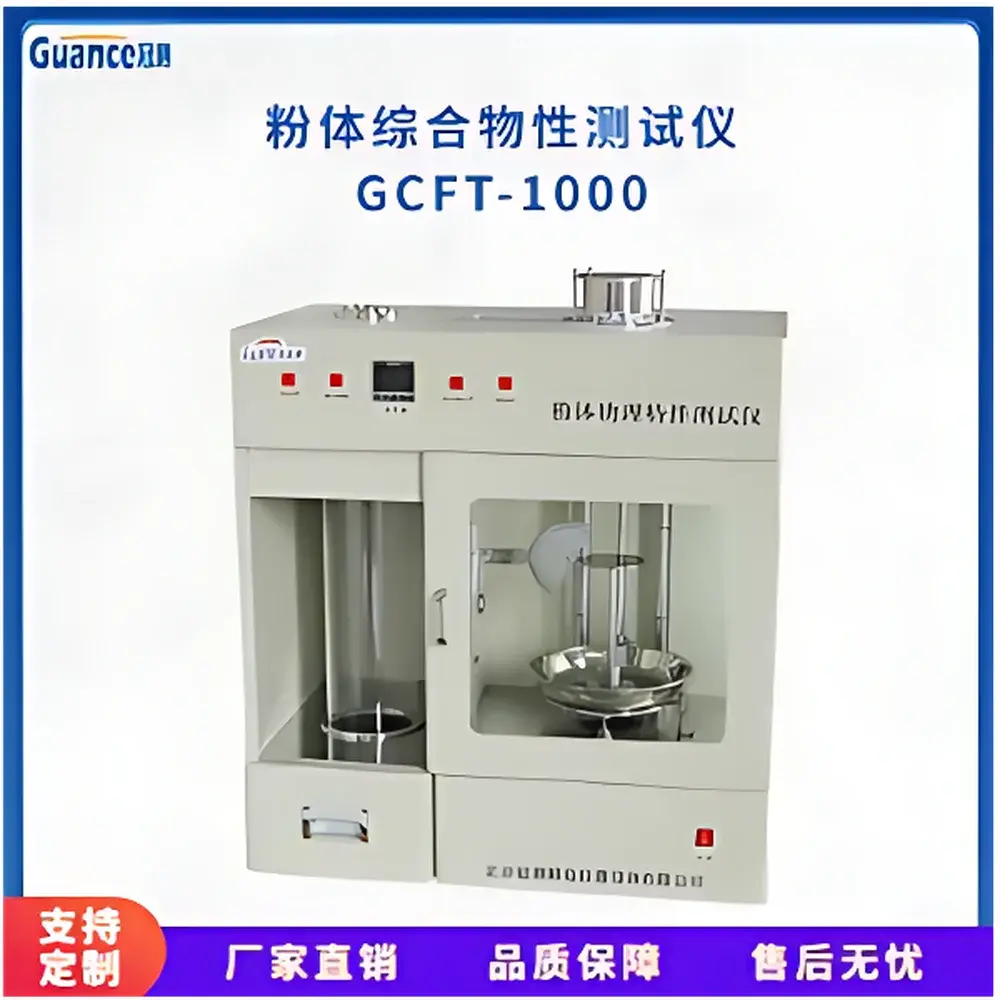
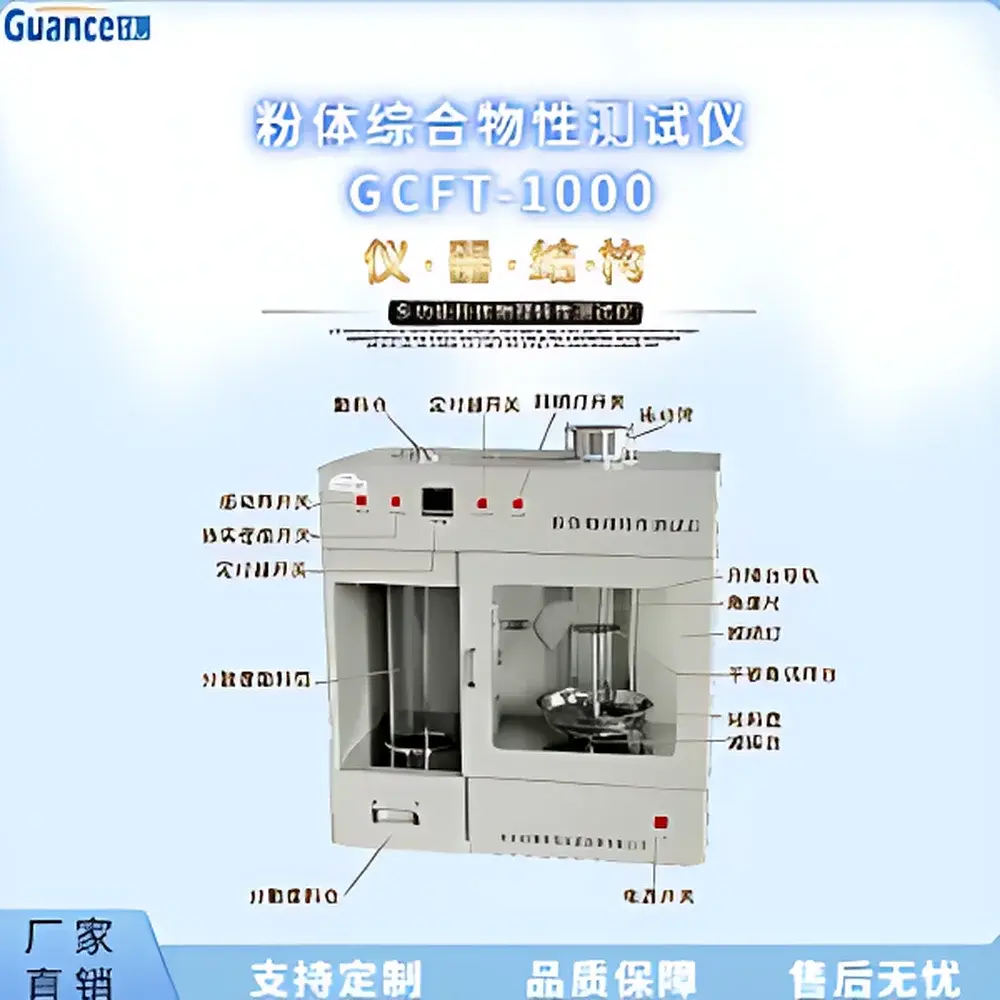
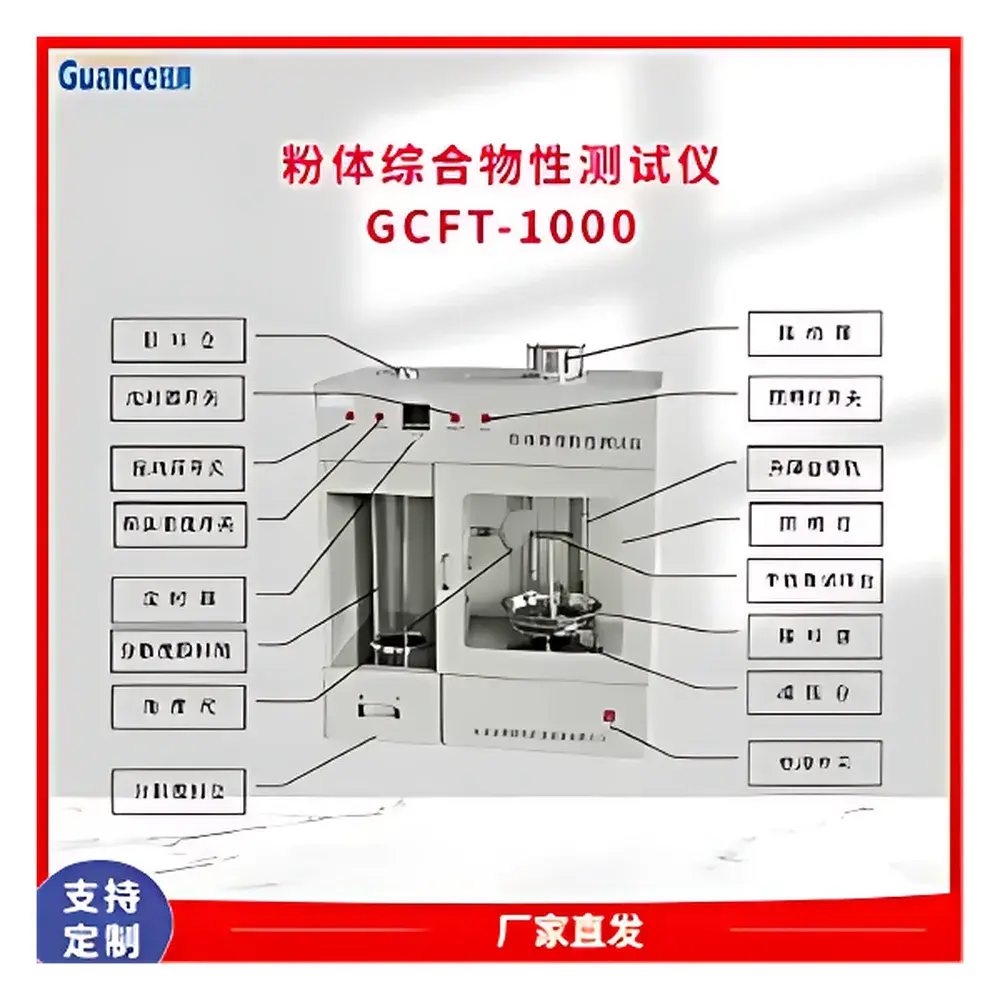
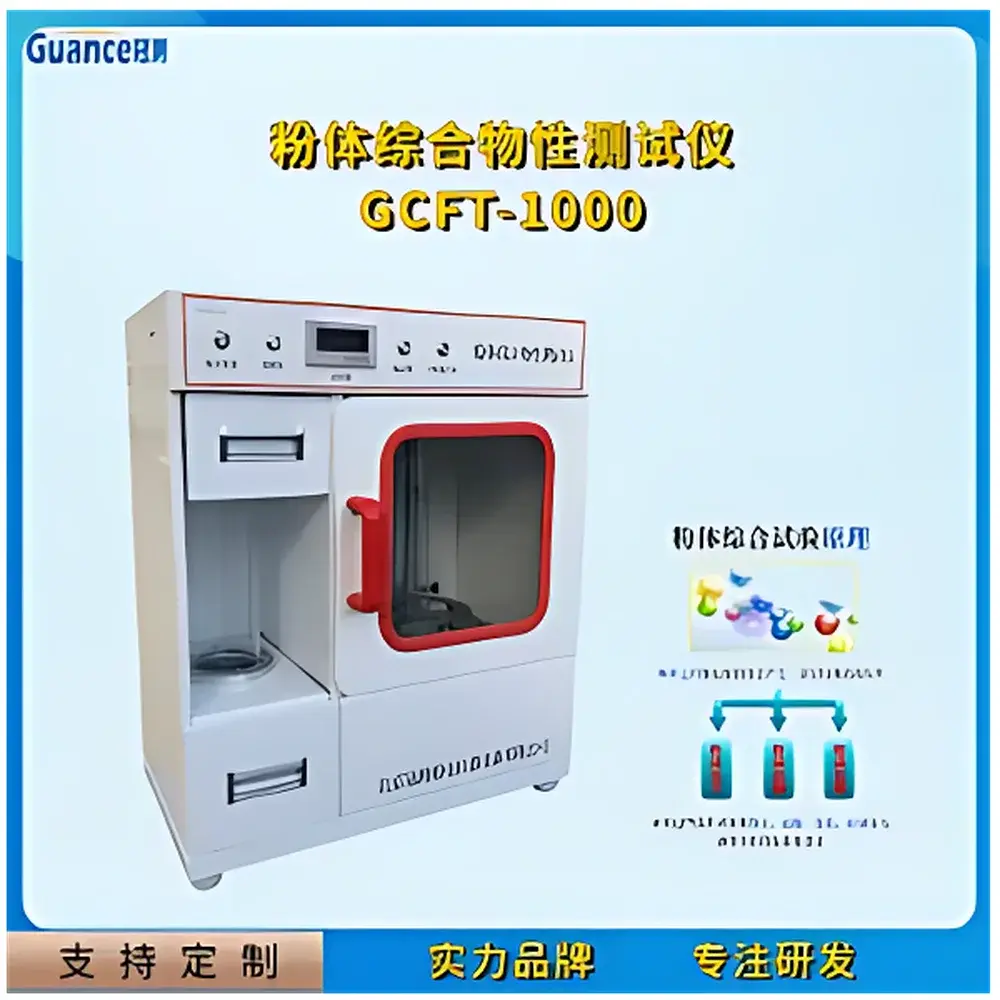
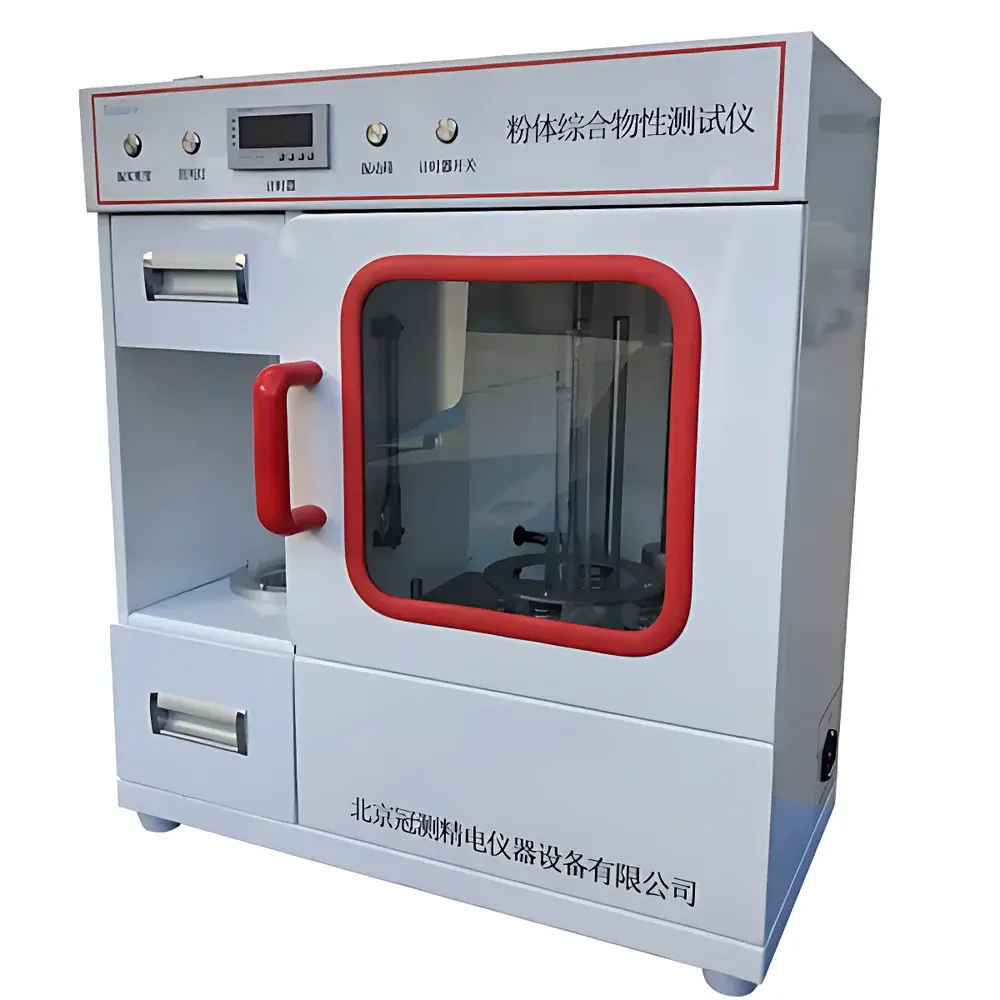
GuanCe GCFT-1000B Powder Flowability Tester
| Brand | GuanCe |
|---|---|
| Model | GCFT-1000B |
| Origin | Beijing, China |
| Instrument Type | Powder Flowability Tester |
| Rated Power | 500 W |
| Rated Voltage/Frequency | 220 V / 50 Hz |
| Tap Density Vibration Frequency | 300 taps/min |
| Sample Capacity | Standardized for ASTM D6393 & USP <616> compliant bulk density and flow index testing |
| Compliance | GB/T 31057.2–2018, GB/T 31057.3–2018, ASTM D6393–2014, USP 32–NF27 <616>, EP 7.0 20934, GB/T 1479.1–2011, GB/T 5162–2021, YB/T 16913–2008 |
Overview
The GuanCe GCFT-1000B Powder Flowability Tester is a precision-engineered instrument designed for standardized quantitative assessment of bulk powder behavior under controlled mechanical excitation. It operates on the principle of gravitational flow and vibration-induced densification to determine critical bulk solid properties—including tap density, compressibility index (Carr Index), Hausner ratio, and flow function—per internationally recognized test protocols. Unlike empirical funnel-based methods, the GCFT-1000B implements a regulated vertical tapping mechanism with fixed amplitude and programmable frequency (300 taps/min), enabling reproducible compaction cycles essential for regulatory-compliant characterization in pharmaceutical, metallurgical, and advanced materials R&D environments. Its architecture supports both static and dynamic flow evaluation modes, facilitating correlation between macroscopic handling behavior and microstructural attributes such as interparticle friction, cohesion, and air entrapment.
Key Features
- Stainless-steel sample cylinder and tapping assembly ensure long-term dimensional stability and resistance to abrasive wear across repeated test cycles.
- High-accuracy digital timer with ±0.1 s resolution guarantees precise control over tap count and duration—critical for compliance with ASTM D6393 and USP repeatability requirements.
- Electrostatically coated steel enclosure provides corrosion resistance and meets ISO 14001-aligned environmental safety standards for laboratory use.
- Dual-mode operation: supports both single-tap and multi-cycle (up to 999 taps) protocols for granular density profiling and compressibility trend analysis.
- Modular design allows rapid interchange of standardized sample cups (10–100 mL range) per ISO 3953 and USP specifications.
- Integrated leveling base and anti-vibration feet minimize external mechanical interference during measurement.
Sample Compatibility & Compliance
The GCFT-1000B accommodates free-flowing to marginally cohesive powders—including metal alloys (e.g., Ti-6Al-4V, Inconel), pharmaceutical actives and excipients, ceramic precursors, battery cathode materials (e.g., NMC, LFP), and food-grade starches. All test procedures align with pharmacopeial and industrial standards: USP (bulk/tap density, Carr Index), EP 7.0 20934 (flow through orifice), ASTM D6393 (Carr indices suite), GB/T 31057.2–2018 (tap density), GB/T 31057.3–2018 (flowability index), and GB/T 5162–2021 (metal powder consolidation). The instrument’s mechanical consistency enables traceable calibration against NIST-traceable reference powders, supporting GLP audit readiness and 21 CFR Part 11–aligned data integrity when paired with validated software.
Software & Data Management
While the GCFT-1000B operates as a stand-alone hardware platform, it is fully compatible with third-party laboratory information management systems (LIMS) and electronic lab notebooks (ELN) via RS-232 or USB-to-serial interface. Raw timing and mass inputs are exportable in CSV format for downstream statistical analysis in JMP, Minitab, or Python-based QbD workflows. When integrated with GuanCe’s optional FlowCalc Pro software (v3.2+), users gain automated calculation of Carr Index, Hausner Ratio, compressibility %, and flow classification (free-flowing to very poor), with built-in uncertainty propagation per GUM guidelines. Audit trails, user access logs, and electronic signatures comply with FDA 21 CFR Part 11 requirements for regulated environments.
Applications
- Pharmaceutical formulation development: screening excipient compatibility, predicting die-filling variability in tablet compression, and qualifying raw material batches per ICH Q5A.
- Advanced manufacturing: qualification of metal powders for additive manufacturing (ASTM F3049), optimizing powder bed fusion process parameters.
- Battery R&D: evaluating cathode/anode slurry dry-powder flow consistency prior to electrode coating.
- Quality control labs: routine release testing of bulk density and flow index per internal SOPs aligned with USP/EP monographs.
- Academic research: correlating particle surface energy (via inverse gas chromatography) with macroscopic flow metrics derived from GCFT-1000B datasets.
FAQ
What standards does the GCFT-1000B directly support?
It is mechanically and procedurally configured to execute tests per ASTM D6393–2014, USP , EP 7.0 20934, GB/T 31057.2–2018, GB/T 31057.3–2018, GB/T 5162–2021, and YB/T 16913–2008 without modification.
Is the instrument suitable for cohesive or nano-sized powders?
Yes—when used with appropriate conditioning (e.g., deagglomeration via gentle spatulation or fluidization pre-test), it quantifies relative flow resistance even for sub-10 µm particles; however, true nanoscale (<100 nm) agglomerates may require complementary shear cell analysis.
Does the GCFT-1000B include calibration certification?
Each unit ships with a factory-verified calibration report referencing traceable mass standards and timing references; full ISO/IEC 17025 calibration services are available upon request.
Can test data be exported for statistical process control (SPC)?
Yes—CSV exports contain timestamped tap counts, initial/final masses, calculated densities, and derived indices, enabling direct import into SPC platforms like InfinityQS or Minitab.
What maintenance is required for long-term accuracy?
Annual verification of tap amplitude (±0.1 mm tolerance) and timer drift (<±0.05 s/hour) is recommended; stainless components require only periodic wipe-down with ethanol—no lubrication or alignment adjustments are needed.



