
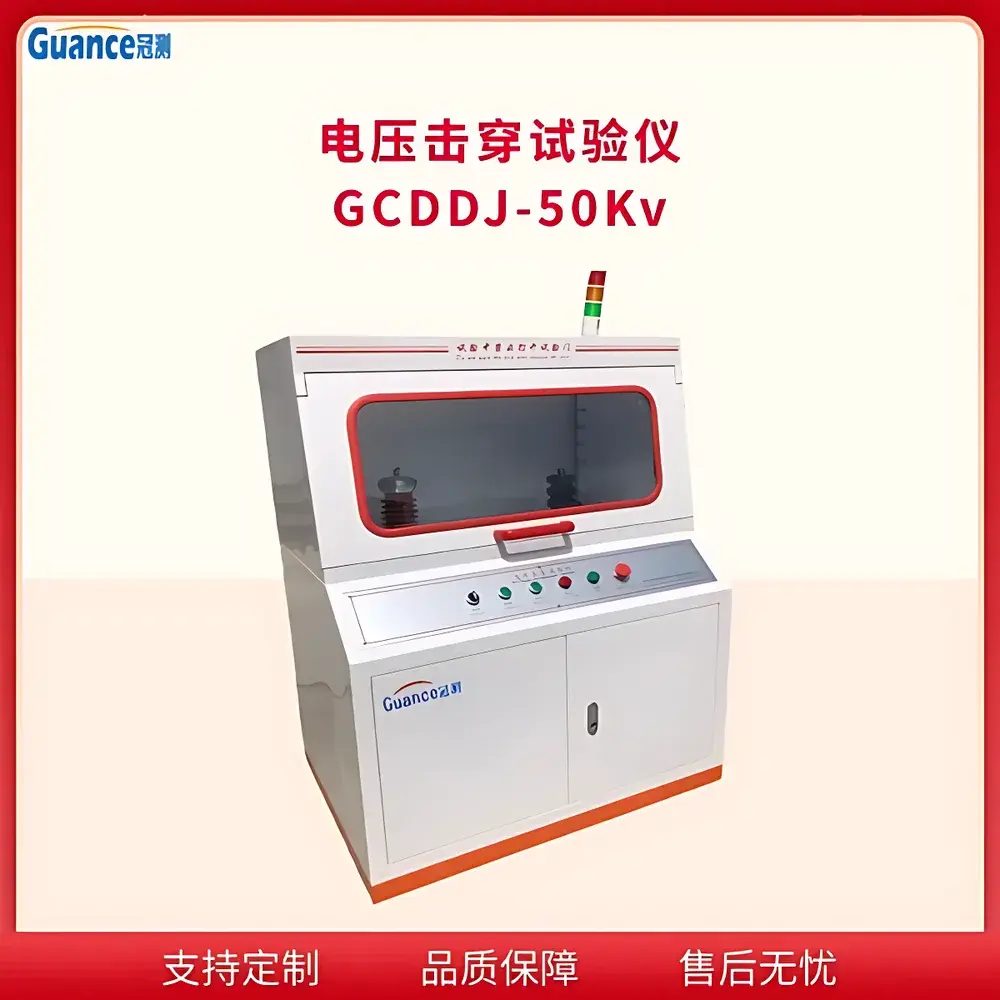
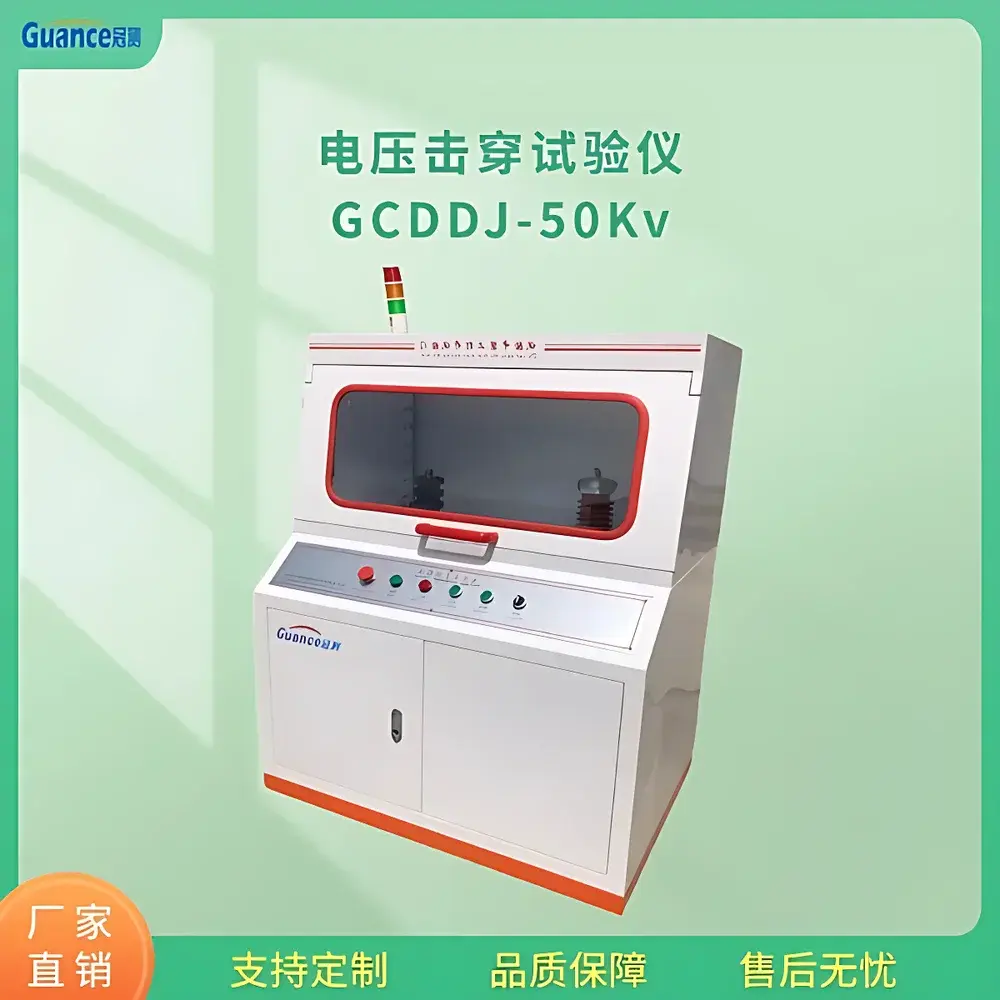
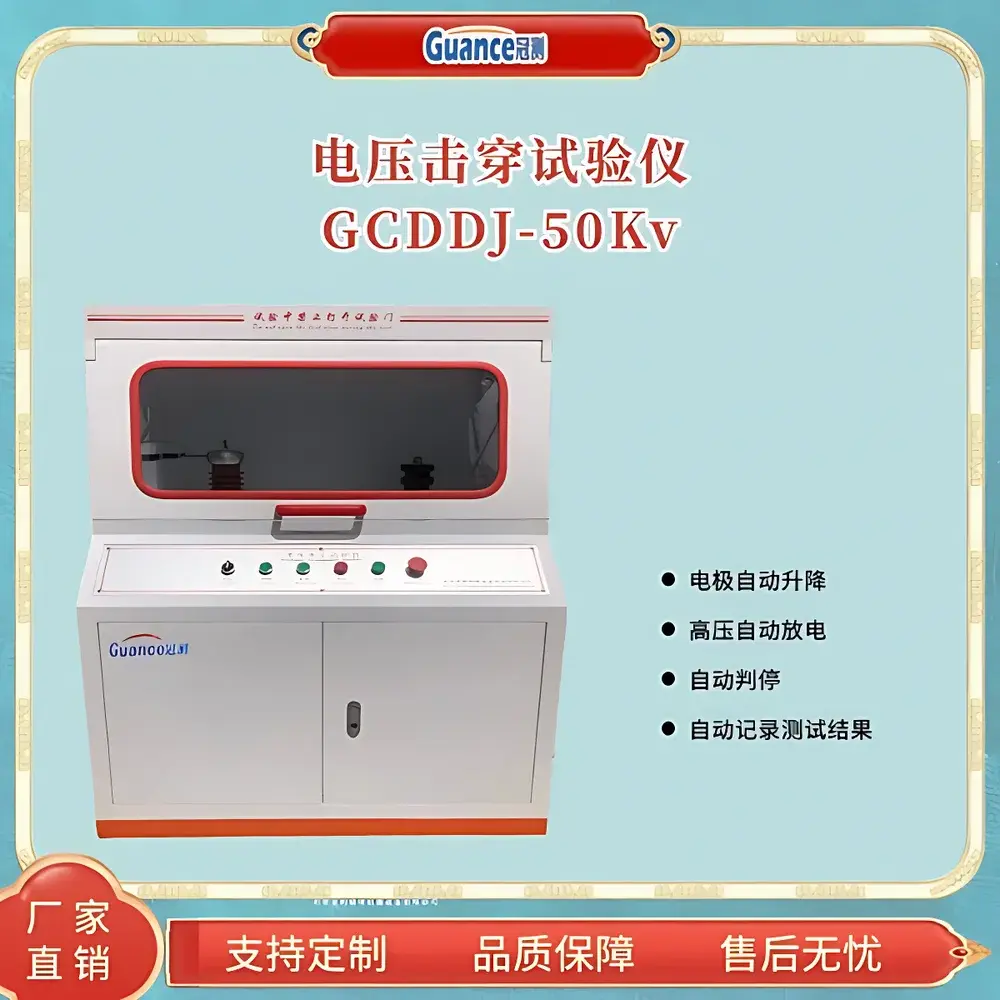
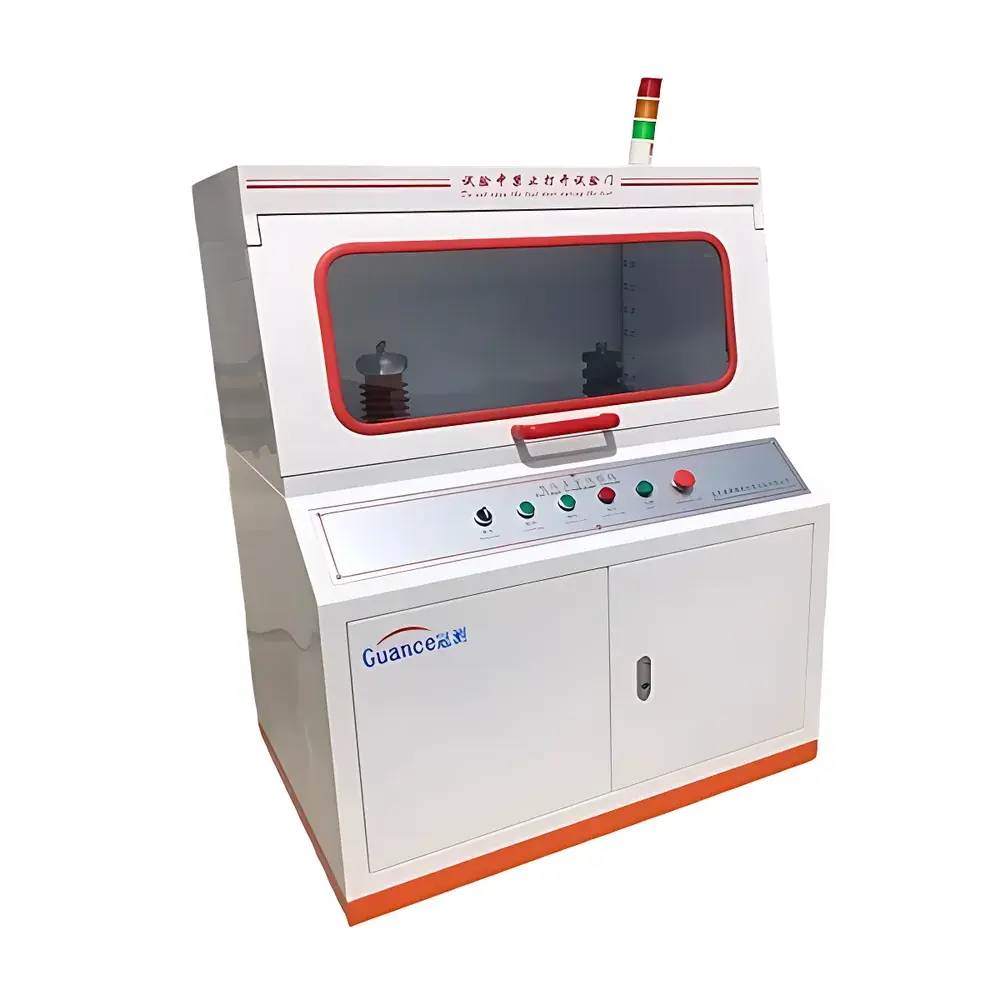
GuanCe Instruments GCDDJ-50kV4 Microcomputer-Controlled Voltage Breakdown Tester
| Brand | GuanCe Instruments |
|---|---|
| Origin | Beijing, China |
| Manufacturer Type | Authorized Distributor |
| Country of Origin | China |
| Model | GCDDJ-50kV4 |
| Breakdown Voltage Range | 0–50 kV AC/DC |
| Power Rating | 5 kVA |
| Input Voltage | AC 220 V / 50 Hz |
| Rise Rate Adjustment | 0.1–5 kV/s (stepless) |
| Voltage Accuracy | ≤ ±1.5% |
| Leakage Current Measurement Range | 0–100 mA |
| Electrode Options | φ25 mm (×2), φ75 mm (×1), customizable |
| Test Medium | Air, Oil Bath (300 × 150 × 200 mm tank), or High-Temperature Environment |
| Safety Protections | Overvoltage, Overcurrent, Short-Circuit, Ground-Fault, Interlock Door Sensing |
| Compliance Standards | GB/T 1408.1–2006, GB/T 1695–2005, GB/T 3333–1999, HG/T 3330–2003, GB/T 12656–1990, ASTM D149–2022 |
Overview
The GuanCe Instruments GCDDJ-50kV4 Microcomputer-Controlled Voltage Breakdown Tester is an industrial-grade dielectric strength measurement system engineered for precise, repeatable evaluation of electrical insulation performance under alternating current (AC) and direct current (DC) stress conditions. It operates on the principle of controlled voltage ramping until dielectric failure—defined as a sudden, irreversible increase in conduction current—occurs across a standardized test specimen. This event marks the dielectric breakdown voltage, from which dielectric strength (kV/mm) is calculated based on specimen thickness. Designed for compliance with internationally recognized standards—including ASTM D149, IEC 60243-1, and multiple GB-series Chinese national standards—the instrument supports both short-term breakdown testing and extended withstand (hipot) verification protocols essential for quality assurance in electrical insulation manufacturing, R&D laboratories, and third-party certification facilities.
Key Features
- Integrated Siemens PLC-based control architecture with optical-isolated data acquisition, ensuring electromagnetic immunity in high-voltage laboratory environments.
- Programmable voltage ramp rate (0.1–5 kV/s, continuously adjustable), supporting uniform rise, stepwise gradient, and fixed-voltage hold modes per ASTM D149 Section 8 and GB/T 1408.1 Clause 6.3.
- Dual-mode breakdown detection: configurable voltage threshold stop or current threshold stop (0–100 mA range, calibrated sensor input), minimizing false positives during transient leakage events.
- Modular high-voltage generation unit featuring oil-immersed transformer design, rated for continuous 50 kV AC/DC output at 5 kVA capacity, with built-in overvoltage clamping and thermal monitoring.
- Interlocked safety enclosure with pneumatic-assisted access door, multi-color status tower light, internal LED illumination, and forced-air exhaust—fully compliant with EN 61010-1:2010 requirements for Class I laboratory equipment.
- Motor-driven automatic discharge circuit activated post-test, eliminating manual grounding risks and enabling rapid specimen turnover.
Sample Compatibility & Compliance
The GCDDJ-50kV4 accommodates solid insulating materials conforming to standard electrode geometries defined in ASTM D149 and GB/T 1408.1. Compatible specimens include thermoset and thermoplastic polymers (e.g., epoxy resins, polyimide films), elastomers (silicone rubber, EPDM), laminates (G10/FR4), ceramics, glass, mica tapes, insulating varnishes, capacitor papers, and cable jacketing compounds. Testing may be conducted in ambient air, transformer oil immersion (standard 300 × 150 × 200 mm bath with suspended sample holder), or elevated temperature chambers (optional integration). All operational parameters—including electrode spacing, dwell time, humidity control (<65% RH), and pre-conditioning duration—are configurable to satisfy material-specific test plans aligned with ISO/IEC 17025 accredited workflows. The system meets mechanical and electrical safety prerequisites for GLP-compliant environments and supports audit-ready documentation per FDA 21 CFR Part 11 when paired with validated software configuration.
Software & Data Management
Operating on Windows 10/11 via native x64 application, the GCDDJ-50kV4 control software provides real-time dual-channel visualization: synchronized voltage ramp curve and leakage current waveform. Users define test sequences using intuitive parameter templates—selecting AC/DC mode, test type (breakdown, withstand, or step-stress), electrode configuration, and pass/fail criteria. All raw acquisition data (time-stamped voltage, current, and status flags) are stored in encrypted binary format with SHA-256 integrity checksums. Export functions support CSV and Excel (.xlsx) formats for statistical analysis in external tools such as JMP or Minitab. Reports include operator ID, calibration certificate traceability, environmental logs, and digital signatures; templates adhere to ISO 17025 Annex A.3 formatting conventions. Audit trail functionality records all parameter modifications, test starts/stops, and user logins with immutable timestamps—enabling full traceability for regulatory submissions.
Applications
- Quality control of resin formulations (epoxy, phenolic, silicone) used in encapsulation, potting, and PCB underfill applications.
- Evaluation of dielectric integrity in thin polymer films (≤0.5 mm) for flexible electronics and medical device insulation.
- Comparative assessment of aging effects—thermal, UV, or moisture-induced—on insulating performance per IEC 60216 procedures.
- Validation of coating systems (e.g., enamel wires, motor windings) against UL 1446 and IEC 60851 requirements.
- Support of failure analysis investigations where partial discharge inception voltage (PDIV) screening precedes full breakdown testing.
- Training platform for high-voltage engineering curricula requiring hands-on exposure to standardized dielectric test methodology.
FAQ
What standards does the GCDDJ-50kV4 fully support out-of-the-box?
The instrument’s default firmware and test templates are preconfigured for GB/T 1408.1–2006, GB/T 1695–2005, ASTM D149–2022, and IEC 60243-1:2013. Custom protocol implementation requires configuration file upload via administrator interface.
Can the system perform sequential multi-sample testing without manual intervention?
Yes—batch mode enables automated cycling across up to 99 specimens using predefined electrode positioning and parameter sets. Each result is timestamped and appended to a master dataset.
Is high-temperature testing capability built-in or optional?
High-temperature operation (up to 200 °C) requires integration with externally sourced environmental chambers. The base unit includes mounting interfaces and signal routing for thermocouple feedback and chamber interlock signaling.
How is voltage calibration maintained and verified?
Calibration is performed using NIST-traceable high-voltage dividers (e.g., PMM HV Divider Series) at intervals not exceeding 12 months. Internal self-diagnostics verify sensor linearity and isolation integrity prior to each test session.
Does the software meet FDA 21 CFR Part 11 requirements for electronic records?
When deployed with Windows Group Policy–enforced password policies, time synchronization via NTP server, and digital certificate–based user authentication, the system satisfies Part 11 Subpart B technical controls for closed systems. Full validation documentation package available upon request.
Related Products



