
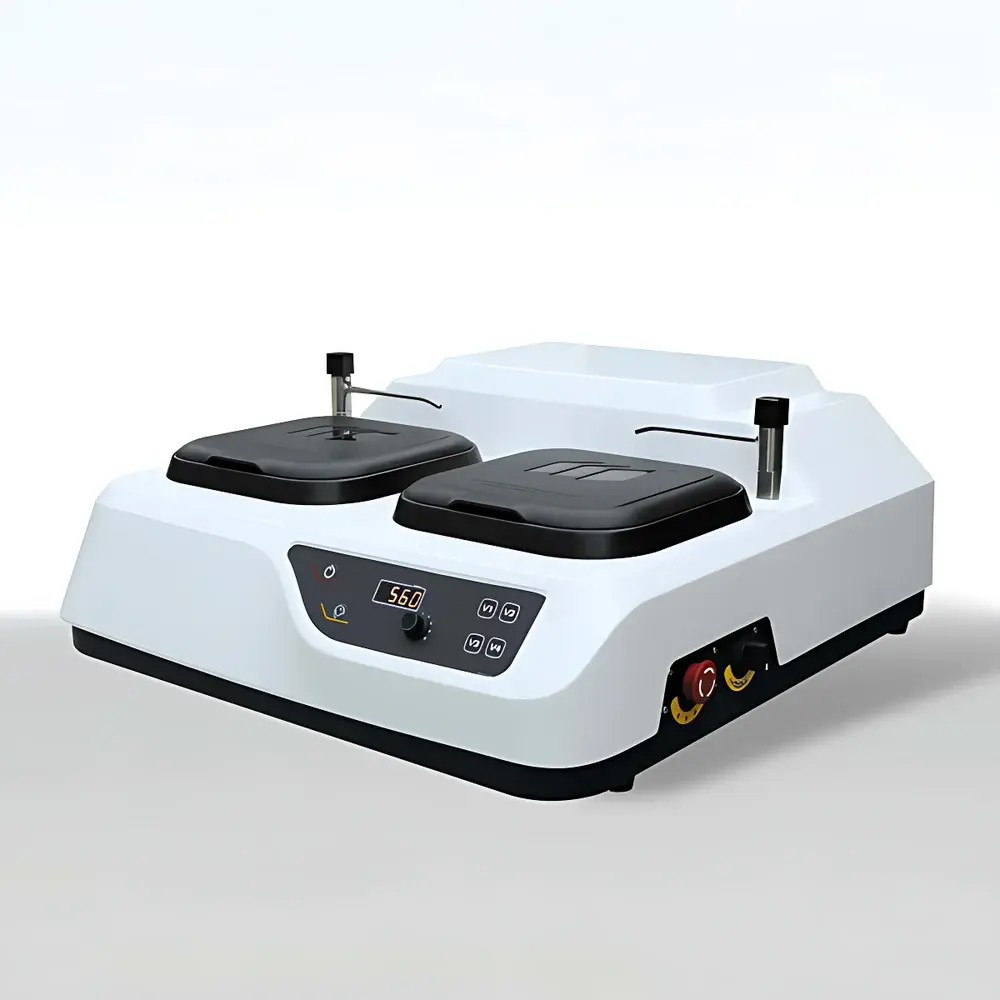
LEI-TECH LK-MP200E Dual-Disc Metallographic Grinding and Polishing Machine
| Brand | LEI-TECH |
|---|---|
| Origin | Tianjin, China |
| Manufacturer Type | Direct Manufacturer |
| Country of Origin | China |
| Model | LK-MP200E |
| Number of Grinding/Polishing Plates | 2 |
| Power Supply | AC 220 V, 50 Hz |
| Input Power | 0.75 kW |
| Platen Diameter | 203 mm |
| Speed Range | 0–1400 rpm (infinitely variable via knob) |
| Preset Speeds | 150, 300, 600, 1000 rpm |
| Rotation Direction | Reversible (CW/CCW selectable) |
| Dimensions (W×D×H) | 758 × 785 × 310 mm |
| Net Weight | 40 kg |
| Cooling System | Integrated water-cooling circuit |
Overview
The LEI-TECH LK-MP200E Dual-Disc Metallographic Grinding and Polishing Machine is an engineered solution for standardized, reproducible specimen preparation in metallurgical, materials science, and failure analysis laboratories. Designed around the fundamental principles of mechanical material removal—grinding via abrasive particle impact and polishing via controlled surface deformation—the LK-MP200E enables precise progression through sequential grit stages (e.g., SiC paper, diamond suspension, alumina slurry) to achieve planar, scratch-free surfaces suitable for optical microscopy, SEM imaging, and microhardness testing. Its dual-platen architecture supports simultaneous or independent operation of grinding and polishing stations, minimizing cross-contamination risk and reducing total cycle time per specimen batch. The machine employs a brushless induction motor coupled with a precision-machined gear train to ensure torque stability across the full 0–1400 rpm range, critical for maintaining consistent material removal rates during coarse grinding and low-shear polishing.
Key Features
- Dual independently controllable 203 mm diameter platens—enabling concurrent grinding and polishing or parallel processing of two specimens under identical parameters
- Reversible rotation direction (clockwise or counterclockwise) per platen, configurable to match abrasive disc labeling conventions and optimize particle ejection trajectory
- Infinitely variable speed control (0–1400 rpm) via calibrated analog knob, supplemented by four factory-calibrated preset speeds (150, 300, 600, 1000 rpm) for rapid method recall
- Integrated water-delivery manifold with adjustable flow valve and splash-resistant nozzle—ensures continuous coolant application directly at the specimen–abrasive interface to suppress thermal damage to microstructural features
- Microprocessor-based control unit with LED status indicators, overload protection, and automatic shutdown on motor stall or thermal fault
- Stainless steel housing and corrosion-resistant platen flanges—designed for long-term exposure to aqueous slurries, alcohol-based lubricants, and mild acidic cleaning agents
- Low-noise operation (<62 dB(A) at 1 m) achieved through vibration-damped mounting and balanced platen assembly
Sample Compatibility & Compliance
The LK-MP200E accommodates standard metallographic specimens up to 40 mm in diameter (with optional holders for smaller or irregular geometries), including ferrous alloys, non-ferrous metals, ceramics, and composite laminates. It supports industry-standard consumables: bonded SiC papers (P80–P2500), diamond-impregnated pads (15–1 µm), colloidal silica suspensions, and alumina-based polishing cloths. The system complies with ISO 15510:2021 (Metallographic specimen preparation—Grinding and polishing procedures) and aligns with ASTM E3-22 requirements for planarity, edge retention, and artifact minimization. While not certified to IEC 61000-6-2/6-4 for EMC, its electromagnetic emissions fall within Class B limits for laboratory environments. All electrical components meet GB/T 19001–2016 (equivalent to ISO 9001:2015) manufacturing quality protocols.
Software & Data Management
The LK-MP200E operates as a standalone hardware platform without embedded software or network connectivity. However, its repeatable mechanical design and stable speed regulation enable full traceability when integrated into GLP/GMP workflows: operators document platen speed, dwell time, abrasive type, and coolant flow rate in laboratory notebooks or LIMS-compatible electronic records. Optional external timers or programmable PLC interfaces can be deployed for SOP-driven automation—particularly valuable in high-throughput QC labs requiring audit-ready parameter logs. Though not FDA 21 CFR Part 11 compliant out-of-the-box, the device’s deterministic behavior and lack of user-modifiable firmware simplify validation for regulated environments where procedural consistency—not digital signatures—is the primary compliance driver.
Applications
- Routine metallographic preparation for ASTM E3-compliant microstructure evaluation in foundries, heat treatment facilities, and aerospace component suppliers
- Failure analysis of fractured weld zones, fatigue cracks, and corrosion-damaged surfaces in petrochemical and power generation infrastructure
- Quality control of sintered powder metallurgy parts, where density gradients and pore morphology must be quantified via image analysis
- Academic research in phase transformation kinetics, grain boundary engineering, and intermetallic compound formation in Ni- and Ti-based superalloys
- Preparation of cross-sectioned PCBs and electronic packaging materials for delamination and void assessment under polarized light
FAQ
What is the maximum specimen diameter supported by the LK-MP200E?
Standard holders accommodate specimens up to 40 mm; custom fixtures for larger or irregular samples are available upon request.
Can the machine operate without water cooling?
Water cooling is strongly recommended for all grinding steps and extended polishing cycles to prevent thermal distortion of microstructures; dry operation is not advised and voids warranty coverage.
Is the LK-MP200E compatible with automated dispensing systems for polishing slurries?
Yes—the platen center shaft includes a 6 mm threaded port for integration with third-party slurry dosing manifolds using standard NPT fittings.
What maintenance intervals are specified for the motor and gearbox?
The sealed induction motor requires no scheduled lubrication; the gearbox is pre-filled with synthetic EP grease rated for 10,000 hours of continuous operation under nominal load.
Does LEI-TECH provide method development support for new material systems?
Yes—application engineers offer remote consultation and documented protocol templates for stainless steels, aluminum alloys, refractory metals, and ceramic matrix composites.



