
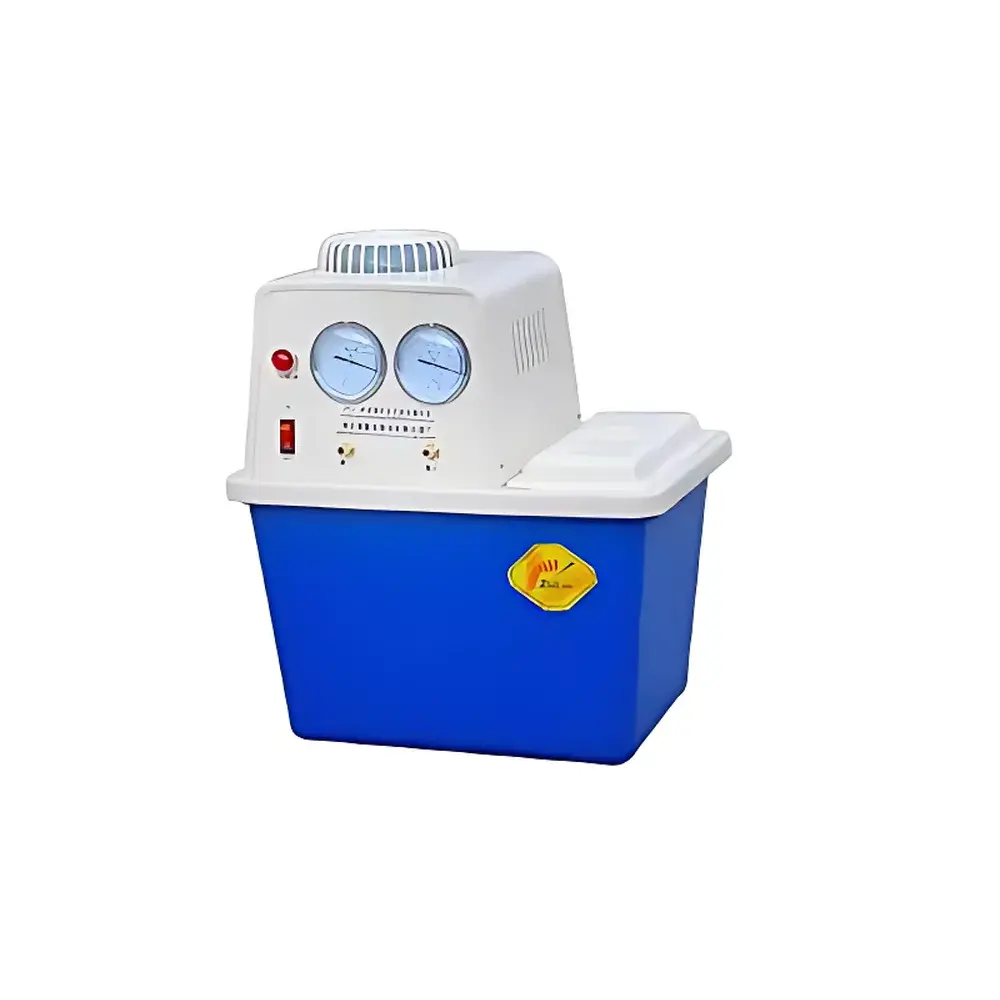
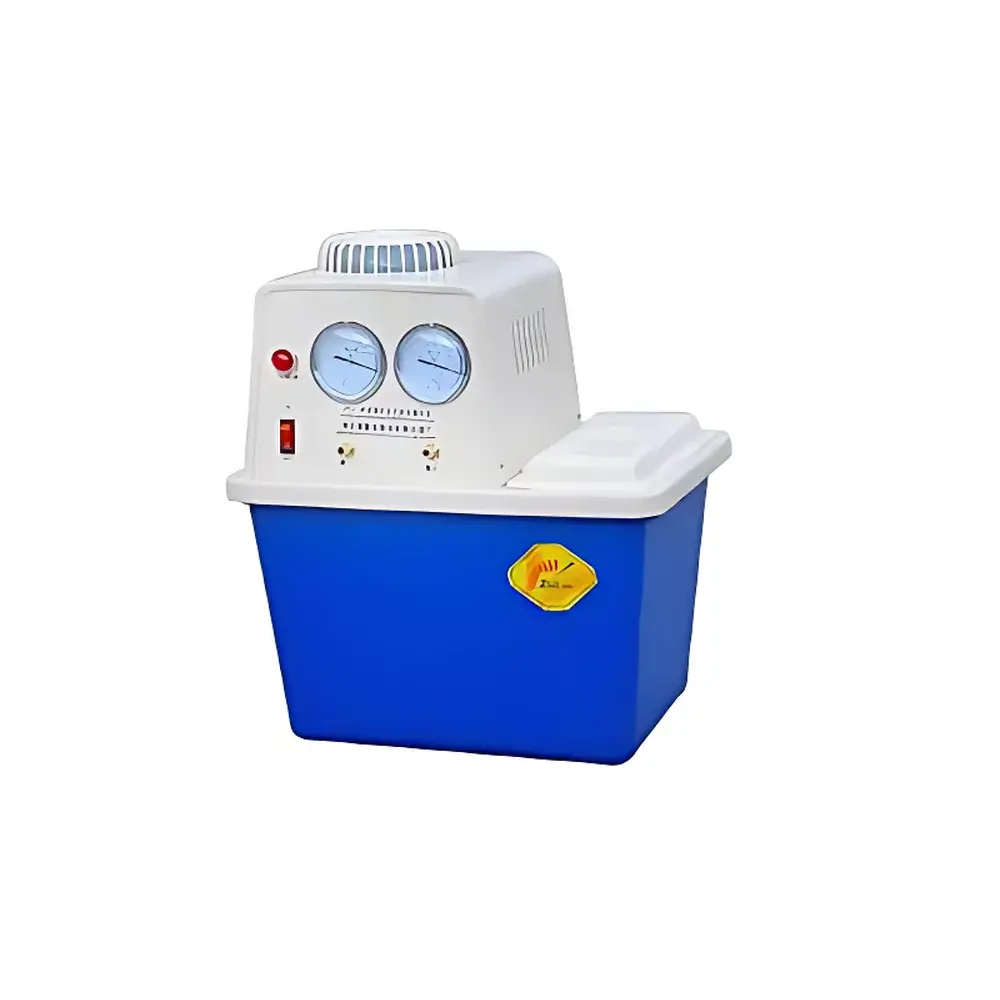
Zhongjiaojinyuan SHD-III Circulating Water Multi-Function Vacuum Pump
| Brand | Zhongjiaojinyuan |
|---|---|
| Origin | Beijing, China |
| Manufacturer Type | Direct Manufacturer |
| Product Origin | Domestic (China) |
| Model | SHD-III |
| Pricing | Available Upon Request |
Overview
The Zhongjiaojinyuan SHD-III Circulating Water Multi-Function Vacuum Pump is an engineered solution for laboratories requiring simultaneous vacuum generation and recirculating cooling water supply. It operates on the principle of water-jet (ejector) vacuum technology: ambient water—circulated via an integrated reservoir and pump—is accelerated through a venturi nozzle to create a controlled negative pressure zone, thereby evacuating air or vapor from connected apparatus. Unlike conventional single-function vacuum pumps, the SHD-III integrates dual utility—vacuum aspiration and coolant circulation—within a compact, self-contained unit. This design eliminates the need for external chillers or separate water sources during distillation, rotary evaporation, filtration, or vacuum drying procedures. Its architecture reflects ergonomic adaptation to space-constrained benchtop environments, drawing functional inspiration from compact Japanese desktop vacuum systems while incorporating localized engineering enhancements—including corrosion-resistant stainless-steel pump heads and an integrated ice-chill port for temperature-sensitive applications.
Key Features
- Integrated dual-function operation: simultaneous vacuum generation (up to –0.095 MPa typical ultimate vacuum) and closed-loop circulating cooling water delivery (adjustable flow rate)
- Stainless-steel pump head assembly for enhanced chemical resistance and long-term durability in acidic, alkaline, or organic solvent environments
- Compact, one-piece molded housing designed for minimal footprint—optimized for standard laboratory workbenches and fume hood integration
- Dedicated ice-chill port enabling direct insertion of ice packs or chilled gel packs to lower circulating water temperature below ambient (typically 5–15 °C reduction achievable)
- Modular multi-port manifold: user-selectable number of vacuum outlets (typically 2–5 independent suction ports), configurable per experimental setup requirements
- Low-noise operation (<60 dB(A) at 1 m) and energy-efficient motor drive suitable for continuous unattended use in QC, teaching, and research labs
Sample Compatibility & Compliance
The SHD-III is compatible with standard ground-glass jointed glassware (e.g., B-24, B-29, NS 14/23), Buchner funnels, rotary evaporator condensers, and vacuum desiccators. Its water-jet mechanism avoids oil contamination, making it ideal for solvent recovery, mild acid/base reactions, and educational demonstrations where hydrocarbon-free vacuum is essential. While not certified to ISO 8573 (compressed air purity) or IEC 61000 (EMC), its construction adheres to GB/T 22989–2008 (Chinese national standard for circulating water vacuum pumps) and incorporates safety features aligned with general laboratory equipment best practices—including thermal overload protection, leak-resistant reservoir sealing, and non-slip rubber feet. For GLP/GMP-regulated workflows, users are advised to validate system performance (e.g., vacuum stability, flow consistency) per internal SOPs prior to critical use.
Software & Data Management
The SHD-III is a manually operated, analog-controlled device with no embedded microprocessor, digital interface, or data logging capability. All operational parameters—including vacuum level (indicated via built-in analog vacuum gauge), water temperature (monitored visually or with external thermometer), and flow status—are observed directly at the unit. This design prioritizes mechanical reliability, ease of maintenance, and compatibility with legacy lab infrastructure. No software drivers, firmware updates, or cybersecurity protocols apply. As such, it inherently satisfies regulatory expectations for “non-computerized systems” under FDA 21 CFR Part 11 Annex A and EU GMP Annex 11, where audit trails and electronic record controls are not required. Routine calibration of the vacuum gauge is recommended annually using a traceable reference manometer.
Applications
- Vacuum-assisted filtration (gravity and pressure-assisted) across chemistry, environmental, and pharmaceutical sample preparation
- Rotary evaporation of heat-sensitive compounds requiring stable low-pressure conditions and concurrent condenser cooling
- Thin-layer chromatography (TLC) chamber evacuation and solvent degassing prior to analysis
- Teaching laboratory demonstrations of gas laws, phase equilibria, and vacuum thermodynamics
- Small-scale vacuum drying of hygroscopic solids or crystalline intermediates in synthetic chemistry workflows
- Supporting Schlenk line auxiliary vacuum manifolds where oil-free, low-maintenance aspiration is preferred
FAQ
What is the maximum achievable vacuum level?
Typical ultimate vacuum is –0.095 MPa (≈710 Torr) at 20 °C ambient with clean tap water; actual performance depends on water temperature, inlet pressure, and tubing configuration.
Can deionized or distilled water be used?
Yes—deionized water is recommended for extended service life and reduced mineral buildup, especially in hard-water regions.
Is the SHD-III suitable for vacuum ovens or freeze dryers?
It is not rated for continuous high-load or high-vacuum applications (>24 h at <10 Torr); best suited for intermittent or moderate-duty vacuum tasks.
How often should the water reservoir be refilled or replaced?
Reservoir volume is ~12 L; replacement frequency depends on evaporation rate and usage duration—typically every 4–8 hours under continuous operation.
Does the unit require annual certification?
No formal certification is mandated; however, periodic verification of vacuum gauge accuracy and seal integrity is advised per institutional maintenance schedules.



