
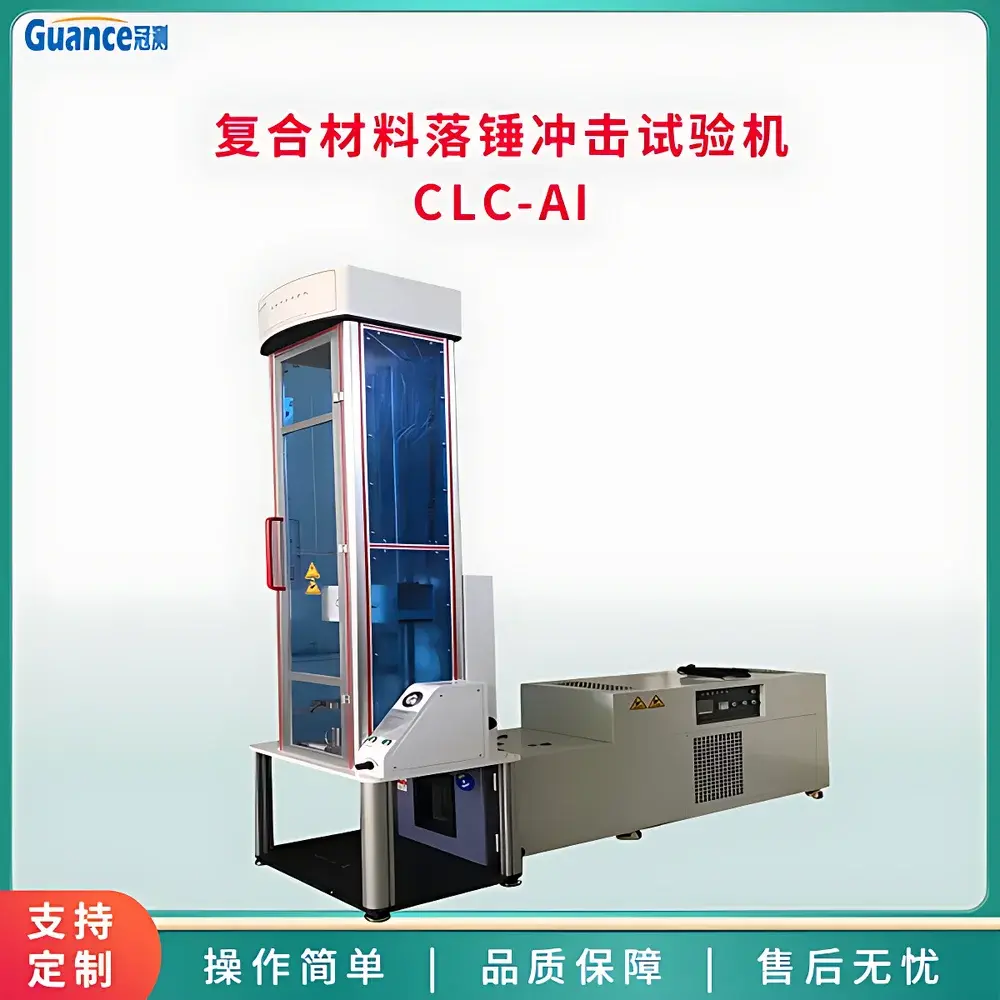
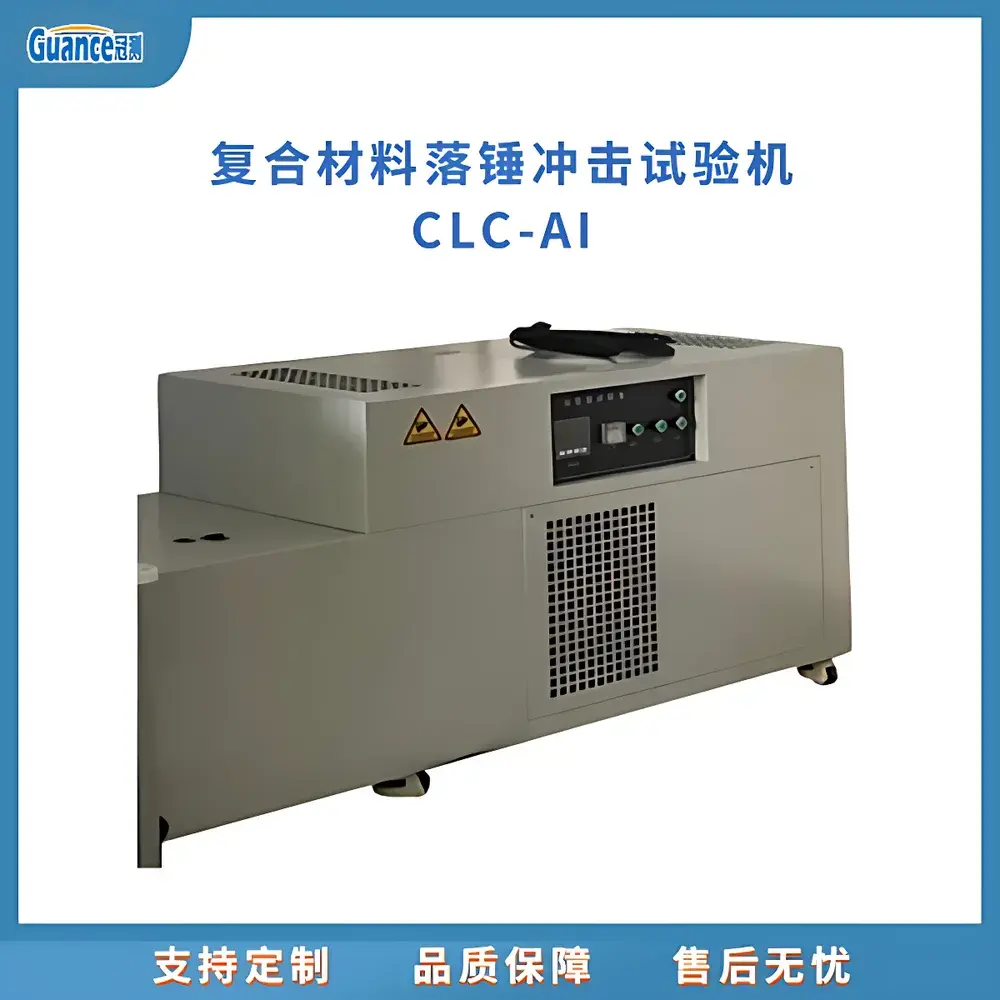

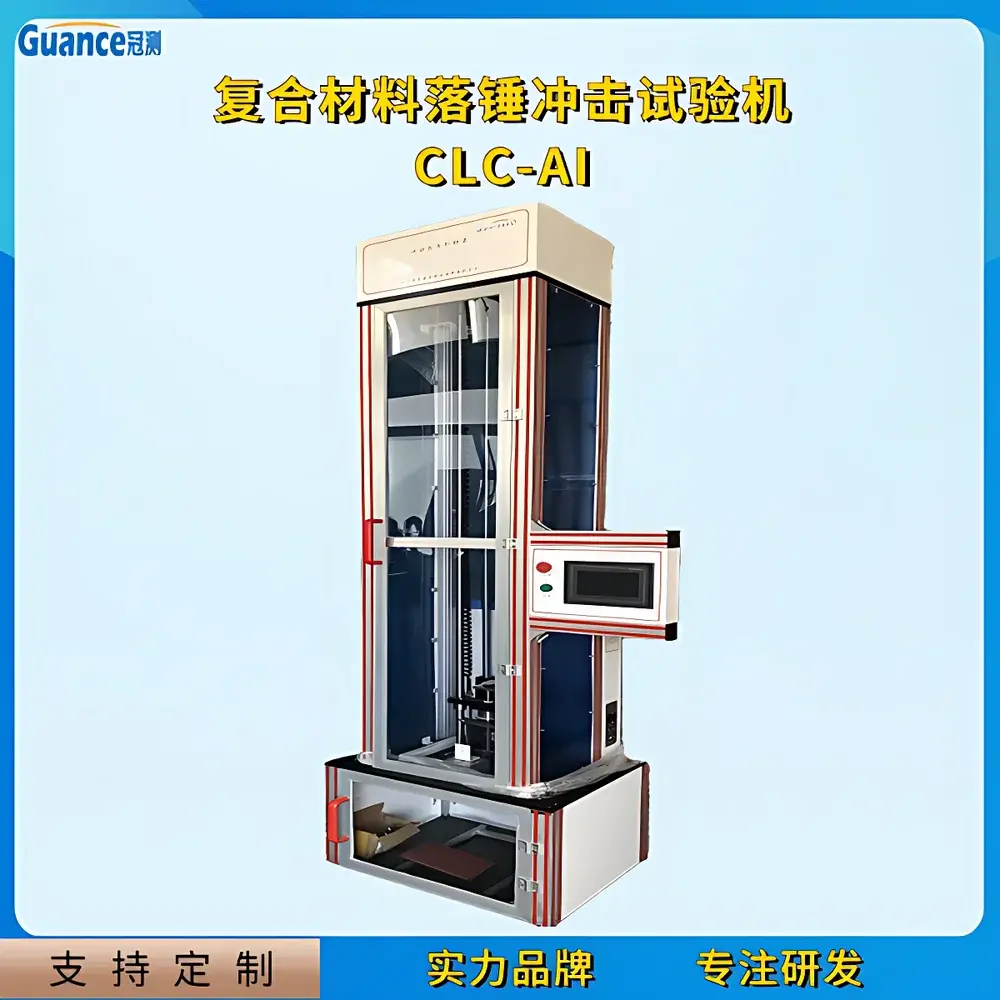
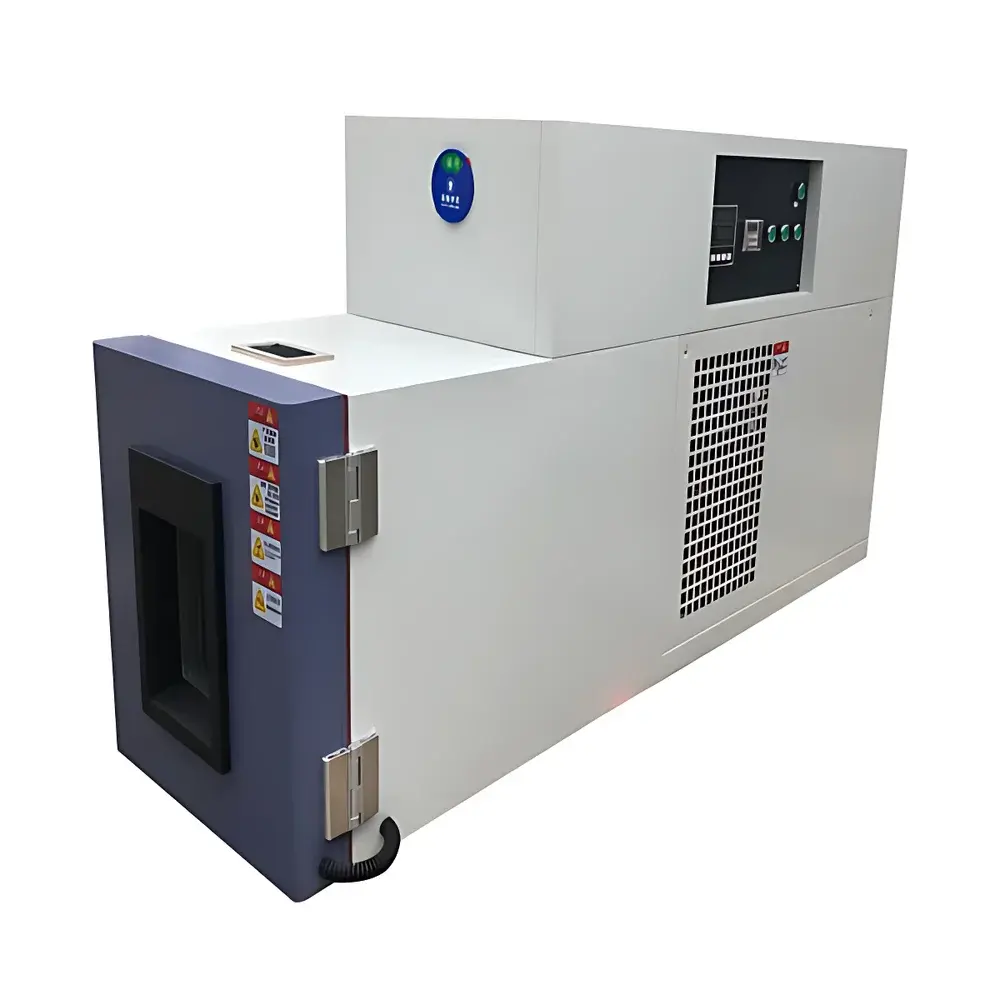
GuanCe CLC-AI8 Instrumented Composite Impact Testing Machine
| Brand | GuanCe |
|---|---|
| Origin | Beijing, China |
| Manufacturer Type | Authorized Distributor |
| Country of Origin | China |
| Model | CLC-AI8 |
| Instrument Type | Drop-Weight Impact Tester |
| Impact Energy | 100 kN·mm (equivalent to 98 J at 2 m drop height) |
| Impact Velocity | 9.8 m/s (theoretical free-fall velocity from 4.9 m |
| Hammer Mass Options | 5 kg / 15 kg / 20 kg |
| Maximum Lift Height | 2000 mm |
| Load Cell Range | 100 kN |
| Effective Impact Height Range | 1500 mm |
| Frame Dimensions (L×W×H) | 1200 × 700 × 2100 mm |
| Unit Weight | 300 kg |
| Compliance | ISO 3127, ISO 6603, ISO 7765, ISO 8256, ISO 11343, ASTM D2444, ASTM D3763, ASTM D5628, ASTM D7136, ASTM D7192, DIN 53373, prEN 6038 |
Overview
The GuanCe CLC-AI8 Instrumented Composite Impact Testing Machine is a precision-engineered drop-weight impact system designed for high-fidelity dynamic mechanical characterization of fiber-reinforced polymer (FRP) composites, laminates, and hybrid structural materials. It operates on the principle of controlled gravitational impact: a calibrated hammer is elevated to a defined height, released, and strikes a standardized specimen supported in a rigid fixture. Unlike conventional non-instrumented impact testers, the CLC-AI8 integrates synchronized high-speed load sensing (up to 100 kN full-scale), real-time displacement tracking, and velocity profiling—enabling full-force–displacement–time history acquisition. This allows quantitative decomposition of incident kinetic energy into elastic rebound energy, plastic dissipation, delamination work, matrix cracking energy, and fiber breakage energy—critical for establishing damage tolerance envelopes, identifying brittle-to-ductile transition thresholds, and validating progressive failure models in finite element simulations.
Key Features
- Instrumented impact measurement with integrated 100 kN piezoelectric load cell and high-resolution displacement transducer, capturing force–time and displacement–time waveforms at ≥1 MHz sampling rate
- Motorized hammer lifting mechanism with programmable height setting (up to 2000 mm), enabling precise kinetic energy control (E = mgh) across multiple impact severity levels
- Automated hammer release and anti-double-strike safety interlock, ensuring repeatable initiation conditions and eliminating secondary loading artifacts
- Modular hammer set (5 kg, 15 kg, 20 kg standard masses) with interchangeable nose geometries (spherical, flat, hemispherical per ASTM/ISO standards)
- Rigid C-frame architecture with vibration-damped base and adjustable support anvil assemblies compliant with ISO 6603-1 and ASTM D7136 fixture requirements
- Integrated pneumatic clamping system for secure specimen fixation under dynamic loading, minimizing boundary-condition-induced scatter
Sample Compatibility & Compliance
The CLC-AI8 accommodates flat composite plates (typically 100 × 100 mm to 150 × 150 mm), sandwich cores, and thermoplastic or thermoset laminates up to 25 mm thickness. Specimen mounting follows ISO 8256 Annex A and ASTM D7136 Section 7 configurations—including simply supported, clamped-edge, and guided-impact variants. All test protocols adhere to internationally recognized standards for impact response quantification, including energy absorption (J), maximum force (kN), time-to-peak-load (ms), deflection at peak load (mm), and post-impact residual strength assessment. The system’s traceable calibration chain meets ISO/IEC 17025 requirements for testing laboratories, and raw waveform data export supports GLP-compliant audit trails when used in regulated R&D environments.
Software & Data Management
The proprietary IMPACT-ANALYZER v4.2 software provides real-time acquisition, synchronized multi-channel visualization (force, displacement, velocity), and automated parameter extraction per ASTM D7136 Annex A and ISO 6603-2. Key derived outputs include: peak impact force (Fmax), absorbed energy (Eabs = ∫F·dv), rebound energy (Ereb), damage initiation threshold (first deviation from linear stiffness), critical fracture energy (GIC estimation via instrumented Charpy method), and hysteresis loop area as a proxy for irreversible damage. Data files are saved in ASCII-compatible .csv and binary .bin formats with embedded metadata (operator ID, timestamp, calibration certificate ID, environmental conditions). Export modules support direct import into MATLAB, Python (NumPy/Pandas), and commercial FEA pre-processors (e.g., ANSA, HyperMesh) for correlation studies.
Applications
- Quantitative evaluation of low-velocity impact resistance in aerospace CFRP wing skins and fuselage panels
- Comparative assessment of toughening mechanisms (e.g., nanofiller dispersion, interleaved veils, z-pinning) in automotive thermoplastic composites
- Validation of LS-DYNA and Abaqus/Explicit progressive damage models using full-field instrumented response
- Development of damage-tolerant design allowables per SAE AIR 4850 and NASA-HDBK-17
- Quality assurance testing of out-of-autoclave (OOA) cured laminates in Tier-1 supplier qualification
- Academic research on strain-rate-dependent fracture toughness transitions in bio-based epoxy systems
FAQ
What standards does the CLC-AI8 fully support for composite impact testing?
The system complies with ISO 3127 (plastics — determination of impact resistance), ISO 6603 (determination of puncture impact behavior), ISO 7765 (determination of impact resistance of rigid cellular plastics), ISO 8256 (tensile-impact testing), ISO 11343 (high-speed impact on adhesives), ASTM D2444 (impact resistance of thermoplastics), ASTM D3763 (high-speed tensile-impact), ASTM D5628 (multi-impact resistance), ASTM D7136 (drop-weight impact on polymer matrix composites), ASTM D7192 (instrumented impact of composites), DIN 53373 (impact testing of plastics), and prEN 6038 (aircraft material impact requirements).
Can the system be configured for instrumented Charpy or Izod tests?
While optimized for plate-level composite impact per ASTM D7136, the modular hammer and anvil design permits adaptation to standardized Charpy fixtures (ASTM E23) and Izod configurations (ASTM D256) with appropriate calibration verification.
Is the software compliant with FDA 21 CFR Part 11 requirements?
IMPACT-ANALYZER v4.2 includes optional 21 CFR Part 11 modules—electronic signatures, audit trail logging, role-based access control, and data integrity validation—available upon request for pharmaceutical or medical device composite packaging validation.
What maintenance intervals are recommended for long-term metrological stability?
Annual recalibration of the load cell and displacement sensor against NIST-traceable references is recommended; biannual inspection of guide rails, pneumatic seals, and hammer release solenoid performance ensures ≤±0.5% energy repeatability over 10,000 cycles.
Does GuanCe provide application support for custom test protocol development?
Yes—GuanCe’s technical team offers remote and on-site protocol engineering services, including fixture design consultation, waveform interpretation training, and uncertainty budgeting per GUM (JCGM 100:2008) for ISO/IEC 17025 accreditation preparation.



