
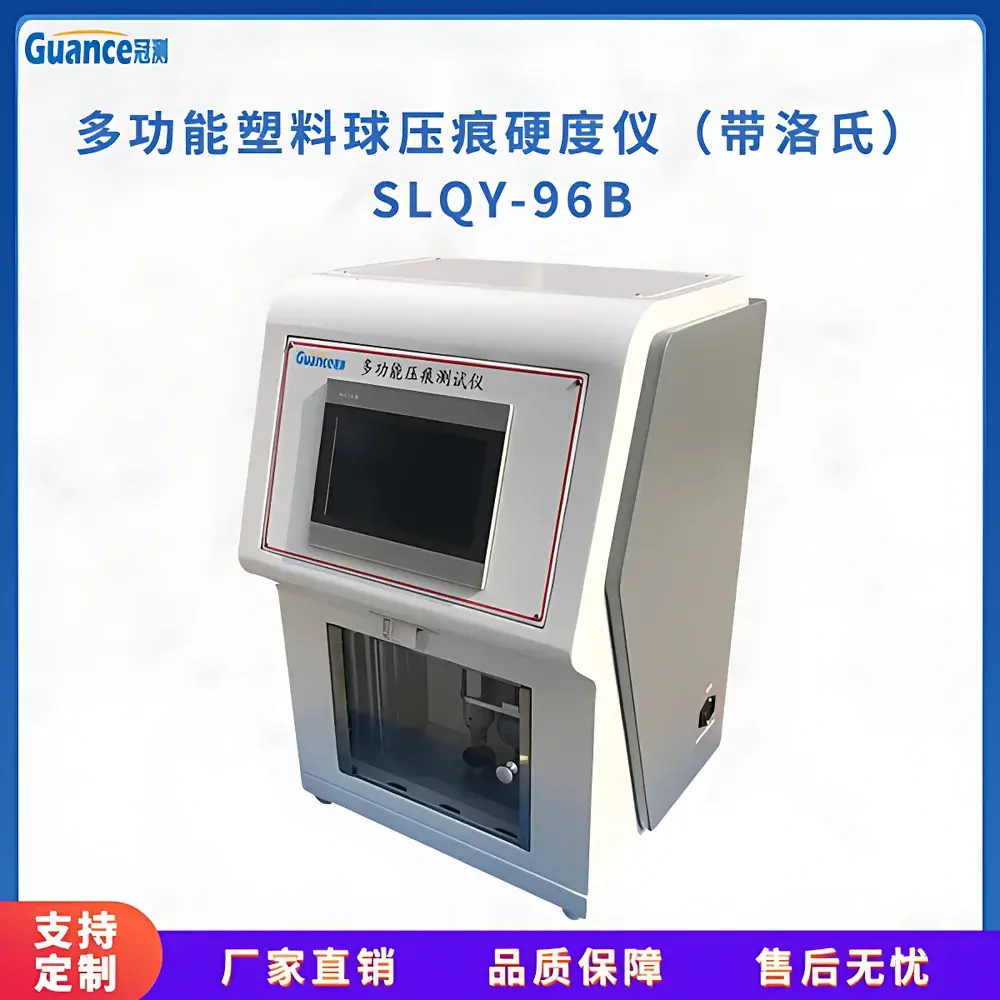
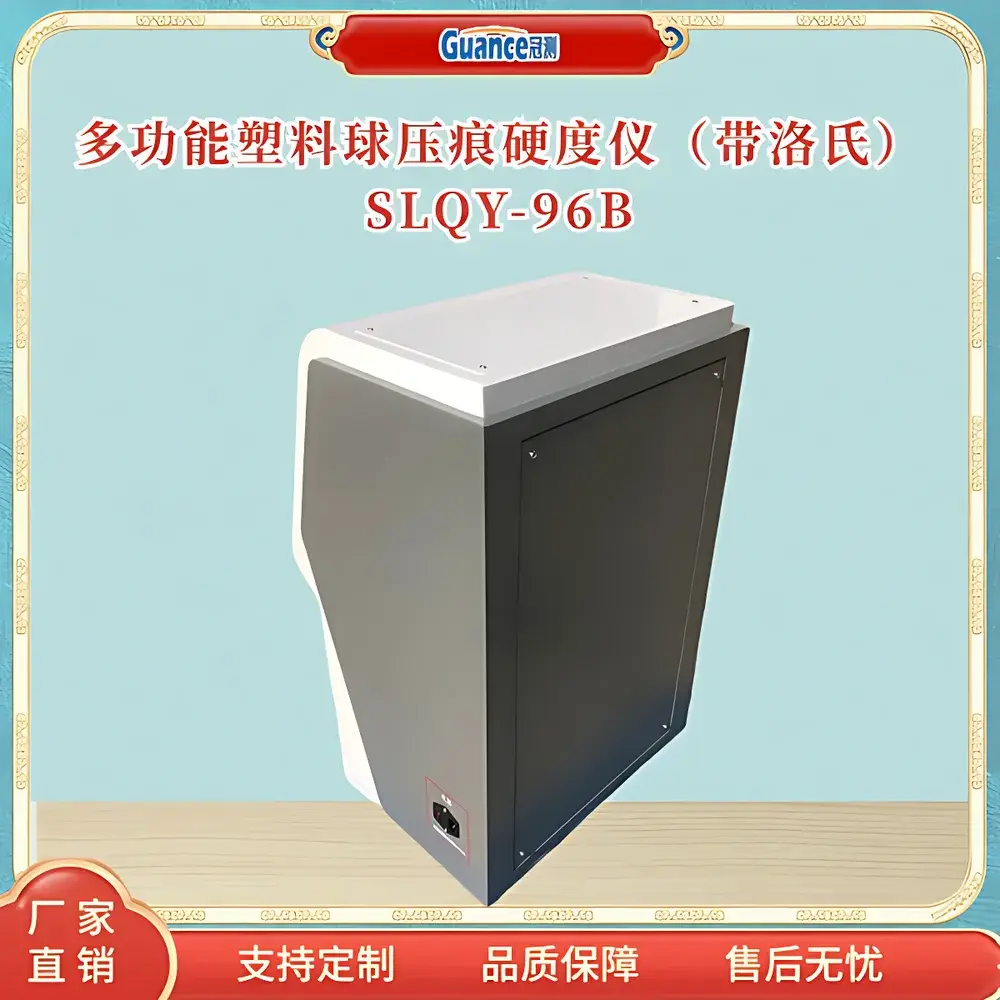
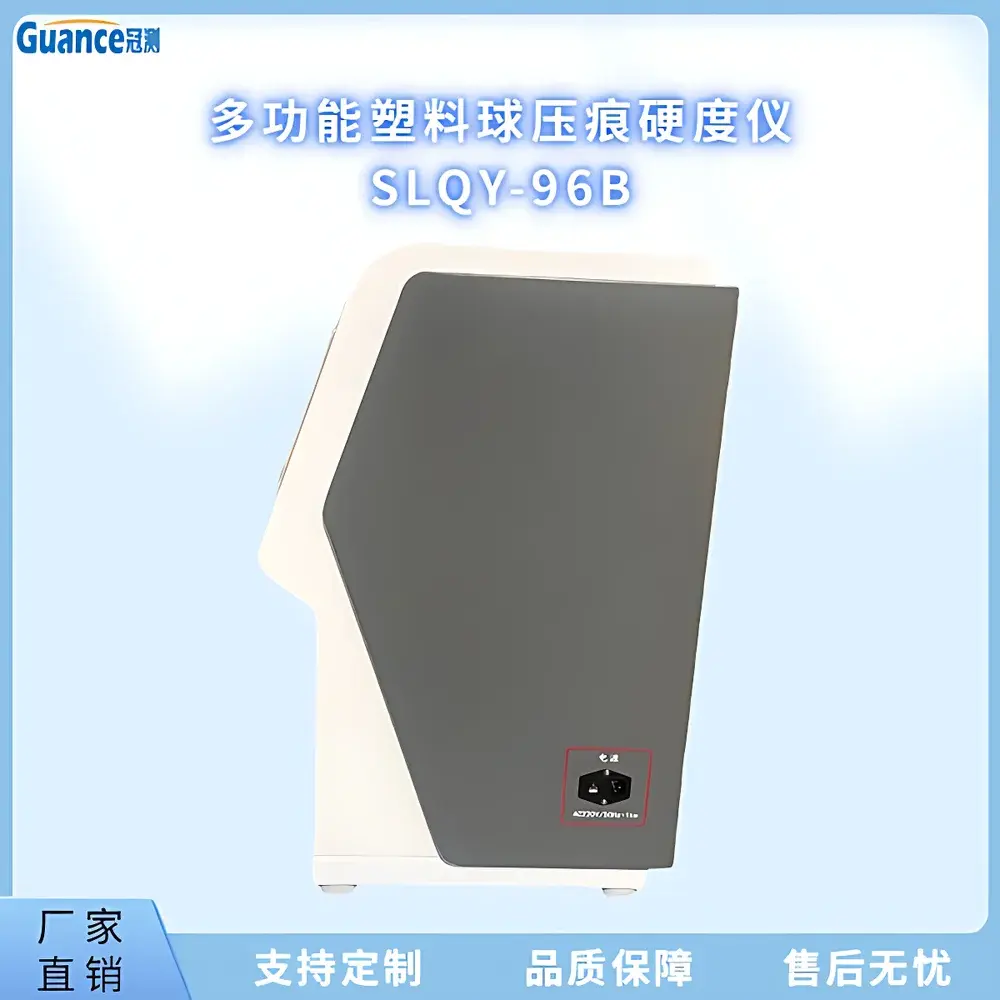
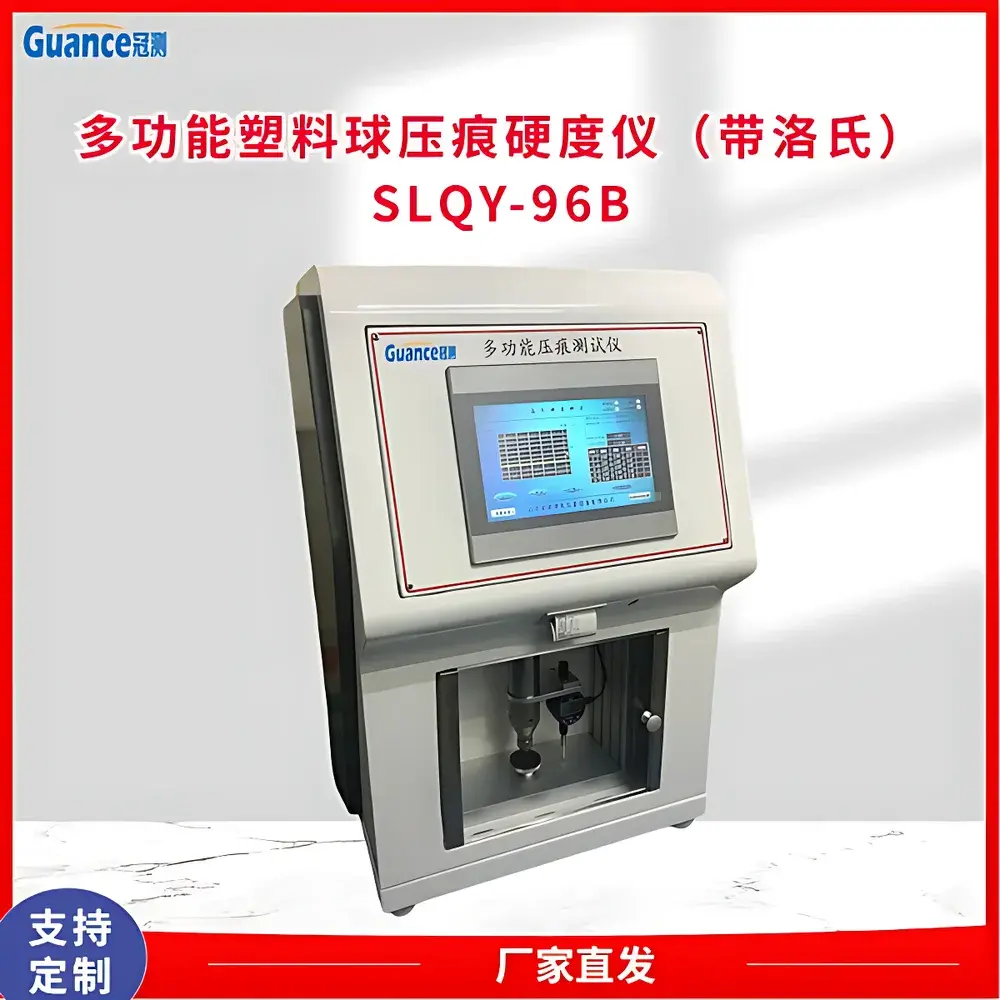
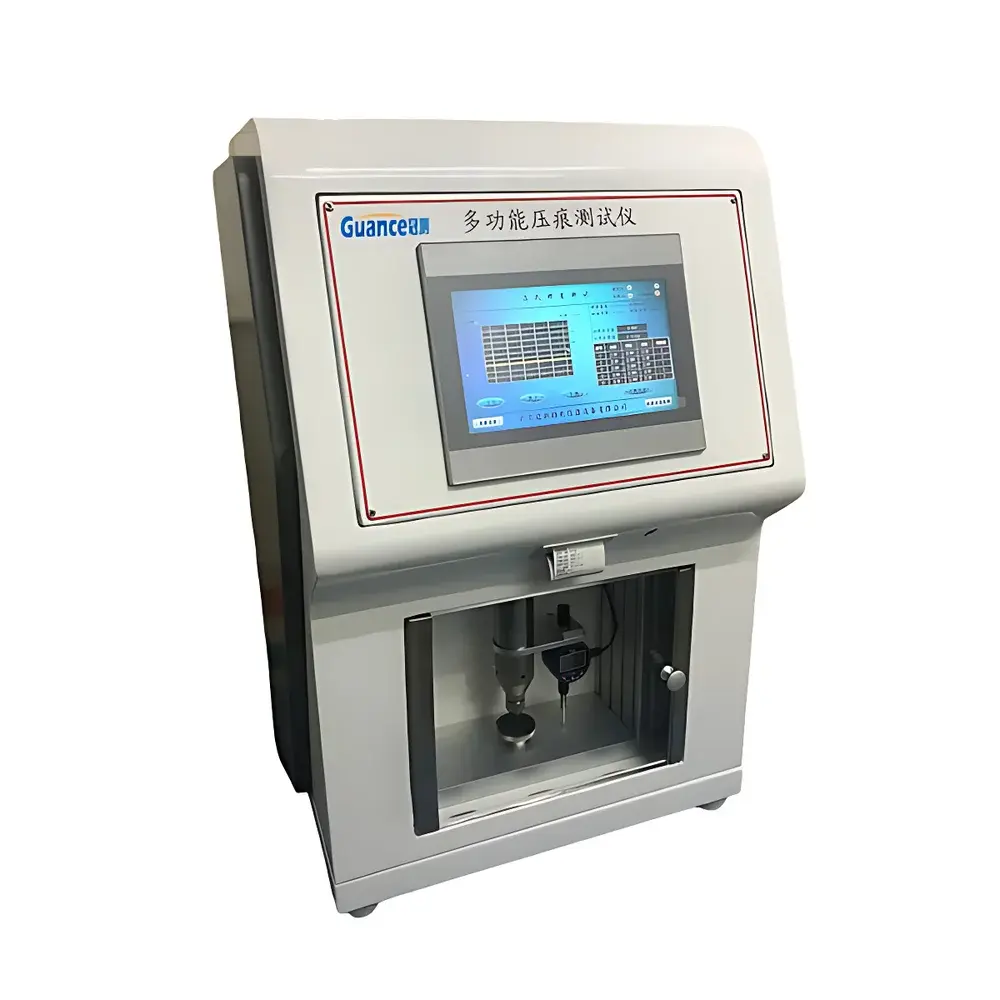
GuanCe Instruments SLQY-96B Plastic Ball Indentation Hardness Tester
| Brand | GuanCe Instruments |
|---|---|
| Origin | Beijing, China |
| Manufacturer Type | Authorized Distributor |
| Country of Origin | China |
| Model | SLQY-96B |
| Instrument Type | Rockwell Hardness Tester |
| Ball Indentation Load | 9.8 N |
| Total Test Forces | 49 N, 132 N, 358 N, 612 N, 961 N |
| Indentation Depth Resolution | 0.001 mm |
| Display Interface | 10-inch capacitive touch screen |
| Data Output | Integrated thermal micro-printer |
| Test Modes | Ball indentation, Rockwell hardness, compression resistance testing |
Overview
The GuanCe Instruments SLQY-96B Plastic Ball Indentation Hardness Tester is a precision-engineered instrument designed for standardized mechanical characterization of thermoplastic and thermosetting polymers under controlled static loading conditions. It operates on the principle of ball indentation hardness measurement as defined in ISO 2039-1 and ASTM D785, where a hardened steel or tungsten carbide ball indenter is applied to the specimen surface under a specified load for a defined dwell time. The resulting permanent indentation depth is measured with high-resolution displacement sensing, and hardness is calculated as the ratio of applied force to the projected spherical cap area. Unlike conventional Rockwell hardness testers optimized for metals, the SLQY-96B integrates calibrated multi-level load capability (49–961 N) and sub-micron depth resolution (0.001 mm), enabling reproducible evaluation of viscoelastic deformation behavior in polymeric materials across varying stiffness ranges—from soft elastomers to rigid engineering plastics.
Key Features
- 10-inch industrial-grade capacitive touch screen interface with intuitive parameter configuration, real-time load monitoring, and step-by-step test guidance.
- High-stability electromechanical loading system with closed-loop force control, ensuring ±1.0% accuracy across all five selectable total test forces (49 N, 132 N, 358 N, 612 N, 961 N).
- Ultra-high-resolution linear variable differential transformer (LVDT)-based displacement sensor, delivering consistent 0.001 mm depth resolution and traceable linearity over full stroke range.
- Automated test sequence: auto-loading, dwell timing (programmable 10–60 s), unloading, depth acquisition, hardness calculation, and automatic indenter retraction to home position—minimizing operator influence and inter-test variability.
- Onboard thermal micro-printer for immediate hard-copy output of test ID, load level, dwell time, measured depth, calculated hardness value (in N/mm²), and timestamp—supporting laboratory documentation requirements.
- Triple-mode operation: dedicated ball indentation mode per ISO 2039-1; Rockwell hardness mode (HRR scale) compliant with ASTM D785 for comparative polymer assessment; and compression resistance mode for evaluating short-term load-bearing performance.
Sample Compatibility & Compliance
The SLQY-96B accommodates flat, parallel-surface specimens with minimum thickness of 4 mm and lateral dimensions ≥ 50 mm × 50 mm. It supports standard test plates, injection-molded bars, extruded sheets, and compression-molded discs. All test procedures align with internationally recognized standards including ISO 2039-1 (Plastics — Determination of indentation hardness by means of a spherical indenter), ASTM D785 (Standard Test Method for Rockwell Hardness of Plastics and Electrical Insulating Materials), and GB/T 3398.1–2018 (Chinese national standard equivalent). The instrument’s mechanical architecture and calibration protocol are compatible with GLP-compliant environments; audit trails, user access levels, and parameter lock functions can be implemented via optional software integration.
Software & Data Management
While the SLQY-96B operates autonomously via its embedded touchscreen controller, it features RS-232 and USB host interfaces for external data export. Raw depth values, applied loads, dwell durations, and computed hardness results are stored in CSV format for post-processing in Excel or statistical analysis platforms (e.g., JMP, Minitab). Optional PC-based software (sold separately) provides extended functionality including test method templates, batch reporting, SPC charting, electronic signature support, and 21 CFR Part 11–compliant audit logging—enabling full traceability from raw measurement to final report in regulated quality systems.
Applications
- Quality control of polypropylene (PP), polyethylene (PE), ABS, polycarbonate (PC), and PVC formulations during incoming raw material inspection.
- Comparative evaluation of plasticizer content, filler dispersion, or crosslink density effects on surface resistance to localized deformation.
- Correlation studies between ball indentation hardness and tensile modulus or creep compliance in R&D laboratories.
- Validation of heat aging, UV exposure, or hydrolytic degradation impacts on near-surface mechanical integrity.
- Supporting ASTM D638 / ISO 527 tensile testing workflows by providing complementary hardness screening prior to destructive mechanical testing.
FAQ
What standards does the SLQY-96B comply with for plastic hardness testing?
It conforms to ISO 2039-1 (ball indentation), ASTM D785 (Rockwell hardness for plastics), and GB/T 3398.1–2018.
Can the instrument be calibrated traceably to national metrology institutes?
Yes—load cells and displacement sensors are supplied with factory calibration certificates traceable to CNAS-accredited standards; annual recalibration services are available.
Is the 0.001 mm depth resolution maintained across the full 0–1.0 mm measurement range?
Yes—the LVDT sensor exhibits linearity error < ±0.1% FS and repeatability ≤ ±0.0005 mm over its operational span.
Does the device support automated pass/fail judgment based on user-defined hardness limits?
Not natively via touchscreen interface; however, this logic can be implemented in the optional PC software using configurable tolerance bands and conditional reporting rules.
What maintenance is required for long-term stability of force and depth measurements?
Annual verification of load cell output and sensor zero drift is recommended; routine cleaning of indenter tip and specimen stage with isopropyl alcohol ensures measurement fidelity.



