
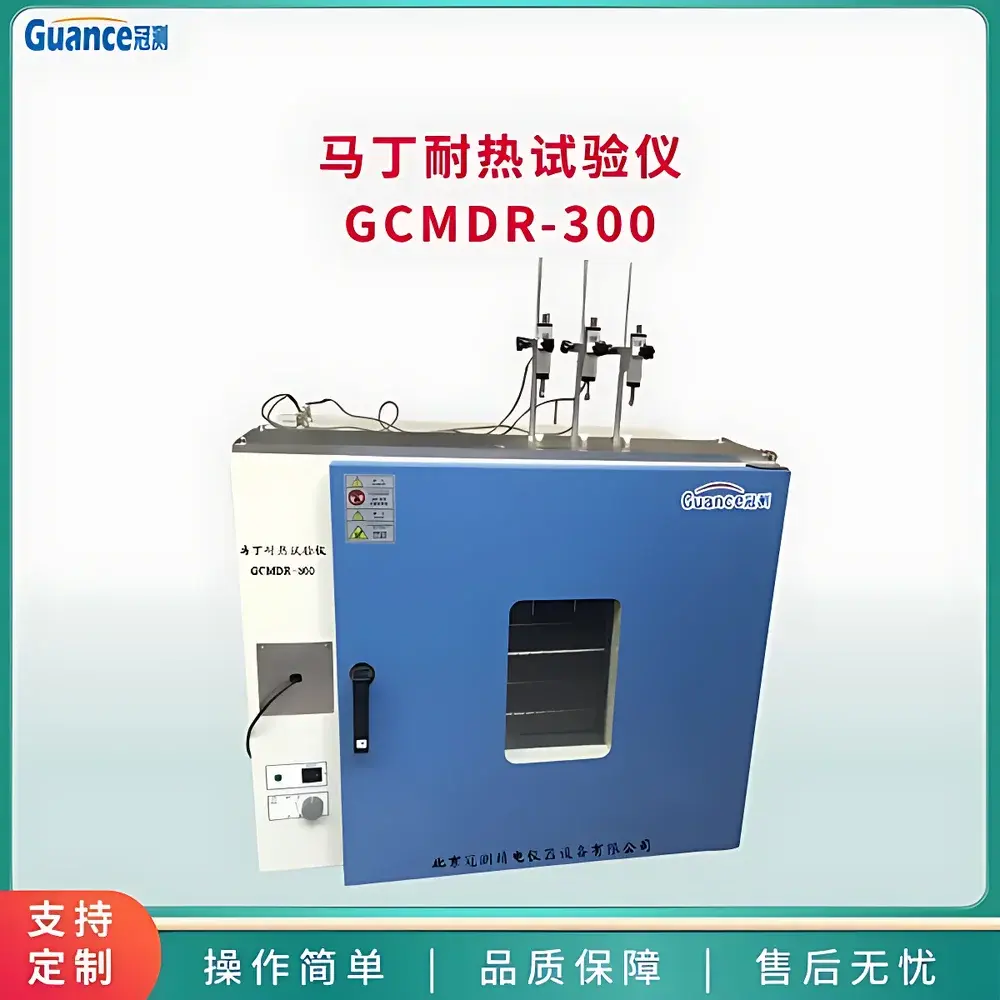


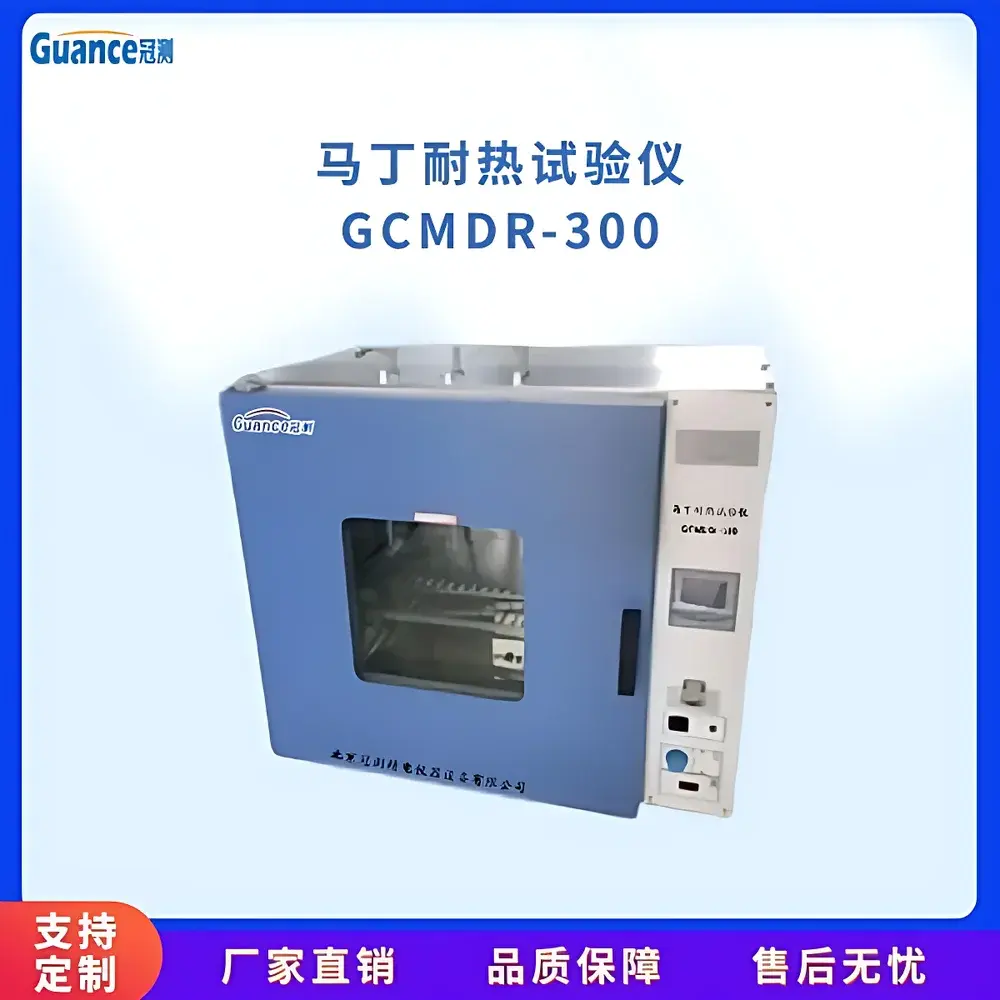
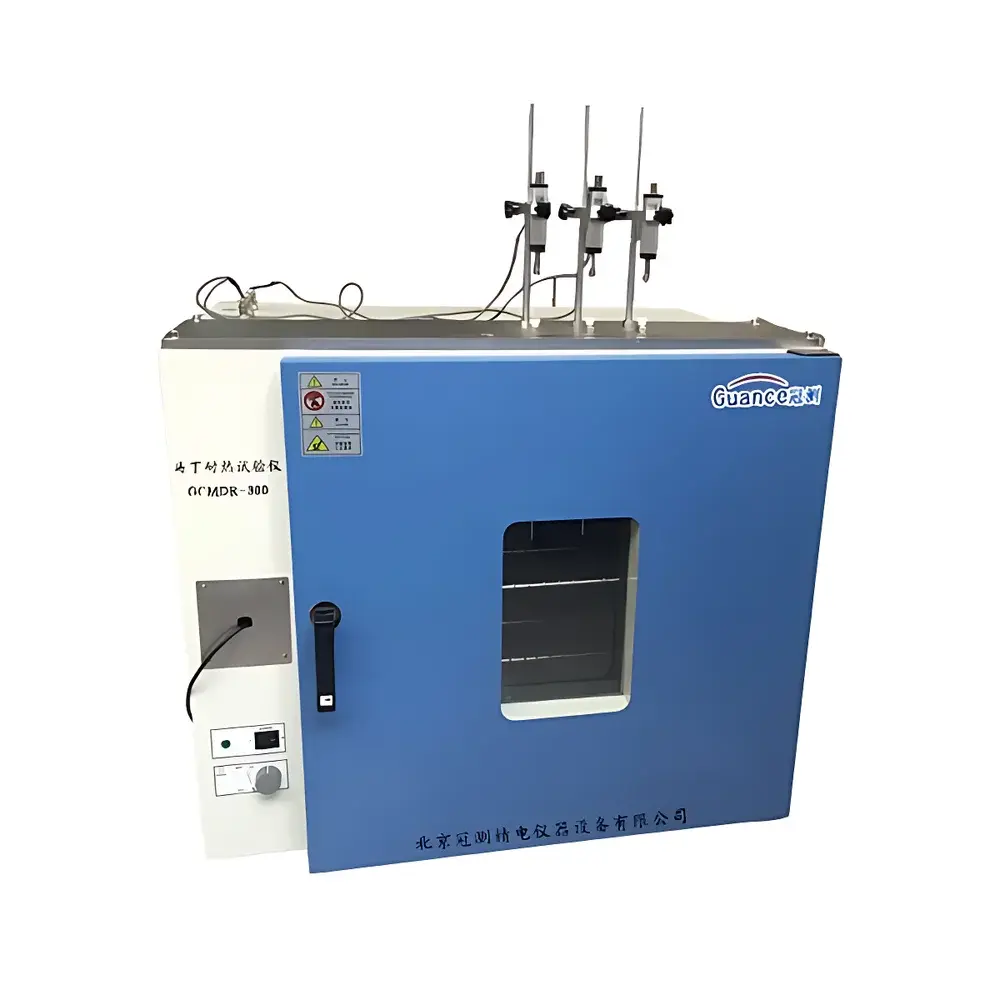
GuanCe Instruments GCMDR-300 Martin Heat Resistance Tester
| Brand | GuanCe Instruments |
|---|---|
| Origin | Beijing, China |
| Manufacturer Type | Authorized Distributor |
| Country of Origin | China |
| Model | GCMDR-300 |
| Price | USD 1,750 (FOB Beijing) |
| Standard Compliance | GB/T 1699–2003, GB/T 1035–1970, HG/T 3847–2008 |
| Temperature Range | RT+10 °C to 300 °C |
| Heating Rate | 50 ±3 °C/h or 10 ±2 °C/12 min |
| Load Stress | 50 ±0.2 kgf/cm² (≈4.90 MPa) |
| Specimen Dimensions | 120 ±2 mm (L) × 15 ±0.2 mm (W) × 10 ±0.2 mm (T) |
| Deflection Threshold | 6 mm |
| Temperature Resolution | ±0.1 °C |
| Thermal Stability | ≤±2 °C |
| Effective Span Length | 56 ±1 mm |
| Data Acquisition | Triple-channel high-precision digital dial indicator (0.001 mm resolution) |
| Control System | LABVIEW-based real-time monitoring & PID temperature regulation |
| Reporting | Exportable test reports in .DOCX and .XLSX formats |
Overview
The GuanCe Instruments GCMDR-300 Martin Heat Resistance Tester is a precision-engineered instrument designed for the standardized determination of the Martin heat resistance temperature (MHRT) of rigid plastics, thermosetting resins, vulcanized rubber, and polymer-based cable compounds. Based on the classical Martin method—defined in GB/T 1699–2003, GB/T 1035–1970, and HG/T 3847–2008—the system applies a constant bending stress of 4.90 MPa (50 ± 0.2 kgf/cm²) to rectangular specimens while subjecting them to a controlled, linear thermal ramp. The MHRT is defined as the temperature at which the specimen deflects by 6 mm under load, providing a reproducible metric for comparative thermal stability assessment in quality control and material development workflows. Unlike differential scanning calorimetry (DSC) or thermomechanical analysis (TMA), the Martin test delivers a practical, application-relevant endpoint tied directly to structural deformation under service-like mechanical constraint.
Key Features
- Triple-channel independent deflection measurement using calibrated digital dial indicators with 1 µm resolution—ensuring high repeatability across parallel specimens.
- LABVIEW-developed control and acquisition software enabling real-time visualization of all three displacement curves; users may toggle individual channels on/off during active testing.
- Automated load calculation and weight positioning logic—reducing operator dependency and minimizing setup error in stress application.
- PID-regulated heating system delivering stable, programmable ramp rates: 50 ± 3 °C/h (standard) or 10 ± 2 °C per 12 minutes (low-rate mode), both traceable to internal platinum RTD feedback.
- Full automation sequence: parameter input → auto-calibration → heating initiation → deflection monitoring → endpoint detection → data archiving—all without manual intervention.
- Comprehensive reporting engine supporting editable templates and direct export to Microsoft Word (.DOCX) and Excel (.XLSX) for audit-ready documentation and cross-departmental data sharing.
Sample Compatibility & Compliance
The GCMDR-300 accommodates standard bar-shaped specimens conforming to national and industry specifications: 120 ± 2 mm length, 15 ± 0.2 mm width, and 10 ± 0.2 mm thickness (specimens >10 mm thick are machined symmetrically to meet tolerance). It supports materials including but not limited to phenolic molding compounds, epoxy laminates, polyamide (PA6/PA66), crosslinked polyethylene (XLPE), chloroprene rubber (CR), and hard rubber formulations. All test procedures align with mandatory requirements for QC laboratories operating under ISO/IEC 17025 accreditation frameworks. While not FDA 21 CFR Part 11–validated out-of-the-box, the software architecture supports electronic signature integration and full audit trail configuration when deployed in GLP/GMP environments with appropriate IT validation protocols.
Software & Data Management
The embedded LABVIEW application provides synchronized acquisition from three independent displacement sensors and one Class A Pt100 temperature probe. Raw data streams—including time-stamped temperature, load position, and real-time deflection—are stored in binary format with metadata headers (operator ID, sample ID, test date, calibration status). The software enforces parameter locking prior to run initiation and logs all user actions—including modifications to setpoints or curve visibility—for traceability. Export functions generate fully formatted reports containing graphical overlays of displacement vs. temperature, annotated MHRT values, pass/fail flags against specification limits, and statistical summaries (n=3 mean ± SD). Data files comply with ASTM E1447–22 recommendations for raw scientific data retention.
Applications
This instrument serves critical roles in R&D labs evaluating thermal performance of new polymer formulations, production QA departments verifying batch-to-batch consistency of molded components, and third-party testing facilities conducting certification tests for construction-grade plastics and electrical insulation materials. Typical use cases include benchmarking heat distortion resistance of automotive interior trim polymers, validating thermal endurance of wire jacketing compounds under IEC 60811–3–1 conditions, and assessing the effect of filler content (e.g., glass fiber, mineral fillers) on the MHRT of engineering thermoplastics. Its robust mechanical design and consistent thermal gradient profile make it suitable for long-term deployment in industrial metrology labs requiring >5 years of uninterrupted operation.
FAQ
What standards does the GCMDR-300 support?
GB/T 1699–2003, GB/T 1035–1970, and HG/T 3847–2008—covering rigid rubber and thermoplastic/thermoset polymer evaluation.
Can the instrument be integrated into a LIMS environment?
Yes—via CSV/Excel export and optional OPC UA or Modbus TCP gateway modules (available as add-ons upon request).
Is calibration certification included with shipment?
A factory-issued calibration report (traceable to CNAS-accredited reference standards) is provided; on-site verification services are available separately.
What maintenance is required for long-term accuracy?
Annual verification of dial indicator linearity and temperature sensor drift is recommended; no consumables or routine part replacement is needed within first 36 months.
Does the system support multi-language UI?
The base software interface is English-only; Chinese-language localization can be enabled via firmware update upon order confirmation.



