
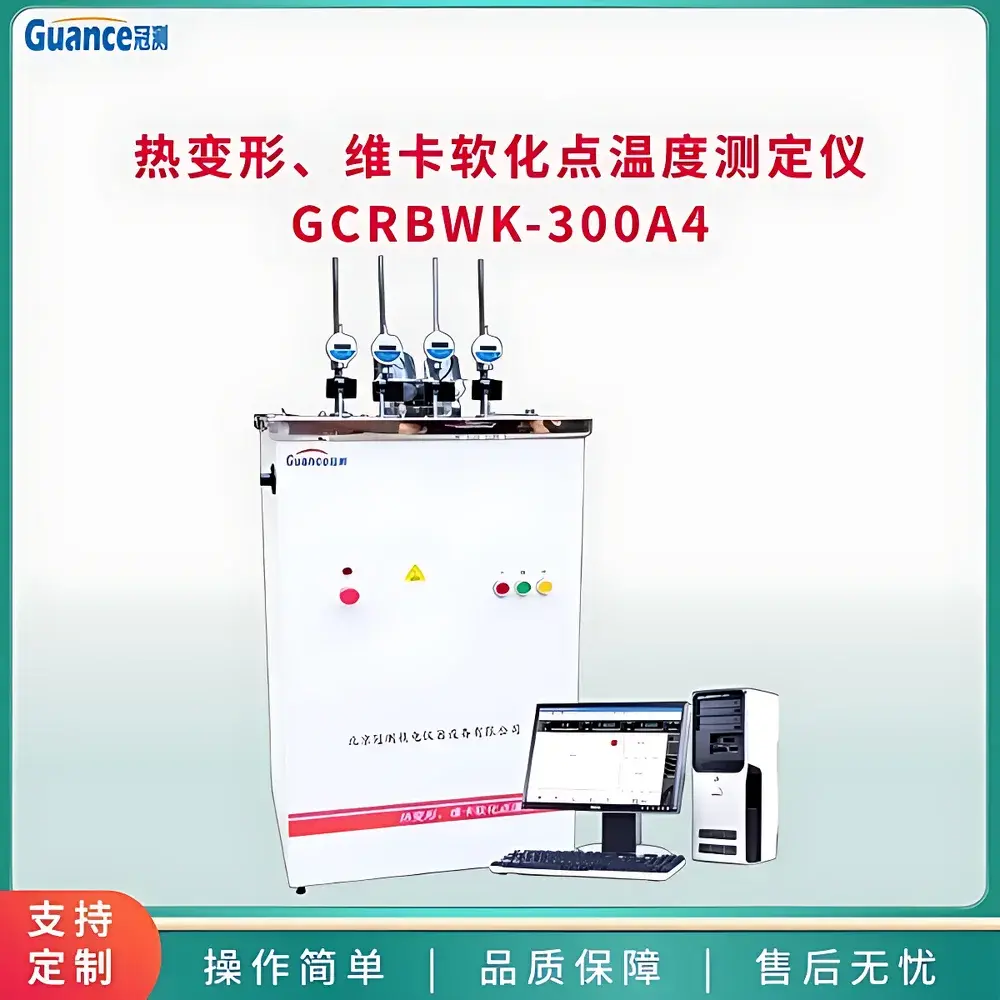
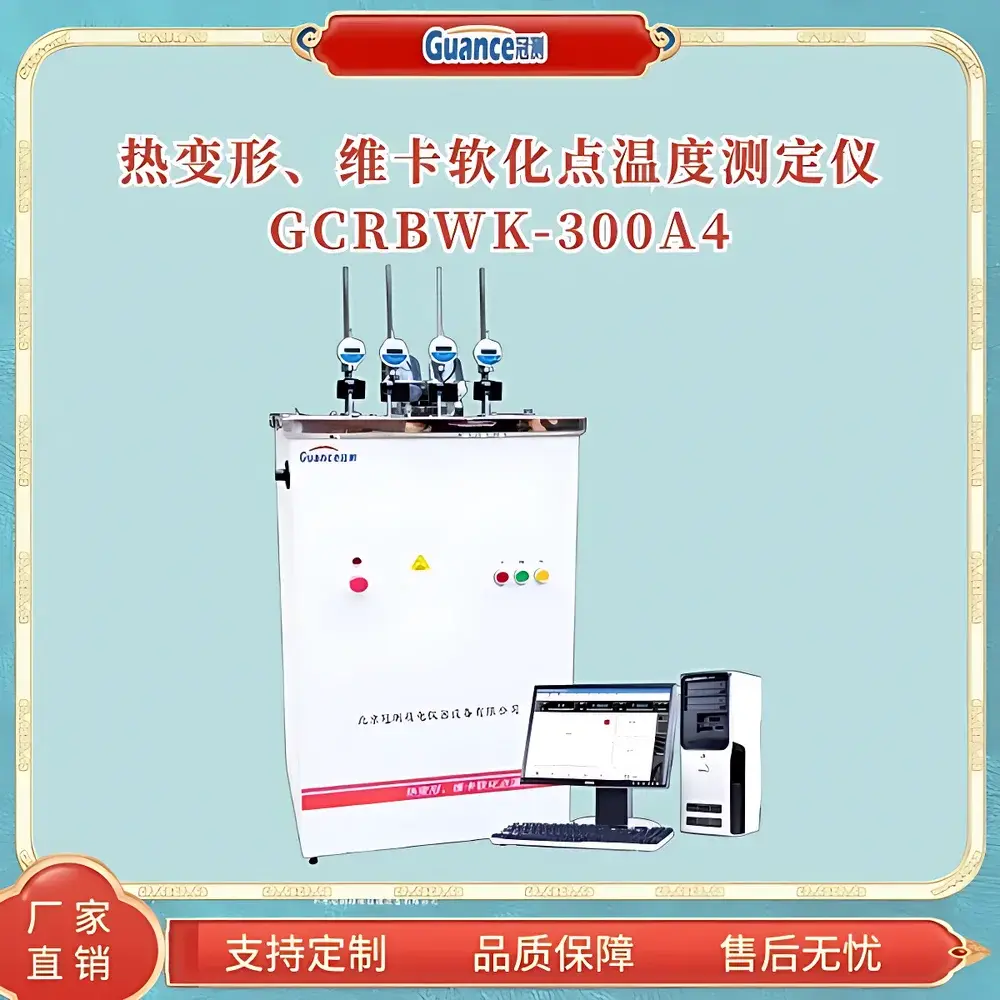
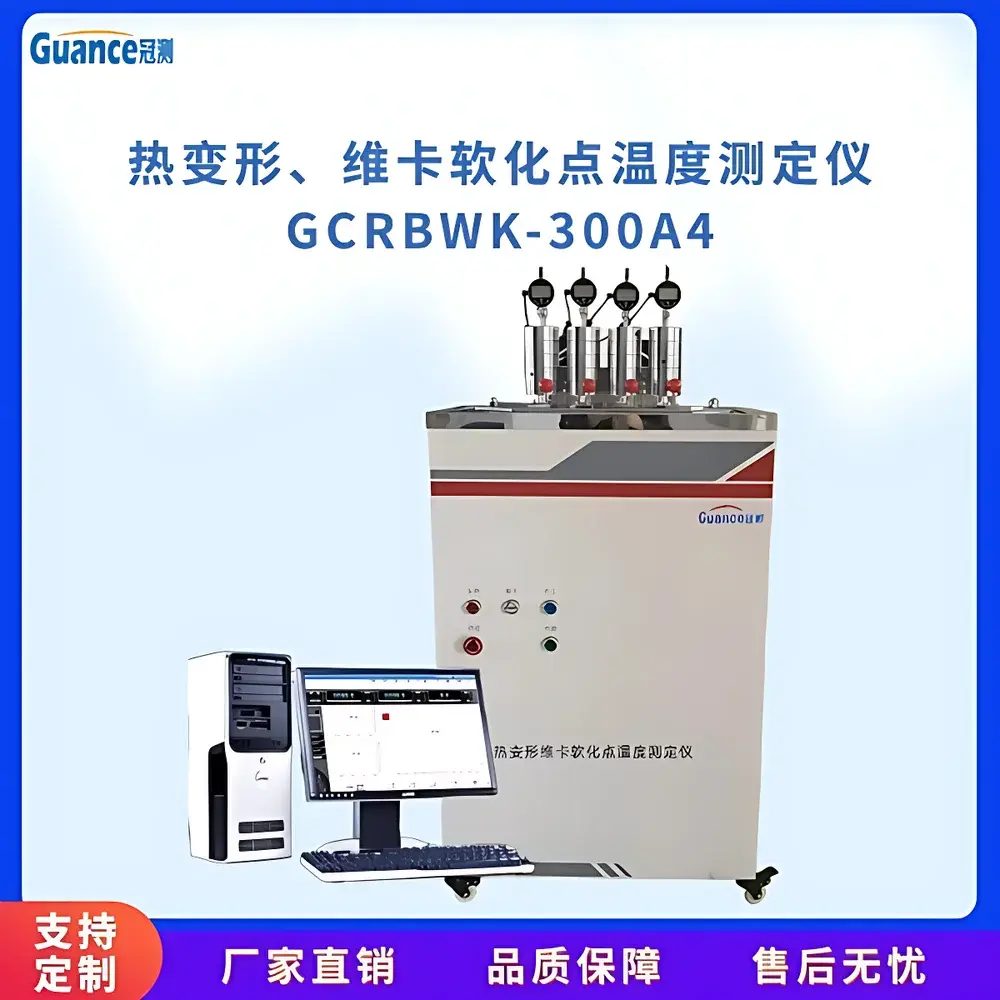

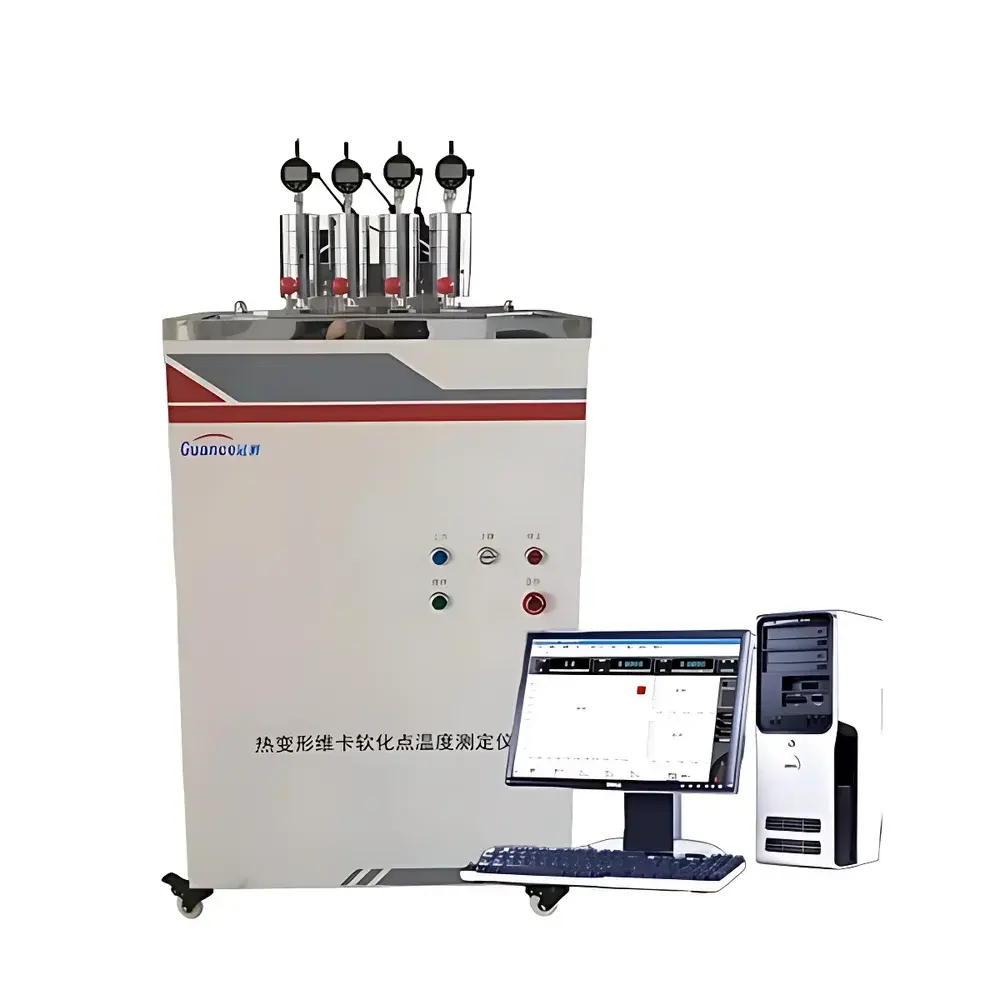
GuanCe GCRBWK-300A4 Heat Deflection Temperature & Vicat Softening Point Tester
| Brand | GuanCe |
|---|---|
| Origin | Beijing, China |
| Model | GCRBWK-300A4 |
| Temperature Range | Ambient to 300 °C |
| Temperature Accuracy | ±0.5 °C |
| Heating Rates | 50 °C/h or 120 °C/h (adjustable between 50–120 °C/h) |
| Temperature Resolution | 0.001 °C |
| Deformation Measurement Range | 0–10 mm |
| Deformation Accuracy | ±0.005 mm |
| Deformation Resolution | 0.001 mm |
| Number of Test Stations | 4 |
| Support Span Options | 64 mm or 100 mm |
| Thermal Expansion Coefficient of Test Frame | <0.005 /100 °C |
| Temperature Sensing Points | 4 |
| Heating Power | 4000 W |
| Bath Medium | Methyl Silicone Oil or Transformer Oil |
| Cooling Method | Natural cooling above 150 °C |
| Control Architecture | Distributed MCU + PC System |
| Safety Protections | Dual hardware/software temperature limit switches, auto-stop on test completion, administrator access control |
Overview
The GuanCe GCRBWK-300A4 Heat Deflection Temperature (HDT) and Vicat Softening Point (VSP) Tester is a precision-engineered thermal analysis instrument designed for standardized determination of thermomechanical transition temperatures in rigid polymeric materials. It operates on two internationally recognized test principles: (1) the heat deflection temperature method per ASTM D648 / ISO 75, where a rectangular specimen is subjected to a specified flexural stress under controlled heating while monitoring lateral deflection; and (2) the Vicat softening point method per ISO 306 / ASTM D1525, where a needle of defined geometry penetrates the material surface under constant load as temperature increases. Both methods rely on precise, synchronized control of thermal ramp rate, mechanical loading, and sub-millimeter displacement measurement—critical for comparative evaluation of dimensional stability, processing suitability, and service temperature limits of thermoplastics, thermosets, reinforced composites, and elastomeric compounds.
Key Features
- Distributed dual-control architecture integrating an embedded MCU for real-time thermal regulation and a Windows-based PC host for data acquisition, visualization, and reporting—ensuring deterministic response and traceable execution.
- Four independent test stations with motorized lift mechanisms, enabling sequential or parallel testing without manual handling, reducing operator exposure to hot bath media and improving throughput consistency.
- High-stability temperature control system featuring PID algorithm with full-optical isolation phase-angle modulation, achieving ramp rate accuracy better than ±0.5 °C/h across the full 50–120 °C/h range and maintaining thermal uniformity across four sensing points within ±0.5 °C.
- Ultra-low thermal expansion test frame (<0.005 /100 °C), fabricated from low-coefficient alloys, minimizing parasitic deformation artifacts during long-duration heating cycles—essential for compliance with ISO 75-2 Annex A requirements for frame calibration.
- High-resolution displacement metrology using four imported capacitive digital indicators (0–10 mm range, 0.001 mm resolution, ±0.005 mm linearity error), directly coupled to standardized Vicat needles and HDT loading bars.
- Redundant safety architecture: dual independent hardware temperature cutoffs (including a certified 30 A Korean thermal switch), software-enforced upper limit logic, automatic termination upon endpoint detection, and role-based administrator authentication for method modification and calibration access.
Sample Compatibility & Compliance
The GCRBWK-300A4 accommodates standard-compliant specimens per ISO 306 (Vicat), ISO 75 (HDT), and ISO 1634 (HDT for laminates). Compatible materials include unreinforced and fiber-reinforced thermoplastics (e.g., ABS, PC, PEEK), thermosetting resins (epoxy, phenolic), rigid elastomers (vulcanized rubber), and high-performance composites (CFRP, GFRP). The instrument supports both 64 mm and 100 mm support spans to meet variant specimen geometries defined in GB/T 1634.2, ISO 75-2, and ASTM D648. It is fully compliant with GB/T 1633 (Vicat), GB/T 8802 (PVC pipe), GB/T 1634 (HDT), ISO 2507 (thermoplastic pipes), ISO 75-1/2/3, ISO 306, ASTM D1525, and ASTM D648. All test sequences are structured to support GLP audit trails, including timestamped parameter logs, user authentication records, and immutable raw displacement/temperature datasets.
Software & Data Management
The proprietary PC software provides real-time synchronized plotting of temperature vs. deformation, with selectable coordinate systems (linear, semi-log, derivative views) for critical inflection point identification. It supports multi-curve overlay for inter-lot comparison, automated pass/fail evaluation against user-defined thresholds, and export of ASCII CSV or PDF reports compliant with internal QA templates. Calibration certificates for displacement sensors and temperature probes are stored digitally with version control. Audit trail functionality meets FDA 21 CFR Part 11 requirements for electronic records, including operator ID logging, parameter change history, and electronic signature capability. Data backups are configurable to network drives or encrypted USB storage, with optional integration into LIMS via OPC UA or TCP/IP socket interface.
Applications
- Quality control of incoming polymer pellets and compounded granules in automotive and electronics supply chains.
- R&D screening of novel biopolymer formulations for thermal stability benchmarking against PET or PP references.
- Regulatory submission support for medical device housings (ISO 10993-12), requiring documented HDT/VSP values under defined load conditions.
- Evaluation of flame-retardant additives’ impact on matrix softening behavior in wire & cable insulation materials.
- Validation of post-cure thermal profiles for aerospace-grade epoxy laminates per Boeing BMS 8-268 or Airbus AITM 1-0005.
- Teaching laboratories for polymer physics courses covering viscoelastic transitions, time–temperature superposition, and structure–property relationships.
FAQ
What standards does the GCRBWK-300A4 fully support for HDT and Vicat testing?
It complies with ISO 75-1/2/3, ISO 306, ASTM D648, ASTM D1525, GB/T 1634, GB/T 1633, GB/T 8802, and ISO 2507—covering both method definition and apparatus verification requirements.
Can the instrument operate with both methyl silicone oil and transformer oil as bath media?
Yes; the system is configured for either medium, with thermal stability validation up to 300 °C using methyl silicone oil (flash point >300 °C) or lower-temperature applications using transformer oil (flash point ~160 °C).
How is thermal uniformity ensured across all four test stations?
Four independently calibrated PT100 sensors monitor bath temperature at spatially distributed locations, feeding real-time feedback to the PID controller; combined with optimized bath circulation design and low-expansion frame construction, this achieves ≤0.5 °C inter-station deviation during steady-state ramping.
Is the deformation measurement traceable to national metrology standards?
Each capacitive indicator is supplied with a factory calibration certificate traceable to NIM (China National Institute of Metrology); users may perform in-house verification using certified gauge blocks per ISO 9276-2 and JJG 379.
Does the system support automated report generation for ISO/IEC 17025 accredited labs?
Yes—the software exports structured XML and PDF outputs containing instrument ID, operator ID, calibration dates, raw data timestamps, environmental conditions, and statistical summaries required for accredited testing documentation.






