
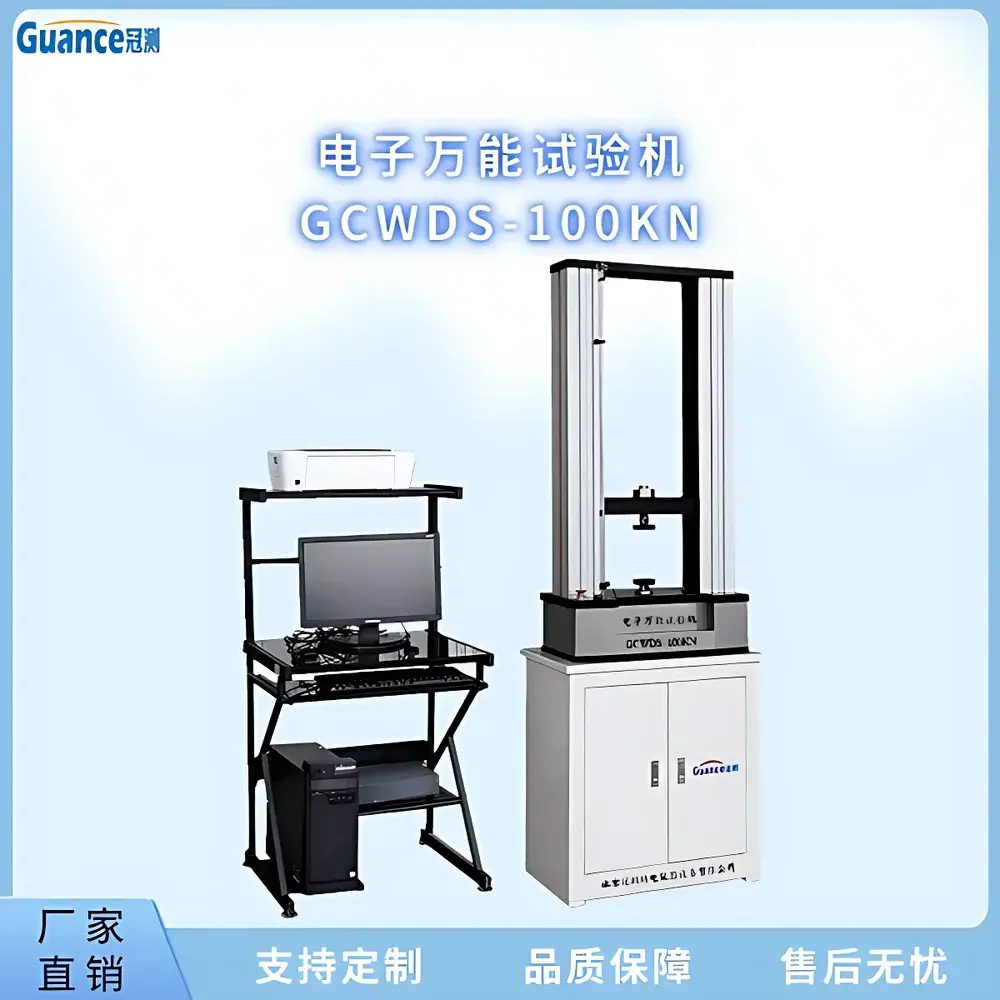
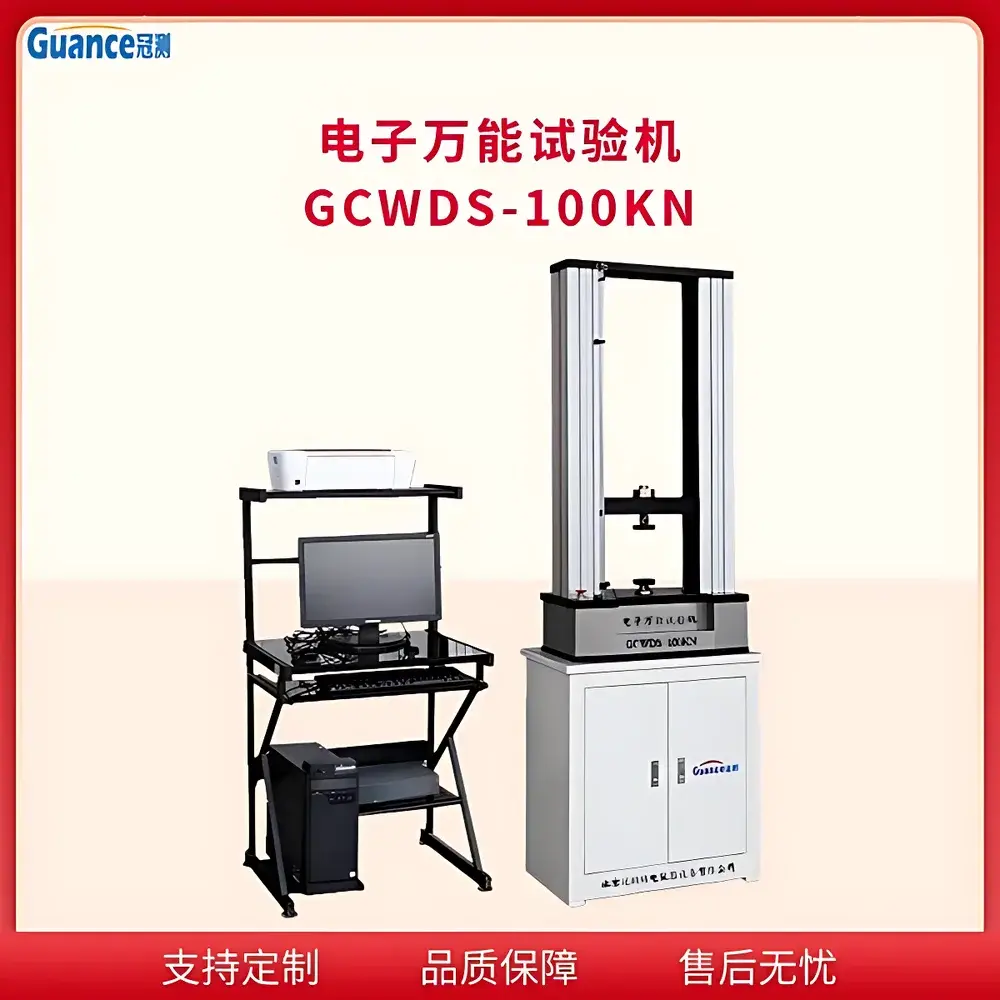
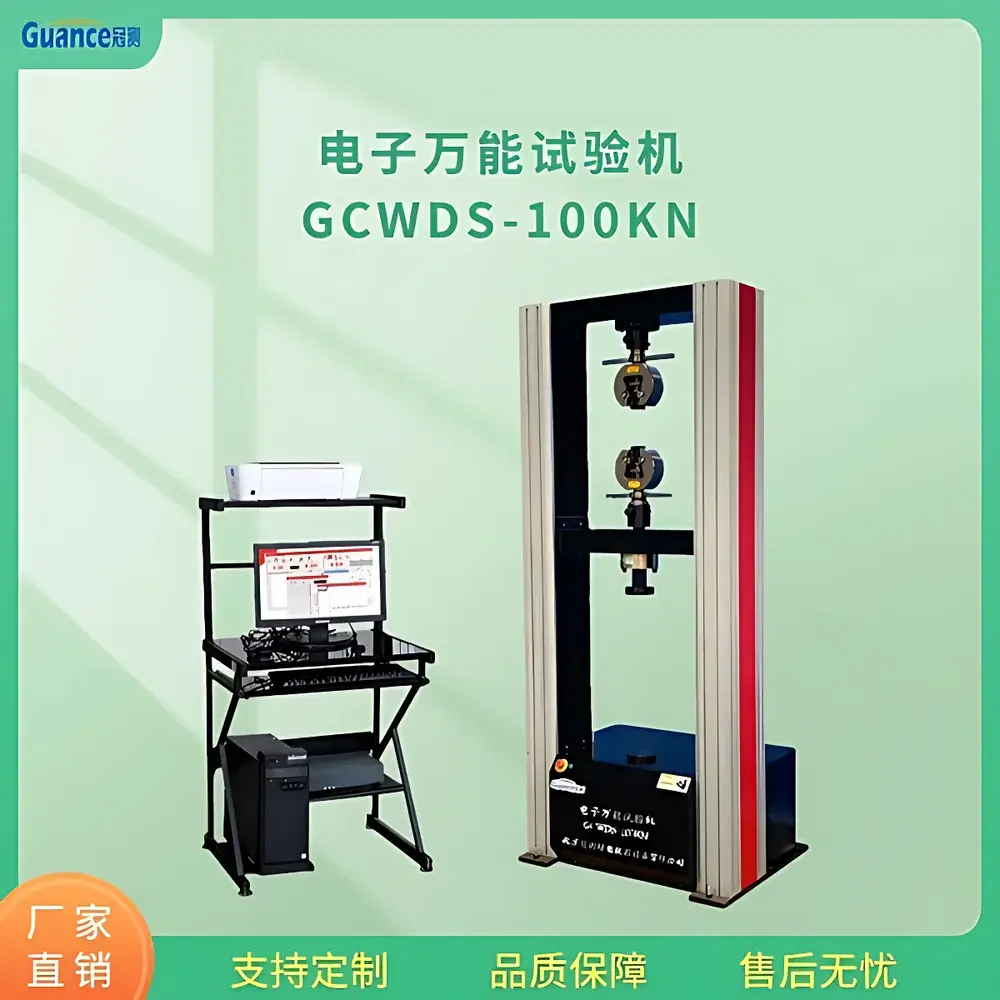
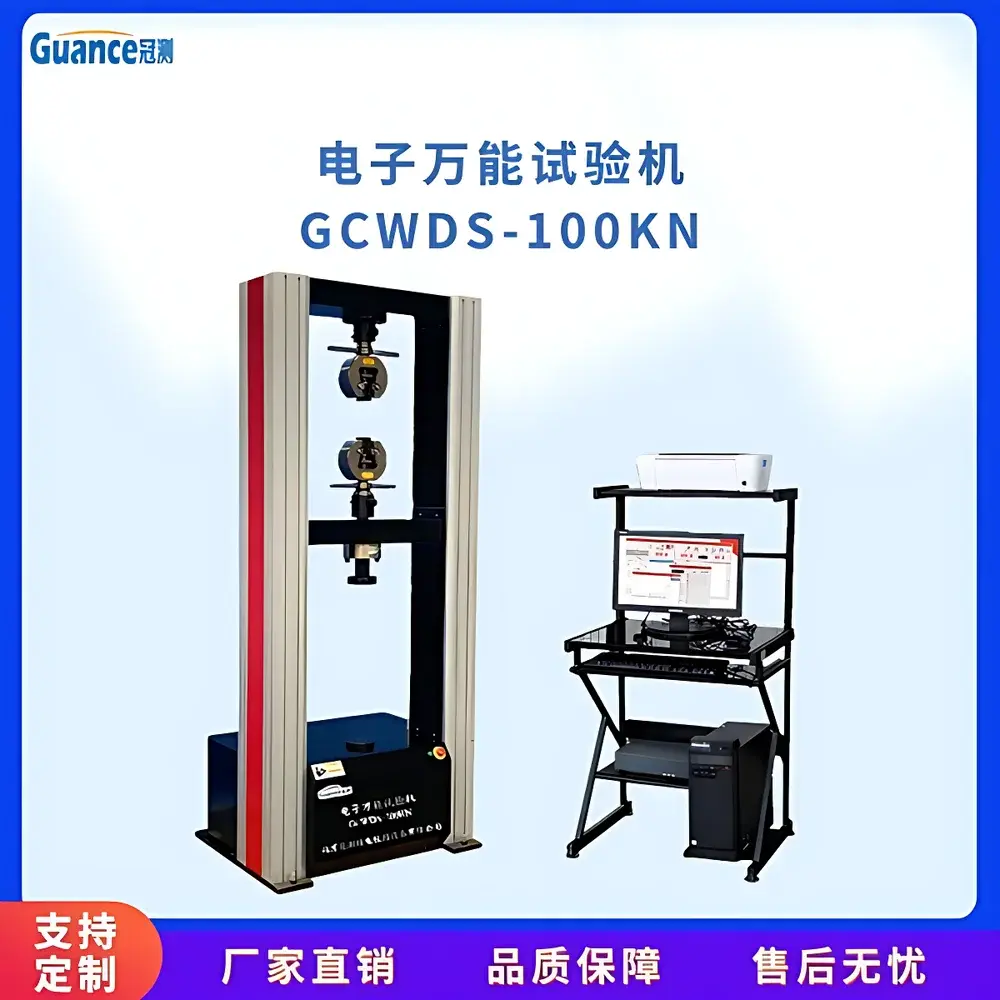
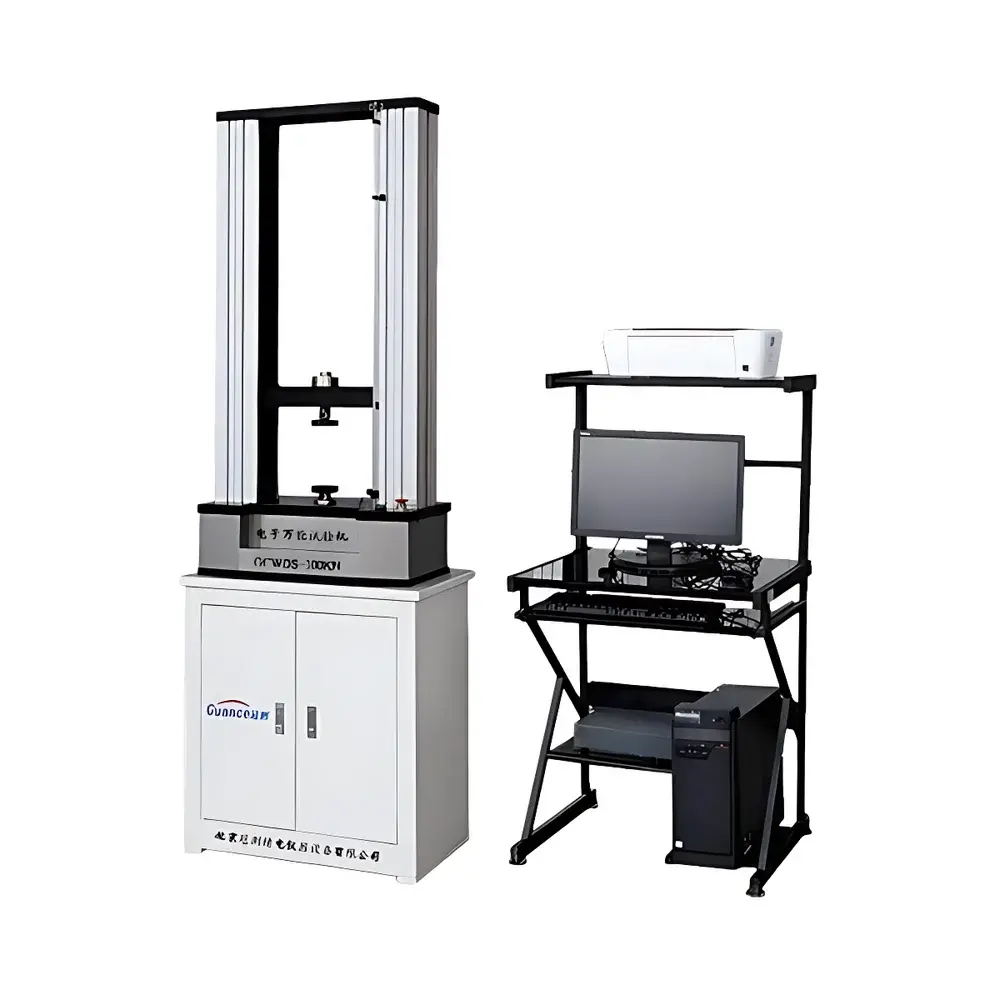
GuanCe GCWDS-100KN Microcomputer-Controlled Electromechanical Universal Testing Machine
| Brand | GuanCe |
|---|---|
| Origin | Beijing, China |
| Manufacturer Type | Authorized Distributor |
| Country of Origin | China |
| Model | GCWDS-100KN |
| Instrument Type | Electromechanical Universal Testing Machine |
| Max. Test Load | 100 kN |
| Accuracy Class | 0.5 |
| Force Measurement Range | 0.2–100% F.S. |
| Force Resolution | 1/300,000 (full-scale, unsegmented) |
| Displacement Rate Range | 0.1–500 mm/min |
| Tensile/Compressive Stroke | 650 mm |
| Test Width | 400 mm |
| Power Supply | AC 220 V, 50 Hz |
| Rated Power | 1.6 kW |
| Operating Environment | 10–40 °C, 20–80% RH |
| Dimensions (W×D×H) | ≈800×650×2000 mm |
| Weight | ≈320 kg |
Overview
The GuanCe GCWDS-100KN is a microcomputer-controlled electromechanical universal testing machine engineered for high-precision static mechanical property evaluation of metallic and non-metallic materials under tension, compression, bending, and shear loading conditions. It operates on the principle of closed-loop servo control: an industrial-grade AC servo motor—driven by a high-fidelity digital speed regulation system—transmits motion through a precision planetary reducer and a backlash-free ground ball screw assembly to actuate the moving crosshead. This architecture ensures exceptional force linearity, positional repeatability, and long-term stability in load application. The system conforms to ISO 7500-1 (static calibration of testing machines), ASTM E4 (load verification), and GB/T 16491–2008 (electronic universal testing machines), supporting traceable metrology in compliance with GLP and GMP laboratory practices. Designed as a dual-space portal frame (upper space for tension, lower space for compression/bending), it delivers structural rigidity exceeding 1.2 × 10⁶ N/mm, minimizing frame deflection during high-load tests and preserving specimen alignment per ISO 5893 requirements.
Key Features
- High-accuracy force measurement using a calibrated U.S.-sourced S-type load cell (Celtron or equivalent), certified to ±0.5% indication error across 0.2–100% full scale, with true digital zeroing and auto-calibration routines embedded in firmware.
- True 1/300,000 full-scale force resolution maintained uniformly across the entire range—no manual range switching required—enabling detection of sub-newton-level deviations during low-force creep or yield onset analysis.
- Bi-directional crosshead displacement control with programmable velocity profiles (0.1–500 mm/min), supporting multi-step ramp-hold sequences compliant with ASTM D638, ISO 527, and GB/T 228.1–2021 test protocols.
- Integrated optical encoder-based extensometer interface (optional) for direct strain measurement, compatible with clip-on and non-contact systems meeting ISO 9513 Class 1 accuracy requirements.
- Robust mechanical architecture featuring imported preloaded ball screws, hardened linear guide columns, and symmetrical load train geometry—validated via finite element analysis to ensure ≤0.02 mm eccentricity at 100 kN load.
- Real-time data acquisition at ≥1 kHz sampling rate, synchronized with position, load, and optional strain channels; all raw data stored in HDF5-compliant binary format for auditability.
Sample Compatibility & Compliance
The GCWDS-100KN accommodates standard tensile specimens (e.g., ASTM E8 rectangular, ISO 6892-1 round), compression cylinders (ASTM C39, ISO 7500-1), three- and four-point bending fixtures (ASTM D790, ISO 178), and shear adapters per ASTM D5379. Fixture compatibility extends to wedge-grip, pneumatic clamp, and hydraulic wedge systems (up to 100 kN clamping force). All software-defined test procedures include built-in validation checks against ISO/IEC 17025 clause 7.7 (method validation) and support electronic signature workflows aligned with FDA 21 CFR Part 11 Annex 11 requirements. Calibration certificates are issued with NIST-traceable references and uncertainty budgets per ISO/IEC 17025:2017.
Software & Data Management
Control and analysis are executed via GuanCe’s proprietary Windows 10–compatible software suite, developed using .NET Framework and SQLite database architecture. The interface provides real-time visualization of stress–strain, force–displacement, and time-based curves with customizable axes, grid overlays, and dynamic scaling. Data export supports CSV, XML, PDF, and Excel formats; report templates comply with ISO 14289-1 (PDF/A-2u) for archival integrity. Audit trails record user actions—including method edits, calibration events, and result approvals—with immutable timestamps and operator IDs. Software modules include automatic yield point detection (Rp0.2, ReH/ReL per ISO 6892-1), modulus calculation (tangent/secant), fracture toughness estimation (J-integral approximation), and statistical batch analysis (mean, SD, CV%, confidence intervals).
Applications
This system serves quality assurance laboratories in steel mills (GB/T 228.1–2021 tensile certification), aerospace component suppliers (AMS 2300 fatigue pre-screening), battery material R&D (electrode foil tensile strength per IEC 62660-2), polymer compounders (ISO 527 modulus mapping), and academic mechanics labs conducting constitutive modeling. Its dual-space configuration enables concurrent development of compression yield criteria for aluminum alloys (ASTM B557) and flexural performance of fiber-reinforced composites (ASTM D7264). Regulatory submissions supported include CE technical files, FDA IDE documentation, and CNAS-accredited test reports.
FAQ
Does the GCWDS-100KN support third-party transducer integration?
Yes—via IEEE 1451.4 TEDS-compliant analog input channels (±10 V, 24-bit ADC) and digital I/O for external extensometers, environmental chambers, or acoustic emission sensors.
Is the software validated for regulated environments?
The software includes IQ/OQ documentation packages, electronic signature capability, and 21 CFR Part 11-compliant audit trail generation—available upon request with installation qualification support.
What maintenance intervals are recommended?
Ball screw lubrication every 1,000 hours; load cell recalibration annually or after 50,000 cycles; full system verification per ISO 7500-1 every 12 months by accredited service provider.
Can test methods be exported/imported between instruments?
Yes—XML-based method files preserve all parameters, tolerances, and pass/fail logic, enabling seamless transfer across GCWDS-series machines in multi-site networks.
Is remote diagnostics supported?
Standard Ethernet connectivity enables secure remote access via TLS-encrypted VNC sessions for troubleshooting, firmware updates, and real-time parameter adjustment under IT department policy approval.



