
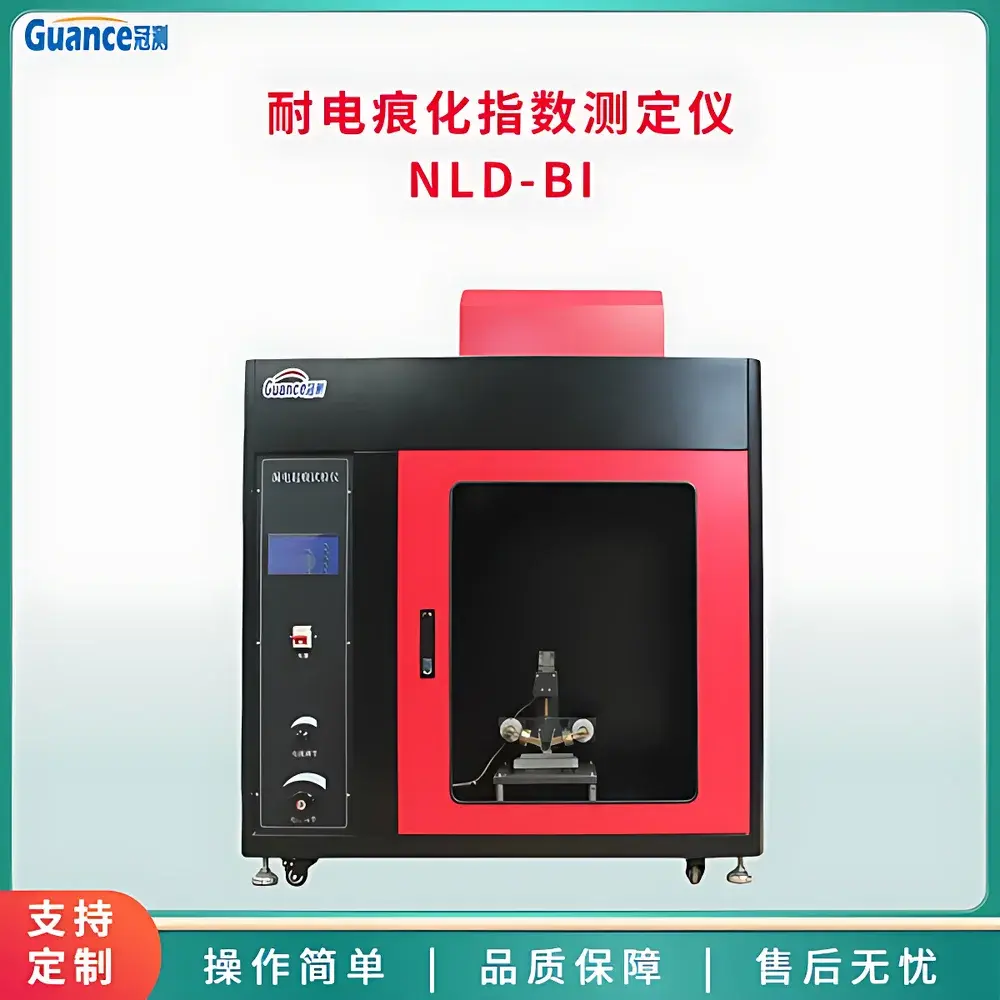
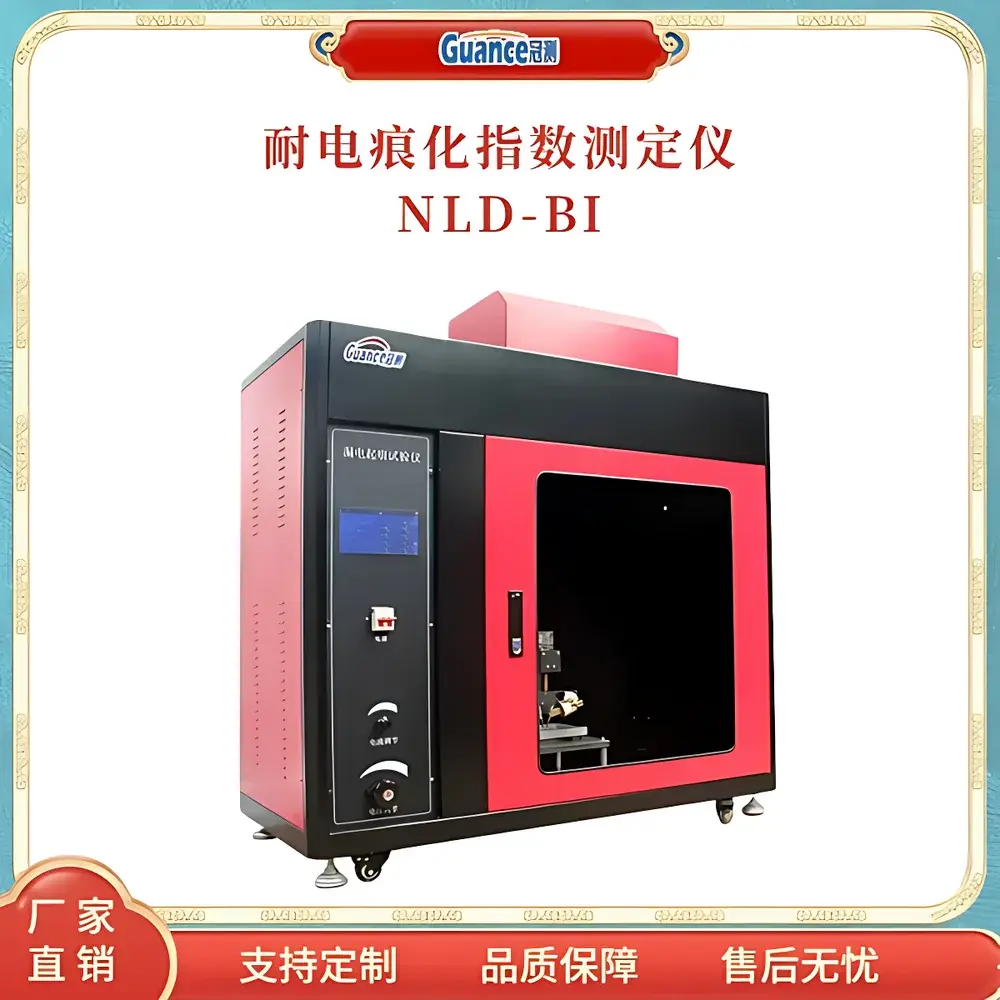
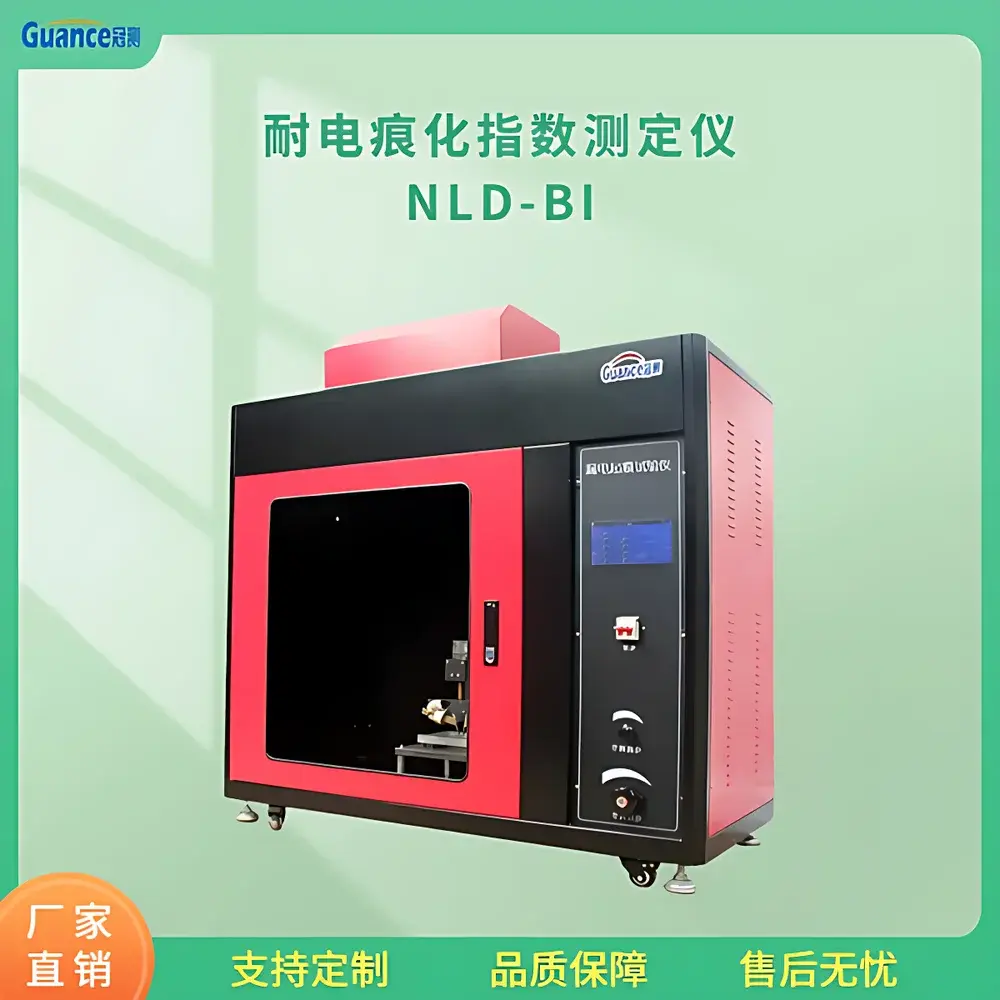
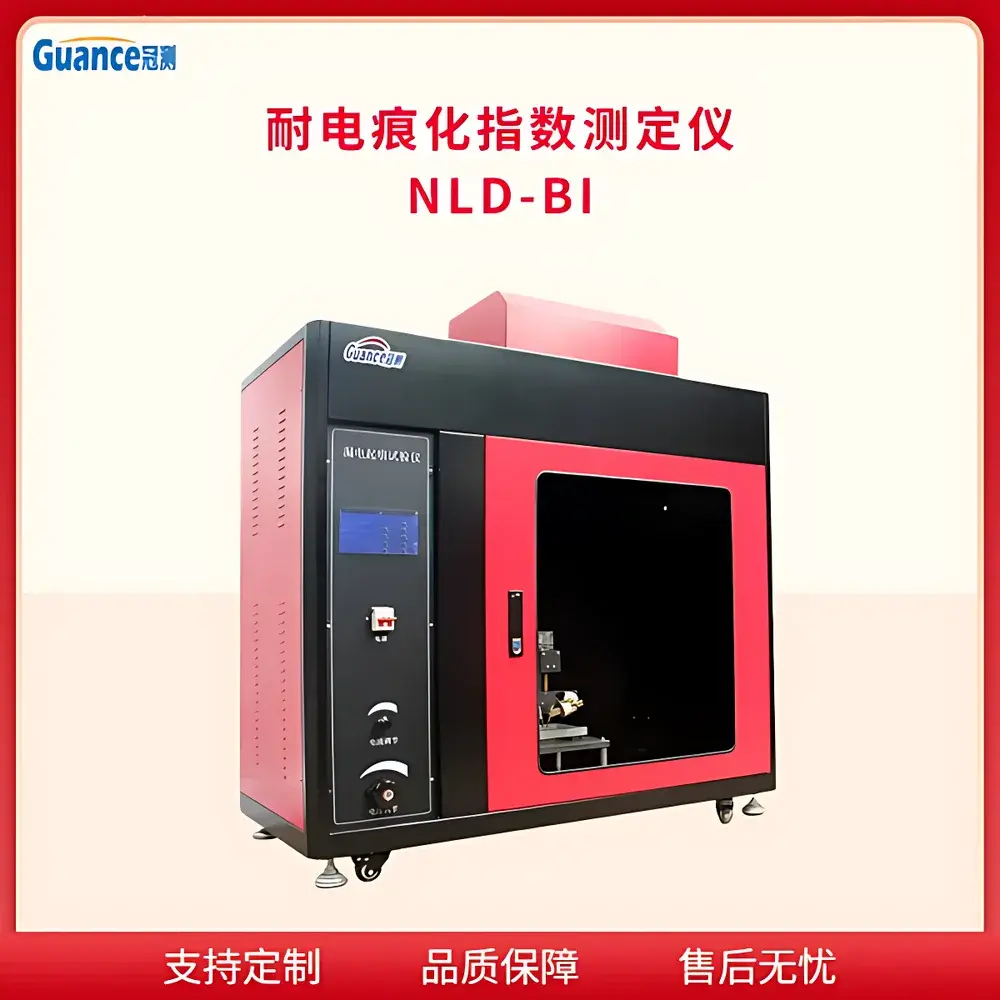
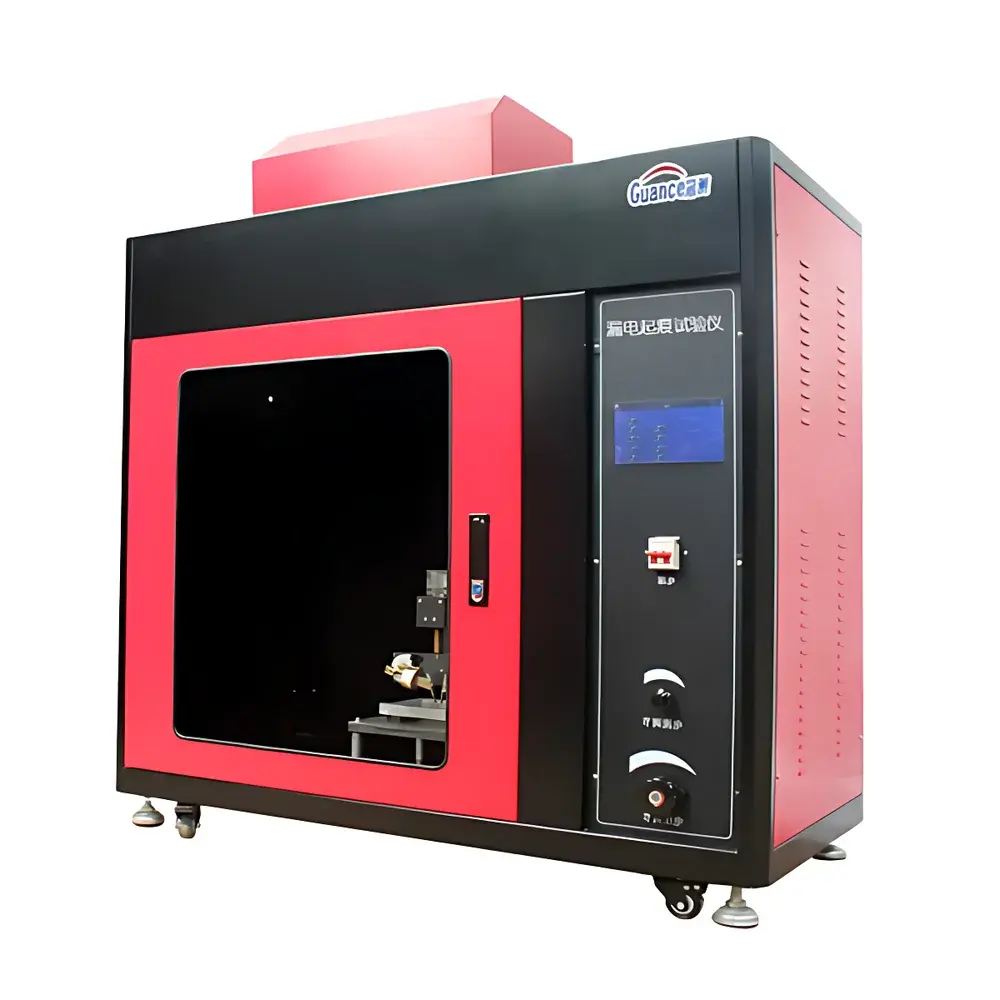
Guance NLD-BI4 Touchscreen Comparative Tracking Index (CTI) and Proof Tracking Index (PTI) Tester
| Brand | Guance Instruments |
|---|---|
| Origin | Beijing, China |
| Manufacturer Type | Authorized Distributor |
| Product Category | Domestic |
| Model | NLD-BI4 |
| Instrument Type | Electronic Universal Testing Machine |
| Test Voltage Range | 100–600 V AC (48–60 Hz) |
| Electrode Material | Platinum (99% purity) / Copper electrode holder |
| Electrode Dimensions | (2.0 ± 0.1) mm × (5.0 ± 0.1) mm × (40 ± 5) mm |
| Tip | 12 mm long, 30° ± 2° bevel |
| Electrode Spacing | 4.00 ± 0.01 mm, included angle 60° ± 5° |
| Electrode Force | 1.00 ± 0.01 N |
| Test Solution Resistivity | Solution A: 0.1% NH₄Cl, 3.95 ± 0.05 Ω·m |
| Solution B | 1.98 ± 0.05 Ω·m |
| Droplet Height | 35 ± 5 mm (adjustable) |
| Droplet Interval | 30.00 ± 0.01 s (digital display, presettable) |
| 50-droplet duration | 24.5 ± 2 min |
| Droplet Count Range | 1–9999 (digital, presettable) |
| Airflow Velocity | 0.2 m/s (per IEC 60695-11-5) |
| Short-Circuit Current Threshold | 0.50 A ± 10%, hold time 2.00 s ± 10% |
| Voltage Drop Limit | ≤8% at 1.0 A ± 0.1 A |
| Power Supply | 220 V, 0.6 kVA, 50–60 Hz |
| Ambient Conditions | 0–40 °C, RH ≤80%, non-corrosive, low-vibration environment |
| Combustion Chamber Volume | >0.5 m³ (approx. 900 × 590 × 1050 mm), black background, illuminance ≤20 lux |
| Exhaust Port Diameter | Ø100 mm |
| Overall Dimensions (W×D×H) | 1160 × 600 × 1310 mm (incl. leveling feet) |
Overview
The Guance NLD-BI4 Touchscreen Comparative Tracking Index (CTI) and Proof Tracking Index (PTI) Tester is an engineered solution for evaluating the surface resistance of solid electrical insulating materials to electrochemical degradation under high-voltage stress in the presence of conductive electrolyte contamination. Based on the principle of controlled electrolytic tracking—where discrete droplets of standardized ammonium chloride solution bridge two platinum electrodes mounted on a specimen surface—the instrument quantifies material performance by determining either the highest voltage at which no tracking occurs after 50 droplets (CTI), or the lowest voltage at which tracking initiates within 50 droplets (PTI). This test method directly simulates real-world failure modes observed in outdoor insulators, PCB substrates, terminal blocks, and housing components exposed to humidity, dust, and ionic pollutants. The NLD-BI4 complies with the core physical measurement architecture defined in IEC 60695-11-5 and GB/T 4207–2003, ensuring traceable, repeatable assessment of comparative tracking behavior across laboratories and production QA environments.
Key Features
- Integrated 7-inch full-color industrial touchscreen HMI paired with a certified PLC control system for deterministic sequencing, eliminating manual intervention during voltage ramping, droplet timing, and safety interlock monitoring.
- Real-time digital display of critical operational parameters: applied voltage (100–600 V, 25 V increments), droplet count (1–9999), elapsed time per droplet (30.00 ± 0.01 s), leakage current, chamber airflow velocity (0.2 m/s), door status, and pass/fail verdict based on IEC-defined short-circuit criteria (0.50 A ±10% for ≥2.00 s).
- Precision-machined platinum electrodes (99% purity) with geometrically controlled 30° ±2° bevel and fixed 4.00 ±0.01 mm spacing—ensuring compliance with electrode dimensional tolerances mandated by IEC 60695-11-5 Annex A.
- Dedicated low-noise, anti-backflow exhaust system (Ø100 mm port) with post-test auto-activation, effectively removing combustion byproducts while maintaining laminar airflow stability during active testing.
- Self-contained data logging: all test sequences—including voltage profile, droplet timestamps, current transients, and final classification—are stored internally on the HMI’s non-volatile memory for later export via USB without external PC dependency.
- Optimized combustion chamber design (>0.5 m³ volume, matte black interior, ≤20 lux ambient illumination) meets optical contrast requirements for unambiguous visual detection of carbonized tracking paths per Clause 8.3 of GB/T 4207.
Sample Compatibility & Compliance
The NLD-BI4 accommodates flat, rigid specimens up to 130 mm × 130 mm × 12 mm thick, including thermosets (e.g., epoxy, phenolic), thermoplastics (e.g., PBT, PA66), filled composites, and ceramic-polymer hybrids. Specimen mounting fixtures apply consistent 1.00 ± 0.01 N electrode pressure via calibrated spring mechanisms, minimizing variability from mechanical preload. All fluid handling components—including droplet nozzle, reservoir, and tubing—are chemically inert to NH₄Cl solutions. The system satisfies functional safety requirements outlined in IEC 61010-1 for laboratory electrical equipment, with reinforced insulation, redundant overcurrent cutoff (0.5 A/2 s), and interlocked access door monitoring. Calibration documentation supports ISO/IEC 17025 traceability when used with certified reference standards (e.g., NIST-traceable multimeters, precision resistivity cells).
Software & Data Management
No proprietary PC software is required: test configuration, execution, and result review occur entirely on the embedded HMI. Users configure voltage level, droplet count limit, and solution type (A or B) via intuitive menus. Each test generates a timestamped record containing raw voltage/current waveforms sampled at 100 Hz, droplet event log with microsecond resolution, and operator-annotated notes. Data exports as CSV files compatible with LIMS integration or statistical process control (SPC) platforms. Audit trails comply with GLP principles—modifications to test parameters require dual-password authentication, and all changes are logged with user ID and timestamp. While not FDA 21 CFR Part 11-certified out-of-the-box, the system’s deterministic firmware architecture and immutable internal storage provide a foundation for validation under GMP-regulated environments.
Applications
- Qualification of polymer formulations for high-voltage connectors and switchgear housings per IEC 60695-11-10.
- Comparative screening of flame-retardant additives (e.g., alumina trihydrate, phosphinates) on tracking resistance in polyamide and polyester matrices.
- Failure analysis of field-failed insulators where dendritic carbonization suggests electrochemical tracking rather than pure thermal degradation.
- Production line verification of batch-to-batch consistency in CTI/PTI values for UL 746A recognition.
- Research into nanofiller dispersion effects (e.g., SiO₂, Mg(OH)₂) on surface conductivity pathways under humid, contaminated conditions.
FAQ
What standards does the NLD-BI4 fully support?
The instrument implements all mandatory hardware and procedural requirements of IEC 60695-11-5 (2020), IEC 60695-11-10 (2011), and GB/T 4207–2003, including electrode geometry, droplet timing accuracy, airflow control, and pass/fail logic.
Can the system test both CTI and PTI in a single setup?
Yes—CTI is determined by incrementally increasing voltage until tracking occurs within 50 drops; PTI is assessed by applying a fixed voltage (e.g., 250 V) and recording whether tracking initiates before 50 drops. Both protocols use identical electrode alignment and solution delivery.
Is calibration certification provided with shipment?
Each unit ships with a factory verification report confirming electrode spacing, droplet interval accuracy, voltage output linearity, and short-circuit response time against traceable references. Third-party calibration services are available upon request.
How is specimen conditioning handled prior to testing?
Per IEC 60695-11-5 Clause 6.2, specimens must be conditioned at 23 °C ± 2 °C and 50% ± 5% RH for ≥48 h. The NLD-BI4 does not include environmental conditioning; users must perform this externally using accredited climate chambers.
What maintenance is required for long-term repeatability?
Platinum electrodes require periodic cleaning with analytical-grade ethanol and inspection under 10× magnification for pitting or residue buildup. The droplet nozzle should be flushed weekly with deionized water. Annual verification of force sensor calibration and voltage divider accuracy is recommended.



