

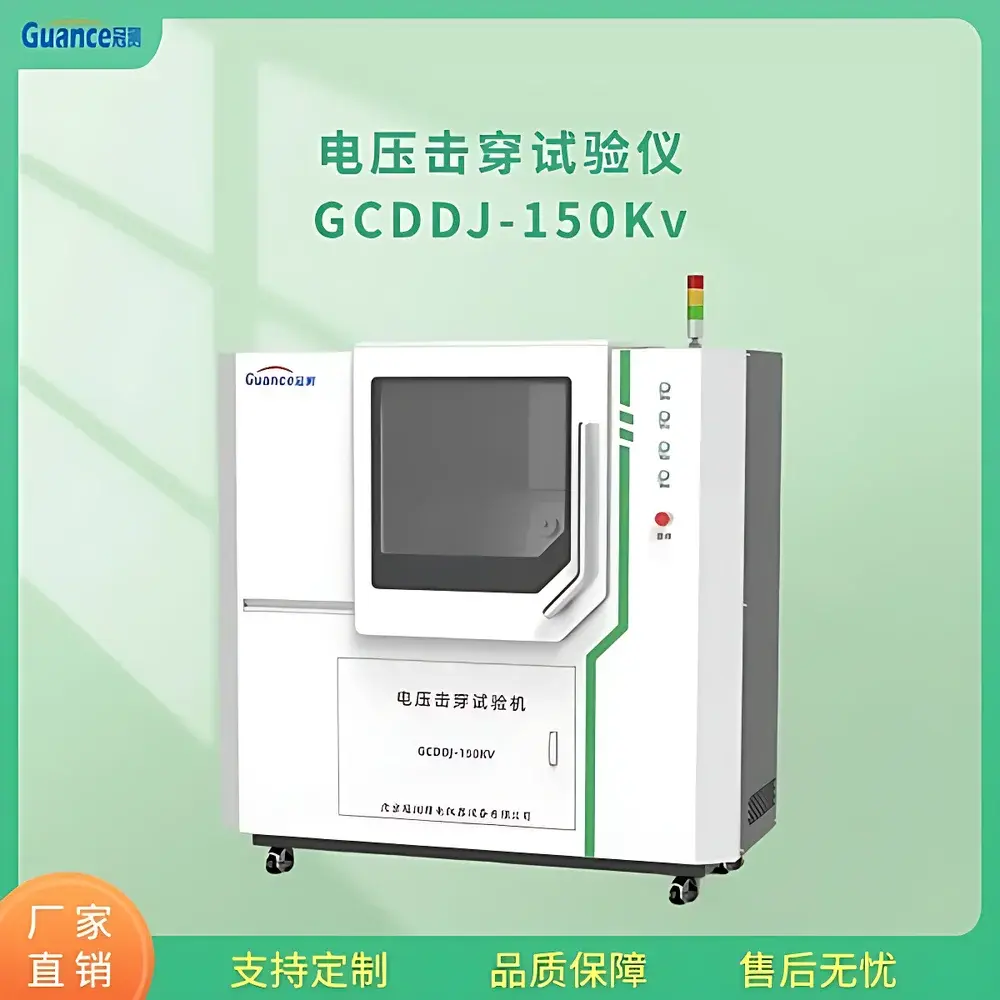
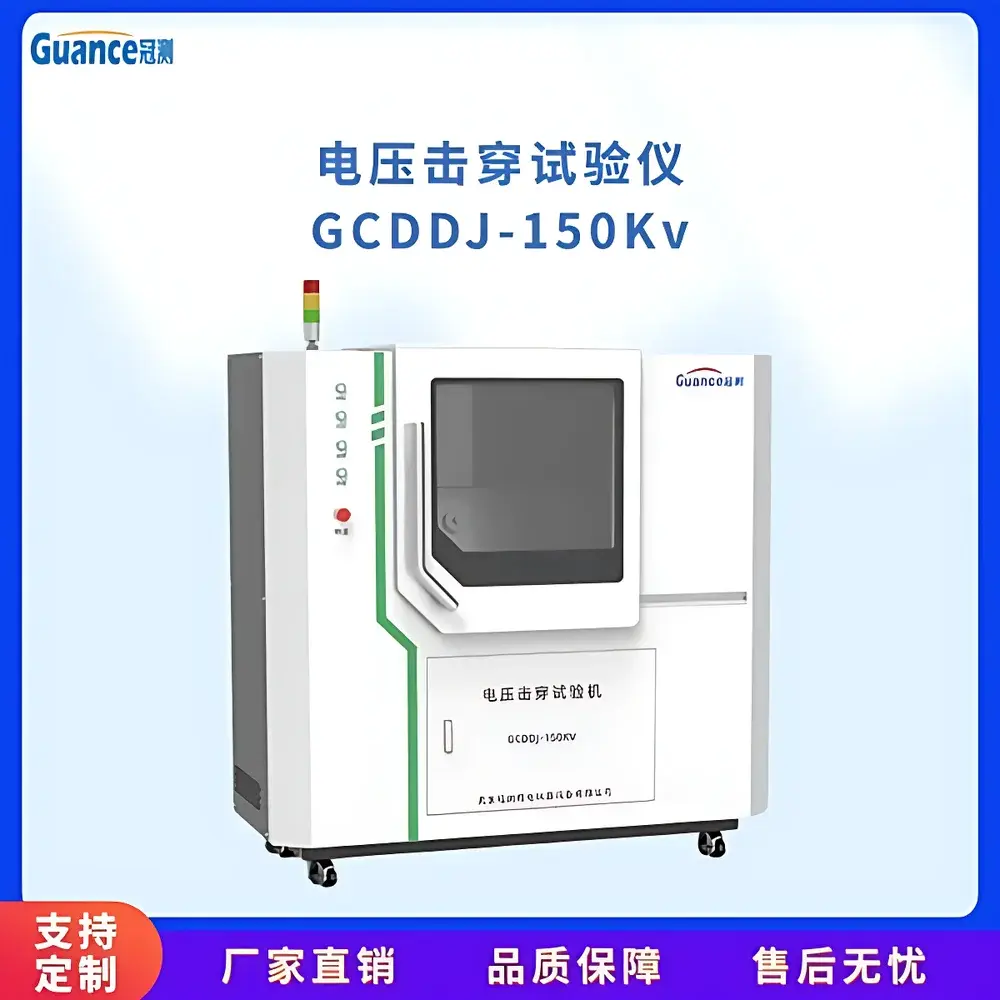
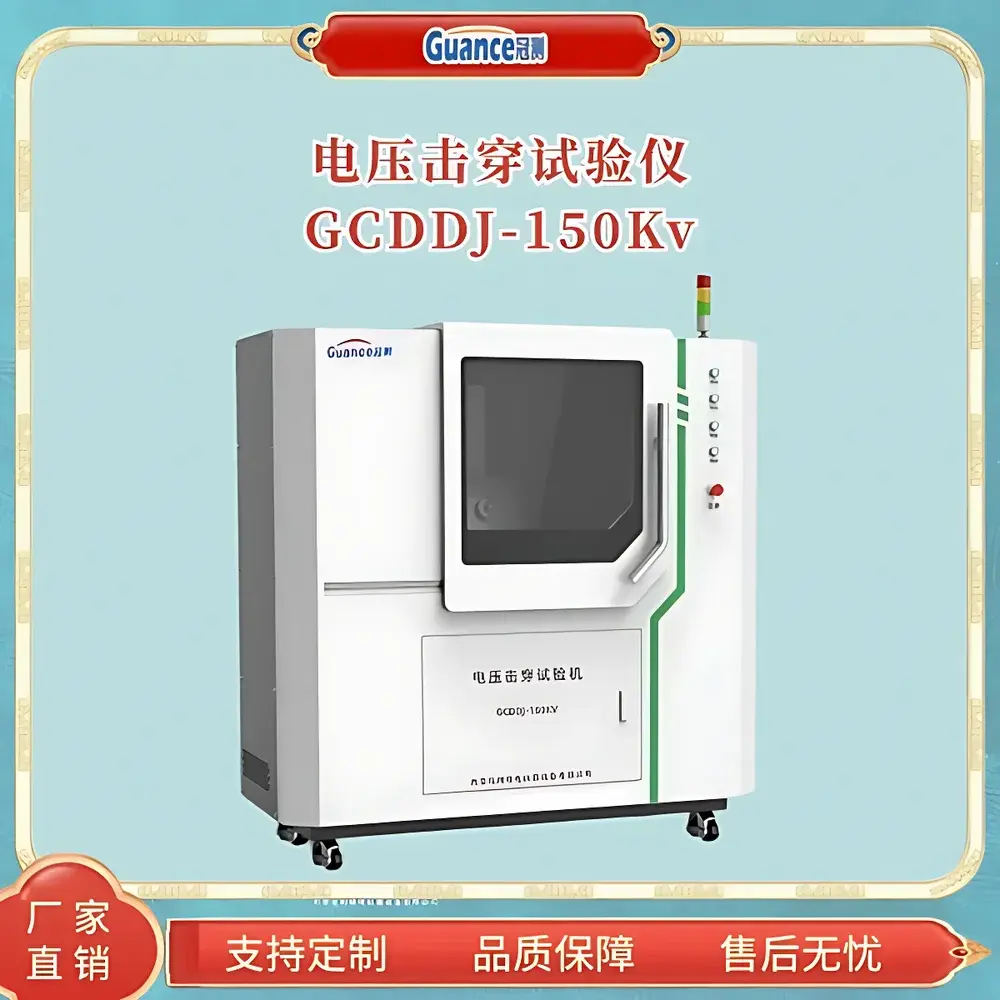
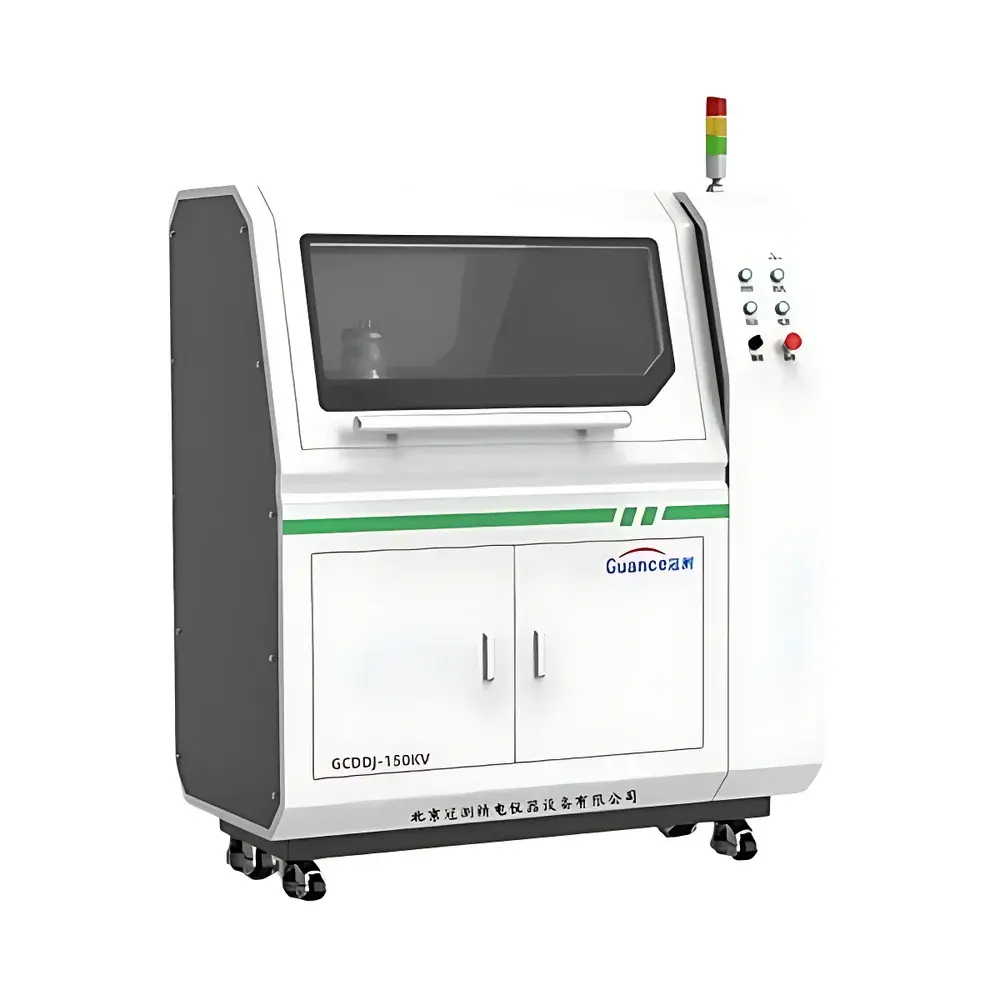
GuanCe Instruments GCDDJ-150kV Dielectric Breakdown Tester for Plastic Films
| Brand | GuanCe Instruments |
|---|---|
| Origin | Beijing, China |
| Model | GCDDJ-150kV |
| Breakdown Voltage Range | 0–150 kV (AC/DC) |
| Compliance | GB/T 1408.1–2006, GB/T 1695–2005, GB/T 3333–1999, GB/T 12656–1990, HG/T 3330–1978, ASTM D149–2022 |
| Control System | Siemens PLC with optical-isolated PC communication |
| Voltage Ramp Rate | Continuously adjustable (0.1–5.0 kV/s), programmable |
| Data Acquisition | High-precision voltage & leakage current sensors |
| Test Modes | AC breakdown, DC breakdown, stepwise voltage hold (dielectric strength & withstand testing) |
| Environmental Operation | Compatible with high-temperature test chambers (optional) |
Overview
The GuanCe Instruments GCDDJ-150kV Dielectric Breakdown Tester is an industrial-grade high-voltage testing system engineered for precise determination of dielectric strength and voltage withstand capability in solid insulating materials. Operating on the principle of controlled voltage ramping under standardized electrostatic stress conditions, the instrument applies either sinusoidal AC (50/60 Hz) or steady-state DC voltage across a defined electrode geometry until electrical breakdown occurs—marked by a sudden, irreversible increase in conduction current. This measurement directly yields the material’s dielectric breakdown voltage (kV) and, when normalized to specimen thickness, its dielectric strength (kV/mm). Designed in strict accordance with IEC 60243-1, ASTM D149, and multiple Chinese national standards (GB/T 1408.1, GB/T 1695, GB/T 12656), the GCDDJ-150kV supports traceable, repeatable evaluation of polymeric films, elastomers, laminates, ceramics, varnishes, and molded insulators used in power electronics, cable manufacturing, aerospace composites, and medical device packaging.
Key Features
- Full-range output: 0–150 kV AC (RMS) and DC, with real-time digital monitoring of applied voltage and leakage current (resolution ≤0.1 kV / ≤0.1 µA)
- Siemens S7-1200 PLC-based control architecture with optically isolated PC interface—ensuring electromagnetic immunity during high-voltage transients
- Programmable voltage ramp rate (0.1–5.0 kV/s, linear or stepwise), supporting both IEC-compliant slow-ramp and accelerated stress protocols
- Automated breakpoint detection: Instantaneous termination upon current surge (>2 mA threshold, configurable), with auto-zeroing and post-failure safety discharge
- Integrated test chamber compatibility: Supports elevated-temperature testing (up to 150 °C) via optional environmental enclosures with temperature-controlled oil baths or air-gap electrodes
- Dual-mode electrode configuration: Standard brass disk electrodes (25 mm diameter, 2 mm edge radius per ASTM D149) and customizable fixtures for film clamping, multi-layer stacking, or edge-flash suppression
Sample Compatibility & Compliance
The GCDDJ-150kV accommodates flat, rigid, or flexible specimens up to 150 mm × 150 mm and 25 mm thick—including biaxially oriented polypropylene (BOPP), polyethylene terephthalate (PET), polyimide (PI), silicone rubber sheets, epoxy-glass laminates (FR-4), alumina substrates, and solvent-cast insulation varnish films. All test configurations adhere to electrode geometry, sample conditioning (IEC 60216 pre-conditioning at 23 °C/50% RH for 48 h), and voltage application requirements specified in GB/T 1408.1–2006 and ASTM D149–2022. The system supports full audit trails for GLP/GMP-aligned laboratories, including user authentication logs, parameter change history, and timestamped raw data capture—meeting foundational expectations for FDA 21 CFR Part 11 compliance when deployed with validated software configuration.
Software & Data Management
The Windows-based GCDDJ Control Suite (v3.2) provides a deterministic, deterministic GUI for test definition, execution, and reporting. Real-time dual-channel plotting displays voltage ramp trajectory and concurrent leakage current response—enabling immediate identification of partial discharge onset or pre-breakdown conduction anomalies. Test parameters (voltage mode, ramp rate, hold time, pass/fail thresholds) are stored in XML templates for method standardization across shifts or sites. Export functionality includes CSV and native Excel (.xlsx) formats with embedded metadata (operator ID, calibration date, ambient T/RH, electrode gap). Reports comply with ISO/IEC 17025 documentation requirements: each record contains specimen ID, measured breakdown voltage, calculated dielectric strength, statistical deviation (n ≥ 5), and digital signature fields. Raw binary acquisition files (.gddj) retain full 10 kHz sampling fidelity for retrospective waveform analysis.
Applications
- Quality assurance of capacitor dielectrics (e.g., metallized PET film for EMI suppression)
- R&D screening of nanocomposite insulation systems (e.g., SiO₂/epoxy hybrids)
- Accelerated aging studies correlating breakdown voltage decay with thermal-oxygen exposure (ASTM D2303)
- Validation of conformal coatings on printed circuit boards (IPC-CC-830B)
- Comparative assessment of biodegradable polymer films (PLA, PHA) for sustainable packaging insulation
- Third-party certification testing per UL 746A, IEC 60674-2, and EN 60851-5
FAQ
What voltage accuracy and stability does the GCDDJ-150kV maintain during ramping?
The system maintains ±1.5% of reading (kV) linearity across 10–150 kV, verified per JJG 795–2018 using NIST-traceable high-voltage dividers. Output ripple is <0.5% RMS at 50 Hz.
Can the instrument perform step-stress (multi-level) withstand testing?
Yes—software-defined step-hold sequences allow up to 10 voltage levels with independent dwell times (1 s to 60 min), compliant with IEC 60270 partial discharge inception voltage (PDIV) pre-screening protocols.
Is calibration certification included with delivery?
Each unit ships with a factory calibration report (traceable to CNAS-accredited labs), covering voltage output, current sensing, and timing accuracy. Annual recalibration services are available under ISO/IEC 17025 scope.
How is operator safety enforced during high-voltage operation?
Hardware interlocks disable HV output if the test chamber door is open or grounding rods are disengaged. A redundant emergency stop circuit triggers passive discharge (<5 s to <100 V) and audible/visual alarms per IEC 61010-1.
Does the software support automated batch testing with barcode-linked sample IDs?
Yes—via optional USB barcode scanner integration, the system auto-populates specimen metadata and appends unique identifiers to exported datasets for LIMS interoperability.



