
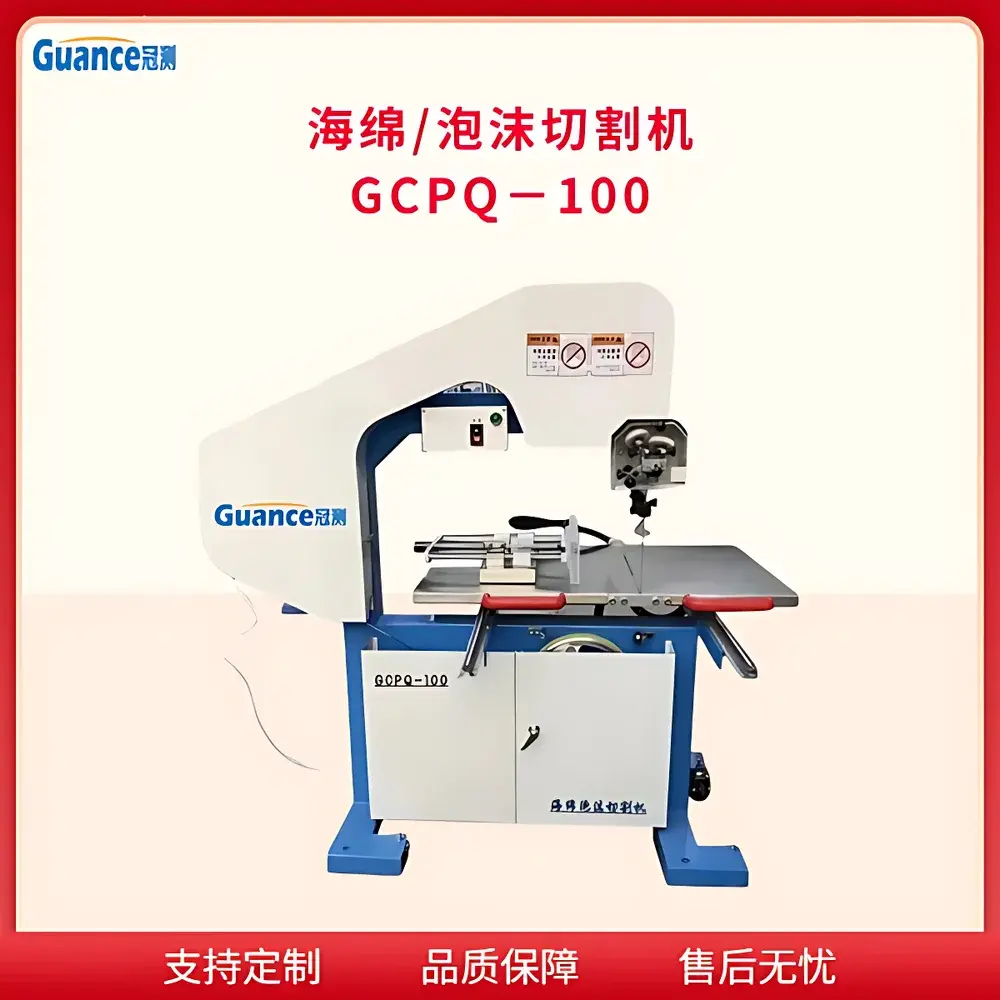
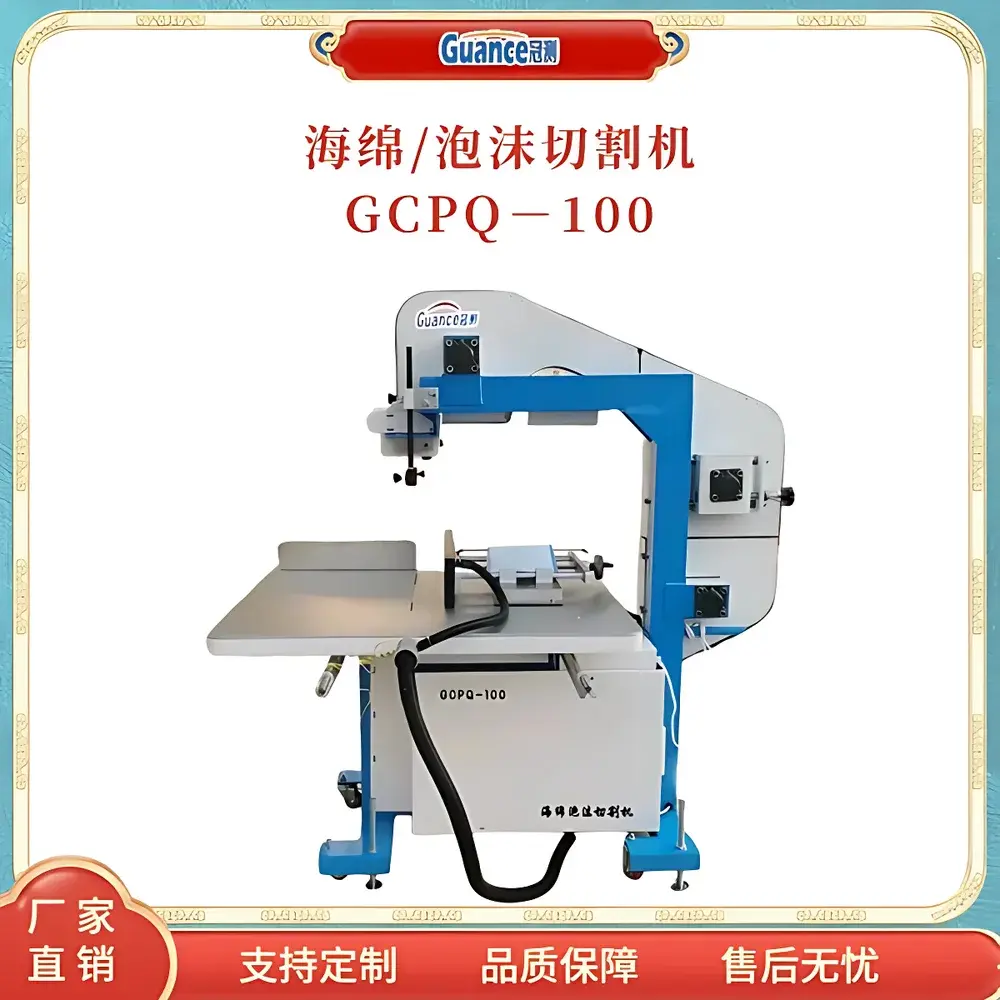
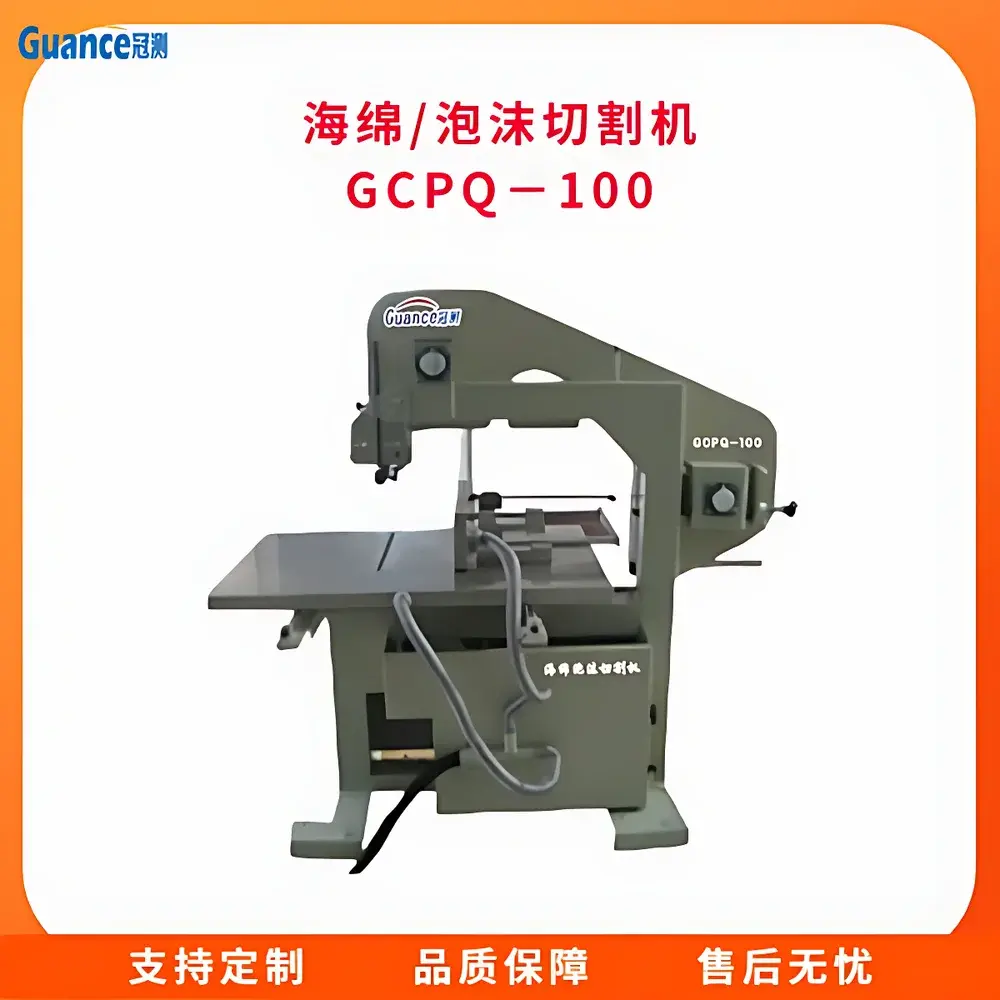
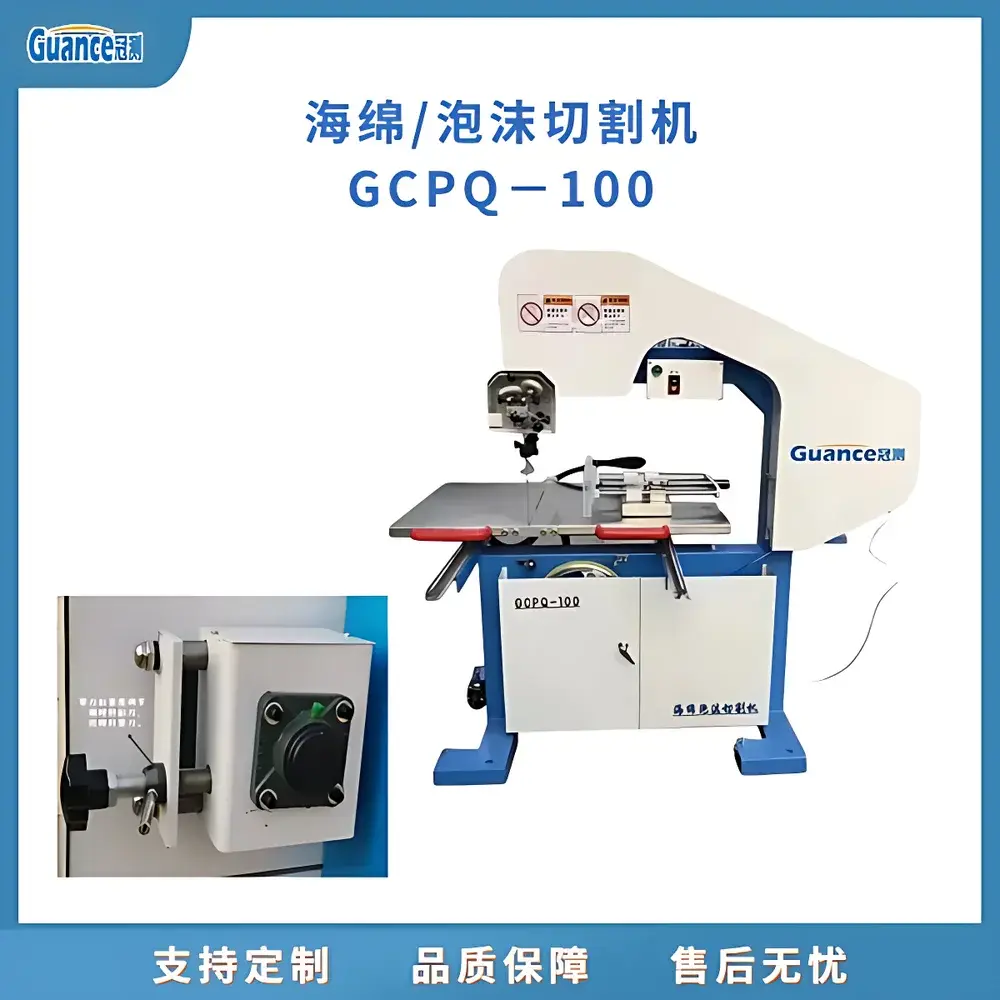
Guance Instruments GCPQ-100.2 Precision Foam Cutting Machine
| Brand | Guance Instruments |
|---|---|
| Origin | Beijing, China |
| Model | GCPQ-100.2 |
| Instrument Type | Precision Foam Cutting Machine |
| Digital Caliper Resolution | 0.01 mm |
| Cutting Accuracy | ±1 mm (material-dependent) |
| Worktable Dimensions | 1000 × 700 mm |
| Effective Travel Range | 500 mm |
| Maximum Cutting Thickness | 400 mm |
| Blade Circumference | 3920 mm |
| Power Rating | 1 kW |
| Rated Voltage/Frequency | 220 V / 50 Hz |
| Worktable Material | Anodized Aluminum |
| Guard Material | Acrylic |
| Vacuum Fixturing | Integrated Negative-Pressure Adsorption System |
| On-Machine Blade Sharpening | Supported |
Overview
The Guance Instruments GCPQ-100.2 Precision Foam Cutting Machine is an engineered solution for reproducible, dimensionally controlled sectioning of low-density polymeric foams and elastomeric sponge materials in laboratory and quality control environments. Designed around a rigid, high-flatness anodized aluminum worktable (1000 × 700 mm), the system employs a continuous-loop heated wire cutting mechanism driven by precision linear motion control. Unlike abrasive or mechanical saw-based systems, this machine utilizes resistive thermal cutting—where a taut, electrically heated nichrome wire (circumference 3920 mm) melts through cellular polymer structures with minimal mechanical force, thereby eliminating compression-induced distortion and preserving sample integrity. The system’s core architecture supports both manual point-to-point operation and repeatable fixed-dimension cuts via integrated digital caliper feedback (0.01 mm resolution), making it suitable for ASTM D3574-compliant foam physical testing specimen preparation—including tensile, compression, and indentation resilience test specimens.
Key Features
- High-flatness anodized aluminum worktable (1000 × 700 mm standard; customizable upon request) ensures dimensional stability and thermal uniformity across extended cutting sessions.
- Point-actuated start/stop control enables real-time operator intervention, reducing risk of over-travel or material overrun during manual positioning.
- Multi-stage acrylic safety guards surround the cutting zone, meeting basic IEC 61000-6-2 electromagnetic compatibility and mechanical safeguarding expectations for Class I laboratory equipment.
- Vacuum-assisted negative-pressure adsorption secures low-density foam samples (density range: 10–120 kg/m³) without clamping-induced deformation—critical for maintaining planar fidelity prior to cut.
- Integrated on-machine blade sharpening station eliminates tool removal, minimizing downtime and preserving geometric alignment between heating element and guide rollers.
- Low-noise operation achieved via rubber-damped roller assemblies and vibration-isolating mounting feet—acoustic emission <68 dB(A) at 1 m distance under nominal load.
- Adjustable movable stop gauge with digital display (0.01 mm resolution) enables rapid setup of standardized specimen dimensions (e.g., 25 × 25 × 10 mm cubes per ISO 1797-1).
- Effective X-axis travel of 500 mm accommodates full-length cuts across standard foam billets while maintaining ±1 mm positional repeatability under consistent environmental conditions (23 ± 2 °C, 50 ± 10% RH).
Sample Compatibility & Compliance
The GCPQ-100.2 is validated for use with flexible and semi-rigid polyurethane (PU), polyethylene (PE), polystyrene (PS), and ethylene-vinyl acetate (EVA) foams, as well as natural latex and synthetic sponge matrices. It is not intended for conductive, flame-retardant-treated, or thermally unstable foams (e.g., those containing halogenated fire retardants prone to HBr off-gassing at >200 °C). While not certified to UL 61010-1 or CE Machinery Directive Annex I out-of-the-box, its electrical design complies with GB/T 38337–2019 (Chinese national standard for lab-scale thermal cutting equipment) and incorporates dual-pole isolation, thermal cutoff protection, and grounded chassis construction. For GLP-regulated labs, the digital caliper output may be logged externally to support traceability requirements under 21 CFR Part 11 when paired with compliant data acquisition software.
Software & Data Management
The GCPQ-100.2 operates as a standalone electromechanical instrument with no embedded microprocessor or firmware. All dimensional inputs are manually entered via the digital caliper interface; no proprietary software, drivers, or cloud connectivity are required. However, the 0–10 V analog output signal from the digital scale can be interfaced with third-party DAQ systems (e.g., National Instruments USB-6009 or Keysight 34972A) for automated logging into LIMS or ELN platforms. Audit trails for cut parameters must be maintained manually or via external timestamped recording—no built-in electronic record retention or user access control is provided.
Applications
- Preparation of standardized test specimens for ASTM D3574 (flexible cellular materials), ISO 1797-1 (foam resilience), and DIN 53571 (compression set).
- Cutting of acoustic insulation panels for sound transmission loss characterization (ASTM E90).
- Sectioning of packaging-grade foam inserts for dimensional verification and void analysis.
- Manufacturing support for orthopedic cushioning prototypes requiring precise thickness gradients (±1 mm tolerance).
- Research-scale fabrication of porous scaffolds in biomaterials labs where thermal degradation must be minimized relative to mechanical shearing.
FAQ
What foam densities is the GCPQ-100.2 rated for?
The system is optimized for foams ranging from 10 kg/m³ (ultra-soft open-cell PU) to 120 kg/m³ (semi-rigid cross-linked PE), with optimal performance observed between 25–60 kg/m³.
Can the machine cut non-foam materials such as rubber or gel pads?
No—thermal wire cutting is unsuitable for high-elasticity or high-thermal-conductivity materials; excessive heat dissipation prevents clean melt-through and risks wire breakage.
Is vacuum pressure adjustable?
Yes—the integrated vacuum pump includes a calibrated pressure regulator allowing adjustment between –30 kPa and –70 kPa to accommodate varying foam porosity and surface finish.
Does the device comply with FDA or ISO 13485 requirements?
It is not a medical device nor manufactured under ISO 13485; however, its stainless steel and food-grade silicone components meet incidental contact criteria per FDA 21 CFR 177.2600 for non-intended-use applications.
What maintenance intervals are recommended?
Blade tension verification every 200 operating hours; vacuum filter cleaning every 50 hours; roller lubrication with silicone grease every 1000 hours.



