
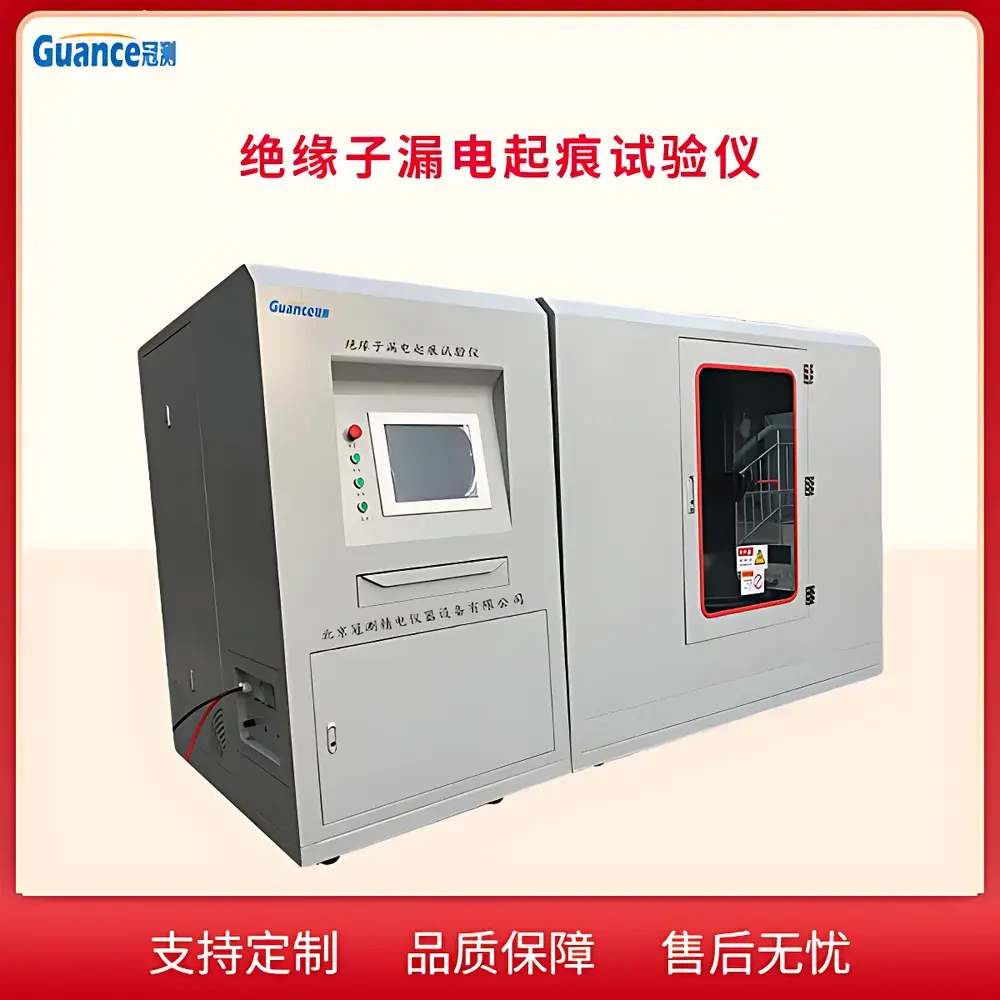
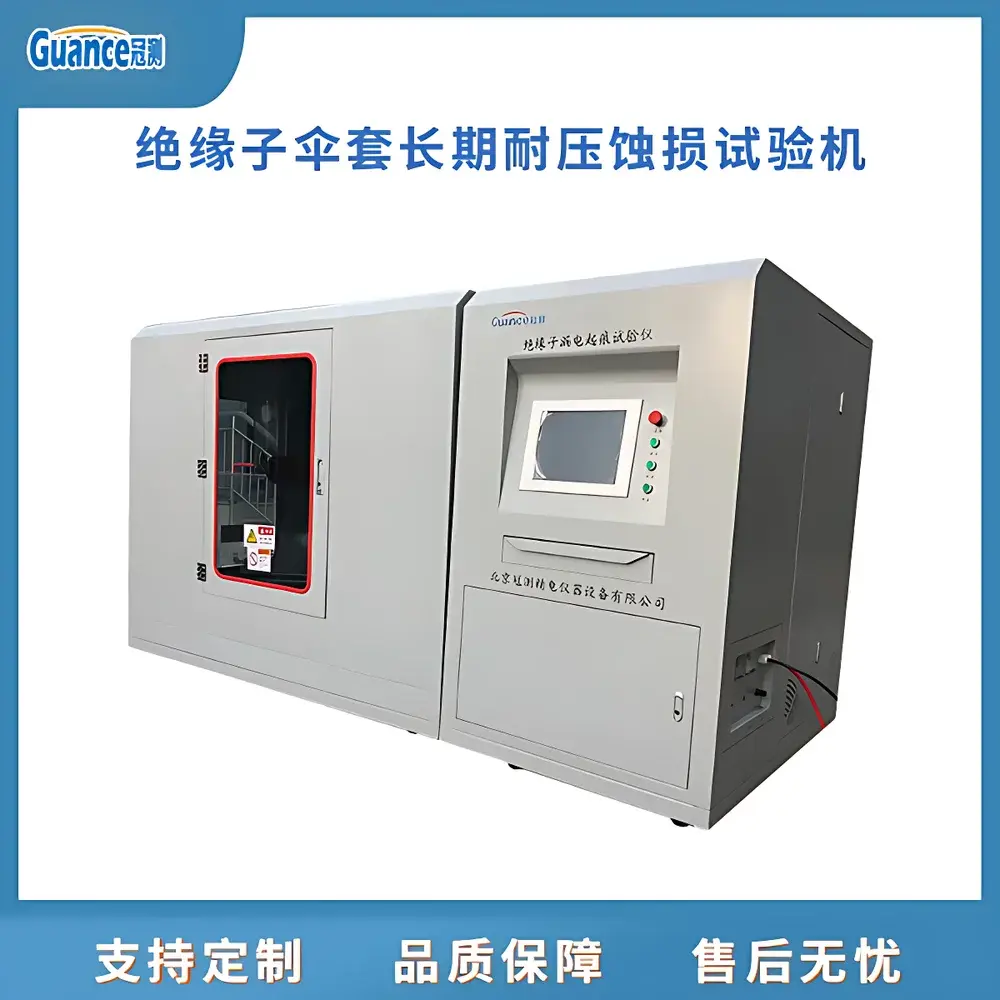
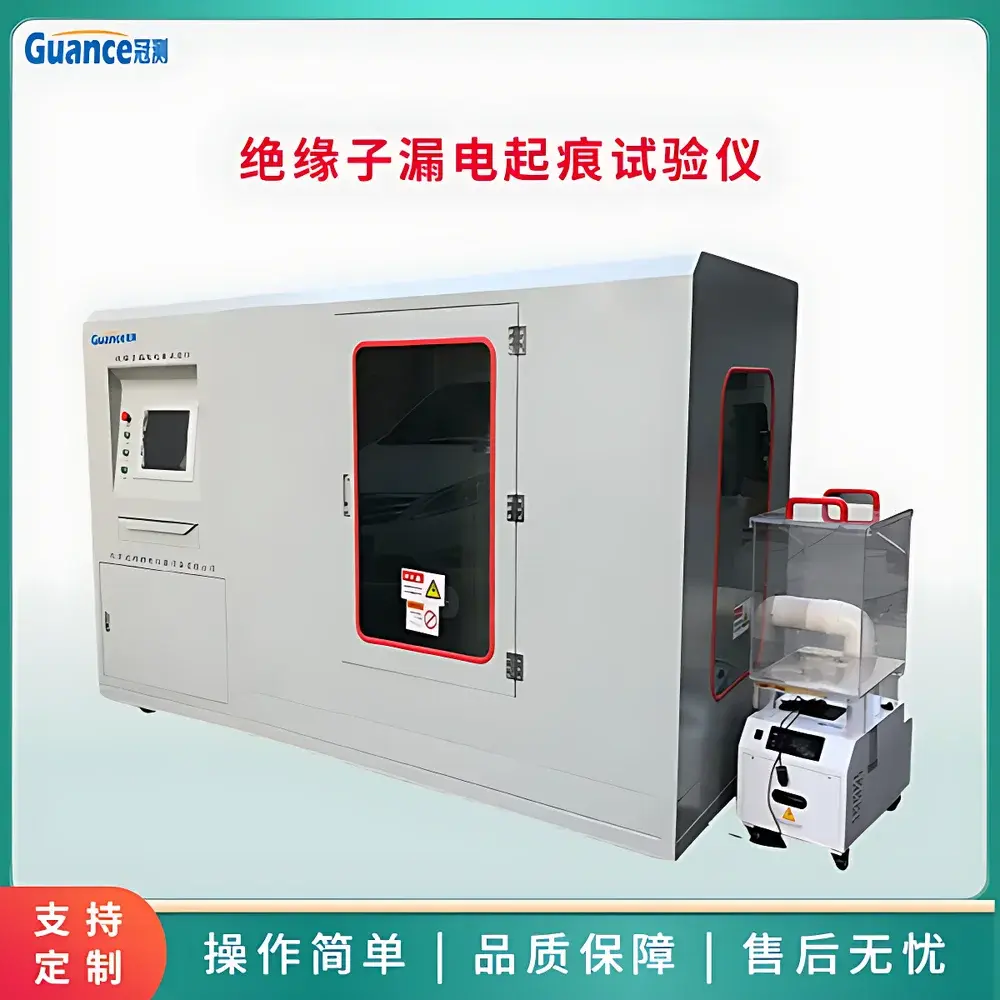
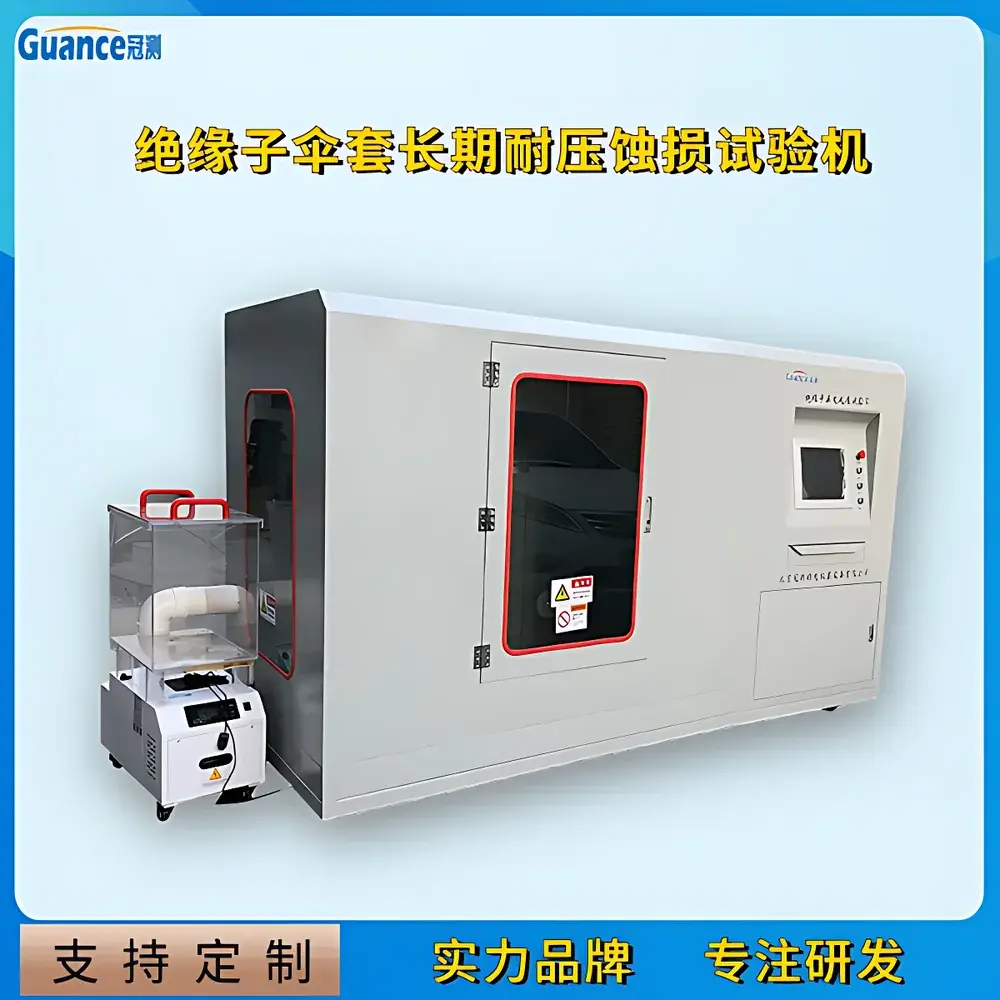
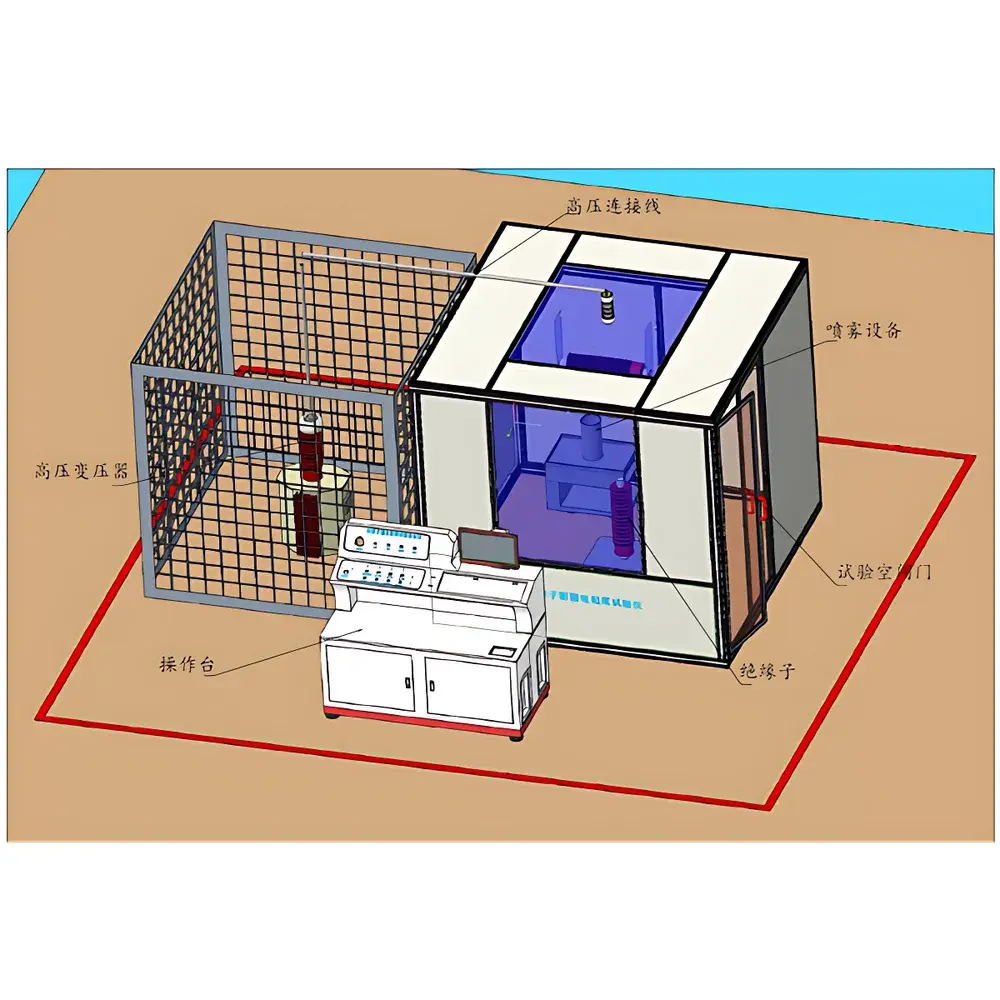
GuanCe Instruments NLD-AII Universal Testing Machine for Electrical Tracking Resistance of Insulators
| Brand | GuanCe Instruments |
|---|---|
| Origin | Beijing, China |
| Manufacturer Type | Authorized Distributor |
| Country of Origin | China |
| Model | NLD-AII |
| Instrument Type | Electromechanical Universal Testing Machine |
| Input Voltage | AC 220 V |
| Output Voltage Range | AC 0–50 kV / DC −50–0 kV (adjustable) |
| Power Rating | 50 kVA |
| Voltage Accuracy | < ±2% |
| High-Voltage Output Current | ≥1 A |
| Current Measurement Accuracy | < ±1% |
| Spray Velocity at Specimen | 3 m/s |
| Salt Fog Generation | Ultrasonic atomizer |
| Fog Volume Concentration | (0.4 ± 0.1) L/m³·h |
| Fog Particle Size | 5–10 µm |
| Fog Chamber Volume | 4 m³ (2000 × 1200 × 1700 mm) |
| Specimen Mounting | 1 horizontal + 1 vertical position |
| Minimum Clearance | ≥400 mm from chamber ceiling and walls |
| Test Duration | Up to 1000 h continuous |
| Safety Interlock | Door-activated high-voltage cutoff and automatic voltage zeroing |
| Control System | Embedded industrial computer |
| Dimensions (L×W×H) | 3400 × 1300 × 1800 mm |
| Weight | 300 kg |
Overview
The GuanCe Instruments NLD-AII Universal Testing Machine is a purpose-built system for evaluating the electrical tracking resistance and erosion performance of polymeric insulators under accelerated salt fog and high-voltage stress conditions. Designed in strict accordance with GB/T 20142–2006 and GB/T 22079–2008—Chinese national standards aligned with IEC 60587 and ASTM D2303—the instrument replicates long-term service exposure by simultaneously applying alternating or direct high voltage and controlled saline aerosol in a sealed fog chamber. The test principle relies on establishing conductive leakage paths across the insulator surface via electrolytic ion migration under humid, contaminated conditions. As surface tracking progresses, localized heating, carbonization, and material degradation occur; the NLD-AII quantifies time-to-failure, leakage current evolution, and visible tracking morphology to assess comparative material robustness and design adequacy.
Key Features
- Integrated high-voltage generation subsystem: dual-mode AC/DC output (0–50 kV AC / −50–0 kV DC), digitally adjustable with < ±2% voltage accuracy and real-time monitoring.
- Ultrasonic salt fog generator delivering consistent aerosol at (0.4 ± 0.1) L/m³·h, with particle size distribution tightly controlled between 5–10 µm—critical for reproducible surface wetting and ionic deposition.
- 4 m³ sealed fog chamber (2000 × 1200 × 1700 mm) engineered for uniform fog distribution, thermal stability, and corrosion-resistant internal surfaces.
- Dual-specimen mounting configuration: independent horizontal and vertical fixtures accommodating standard line-post and station-type insulators per GB/T 20142.
- Embedded industrial control computer enabling full-cycle automation: start/pause/resume functionality with cumulative runtime logging—even after interruption—ensuring compliance with 1000-hour endurance protocols.
- Comprehensive safety architecture: interlocked access door triggering immediate HV disconnection and auto-zeroing; programmable overcurrent protection; mechanical limit switches with status indication.
- Real-time data acquisition: synchronized recording of applied voltage, leakage current, elapsed time, and environmental parameters with 1 ms sampling resolution.
Sample Compatibility & Compliance
The NLD-AII accommodates insulators conforming to IEC 60137, GB/T 20142, and GB/T 22079 dimensional and mounting specifications—including porcelain, silicone rubber, and EPDM composite types up to 1.5 m in height. Specimen clearances (>400 mm from chamber walls and ceiling) ensure laminar airflow and minimize field distortion. All electrical and fog-generation subsystems meet CE-relevant EMC and low-voltage directive requirements. Test methodology supports traceable validation against ISO/IEC 17025-accredited laboratories and satisfies prequalification requirements for grid operators adhering to State Grid Corporation of China (SGCC) technical specifications and南方电网 (CSG) procurement guidelines.
Software & Data Management
The embedded control software provides ISO 17025-aligned data integrity features: audit-trail-enabled user authentication, electronic signature support, and tamper-proof timestamped records. Real-time voltage–current Lissajous curves are rendered with configurable scaling and overlay options. Historical datasets are indexed by specimen ID, test date, operator, and protocol version. Export formats include CSV (for statistical analysis in MATLAB or Minitab), PDF (formatted electronic reports with header/footer metadata), and encrypted USB storage with hardware-level write protection. Calibration parameters for voltage and current transducers are stored with revision history and expiration dates—fully compliant with GLP documentation practices.
Applications
- Qualification testing of outdoor polymer insulators for ultra-high-voltage (UHV) transmission lines (≥1000 kV AC/±800 kV DC).
- Comparative evaluation of hydrophobicity recovery rates in room-temperature vulcanized (RTV) silicone coatings.
- Material screening for anti-tracking additives in HTV silicone rubber formulations.
- Design validation of shed profile geometry and creepage distance optimization under polluted conditions.
- Root-cause analysis of field failures involving flashover or progressive tracking in coastal or industrial environments.
- Supporting third-party certification per CNAS-accredited test reports required for export to ASEAN, Middle East, and African utilities.
FAQ
What standards does the NLD-AII directly support?
GB/T 20142–2006, GB/T 22079–2008, IEC 60587, and ASTM D2303—covering test setup, voltage application, fog concentration, and pass/fail criteria.
Can the system operate unattended for the full 1000-hour test duration?
Yes—hardware watchdog timers, redundant power conditioning, and non-volatile memory ensure stable operation without manual intervention; system logs all anomalies with UTC timestamps.
Is the salt fog concentration verified in situ during testing?
Fog density is calibrated prior to each test using gravimetric collection and conductivity measurement per GB/T 22079 Annex B; real-time flow rate is maintained via closed-loop ultrasonic driver feedback.
How is data integrity ensured for regulatory submissions?
All raw data files are SHA-256 hashed upon generation; electronic reports include digital signatures, calibration certificate references, and instrument identification metadata meeting FDA 21 CFR Part 11 predicate rules.
What maintenance intervals are recommended for long-term reliability?
Ultrasonic transducers require quarterly cleaning and annual replacement; HV bushings and current shunts undergo biannual metrological verification per JJG 1083–2013; firmware updates follow GuanCe’s validated release cycle with version-controlled changelogs.



