

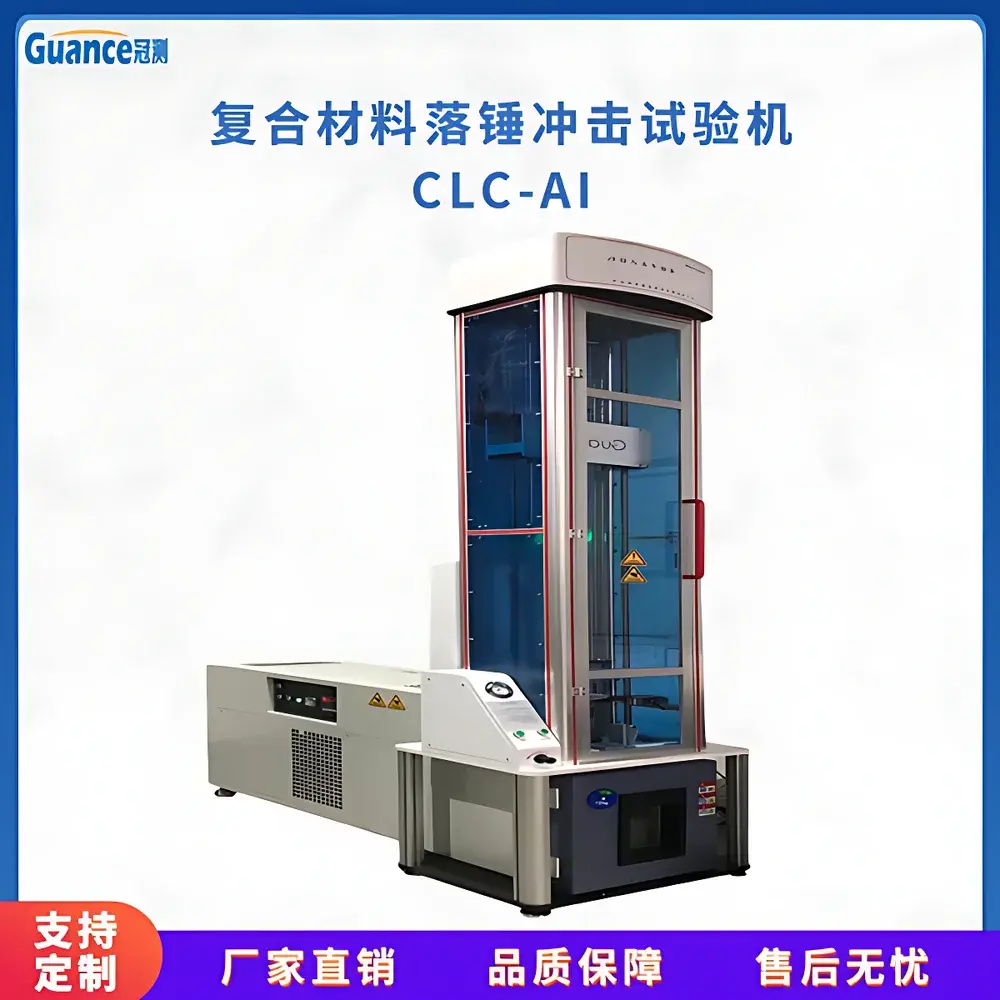
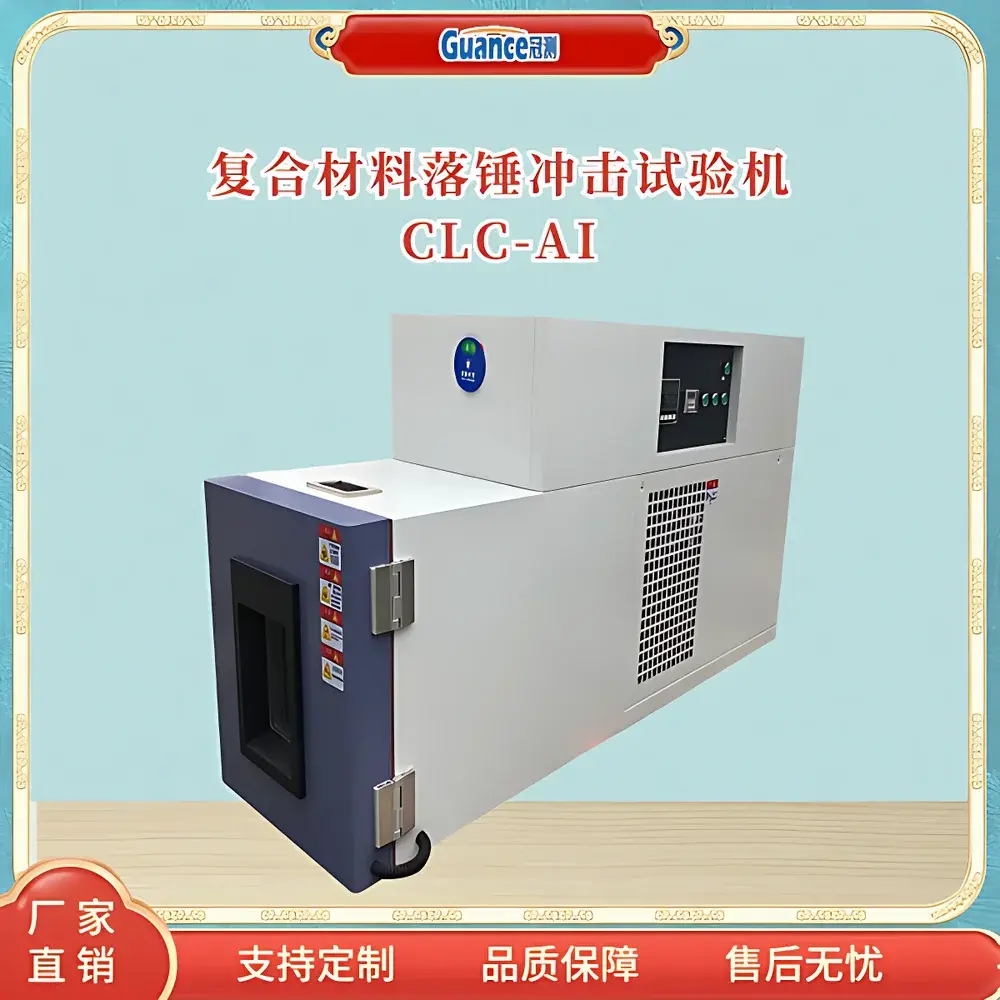
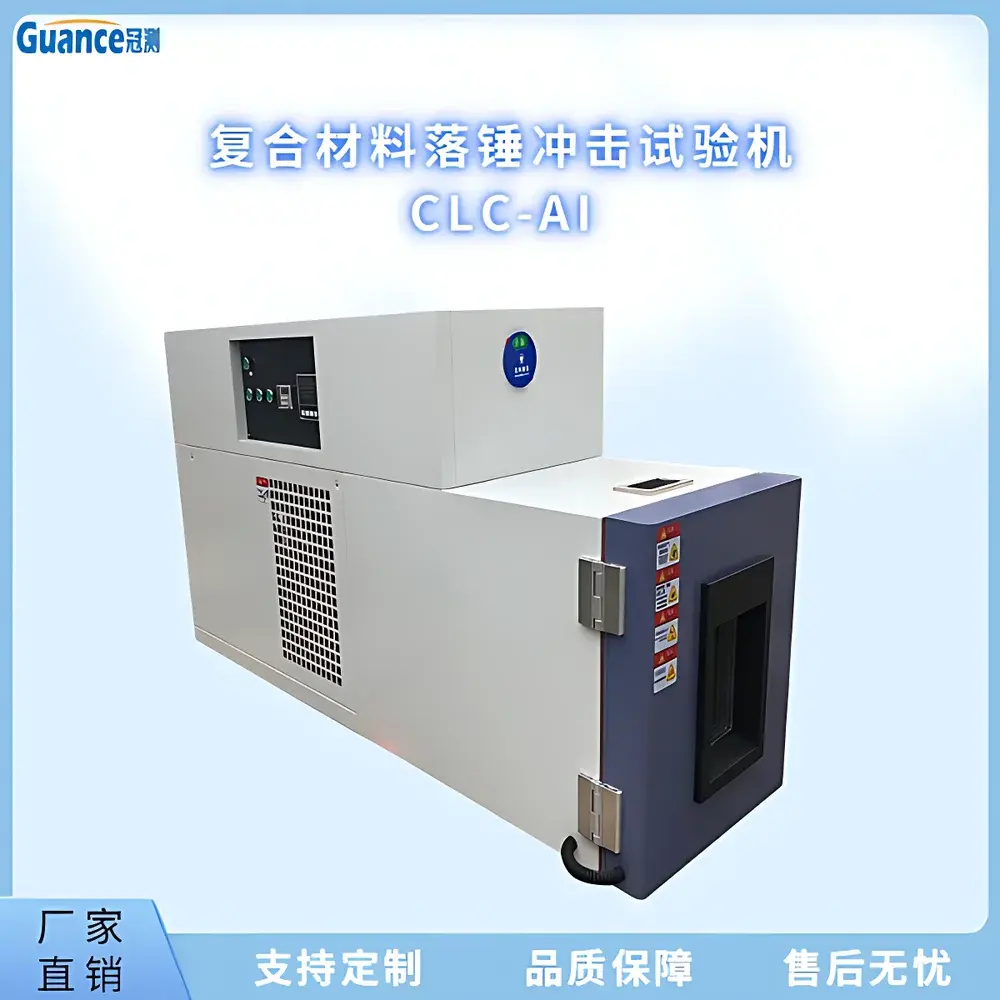
GuanCe Instruments CLC-AI2 Drop-Weight Impact Tester
| Brand | GuanCe Instruments |
|---|---|
| Origin | Beijing, China |
| Manufacturer Type | Authorized Distributor |
| Country of Origin | China |
| Model | CLC-AI2 |
| Instrument Type | Drop-Weight Impact Tester |
| Impact Energy Range | 0–100 J (standard) |
| Impact Velocity | 5.5 m/s (standard) |
| Hammer Mass Range | 2–7 kg |
| Force Sensor Range | 0–100 J (energy equivalent) |
| optional load cells | 10–250 kN |
| Maximum Lift Height | 2000 mm |
| Test Chamber Dimensions | 600 × 550 × 450 mm |
| Hammer Tip Diameters | Ø12, Ø12.5, Ø16, Ø20 mm (±0.1 mm) |
| Hammer Hardness | HRC 60–65 |
| Positioning Accuracy | ±1 mm |
| Dynamic Test Error | <2% |
| Data Acquisition Rate | 2 MHz |
| ADC Resolution | ≥16-bit |
| Force Sensor Sensitivity | 0.05–1 mV/lbf |
| Accelerometer Sensitivity | 2 pC/(m/s²) |
| Frequency Response (Accelerometer) | 1–12,000 Hz |
| Operating Temperature Range | –40°C to +150°C (optional environmental chamber) |
Overview
The GuanCe Instruments CLC-AI2 Drop-Weight Impact Tester is an electromechanical testing system engineered for high-fidelity characterization of dynamic impact resistance in polymeric composites, thermoplastics, fiber-reinforced laminates, and structural sheet materials. It operates on the principle of gravitational free-fall impact: a calibrated hammer mass is elevated to a defined height and released under controlled conditions to strike a horizontally clamped specimen. Real-time acquisition of force, acceleration, displacement, and velocity is achieved via synchronized high-bandwidth sensors—enabling precise quantification of energy absorption, damage initiation thresholds, fracture propagation behavior, and ductile-to-brittle transition points. Designed to meet stringent international test standards—including ASTM D7136/D7136M-05 (for composite laminates), ISO 6603-2, ISO 11343 (pendulum vs. drop-weight correlation), and EN 6038—the CLC-AI2 supports reproducible, traceable, and audit-ready impact evaluation within R&D laboratories, quality control departments, and certification testing facilities.
Key Features
- Triple-mode impact control: user-selectable input parameters—impact energy (J), drop height (mm), or impact velocity (m/s)—with automatic recalibration of hammer mass and lift position.
- Dual-sensor validation architecture: co-located piezoelectric force transducer (50 kN full scale, ±1% linearity) and high-sensitivity accelerometer (2 pC/(m/s²), 1–12 kHz bandwidth) enable cross-verified time-domain signal integrity.
- Sub-microsecond optical velocity measurement: proprietary grating-based photogate with 0.5 µs response time ensures accurate pre-impact velocity capture—critical for kinetic energy calculation and compliance with ASTM D7192 Annex A1.
- Direct analog signal acquisition: National Instruments (NI) PXI-based 2 MHz, 16-bit data acquisition card interfaces directly with sensor mV outputs—eliminating amplifier-induced phase lag and amplitude distortion.
- Automated mechanical alignment: motorized leveling feet and integrated bubble-level indicator guarantee vertical hammer trajectory (≤0.1° deviation), minimizing eccentric loading artifacts.
- 3D impact visualization engine: software-rendered stereoscopic reconstruction of deformation field, including real-time contour mapping of indentation depth, radial crack propagation, and delamination zone extent.
- Pneumatic specimen and hammer clamping: repeatable, low-hysteresis actuation with programmable pressure control (0.3–0.7 MPa) ensures consistent boundary conditions across test series.
Sample Compatibility & Compliance
The CLC-AI2 accommodates flat-sheet specimens up to 300 mm × 300 mm × 50 mm (L×W×T), with standardized fixture openings (75 × 75 mm, 75 × 125 mm, Ø75 mm). Compatible material classes include carbon/aramid/glass fiber composites, injection-molded thermoplastics (PP, PC, PEEK), elastomeric foams, and metal-polymer hybrids. All hardware and firmware comply with ISO/IEC 17025:2017 requirements for test equipment metrological traceability. Force sensor calibration certificates are NIST-traceable; system validation includes interlaboratory round-robin data per ASTM E2577. Optional environmental chamber integration supports testing at –40°C to +150°C, enabling evaluation of thermal-dependent impact performance per ISO 293 and ASTM D695.
Software & Data Management
The proprietary ImpactView™ software (v4.2+) provides GLP-compliant test execution, real-time waveform overlay (F-t, v-t, d-t), and post-processing analytics compliant with 21 CFR Part 11 (electronic signatures, audit trail, role-based access). Export formats include CSV, MATLAB .mat, and universal HDF5. All raw sensor data—including timestamped voltage traces, trigger events, and environmental metadata—are stored in immutable binary archives. Curve-fitting modules calculate absorbed energy (area under F-d curve), maximum contact force, rebound velocity ratio, and critical damage onset (first deviation from linear elasticity). Statistical reporting supports batch analysis across ≥100 specimens with Weibull distribution fitting for reliability assessment.
Applications
- Composite aircraft panel certification per AC 20-107B and DO-160 Section 25.
- Automotive bumper beam impact resilience validation against FMVSS 215 and ECE R42.
- Medical device polymer housing drop-testing per ISO 10993-1 and ASTM F2029.
- Electronics enclosure durability assessment under IEC 60068-2-32 (free-fall shock).
- Academic research into strain-rate-dependent fracture mechanics and viscoelastic energy dissipation.
- Quality assurance of recycled plastic feedstock batches for extrusion-grade impact consistency.
FAQ
What standards does the CLC-AI2 natively support?
ASTM D7136/D7136M-05, ASTM D7192, ISO 6603-2, ISO 11343, ISO 3127, EN 6038, DIN 53373, and ISO 8256—with built-in test templates, pass/fail logic, and report generation aligned to each standard’s clause requirements.
Can the system be validated for GMP-regulated environments?
Yes—optional IQ/OQ documentation packages, electronic audit trail configuration, and 21 CFR Part 11-compliant user authentication are available. Calibration intervals and sensor drift monitoring align with FDA guidance for laboratory instrument qualification.
Is third-party calibration support available?
GuanCe Instruments partners with ISO/IEC 17025-accredited calibration laboratories in North America and EU; factory-certified recalibration services include force sensor linearity verification, velocity gate timing validation, and mechanical alignment certification.
What is the minimum detectable energy resolution?
At 100 J full scale, the system achieves ≤0.1 J effective resolution due to 16-bit digitization, low-noise signal conditioning, and real-time digital filtering (Butterworth 4th-order, cutoff = 50 kHz).
Does the software support automated pass/fail decision logic?
Yes—user-defined criteria (e.g., “max force > 15.2 kN AND absorbed energy < 42.5 J”) trigger color-coded status flags and auto-populated nonconformance logs in accordance with ISO 9001 Clause 8.7.



