
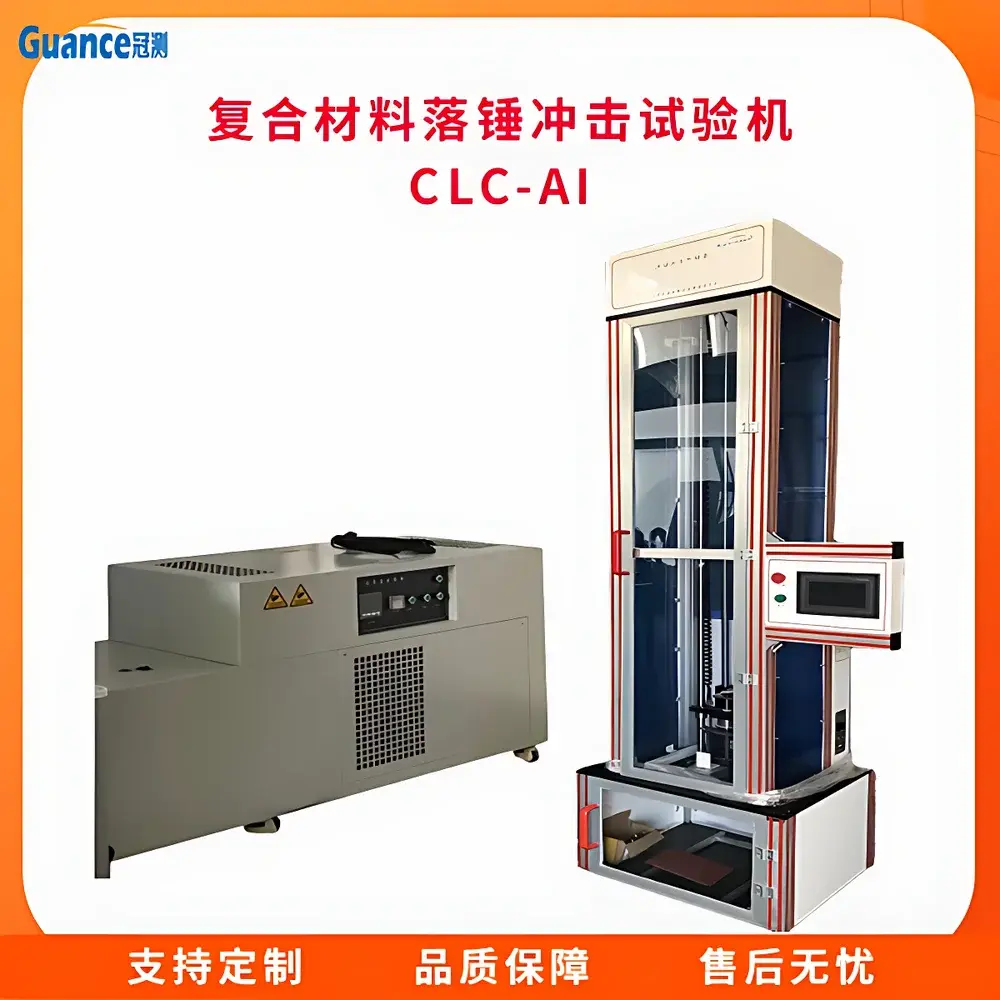

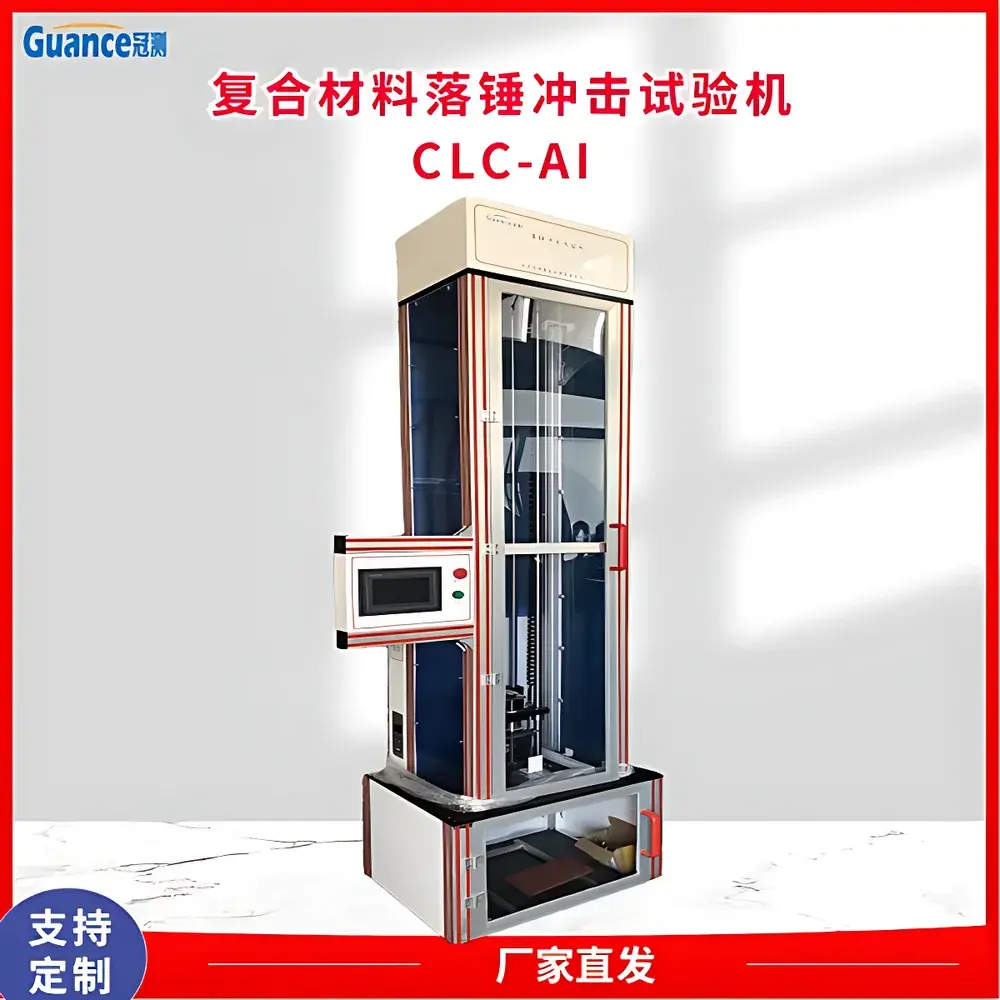
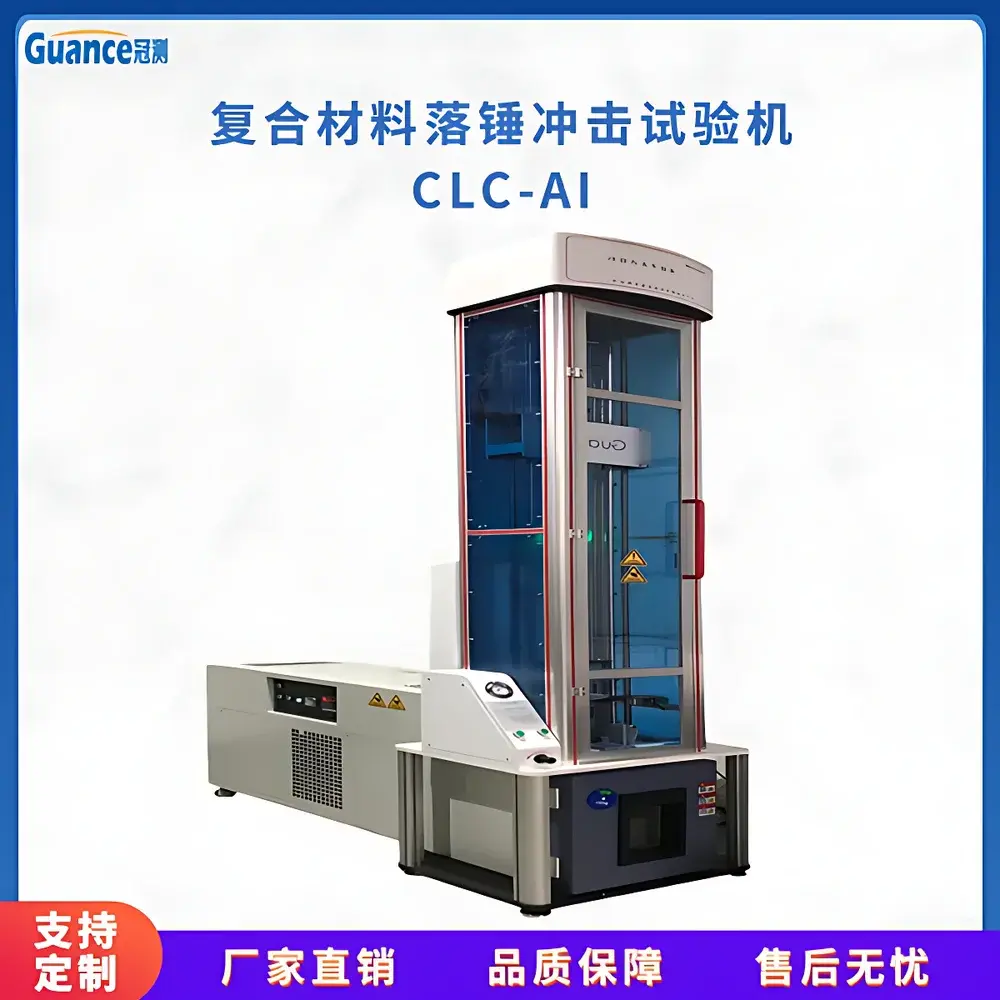
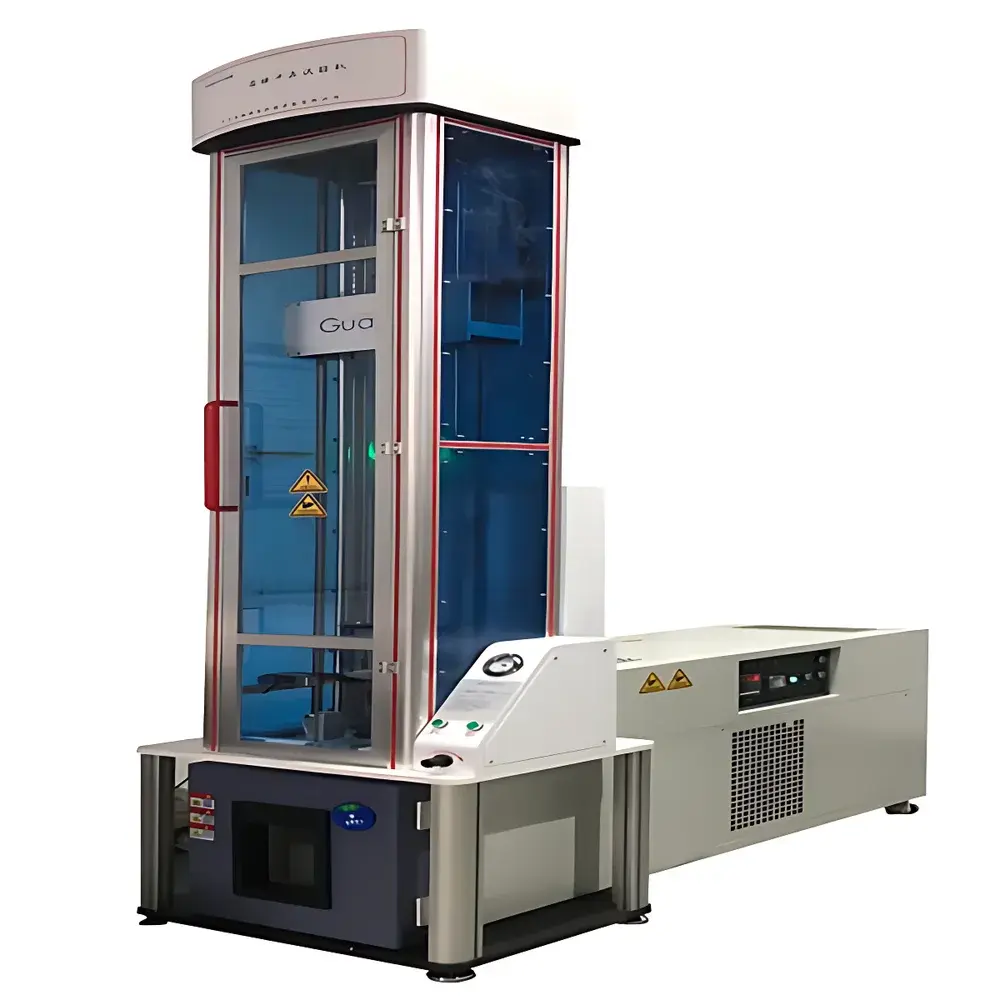
GuanCe Instruments CLC-AI.11 Instrumented Drop-Weight Impact Tester
| Brand | GuanCe Instruments |
|---|---|
| Origin | Tianjin, China |
| Manufacturer Type | Authorized Distributor |
| Country of Origin | China |
| Model | CLC-AI.11 |
| Instrument Type | Drop-Weight Impact Tester |
| Impact Energy Range | 0–100 J (pneumatically adjustable clamping force) |
| Maximum Impact Velocity | 5.5 m/s |
| Hammer Mass Options | 2–7 kg (standard configuration includes 5 kg, 15 kg, and 20 kg hammers) |
| Maximum Lift Height | 3000 mm |
| Effective Test Height | 1500 mm |
| Force Sensor Range | 0–100 J equivalent |
| Dimensions (L×W×H) | 1200 × 700 × 2100 mm |
| Weight | 300 kg |
| Automation Features | Motorized hammer lifting, automatic hammer latching/release, anti-reimpact safety mechanism |
Overview
The GuanCe Instruments CLC-AI.11 Instrumented Drop-Weight Impact Tester is an advanced physical property testing system engineered for high-fidelity dynamic impact characterization of polymeric composites, thermoplastics, fiber-reinforced laminates, and structural polymer-based materials. It operates on the principle of controlled gravitational drop-weight impact, where a calibrated hammer is elevated to a defined height and released to strike a horizontally supported specimen. Unlike conventional Charpy or Izod testers, the CLC-AI.11 integrates high-speed force and displacement sensing—enabled by precision piezoelectric load cells and optical velocity tracking—to capture full transient response curves: impact force vs. time, displacement vs. time, and velocity vs. time. This instrumentation allows quantitative decomposition of incident kinetic energy into recoverable elastic energy, plastic dissipation, delamination work, and fracture energy—critical for evaluating damage tolerance, toughness transition behavior, and failure mode mapping under low-velocity impact conditions.
Key Features
- Real-time synchronized acquisition of impact force, displacement, and velocity waveforms at sampling rates up to 1 MHz, ensuring resolution of microsecond-scale deformation events.
- Pneumatically actuated clamping system with adjustable pressure control for consistent specimen fixation across variable thicknesses and moduli—minimizing boundary-condition-induced scatter.
- Motor-driven vertical positioning column enabling precise, repeatable hammer lift heights from 0 to 3000 mm in 1-mm increments; effective test height optimized at 1500 mm per ISO and ASTM requirements.
- Interchangeable hammer assemblies (2 kg, 5 kg, 15 kg, and 20 kg standard options) with certified mass calibration traceable to national metrology institutes.
- Dual-stage anti-reimpact mechanism prevents secondary loading during rebound—essential for accurate energy partitioning in ductile or viscoelastic specimens.
- Integrated safety enclosure with interlocked access doors and emergency stop circuitry compliant with IEC 60204-1 and ISO 13857.
Sample Compatibility & Compliance
The CLC-AI.11 supports flat plate specimens ranging from 50 × 50 mm to 300 × 300 mm (custom fixtures available), with thicknesses from 1 mm to 50 mm. It accommodates rigid, semi-crystalline, and fiber-reinforced systems—including carbon/epoxy, glass/polypropylene, and thermoplastic matrix composites. The system is fully aligned with international standards governing instrumented impact testing: ISO 3127 (plastics — determination of resistance to puncture), ISO 6603-2 (determination of puncture impact behaviour of plastics), ISO 7765-2 (impact resistance of rigid cellular plastics), ISO 11343 (determination of resistance to impact penetration), ISO 8256 (tensile-impact), PREN 6038 (aerospace composites), DIN 53373 (impact strength of plastics), and key ASTM methods including D2444 (thermoplastic pipe), D3763 (high-speed puncture), D5628 (composite laminates), D7136 (compression after impact), and D7192 (instrumented impact of polymer matrix composites). Data output formats comply with ASTM E2928 for traceability and GLP/GMP audit readiness.
Software & Data Management
The proprietary GuanCe Impact Analysis Suite (v4.2) provides full post-processing functionality: automatic identification of peak force, maximum deflection, energy absorption up to first crack, total dissipated energy, critical damage onset point, and ductile-to-brittle transition threshold. All raw waveform data are stored in HDF5 format with embedded metadata (operator ID, timestamp, environmental conditions, calibration certificates). Audit trails record every parameter change, user login/logout, and report generation event—meeting FDA 21 CFR Part 11 requirements for electronic records and signatures. Export modules support CSV, MATLAB .mat, and universal ASCII formats compatible with third-party statistical platforms such as JMP, Minitab, and Python-based SciPy workflows.
Applications
- Quantification of energy absorption capacity and damage evolution in aerospace composite panels subjected to tool-drop scenarios.
- Evaluation of toughening mechanisms in nanofilled polymers and rubber-modified resins via multi-hit impact sequences.
- Correlation of impact resistance with processing parameters (e.g., injection molding temperature, cooling rate) in automotive thermoplastic components.
- Validation of finite element models (Abaqus/LS-DYNA) using experimentally derived force–displacement hysteresis loops.
- Development of standardized test protocols for recycled composite feedstocks under circular economy initiatives.
FAQ
What standards does the CLC-AI.11 natively support?
The system includes pre-configured test templates and reporting layouts for ISO 3127, ISO 6603-2, ASTM D7136, and ASTM D5628, with optional add-on modules for EN 61000-4-5 and MIL-STD-810H impact verification.
Can the system perform repeated impact tests at fixed energy levels?
Yes—the software enables programmable multi-strike sequences with automated hammer re-lift, position reset, and real-time energy recalibration between impacts.
Is third-party calibration certification included?
Each unit ships with NIST-traceable calibration certificates for hammer mass, force transducer, and displacement encoder, valid for 12 months from commissioning.
What maintenance intervals are recommended?
Preventive maintenance is scheduled every 1,000 test cycles or annually—whichever occurs first—with documented service logs retained in the onboard database.
Does the system support remote diagnostics and firmware updates?
Yes—via secure TLS-encrypted Ethernet connection; remote support requires prior customer authorization and adheres to ISO/IEC 27001 information security policies.



