
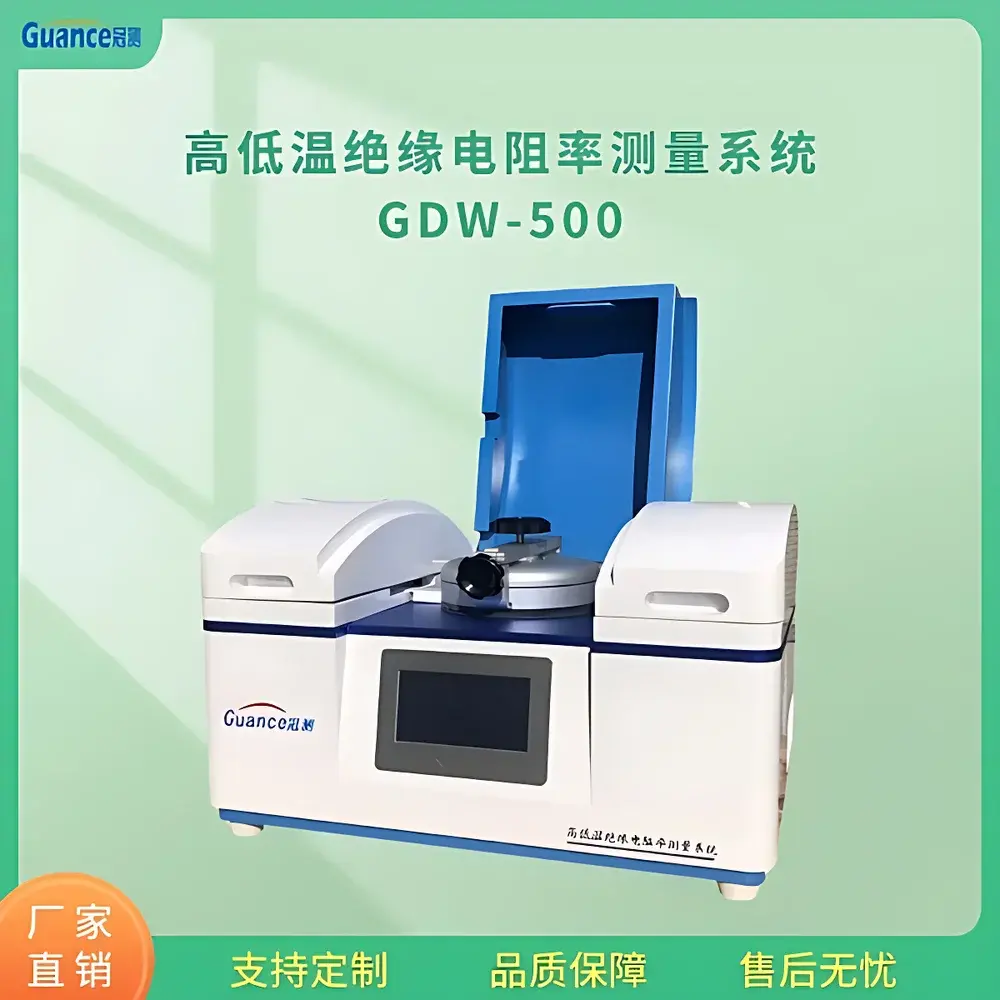
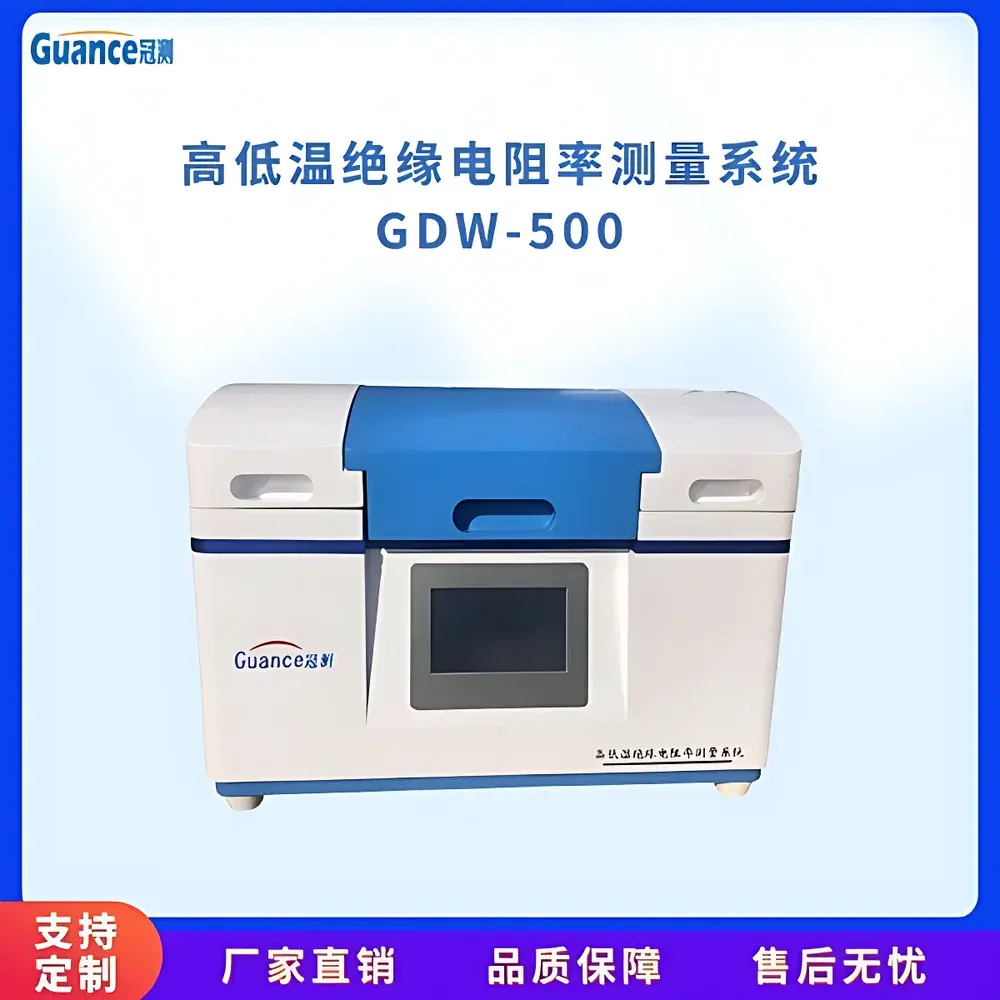
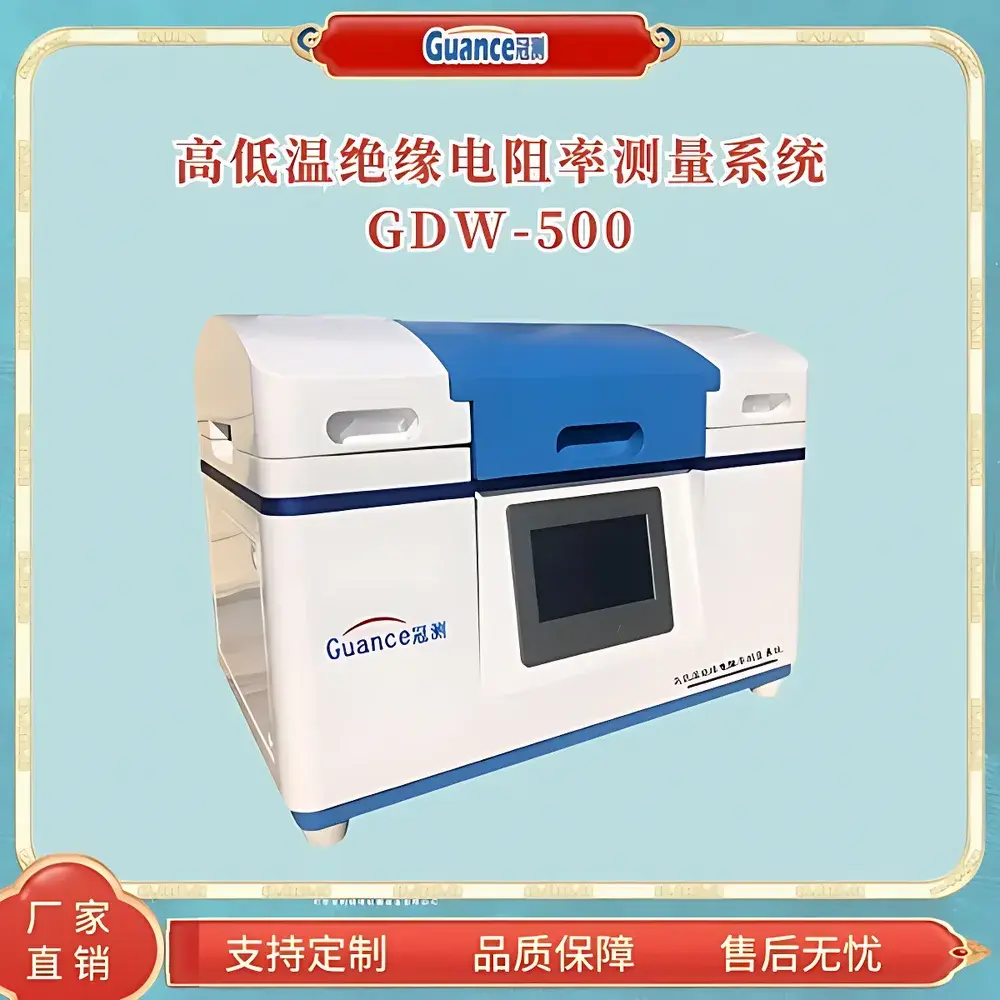
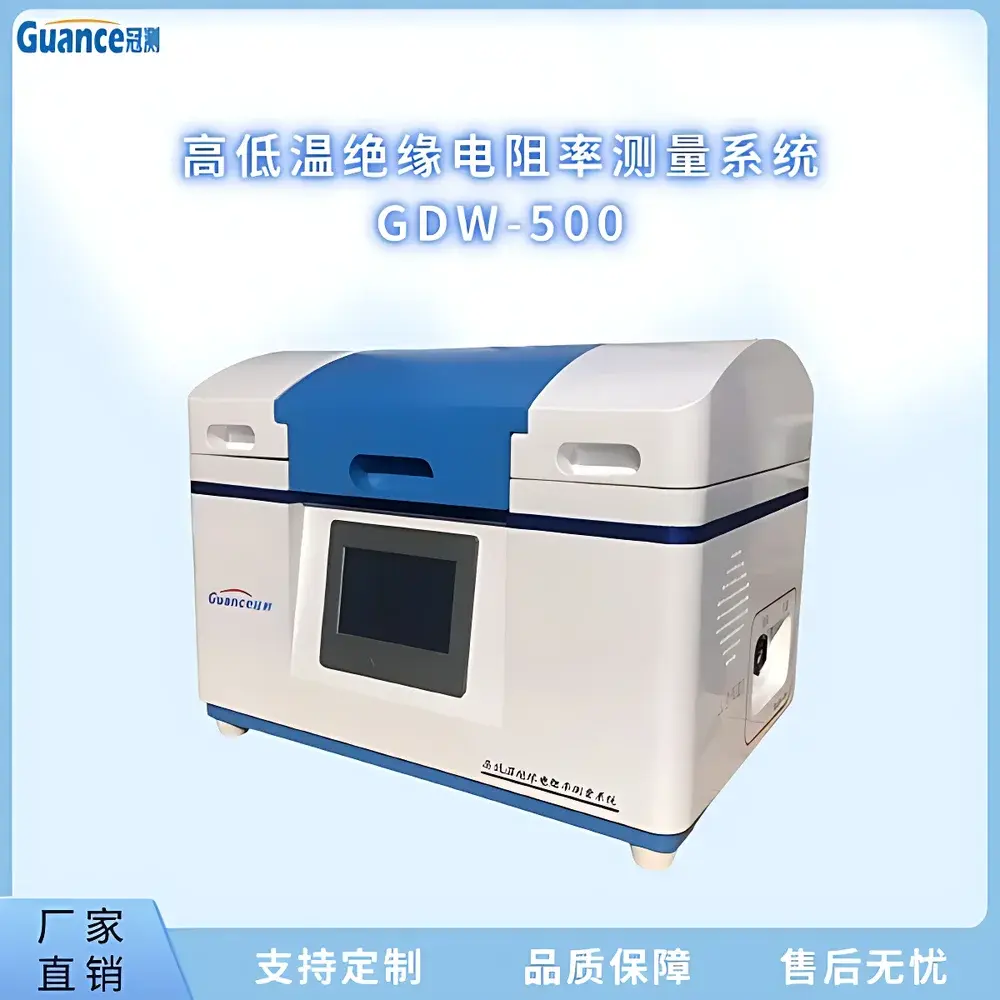
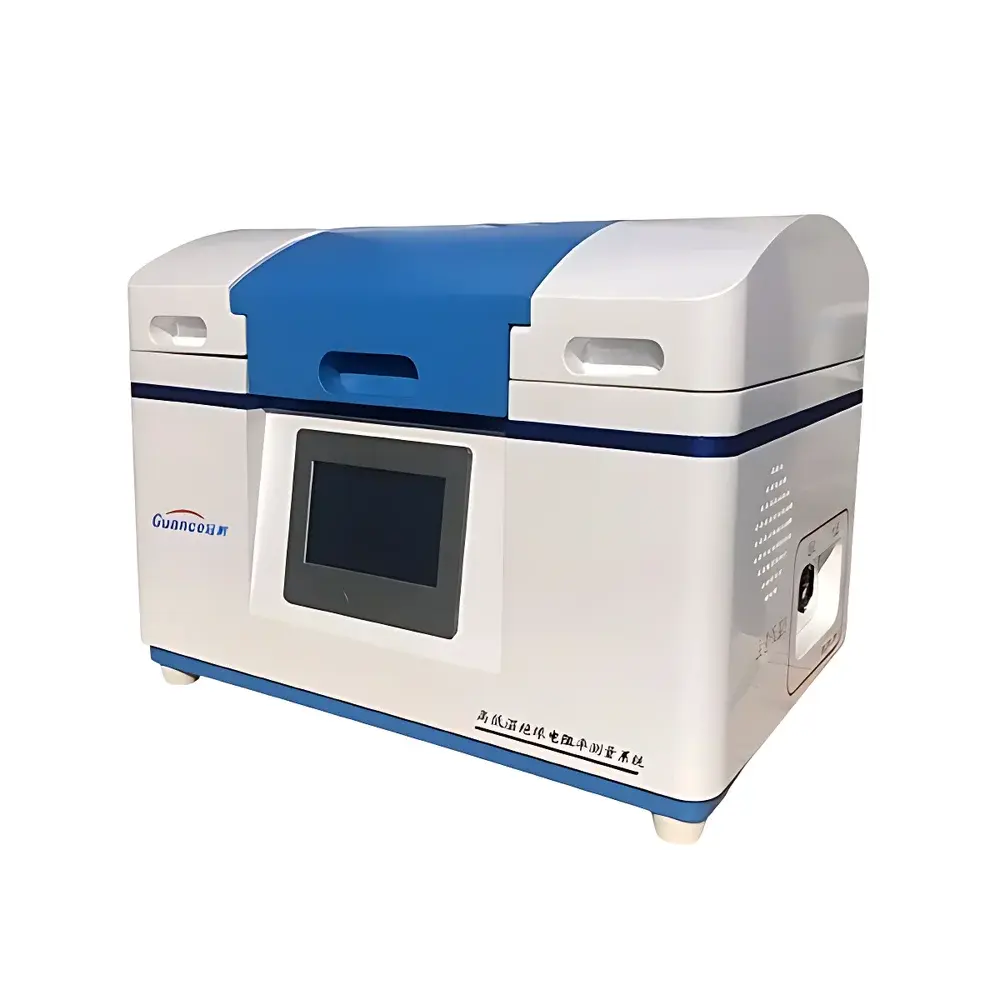
GuanCe Instruments GDW-500.2 High-Low Temperature Dielectric Constant Measurement System
| Brand | GuanCe Instruments |
|---|---|
| Origin | Beijing, China |
| Manufacturer Type | Authorized Distributor |
| Country of Origin | China |
| Model | GDW-500.2 |
| Price | USD 1,700 (approx.) |
Overview
The GuanCe Instruments GDW-500.2 High-Low Temperature Dielectric Constant Measurement System is an engineered solution for precision characterization of dielectric properties—specifically permittivity (ε′, ε″) and loss tangent (tan δ)—of solid and liquid dielectric materials across an ultra-wide thermal range from −160 °C to +500 °C. It operates on the principle of impedance spectroscopy using a calibrated LCR bridge, enabling quantitative determination of complex capacitance under controlled thermal conditions. The system integrates a cryogenic–high-temperature test chamber with active temperature regulation via electric heating and liquid nitrogen cooling, ensuring stable thermal equilibrium during dynamic or static dielectric measurements. Designed for rigorous R&D environments, it supports fundamental studies of polarization mechanisms—including dipolar, interfacial (Maxwell–Wagner), and ionic conduction effects—as functions of both frequency (20 Hz–2 MHz) and temperature. Its architecture conforms to the physical measurement paradigms defined in ASTM D150, IEC 60250, GB/T 1409–2006, and GB/T 1693–2007, making it suitable for materials qualification in academic laboratories, national research institutes, and industrial R&D centers developing advanced ceramics, polymer composites, ferroelectrics, and high-temperature insulators.
Key Features
- Thermal control range: −160 °C to +500 °C, achieved via dual-mode regulation—electric resistance heating and direct liquid nitrogen injection into the cold stage
- Temperature stability: ±0.5 °C at steady state, verified by integrated Pt100 sensor with real-time feedback loop
- Electrode configuration: Precision-machined brass parallel-plate electrodes (25 mm diameter), optimized for low contact impedance and uniform field distribution
- Frequency sweep capability: Full programmable LCR measurement from 20 Hz to 2 MHz, supporting single-point, multi-frequency, and continuous logarithmic sweeps
- Measurement modes: Simultaneous acquisition of absolute/relative permittivity (real and imaginary components), dielectric loss factor, capacitance, and volume resistivity
- Modular hardware design: Interchangeable electrode fixtures accommodate thin films, bulk discs, powders (with pelletizing jig), and liquid cells
Sample Compatibility & Compliance
The GDW-500.2 accommodates rigid solids (ceramics, glasses, sintered oxides), flexible polymers, elastomers (e.g., silicone rubber per GB/T 1693), thin-film coatings, and low-conductivity liquids (e.g., transformer oils, ionic liquids). Sample thickness is adjustable via micrometer-driven electrode spacing (0.1–5 mm range). All measurement protocols align with internationally recognized standards: ASTM D150–22 (dielectric constant and dissipation factor of solid electrical insulating materials), IEC 60250 (ac methods for permittivity and tan δ), GB/T 1409–2006 (capacitance and loss factor over broad frequency bands), and GB/T 1693–2007 (rubber-specific dielectric characterization). Data traceability meets GLP requirements, with timestamped metadata, operator ID logging, and configurable audit trails for regulated environments.
Software & Data Management
The proprietary GuanCe DielectricSuite software provides full instrument control, real-time visualization, and post-processing analytics. It supports six core operational workflows: (1) isothermal frequency sweeps; (2) isofrequency temperature ramps; (3) Arrhenius and Vogel–Fulcher–Tammann fitting for activation energy extraction; (4) Cole–Cole and Havriliak–Negami modeling of relaxation spectra; (5) batch export of raw .csv/.xlsx datasets with column headers compliant with ASTM E1318; and (6) automated report generation including calibration certificates, uncertainty budgets (based on LCR bridge accuracy class ±0.05%), and comparative overlay plots. All data files include embedded metadata: ambient humidity, chamber pressure (for cryo-vacuum configurations), thermal ramp rate, and electrode contact resistance monitoring.
Applications
- Development and screening of high-k dielectrics for microelectronics packaging and gate stack integration
- Thermal stability assessment of piezoelectric ceramics (e.g., PZT, BaTiO₃) under operational temperature cycling
- Characterization of space-grade polymer insulation for satellite power systems operating below −100 °C
- Quality control of ceramic substrates used in automotive sensors exposed to exhaust manifold temperatures
- Fundamental study of glass transition dynamics in amorphous polymers via dielectric α-relaxation mapping
- Correlation of moisture uptake in epoxy encapsulants with low-frequency dielectric dispersion and DC conductivity rise
FAQ
What temperature calibration standards are supported?
The system includes NIST-traceable Pt100 calibration certificates and supports user-defined calibration tables per IEC 60751 Class A tolerance. External reference thermometers (e.g., Lake Shore DT-670) can be integrated via analog input.
Can the system perform simultaneous AC/DC measurements?
Yes—optional high-voltage DC bias module (up to ±1 kV) enables combined dielectric spectroscopy and DC resistivity mapping under thermal stress.
Is the software compliant with FDA 21 CFR Part 11?
The current release supports electronic signatures, role-based access control, and audit trail export; full Part 11 compliance requires on-site validation package and IQ/OQ documentation (available upon request).
What electrode configurations are available beyond the standard 25-mm brass plates?
Custom options include interdigitated electrodes (IDEs) for thin-film anisotropy studies, guarded three-terminal setups for surface resistivity suppression, and coaxial liquid cells with Teflon seals.
How is condensation managed during low-temperature operation?
The chamber features dual-stage purge ports for dry nitrogen or argon gas flow, plus internal dew-point monitoring to maintain <−40 °C dew point during sub-ambient runs.



