
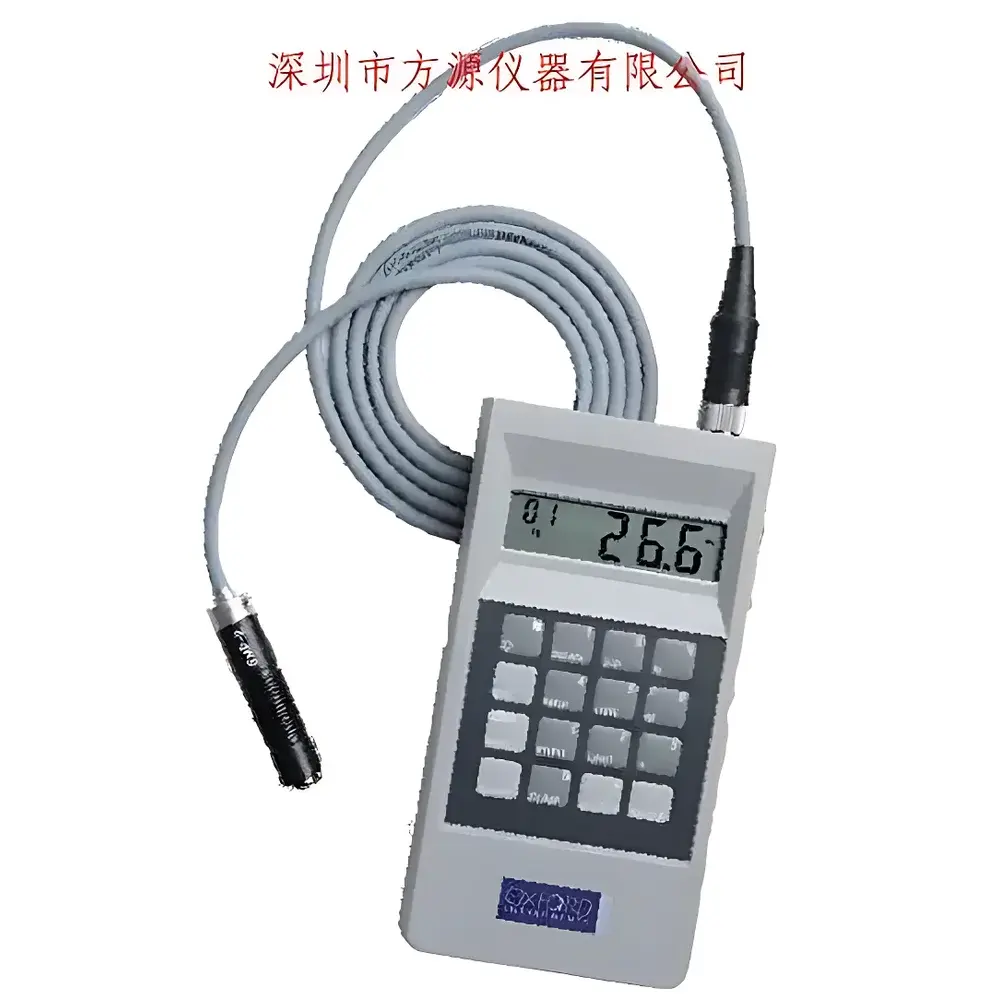
Oxford Instruments CMI-233 Electromagnetic Eddy Current & Magnetic Induction Coating Thickness Gauge
| Brand | Oxford Instruments |
|---|---|
| Origin | USA |
| Model | CMI-233 |
| Measurement Principle | Dual-mode (Magnetic Induction for ferrous substrates |
| Measurement Range | 0–3.05 mm (magnetic induction), 0–1.52 mm (eddy current) |
| Accuracy | ±1% or ±0.1 µm (per certified reference standards) |
| Resolution | 0.1 µm |
| Minimum Substrate Thickness | 0.35 mm |
| Minimum Curvature Radius | 5 mm (convex), 25 mm (concave) |
| Minimum Test Area | Ø20 mm |
| Standards Compliance | ASTM B499, B530, B244, B259 |
| Data Storage | 12,400 readings |
| Display | 1/2-inch backlit LCD |
| Interface | RS-232 serial port |
| Power | 9 V alkaline or rechargeable battery |
| Weight | 260 g (with battery) |
| Dimensions | 149 × 79.4 × 30.2 mm |
| Statistical Functions | Mean, SD, min/max, histogram, CPK |
| Units | Switchable between metric (µm, mm) and imperial (mils) |
Overview
The Oxford Instruments CMI-233 is a dual-principle, hand-held coating thickness gauge engineered for high-reproducibility measurement of non-magnetic coatings on ferromagnetic substrates (e.g., Zn, Cr, epoxy, or paint on steel) and non-conductive coatings on non-ferrous conductive substrates (e.g., anodized layers, enamel, or powder coatings on aluminum or copper). Its operation relies on two well-established electromagnetic principles: magnetic induction (per ASTM B499 and ISO 2178) for ferrous base materials, and eddy current (per ASTM B244 and ISO 2360) for non-ferrous conductive substrates. This dual-mode architecture eliminates the need for instrument swapping across diverse production lines—enabling consistent, traceable thickness verification in multi-material manufacturing environments such as automotive body shops, aerospace component finishing, pipeline corrosion protection, and electronics surface treatment.
Key Features
- Dual-sensor capability: Single-probe (CMI-233, order no. 20706) and dual-probe (CMI-233, order no. 20707) configurations support rapid transition between magnetic and eddy current measurement modes without recalibration.
- High-resolution metrology: 0.1 µm resolution with accuracy certified to ±1% or ±0.1 µm against NIST-traceable reference standards—meeting QC requirements for ISO 9001 and IATF 16949 auditable processes.
- Rugged industrial design: Sealed membrane keypad, IP54-rated enclosure, and shock-absorbing housing ensure reliable operation in shop-floor conditions—including humid paint booths, abrasive sandblasting zones, and offshore marine maintenance decks.
- On-device statistical analysis: Real-time calculation of mean, standard deviation, min/max values, and process capability indices (CPK); histogram generation supports SPC implementation without external software.
- Configurable scanning mode: Time-based averaging over user-defined intervals (e.g., 2–10 seconds) delivers representative thickness values across curved or textured surfaces—critical for validating coating uniformity on cylindrical pipes or contoured auto body panels.
Sample Compatibility & Compliance
The CMI-233 accommodates a broad range of industrial substrate-coating combinations. For ferrous substrates (steel, iron), it measures non-magnetic layers ≥0.35 mm thick—including electroplated Zn, Cd, Sn, Ni; thermoset epoxies; PTFE films; and liquid-applied paints. For non-ferrous conductive bases (Al, Cu, brass), it quantifies insulating layers such as anodized oxides, porcelain enamel, powder coatings, and polymeric laminates. Minimum measurable curvature radii are specified at 5 mm (convex) and 25 mm (concave), supporting inspection of small-diameter tubing and deep-drawn components. All measurement protocols align with internationally recognized standards: ASTM B499/B530 (magnetic), ASTM B244/B259 (eddy current), ISO 2178/2360, DIN 50981/50984, and BS 5411 Parts 3, 9, and 11—ensuring data acceptability in third-party audits, supplier qualification programs, and regulatory submissions.
Software & Data Management
Data export is facilitated via RS-232 serial interface to PCs or printers, enabling direct integration into LIMS or MES platforms. Raw readings (12,400 stored points) retain timestamp, probe ID, and operator code—supporting GLP-compliant recordkeeping. Optional PC software provides advanced reporting: batch-level trend charts, pass/fail flagging against user-defined tolerances, and PDF export with embedded calibration certificate metadata. While the CMI-233 does not implement FDA 21 CFR Part 11 electronic signature controls natively, its audit-ready data structure—including immutable readout logs and uneditable statistical summaries—serves as foundational evidence for GMP-aligned quality systems where manual review workflows are established.
Applications
- Automotive: Verification of e-coat thickness on chassis, zinc-nickel plating on fasteners, and clear-coat build on painted panels.
- O&G Infrastructure: Monitoring fusion-bonded epoxy (FBE) thickness on API 5L pipe joints prior to field burial.
- Aerospace: Measuring anodized layer thickness on aluminum airframe components per AMS-A-8625.
- Electronics: Quantifying solder mask thickness on PCBs and conformal coating integrity on assembled modules.
- General Manufacturing: In-line QA of powder-coated appliance housings, galvanized steel sheet, and decorative chrome on plastic substrates.
FAQ
Can the CMI-233 measure coatings on stainless steel?
Yes—provided the stainless steel grade is ferritic or martensitic (magnetic). Austenitic grades (e.g., 304, 316) are non-magnetic and require eddy current mode; however, their lower conductivity may reduce signal-to-noise ratio, necessitating validation with substrate-matched calibration standards.
Is probe calibration required before each use?
No. The CMI-233 features factory-calibrated probes with stable zero-point drift (<0.05 µm/month). Daily verification using certified shims (e.g., Fe/Cu-backed foil sets) satisfies ISO 17025 traceability requirements.
Does the instrument support custom tolerance limits for go/no-go screening?
Yes. Up to three user-defined upper/lower specification limits can be programmed per job ID. Exceedance triggers audible alerts and auto-flagging in stored datasets.
What is the recommended recalibration interval?
Oxford Instruments recommends annual recalibration by an accredited service center (ISO/IEC 17025) or in-house metrology lab using NIST-traceable reference standards—aligned with ISO 9001 Clause 7.1.5.
Can data be exported to Excel-compatible formats?
Yes. ASCII text output via RS-232 includes tab-delimited fields (reading ID, µm/mils value, date/time, probe type, job name), directly importable into Excel, Minitab, or JMP for further SPC analysis.
Related Products



