
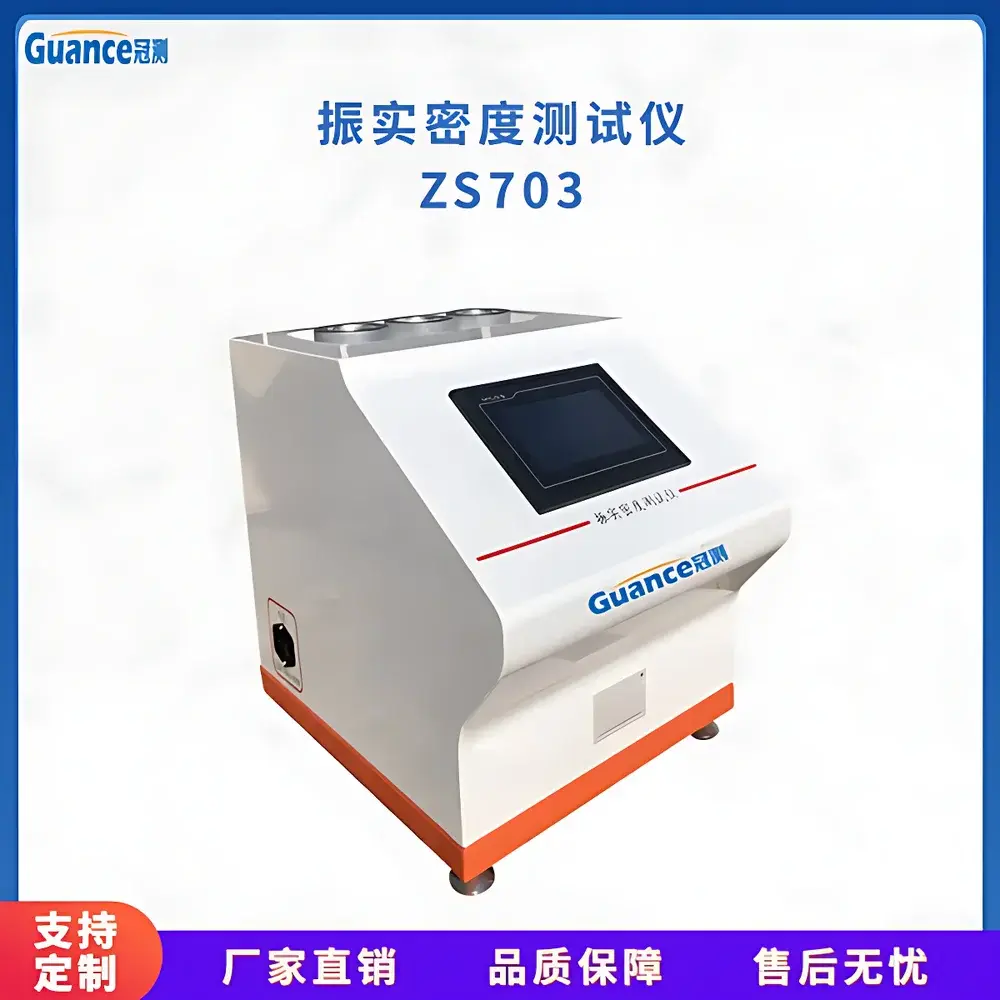
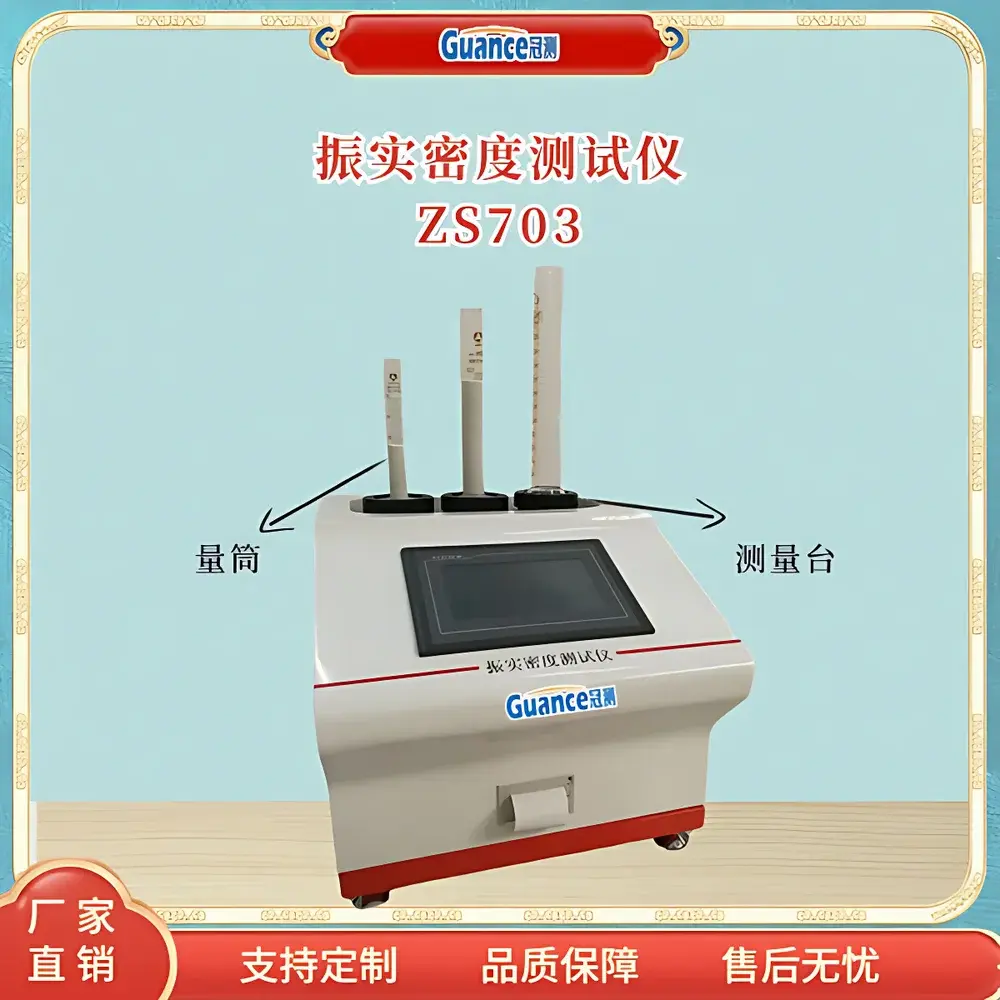
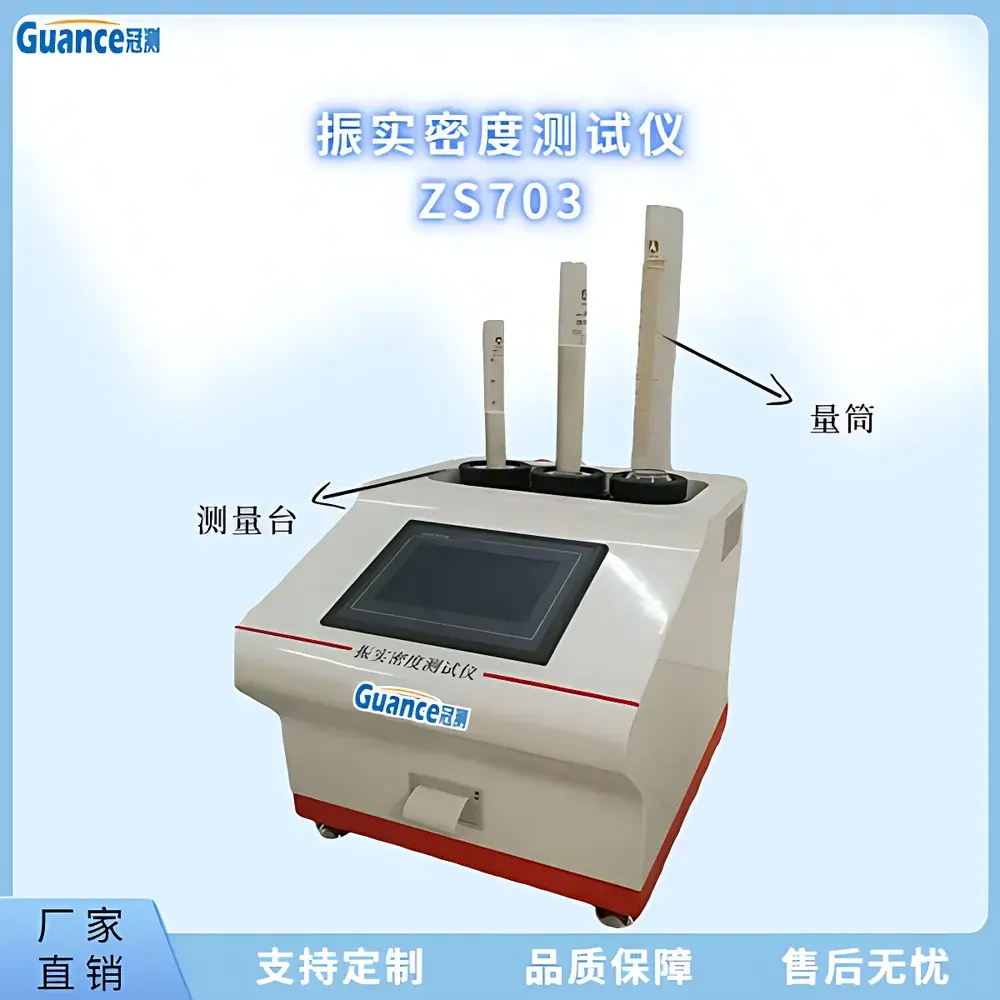
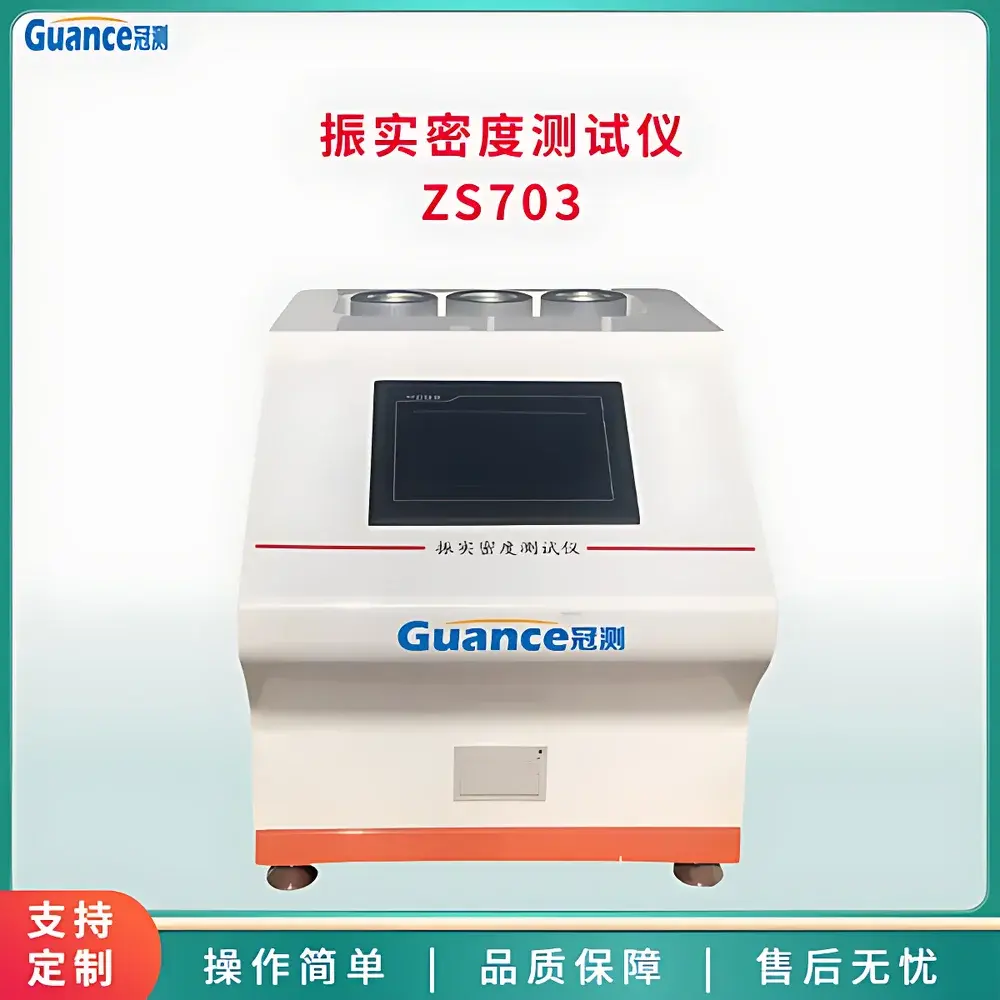
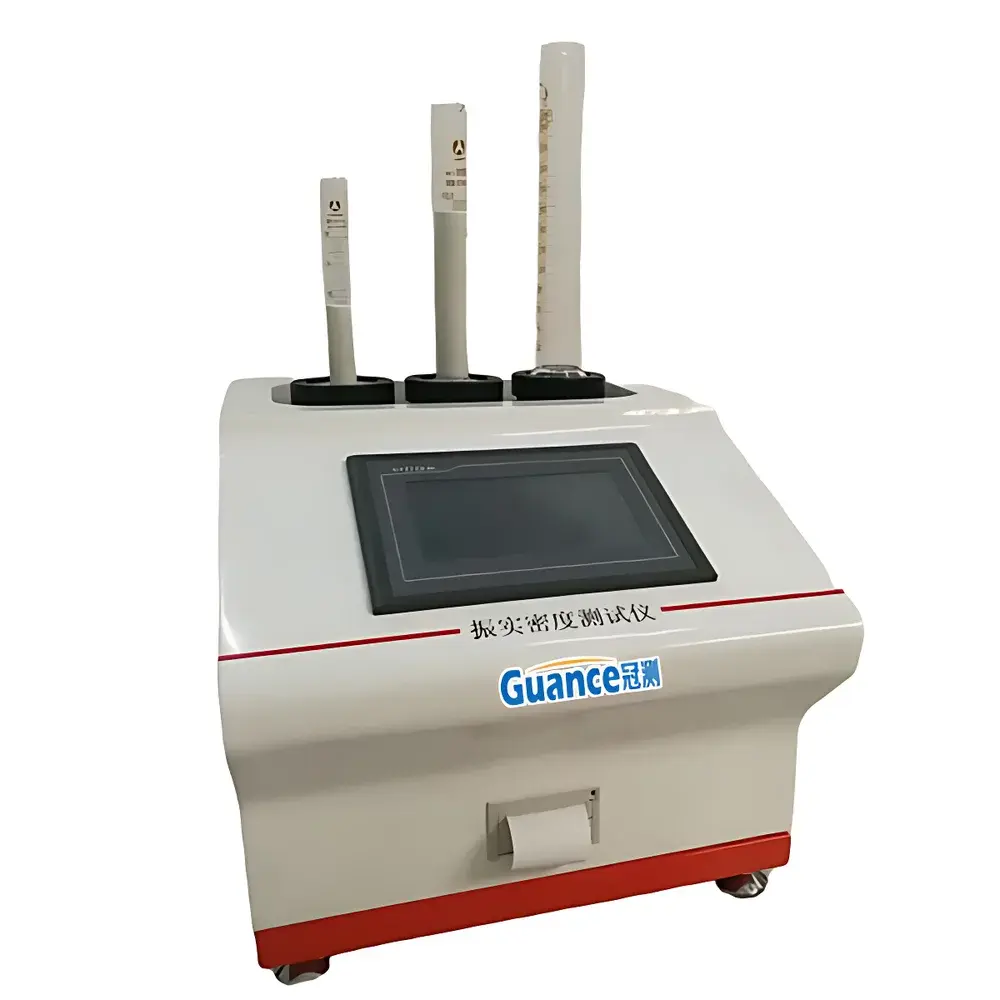
Guance Instruments ZS703 Tap Density Tester
| Brand | Guance Instruments |
|---|---|
| Origin | Beijing, China |
| Manufacturer Type | Authorized Distributor |
| Country of Origin | China |
| Model | ZS703 |
| Instrument Type | Tap Density Tester |
| Density Measurement Principle | Volumetric Displacement with Standardized Mechanical Tapping |
| Applicable Standards | ASTM D1464, ISO 3953, USP <616>, GB/T 5162 |
| Maximum Sample Weight | 500.00 g |
| Vibration Amplitude | 3 mm |
| Vibration Frequency | Adjustable (0–300 taps/min) |
| Number of Taps per Cycle | Programmable (0–9999) |
| Repeatability | ≤1% RSD (n=10, standard reference powder) |
| Display | 7-inch HD capacitive touch screen with embedded PLC controller |
| Power Supply | AC 220 V, 50/60 Hz |
| Rated Power | 100 W |
| Sample Compaction Mode | Rotational tapping (±5° oscillation during vibration for uniform powder distribution) |
| Test Capacity | Up to 3 independent test sequences per session |
| Minimum Sample Volume | ≥5 mL (dependent on powder flowability and container geometry) |
Overview
The Guance Instruments ZS703 Tap Density Tester is an engineered solution for the standardized determination of tap density — a critical physical property in powder characterization across pharmaceuticals, battery materials, metal additive manufacturing feedstocks, catalysts, and ceramic precursors. Tap density reflects the bulk density achieved after mechanical densification of a powder sample under controlled, reproducible tapping conditions. Unlike true density (measured via gas pycnometry) or apparent density (measured without compaction), tap density quantifies the packing behavior of free-flowing or cohesive powders when subjected to gravitational settling augmented by regulated vertical impact. The ZS703 implements the core principle defined in ASTM D1464 (Standard Test Method for Tap Density of Metal Powders) and ISO 3953 (Determination of Tap Density of Powders), utilizing a precision cam-driven tapper mechanism with programmable amplitude (3 mm), frequency, and total tap count. Its integrated rotational oscillation (±5°) during tapping ensures lateral redistribution of particles, minimizing wall adhesion and promoting homogeneous compaction — a key differentiator from fixed-axis tap testers.
Key Features
- Programmable tap control: Users define tap count (0–9999), tap rate (0–300 taps/min), and rest intervals between cycles — enabling method alignment with pharmacopeial standards (e.g., USP requires 1250 taps at 250 taps/min) or internal SOPs.
- Rotational tapping architecture: A synchronized angular oscillation (±5°) occurs concurrently with vertical tapping, enhancing particle rearrangement and reducing segregation bias — particularly beneficial for polydisperse or irregularly shaped powders.
- Dedicated 7-inch HD capacitive touchscreen interface: Hosts an embedded PLC-based control system with on-device data logging, real-time status feedback, and password-protected method storage (up to 20 user-defined protocols).
- Modular sample holder design: Accommodates standard cylindrical graduated cylinders (10–100 mL volumes) with calibrated volume markings traceable to NIST-certified glassware; optional stainless-steel or borosilicate variants available for corrosive or hygroscopic samples.
- Stable mechanical platform: Heavy-duty aluminum alloy chassis with anti-vibration feet ensures minimal energy loss and high inter-laboratory reproducibility — validated against certified reference materials (e.g., NIST SRM 1978 alumina powder).
- Compliance-ready operation: Supports GLP/GMP workflows via timestamped test records, operator ID tagging, and audit-trail-capable firmware (optional 21 CFR Part 11 compliance package available upon request).
Sample Compatibility & Compliance
The ZS703 accommodates dry, free-flowing, and moderately cohesive powders within a mass range of 10–500.00 g. It is not intended for wet slurries, fibrous materials, or temperature-sensitive compounds requiring environmental control. Sample containers are selected based on powder compressibility and required resolution: low-density foams may require larger volumes (>50 mL) to minimize meniscus error, while high-density metal powders achieve statistical confidence at ≤25 mL. The instrument conforms to the dimensional and procedural requirements of ISO 3953:2011, ASTM D1464–18, and USP Chapter “Bulk Density and Tapped Density of Powders.” All firmware and calibration procedures are documented per ISO/IEC 17025:2017 clause 7.7 (Measurement Traceability) and support third-party verification.
Software & Data Management
Data acquisition and reporting are handled natively via the onboard HMI. Each test generates a timestamped record containing: sample ID, operator name, cylinder ID, initial/final volume readings, tap parameters, calculated tap density (g/cm³), and % relative standard deviation (RSD) for replicate runs. Export is supported via USB flash drive in CSV format for integration into LIMS or statistical analysis platforms (e.g., JMP, Minitab). Optional PC-based software (ZS-Link Suite v2.1) provides advanced features including multi-parameter trend analysis, SPC charting, PDF report generation with digital signature fields, and automated compliance checks against configurable acceptance criteria.
Applications
- Pharmaceutical formulation: Quantifying excipient compressibility for tablet development and predicting die-fill consistency during high-speed compression.
- Lithium-ion battery cathode/anode material QC: Monitoring batch-to-batch consistency of nickel-manganese-cobalt (NMC) or graphite powders prior to slurry mixing.
- Metal injection molding (MIM): Validating feedstock powder packing density to ensure green part dimensional stability and sintered density uniformity.
- Food ingredient processing: Assessing flowability and handling characteristics of powdered dairy, spices, or functional additives.
- Research laboratories: Supporting DEM (Discrete Element Modeling) parameterization and validating constitutive models for powder rheology simulations.
FAQ
What standards does the ZS703 comply with?
The instrument meets the mechanical and procedural specifications of ASTM D1464, ISO 3953, USP , and GB/T 5162. Calibration certificates reference traceable volume standards and certified reference powders.
Can the ZS703 measure true density?
No. True density measurement requires gas displacement pycnometry (e.g., helium pycnometer). The ZS703 measures only tap density — a bulk property dependent on particle packing efficiency.
Is temperature or humidity control integrated?
The ZS703 operates at ambient laboratory conditions (15–30°C, RH ≤70%). Environmental control is external and must be maintained per ISO 29553 for moisture-sensitive powders.
How is repeatability verified?
Repeatability is assessed using certified reference materials (e.g., NIST SRM 1978) under identical tap parameters; typical RSD is ≤0.8% for 10 consecutive runs.
Does the instrument support IQ/OQ/PQ documentation?
Yes. Comprehensive qualification templates (including test scripts, acceptance criteria, and evidence logs) are provided with purchase for installation qualification (IQ), operational qualification (OQ), and performance qualification (PQ) under GMP environments.



