
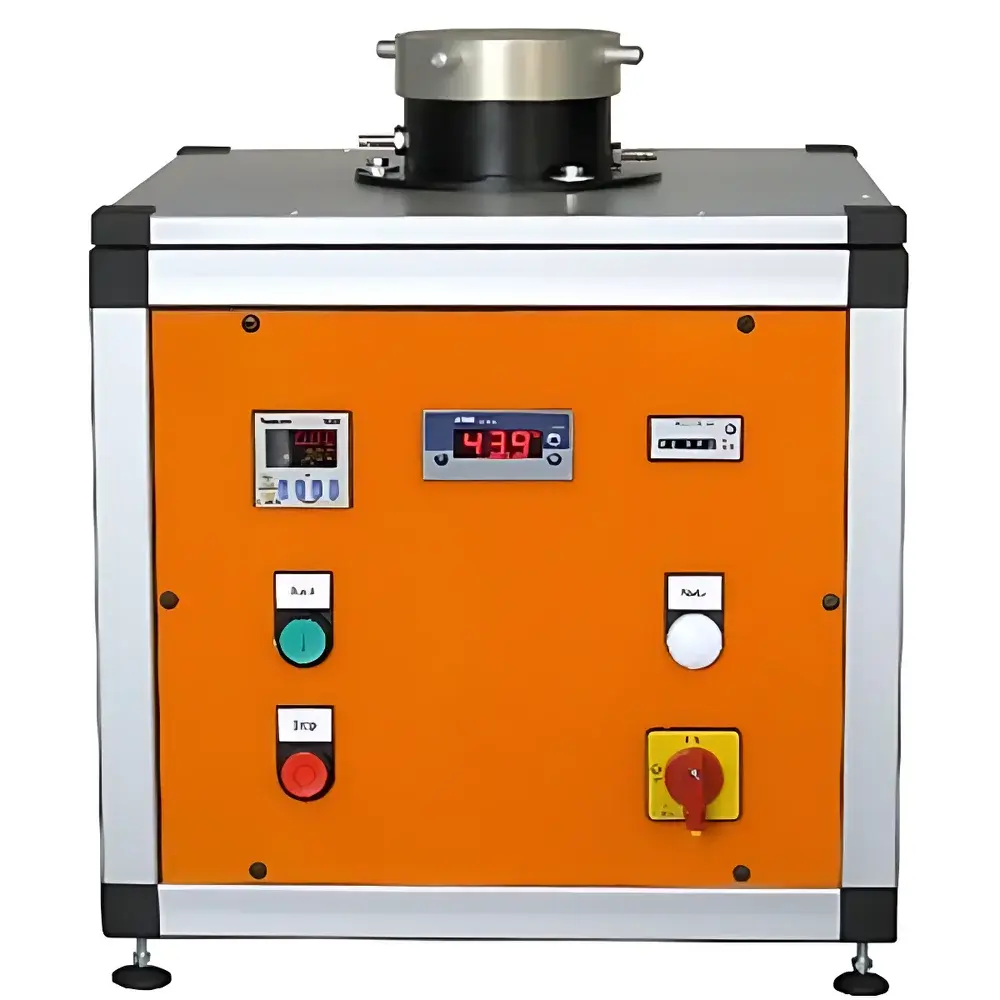
Grease Worker by TTZH – Lubricant Shear Stability Tester
| Brand | TTZH |
|---|---|
| Origin | Germany |
| Manufacturer Type | Authorized Distributor |
| Origin Category | Imported |
| Model | Grease Worker |
| Test Speed | 1550 rpm |
| Max Test Temperature | 70 °C |
| Sample Mass Required | 40 g |
| Observation | Transparent Top Cover with Real-Time Visual Monitoring |
| Thermal Management | Integrated Cooling & Overheat Protection |
| Test Duration | ~90 Minutes |
| Consistency Assessment | Post-Shear Penetration or Structural Recovery Analysis |
Overview
The Grease Worker by TTZH is a precision-engineered laboratory instrument designed to evaluate the shear stability of lubricating greases under controlled, reproducible mechanical stress. Based on the principle of continuous high-shear circulation in a closed-loop gear pump system, the device subjects grease samples to defined hydrodynamic shear fields analogous to those encountered in rolling element bearings (e.g., ball and cylindrical roller bearings) and sliding interfaces. Unlike static penetration or dropping point tests, this method captures dynamic structural degradation—specifically, the breakdown of thickener networks and base oil separation—under conditions mimicking service-relevant shear rates. The test chamber operates horizontally to ensure uniform flow distribution and minimize gravitational segregation effects. Its compact footprint and integrated thermal control make it suitable for routine QC labs, R&D facilities, and third-party testing laboratories requiring ISO/ASTM-aligned grease performance evaluation.
Key Features
- Compact horizontal gear-pump circulation system delivering consistent 1550 rpm rotational shear stress across the entire sample volume
- Real-time visual monitoring via optically transparent polycarbonate top cover, enabling direct observation of texture changes, oil bleeding, or phase separation during operation
- Digital temperature control with PID-regulated heating and active cooling circuitry, maintaining test temperatures from ambient up to 70 °C with ±0.5 °C stability
- Low sample requirement of only 40 g per test—minimizing material consumption while preserving statistical relevance for batch qualification
- Integrated overheat protection with automatic shutdown and thermal fault logging, compliant with IEC 61000-6-2 electromagnetic compatibility and EN 61010-1 safety standards
- Modular design supporting post-test consistency analysis using standard penetrometers (e.g., ASTM D217, ISO 2137) or rheometric follow-up measurements
Sample Compatibility & Compliance
The Grease Worker accommodates NLGI grades 000 through 3, including lithium-, calcium-, aluminum-, polyurea-, and clay-thickened greases, as well as synthetic ester- and PAO-based formulations. It is compatible with both mineral and bio-based base oils. The test protocol aligns with key industry reference methods, including ASTM D1831 (Standard Test Method for Roll Stability of Lubricating Grease), though adapted for accelerated shear exposure in a closed hydraulic loop rather than roller compaction. While not a direct replacement for DIN 51821 or ISO 2137, its output—particularly post-test penetration delta (Δpen) and visual degradation index—is routinely accepted for internal specification conformance, supplier qualification, and formulation screening. All electrical components meet CE marking requirements; documentation supports GLP audit trails when paired with calibrated external instrumentation.
Software & Data Management
The Grease Worker operates as a standalone hardware platform without embedded firmware or proprietary software. Temperature, runtime, and pump status are displayed on an integrated LED interface with non-volatile event logging (start time, max temp reached, shutdown cause). For traceable data management, users integrate the device into existing LIMS or ELN environments via RS-232 or optional USB-to-serial adapter. Timestamped test records—including operator ID, lot number, ambient lab conditions, and post-test analytical results—can be exported in CSV format. When used in regulated environments (e.g., automotive Tier-1 suppliers or pharmaceutical equipment lubrication validation), the system supports 21 CFR Part 11 compliance when paired with validated electronic signatures and audit trail-enabled software layers.
Applications
- Formulation development: Screening thickener–base oil interactions and additive package robustness under shear
- Batch release testing: Verifying shear stability consistency across production lots prior to shipment
- OEM lubricant qualification: Supporting OEM-specific grease specifications requiring dynamic shear resistance data
- Failure analysis: Correlating field-reported bearing wear or grease hardening with laboratory shear degradation profiles
- Compatibility assessment: Evaluating mixing behavior and structural integrity when blending greases in maintenance scenarios
- Regulatory dossier preparation: Generating technical evidence for ISO/TS 16949, VDA 6.3, or API Q1 audits related to lubricant control plans
FAQ
What standards does the Grease Worker directly comply with?
It is engineered to support methodologies referenced in ASTM D1831 and DIN 51821, though it implements a distinct shear mechanism. Validation data must be generated per internal SOPs aligned with customer or regulatory acceptance criteria.
Can the device be used for greases containing solid additives (e.g., MoS₂ or PTFE)?
Yes—provided particle size remains below 50 µm and concentration does not exceed 15 wt%, to prevent pump abrasion or clogging. Pre-screening via sedimentation analysis is recommended.
Is calibration required before each test?
No routine calibration is needed for pump speed or temperature sensors, as they are factory-traceable to DKD/DAkkS-accredited standards. Annual verification using NIST-traceable thermocouples and tachometers is advised.
How is repeatability ensured across different operators?
Standardized sample loading procedure (including degassing, fill level, and pre-conditioning at 25 °C for 2 h), combined with fixed 90-minute duration and identical ramp profiles, delivers inter-operator RSD < 4.2% for post-test penetration (n = 12, ASTM D217).
Does TTZH provide application support or method development assistance?
Yes—TTZH’s technical applications team offers remote method optimization, troubleshooting, and interpretation guidance for shear stability data, including correlation to bearing life models (e.g., SKF Generalized Bearing Life Model).






