
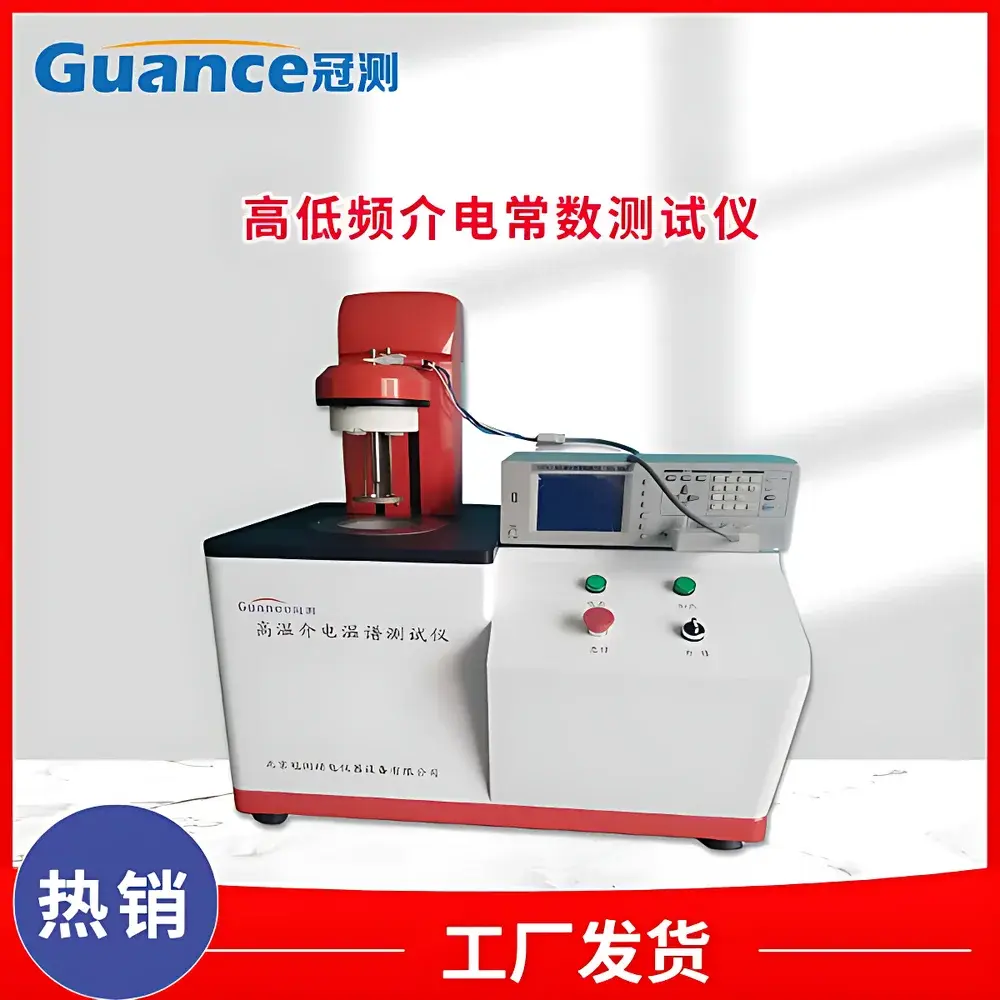
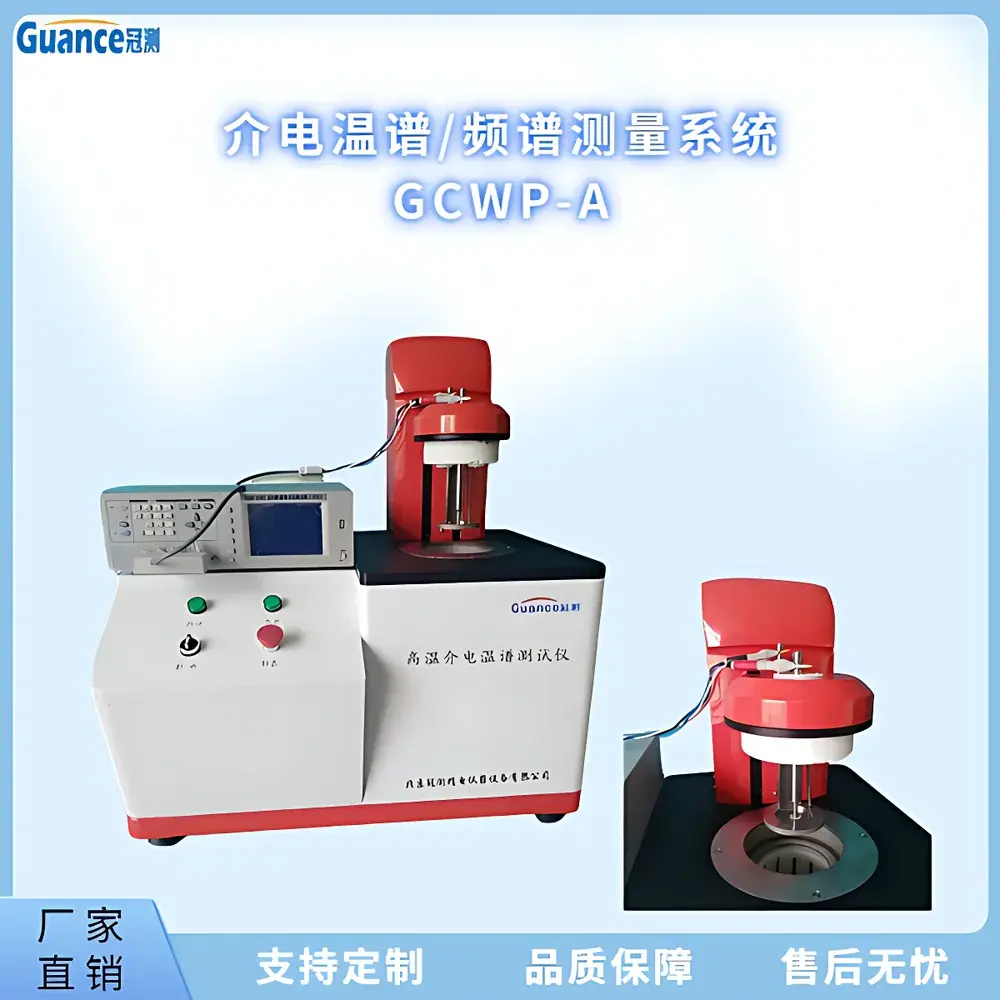
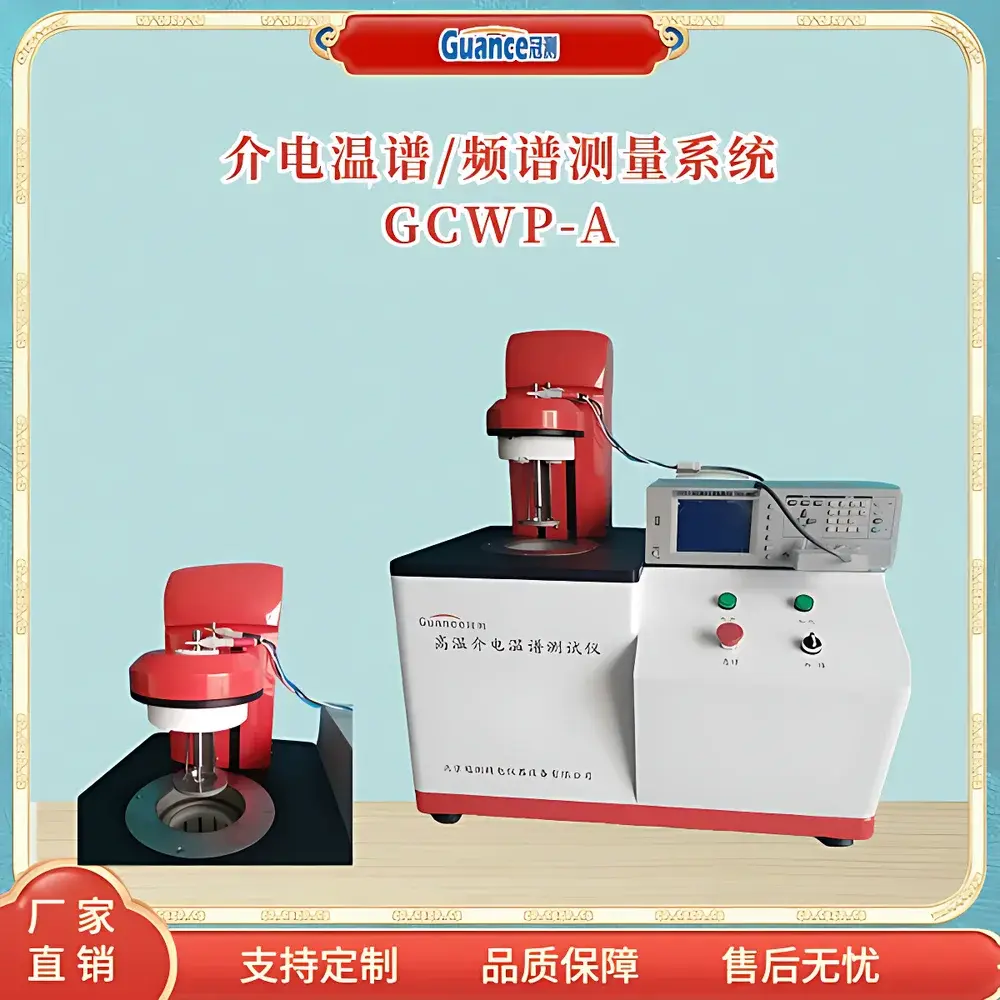
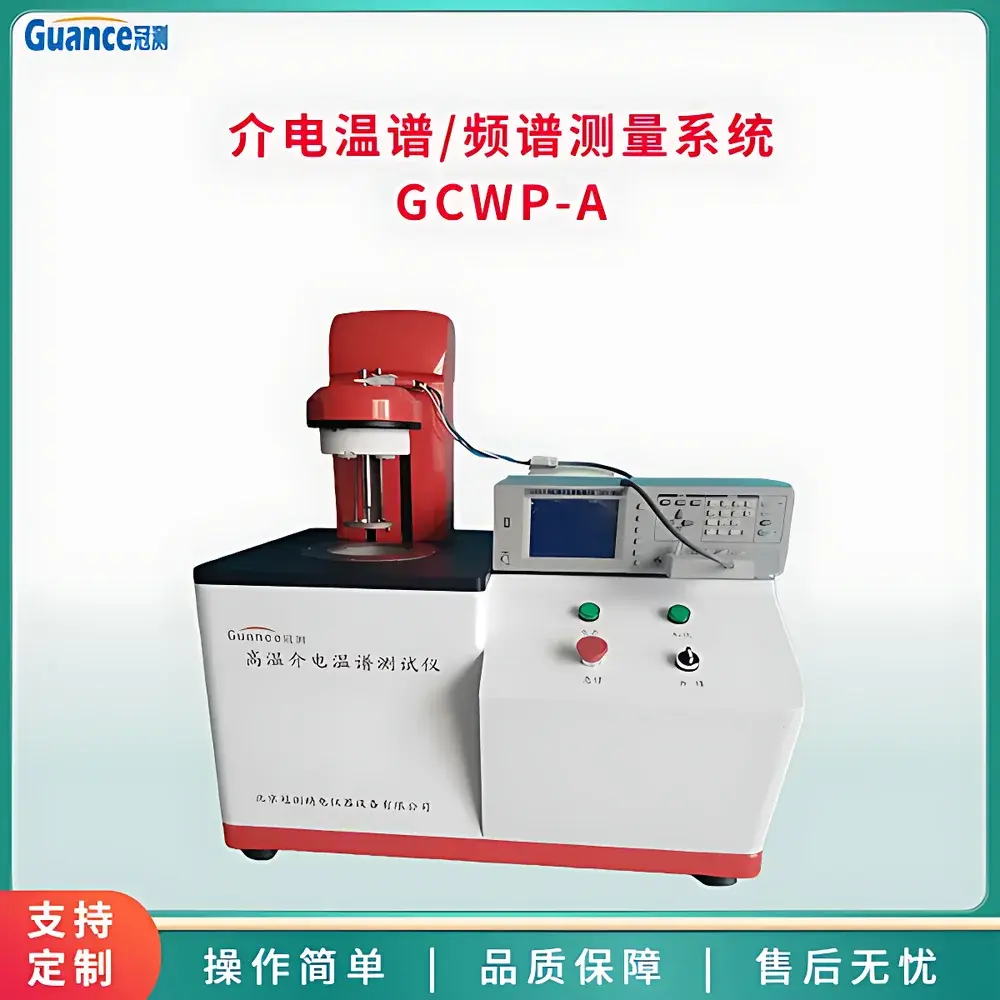
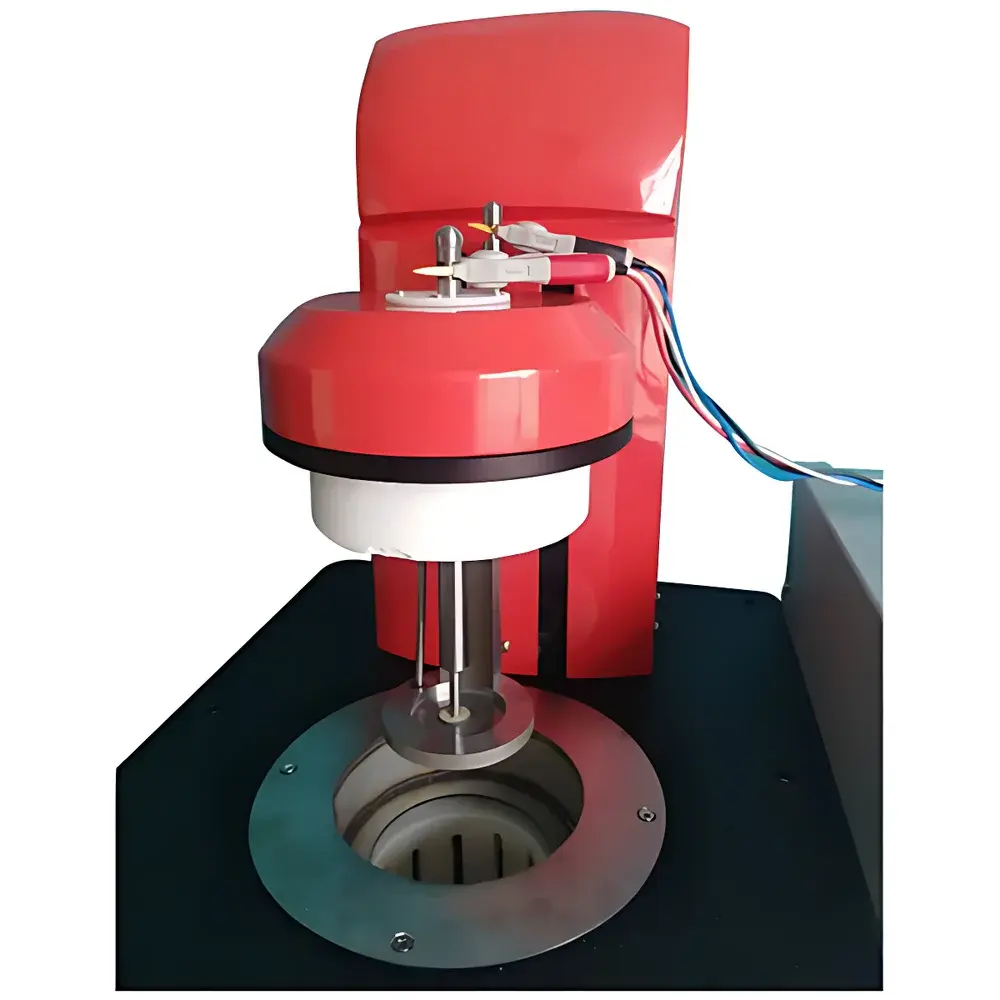
GuanCe Instruments GCWP-A4 Dielectric Constant Analyzer for Ferroelectric Materials
| Brand | GuanCe Instruments |
|---|---|
| Model | GCWP-A4 |
| Measurement Principle | Precision Impedance Bridge (Agilent 4294A-based) |
| Electrode Configuration | Quadruple-channel guarded electrode system (4 × 6 mm stainless-steel electrodes) |
| Shielding | Dual-layer coaxial shielding — inner tube: 304 stainless steel, outer jacket: PTFE |
| Temperature Range | −180 °C to +500 °C |
| Heating Rate | 0.5–2.5 °C/min |
| Data Interface | Silver-plated copper low-noise cryogenic shielded cables |
| Compliance | Designed for ASTM D150, IEC 60250, and ISO 257-1/2 environments |
| Power Supply | AC 220 V, 50 Hz, 2 kW |
| Enclosure | Q235 steel chassis with high-temp epoxy powder coating |
| Operating Environment | Requires low-vibration, low-dust, EMI-shielded laboratory |
| Data Output | Raw impedance spectra (.csv), loss tangent (tan δ) vs. frequency/temperature plots, printable test reports with timestamped metadata |
Overview
The GuanCe Instruments GCWP-A4 Dielectric Constant Analyzer is a high-stability, temperature-controlled impedance spectroscopy platform engineered specifically for the characterization of ferroelectric, piezoelectric, and high-k dielectric materials across extreme thermal conditions. It operates on the fundamental principle of precision AC impedance measurement using a calibrated Agilent 4294A precision LCR meter as its core bridge engine—ensuring traceable accuracy in capacitance (C), dissipation factor (D), and complex permittivity (ε* = ε′ − jε″) determination. The system integrates a quadruple-channel guarded electrode assembly housed within a dual-layer electrostatic and thermal shield, enabling concurrent, interference-minimized evaluation of up to four identical or dissimilar specimens under identical thermal and electrical boundary conditions. Its operational range spans from cryogenic temperatures (−180 °C) to high-temperature ceramic sintering regimes (+500 °C), with programmable heating rates (0.5–2.5 °C/min) optimized for controlled phase transition studies—including Curie point detection, domain relaxation kinetics, and aging-dependent permittivity drift.
Key Features
- Quadruple independent measurement channels with 6 mm diameter 304 stainless-steel electrodes—each individually guarded and thermally anchored to minimize fringing field error and inter-channel crosstalk.
- Dual-material electromagnetic shielding architecture: inner 304 stainless-steel cylinder provides Faraday cage integrity; outer PTFE jacket ensures dielectric isolation and thermal stability at elevated temperatures.
- Programmable sample switching logic—users define dwell time per channel (1 s to 999 s), enabling automated sequential acquisition without manual reconfiguration.
- Two operational modes: Manual mode for exploratory parameter sweeps; Automatic mode for pre-defined thermal-electrical protocols (e.g., isothermal frequency sweeps at fixed T, or isofrequency temperature ramps).
- Low-noise signal path: silver-plated copper conductors with cryogenic-grade braided shielding—validated for stable signal integrity below −100 °C and above +400 °C.
- Robust mechanical enclosure fabricated from Q235 structural steel with high-temperature epoxy powder coating—rated for continuous operation at ambient temperatures up to 40 °C and relative humidity ≤70% non-condensing.
Sample Compatibility & Compliance
The GCWP-A4 accommodates disk-shaped, pelletized, or thin-film specimens (diameter ≥6 mm, thickness 0.1–3 mm) prepared via conventional sintering, spin-coating, or pulsed laser deposition. Electrode contact is achieved via spring-loaded, pressure-regulated probe tips ensuring reproducible contact resistance (<5 mΩ). The system supports compliance with internationally recognized dielectric testing standards including ASTM D150 (dielectric constant and power factor of solid electrical insulating materials), IEC 60250 (measurement of permittivity and dielectric loss of insulating materials at power, audio, and radio frequencies), and ISO 257 Parts 1 & 2 (determination of complex permittivity of plastics). While not certified for GLP/GMP production environments, its data logging architecture—including full audit trail of instrument settings, timestamps, and raw .csv exports—facilitates internal validation and regulatory readiness for R&D laboratories operating under ISO/IEC 17025 frameworks.
Software & Data Management
The GCWP-A4 is operated via a Windows-based control suite that interfaces directly with the Agilent 4294A via GPIB or LAN. All measurement parameters—including frequency sweep range (1 kHz–10 MHz, subject to bridge specification), AC test signal level (10 mV–1 V rms), bias voltage (0–±100 V DC optional), and thermal ramp profiles—are configured prior to run initiation. Real-time monitoring displays live Lissajous curves, Cole-Cole plots, and ε′/ε″ vs. temperature overlays. Post-acquisition, users export fully timestamped datasets in comma-separated format (.csv), compatible with MATLAB, Python (NumPy/Pandas), and OriginLab. Report generation includes customizable templates compliant with institutional documentation requirements—embedding instrument ID, operator name, calibration date, environmental log (ambient T/RH), and uncertainty annotations per NIST-traceable reference standards.
Applications
- Determination of Curie temperature (TC) and tetragonal-to-cubic phase transition behavior in BaTiO3, PZT, and BiFeO3-based ceramics.
- Quantification of aging effects and fatigue-induced permittivity degradation in ferroelectric capacitors after repeated polarization cycling.
- High-temperature dielectric screening of gate-stack oxides (e.g., HfO2, Al2O3) for next-generation MOSFET development.
- Low-temperature dielectric dispersion analysis of relaxor ferroelectrics (e.g., PMN-PT) to resolve polar nanoregion dynamics.
- Quality assurance of multilayer ceramic capacitor (MLCC) dielectric tapes during green-state and sintered-state process qualification.
FAQ
What impedance bridge is integrated into the GCWP-A4?
The system utilizes the Agilent 4294A Precision Impedance Analyzer as its embedded measurement engine—providing factory-calibrated accuracy for C, D, θ, and Z across 40 Hz to 110 MHz (operational bandwidth constrained by electrode design and cabling to 1 kHz–10 MHz in typical ferroelectric configurations).
Can the GCWP-A4 perform simultaneous four-channel measurements?
No—it performs sequential measurements across four channels using programmable dwell timing; true simultaneity is precluded by shared bridge excitation architecture, but inter-channel timing jitter is <±10 ms, enabling quasi-simultaneous comparative analysis.
Is the temperature chamber vacuum-compatible?
The standard configuration is atmospheric-pressure only; vacuum or inert-gas purge options (e.g., N2/Ar glovebox integration) require custom flange adaptation and are available upon request.
Does the system support DC bias superposition during AC measurement?
Yes—optional external DC bias module (±100 V, 1 mA max) can be synchronized with AC sweeps via TTL trigger output from the control software.
What calibration standards are recommended for routine verification?
NIST-traceable air-dielectric capacitor (1 pF–1 nF) and precision resistor-capacitor standards (e.g., Keysight 16047E) are recommended for daily bridge verification; temperature calibration requires Pt100 reference probe traceable to ITS-90.



