
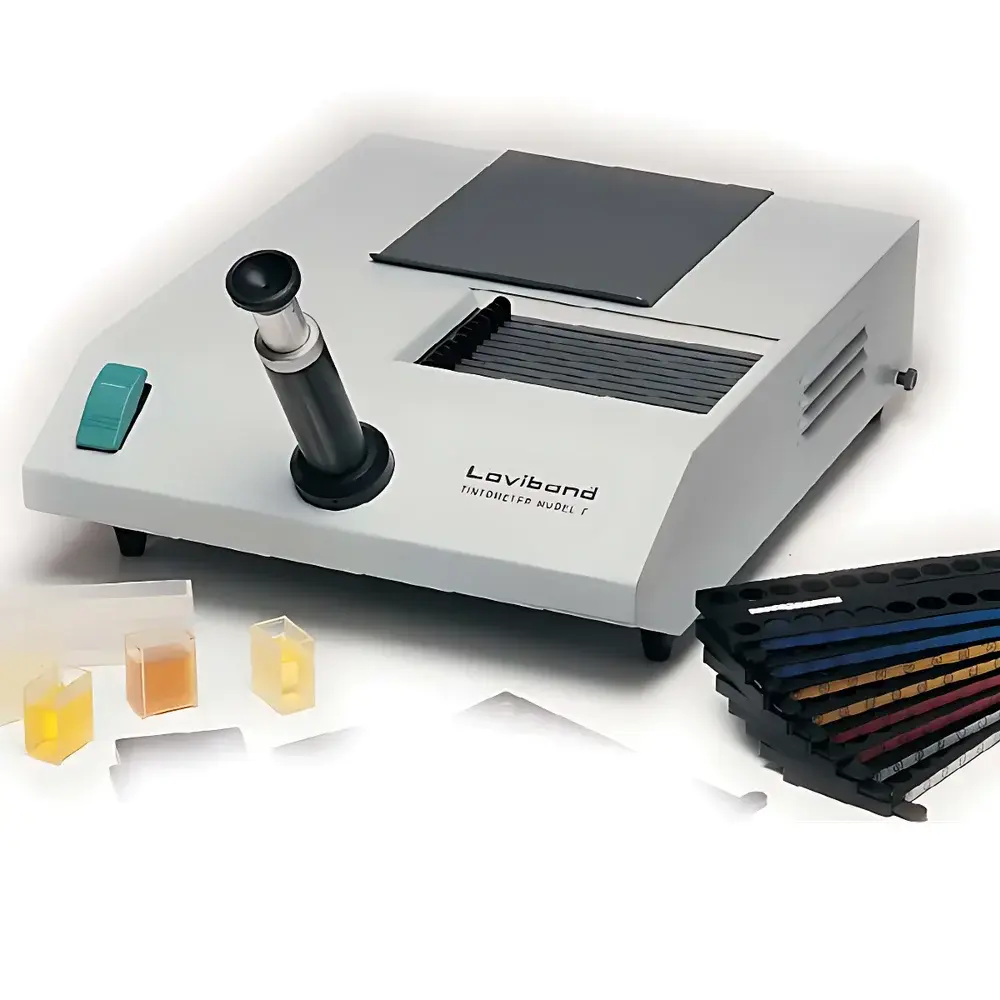
Lovibond Model F Advanced Visual Colorimeter
| Brand | Lovibond (Tintometer) |
|---|---|
| Origin | United Kingdom |
| Manufacturer Type | Authorized Distributor |
| Origin Category | Imported |
| Model | F |
| Light Source | Dual 12 V / 10 W Tungsten-Halogen Lamps |
| Viewing Field | Fully Adjustable Prism System with Integrated Blue Filter for Illumination Standardization |
| Illumination Standard | Approximates CIE Standard Illuminant D65 |
| Color Scale Compatibility | Gardner (1–18), FAC (1–45), EBC (2–27), ASTM D1500 (0.5–8.0), US Naval Stores Rosin (XC-Dx), Lovibond RYBN (Red: 0.1–79.9, Yellow: 0.1–79.9, Blue: 0.1–49.9, Neutral: 0.1–3.9) |
| Resolution | 0.1 Lovibond Unit |
| Cell Pathlength Range | 0.1–153 mm (0.004–6 in) |
| Standard Color Discs | 11 Precision-Calibrated Glass Discs (R×3, Y×3, B×3, N×2) |
| Included Cells | 1 in (25.4 mm) and 5¼ in (133 mm) standard cells |
| Compliance | AOCS Cc 13e-92, AOCS Cc 13j-97, BS 684, ASTM D1500, ISO 4630 |
Overview
The Lovibond Model F Advanced Visual Colorimeter is a precision-engineered optical instrument designed for objective, repeatable visual color assessment of transparent and translucent liquids—and, with appropriate sample preparation, semi-opaque materials such as fats, waxes, and viscous syrups. Operating on the principle of two-field simultaneous comparison, the instrument employs a dual-beam optical path with standardized illumination to enable direct matching between a reference light path (through calibrated glass color standards) and the sample path. Its core measurement methodology adheres to the classical Lovibond RYBN (Red-Yellow-Blue-Neutral) color system, where color is quantified by selecting combinations of red, yellow, blue, and neutral glass filters—each traceably calibrated against primary standards maintained by Tintometer Ltd. in the UK. This approach ensures metrological consistency across laboratories and aligns with internationally recognized methods including AOCS Cc 13e-92 and Cc 13j-97 for edible oil evaluation, ASTM D1500 for petroleum products, and BS 684 for fat and oil analysis.
Key Features
- Two-field simultaneous viewing system with fully adjustable prism-based optics for ergonomic, fatigue-reduced observation
- Dual 12 V / 10 W tungsten-halogen lamps providing stable, high-CRI illumination approximating CIE Illuminant D65
- Integrated blue filter within the optical train to eliminate spectral drift and ensure consistent color rendering
- 11 precision-ground, interference-free Lovibond glass color discs: three red (0.1–0.9, 1.0–9.0, 10.0–70), three yellow (0.1–0.9, 1.0–9.0, 10.0–70), three blue (0.1–0.9, 1.0–9.0, 10.0–40), and two neutral (0.1–0.9, 1.0–3.0)
- Variable pathlength compatibility: accommodates cells from 0.1 mm to 153 mm (0.004–6 inches), supporting both micro-volume screening and bulk liquid assessment
- Mechanically robust housing with anti-vibration base and lockable disc carriage for long-term calibration stability
Sample Compatibility & Compliance
The Model F supports a broad range of industrial and regulatory applications. For transparent liquids—including mineral oils, solvents, pharmaceutical excipients, food-grade syrups, and brewing wort—the instrument delivers direct compliance with AOCS, ASTM, ISO, and BS standards. Its capacity to assess semi-opaque samples (e.g., rendered animal fats, hydrogenated vegetable oils, rosin derivatives) follows validated protocols requiring controlled heating, filtration, or dilution prior to measurement. The device meets requirements for GLP-compliant environments when used with documented SOPs, operator training records, and periodic verification using NIST-traceable reference standards. While not electronically audit-trail enabled, its manual operation supports full traceability under FDA 21 CFR Part 11 when integrated into paper-based or hybrid quality management systems.
Software & Data Management
The Model F is a purely optical, analog instrument with no embedded electronics or digital interface. All measurements are recorded manually in laboratory notebooks or LIMS-compatible spreadsheets. Users may cross-reference results using the official Lovibond Conversion Tables (e.g., Gardner ↔ ASTM D1500, EBC ↔ SRM) published in Tintometer Technical Bulletin TB-012. For laboratories implementing digital workflows, optional third-party data capture tools—including calibrated USB microscope attachments and image-based color matching software—can be deployed alongside the instrument, provided validation per ISO/IEC 17025 Clause 5.9 is performed.
Applications
- Quality control of edible oils and frying fats per AOCS Cc 13 series methods
- Color grading of petroleum distillates, lubricants, and transformer oils per ASTM D1500
- Monitoring caramelization and Maillard reaction progression in sugar syrups and confectionery intermediates
- Batch release testing of pharmaceutical liquid formulations where color serves as a critical quality attribute (CQA)
- Evaluation of rosin purity and thermal degradation in naval stores per US Naval Stores specifications
- Beer and malt extract color assessment per EBC 201 and ASBC Beer-3 methods
FAQ
Is the Model F compliant with ISO/IEC 17025 requirements for accredited testing laboratories?
Yes—when operated within a documented quality system that includes routine verification using certified reference materials, operator competency assessment, and environmental control (e.g., ambient lighting ≤ 50 lux, D65-spectrum ambient light exclusion), the Model F satisfies the metrological traceability and procedural rigor mandated by ISO/IEC 17025 Clause 6.4.
Can the Model F measure samples with suspended particulates?
No—turbid or particulate-laden samples must be filtered (e.g., through 0.45 µm membrane filters) or centrifuged prior to measurement to avoid scattering artifacts. Validation of filtration efficacy must be included in method documentation.
What is the calibration interval recommendation?
Tintometer recommends annual verification against master reference discs supplied with certificate of calibration (traceable to UK National Physical Laboratory standards); interim checks using internal reference white tile should be performed daily.
Does the Model F support color difference (ΔE) calculation?
No—ΔE requires tristimulus XYZ data acquisition, which the Model F does not provide. It reports only Lovibond unit values or equivalent scale indices (e.g., Gardner, EBC). Conversion to CIELAB requires external spectrophotometric correlation.
Are replacement color discs available with individual calibration certificates?
Yes—Tintometer supplies individually certified replacement discs (part numbers R-XX, Y-XX, etc.) with UKAS-accredited calibration certificates valid for 24 months from date of issue.






