
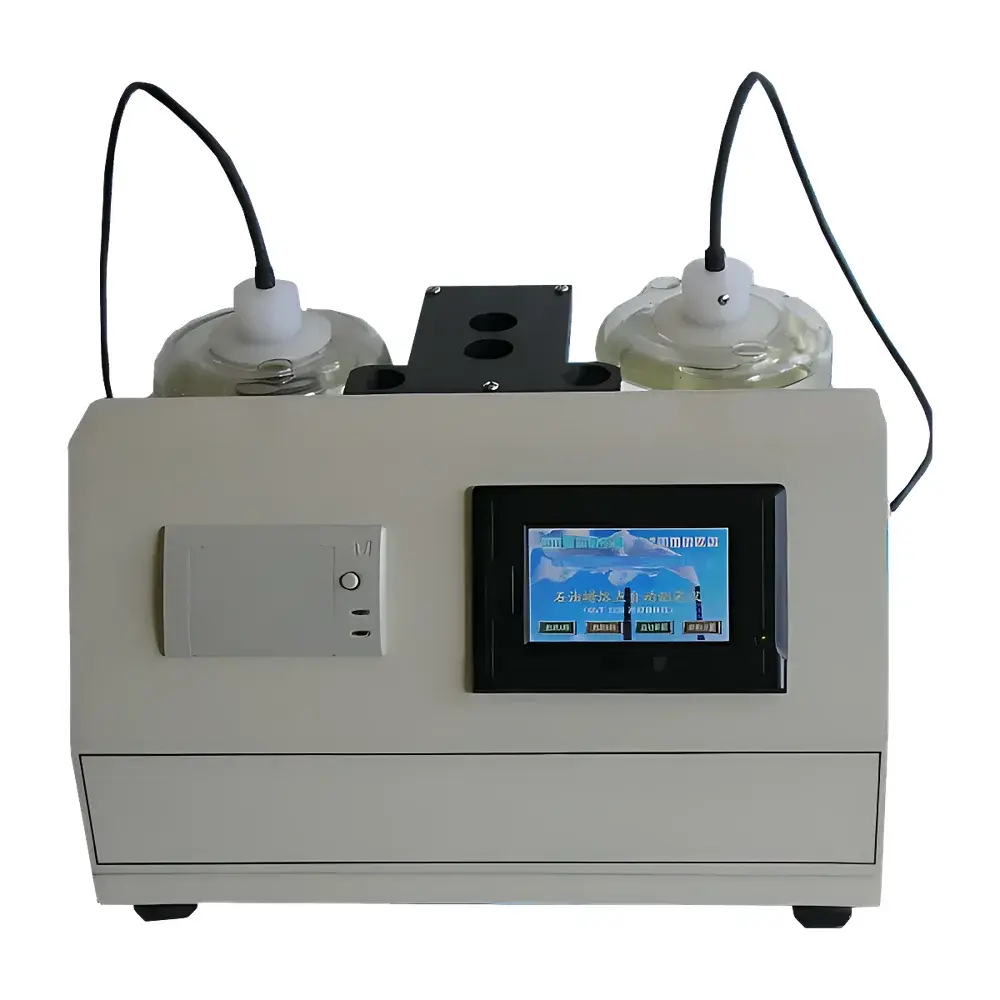
Fland FDS-1571 Automatic Paraffin Melting Point Analyzer
| Brand | Fland (csfriend) |
|---|---|
| Origin | Hunan, China |
| Manufacturer Type | Authorized Distributor |
| Country of Manufacture | China |
| Model | FDS-1571 |
| Test Channels | Dual |
| Temperature Sensor | PT100 |
| Heating Method | Aluminum Block Bath |
| Temperature Range | Ambient to 200 °C |
| Temperature Accuracy | ±0.1 °C |
| Display & Interface | Color Touchscreen with Chinese GUI |
| Compliance | Fully aligned with GB/T 2539–2008 “Standard Test Method for Melting Point of Paraffin Wax” |
| Output | On-screen result display + thermal printer output |
| Power Supply | AC 220 V, 50 Hz |
Overview
The Fland FDS-1571 Automatic Paraffin Melting Point Analyzer is a precision-engineered instrument designed specifically for the standardized determination of melting point in paraffin waxes and related hydrocarbon-based solid materials. It operates on the principle of controlled-rate heating within a thermally uniform aluminum block bath, coupled with real-time PT100 resistance temperature detection and automatic endpoint recognition based on the meniscus rise or needle penetration criteria defined in GB/T 2539. Unlike oil-bath systems, the solid aluminum block provides superior thermal inertia, minimized temperature gradient across test positions, and eliminates risks associated with oil degradation, oxidation, or spillage—making it ideal for routine QC laboratories operating under GLP-aligned workflows. The instrument is fully compliant with national standard methodology and supports dual-sample parallel testing to enhance throughput and intra-laboratory reproducibility.
Key Features
- Dual-channel independent measurement capability enables simultaneous analysis of two paraffin samples—supporting method verification, reference sample comparison, or batch-to-batch consistency checks.
- High-stability aluminum block heating system ensures uniform thermal distribution (<±0.2 °C spatial variation across both wells) and eliminates maintenance overhead linked to silicone oil replacement or cleaning.
- Integrated PT100 platinum resistance thermometer calibrated traceably to national standards delivers temperature accuracy of ±0.1 °C over the full operating range (ambient to 200 °C).
- Intuitive color touchscreen interface with native Chinese menu navigation simplifies operation for technicians without advanced programming training; all critical parameters—including ramp rate, hold time, and endpoint sensitivity—are configurable via guided prompts.
- Fully automated sequence execution: auto-heating, continuous temperature monitoring, real-time meniscus/needle position tracking (per GB/T 2539 visual observation protocol), endpoint confirmation, and final result logging.
- Thermal printer module provides immediate hard-copy documentation with timestamp, sample ID (user-entered), measured melting point (°C), and pass/fail flag relative to specification limits.
Sample Compatibility & Compliance
The FDS-1571 is validated for use with refined paraffin waxes, microcrystalline waxes, petrolatum blends, and other ASTM D87 / ISO 4625 / GB/T 2539-compliant hydrocarbon solids exhibiting sharp melting transitions between 40 °C and 100 °C. Sample preparation follows standard capillary tube filling (10–15 mm column height, packed density control per GB/T 2539). While primarily engineered for paraffin, its extended 200 °C upper limit allows limited applicability to higher-melting-point additives such as polyethylene waxes or fatty acid derivatives—subject to user validation. The instrument’s operational logic, timing thresholds, and detection algorithms are strictly implemented per GB/T 2539–2008 Annex A, ensuring regulatory acceptability in domestic quality control environments. Though not pre-certified to ISO/IEC 17025, its design supports audit readiness through full parameter logging, operator ID input, and non-editable print records.
Software & Data Management
The embedded firmware implements deterministic finite-state machine control logic with no external PC dependency. All measurement data—including start time, heating rate (default 1.0 °C/min, adjustable), recorded temperature points at 10-second intervals, detected onset/midpoint/end temperatures, and final printed report—is stored in non-volatile memory for up to 500 test cycles. Data export is not supported via USB or network interface; however, each thermal printout includes unique batch identifier fields, operator initials, and date/time stamp—satisfying basic record retention requirements under GB/T 19022 and supporting internal QA traceability. For laboratories requiring electronic archiving, manual transcription into LIMS or Excel is typical practice. Future firmware updates (distributed via secure USB key) may introduce CSV export functionality while maintaining compliance with data integrity principles outlined in China’s NMPA Guideline on Computerized System Validation.
Applications
- Quality control release testing of paraffin wax batches in petrochemical refineries and candle manufacturing facilities.
- In-process monitoring during fractional crystallization or dewaxing unit optimization.
- Stability assessment of wax-based pharmaceutical ointment bases per ChP monographs.
- Supplier qualification and incoming raw material inspection against contractual melting point specifications.
- Educational use in polymer science and fuel technology laboratories for teaching standardized thermal transition characterization.
FAQ
Does the FDS-1571 comply with international standards such as ASTM D87 or ISO 4625?
It is fully aligned with GB/T 2539–2008, which is technically equivalent to ISO 4625:1980 and closely harmonized with ASTM D87–18 in procedural structure and endpoint definition. However, formal cross-standard validation reports are not supplied by default.
Can the instrument be used for non-paraffin materials like rosin or beeswax?
While physically capable of heating to 200 °C, the detection algorithm and calibration are optimized for paraffin’s characteristic meniscus behavior. Use with non-standard samples requires full method revalidation per ICH Q2(R2).
Is the thermal printer replaceable or serviceable onsite?
Yes—the integrated thermal printer uses standard 58-mm roll paper and features field-replaceable print head and paper feed mechanism; spare parts and service manuals are available under Fland’s distributor support program.
What maintenance is required for long-term accuracy?
Annual verification using NIST-traceable reference standards (e.g., pure indium, tin, or zinc) is recommended. Aluminum block surface should be cleaned periodically with isopropyl alcohol to prevent thermal contact resistance from residue buildup.
Is remote software update or network connectivity supported?
No. Firmware updates require physical USB key delivery and local initiation via the touchscreen interface—ensuring air-gapped security and avoiding unintended configuration changes in regulated environments.




