
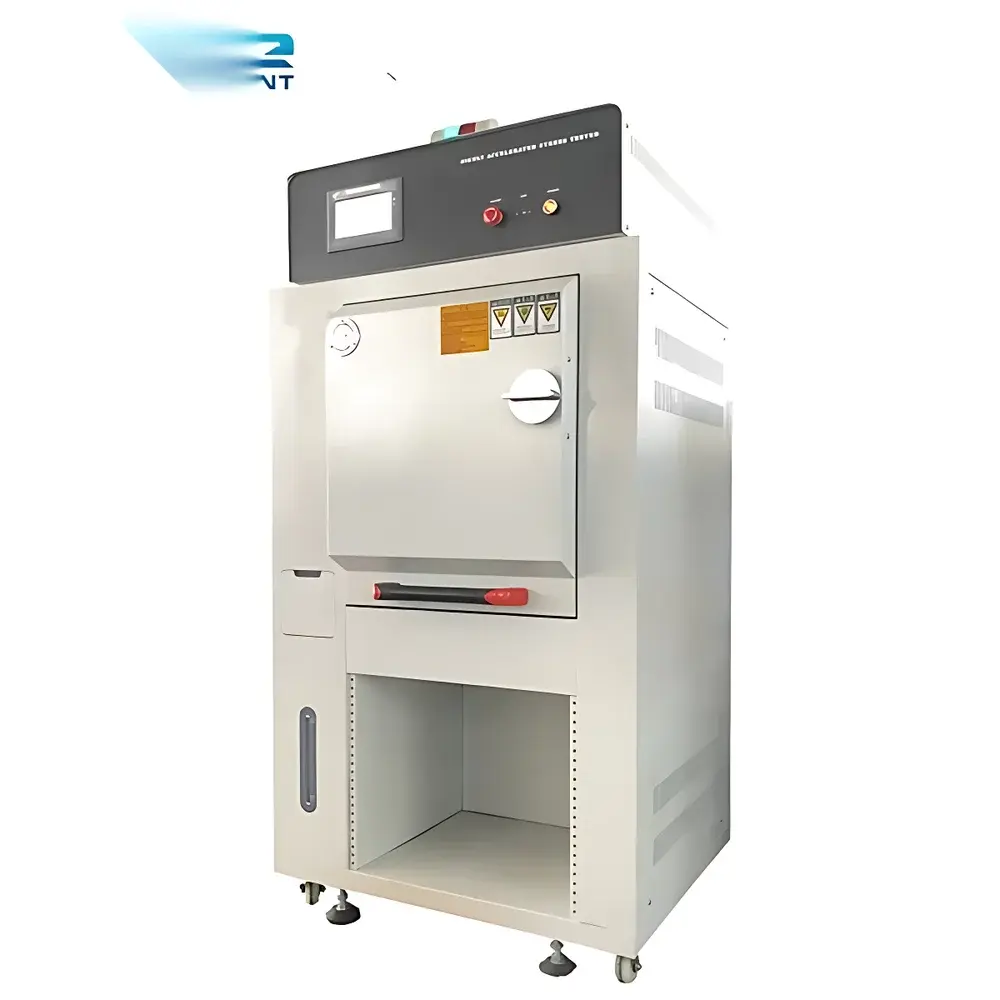
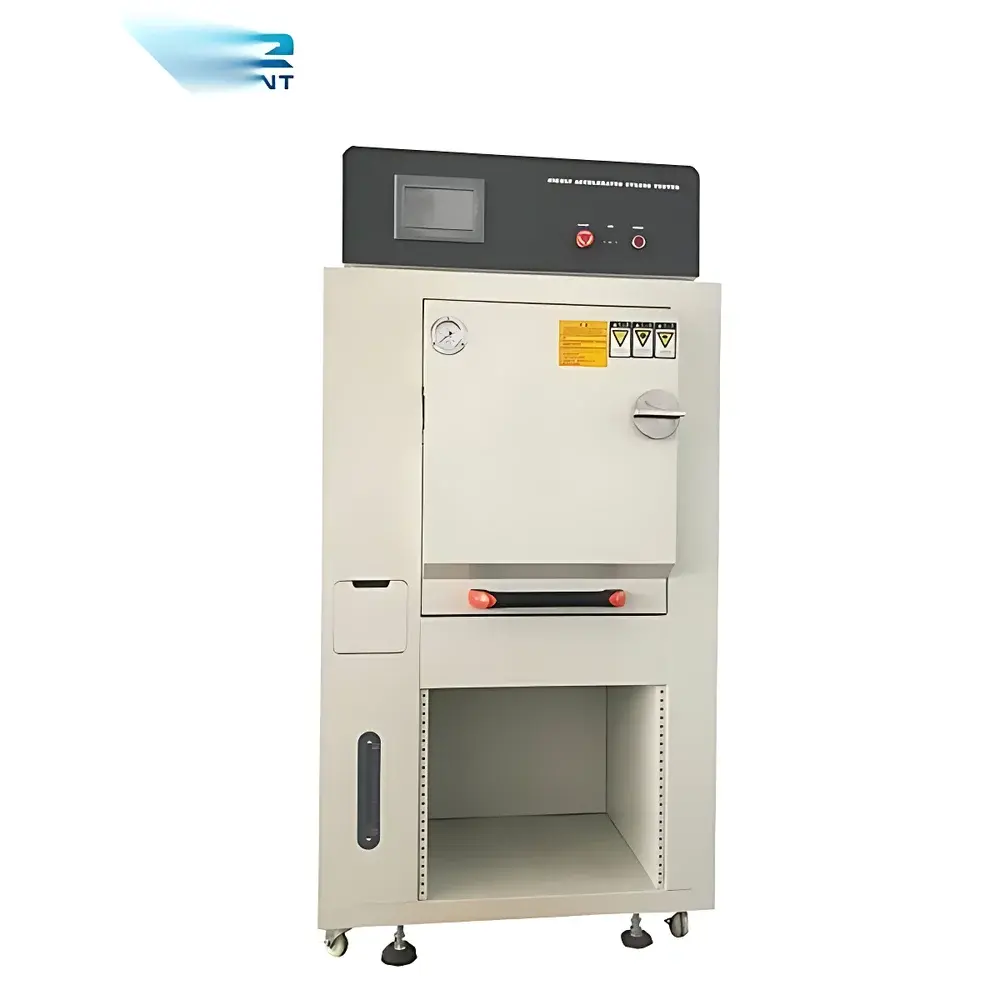
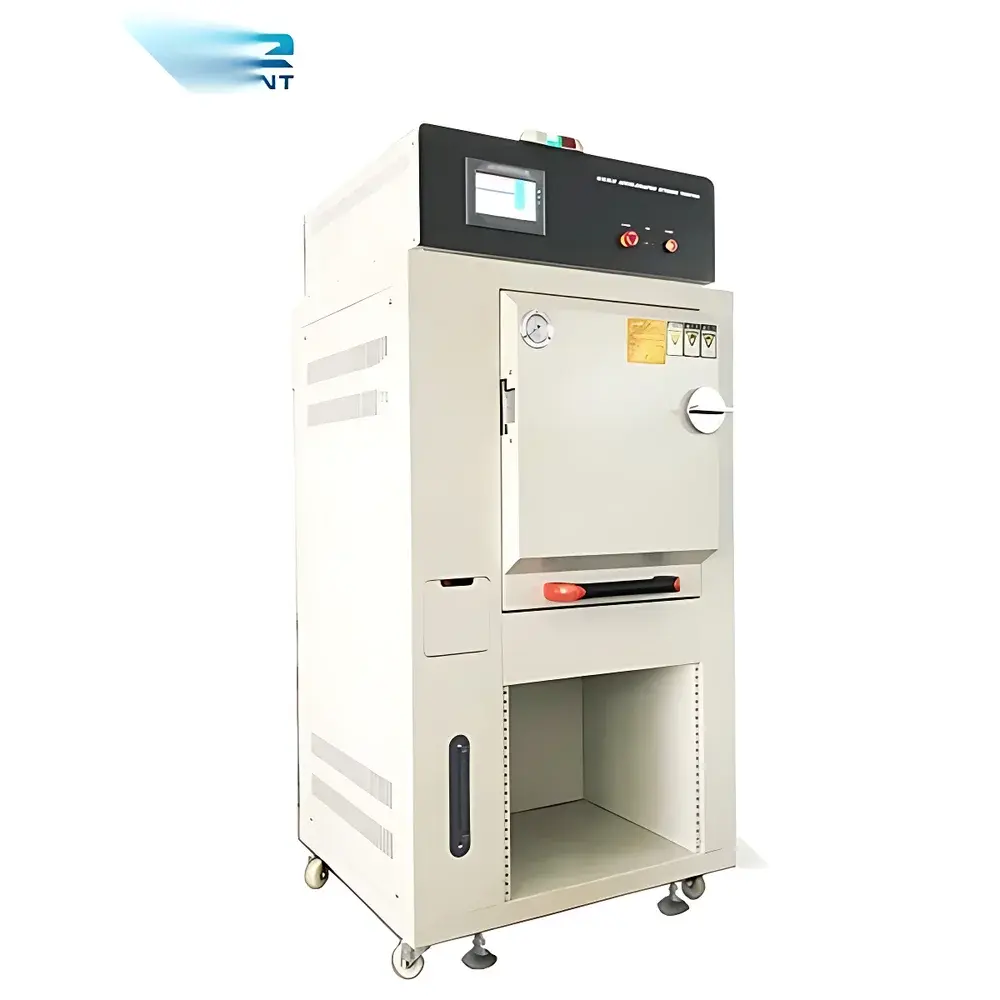
Pre-Conditioning Test Chamber (PCT) – High-Pressure Steam Aging Environmental Test System
| Key | Temperature Range: +100°C to +147°C (saturated steam temperature) |
|---|---|
| Humidity Range | 75–100% RH (saturated steam, up to 75% RH at 47°C) |
| Humidity Stability | ±3% RH |
| Operating Pressure | 1.2–2.89 kgf/cm² (inclusive of 1 atm ambient) |
| Time Setting Range | 0–999 hours |
| Pressurization Time | ~45 min to reach 1.04 kgf/cm² from ambient |
| Temperature Uniformity | ±0.5°C |
| Temperature Display Resolution | 0.1°C |
| Pressure Uniformity | ±0.1 kgf/cm² |
| Humidity Uniformity | ±3% RH |
| Internal Chamber Design Pressure Rating | 4.0 kgf/cm² |
| Vacuum Pre-Purge Function | Integrated |
| Safety Interlock | Dual-redundant pressure/temperature-sensing door lock |
| Water Autonomy | Up to 48 h continuous operation per fill (optional fully automated water replenishment system) |
Overview
The Pre-Conditioning Test Chamber (PCT) is a precision-engineered high-pressure saturated steam aging system designed for accelerated reliability validation under combined thermal, humid, and mechanical stress conditions. It operates on the principle of saturated steam pressurization within a sealed cylindrical chamber, enabling controlled exposure to elevated temperature (up to +147°C), high relative humidity (up to 100% RH), and super-atmospheric pressure (up to 2.89 kgf/cm²). Unlike conventional humidity chambers, this PCT system maintains thermodynamic equilibrium between temperature, pressure, and humidity—ensuring true saturated steam conditions required by industry standards such as JESD22-A102 (Failure Mechanism and Electrical Testing of Non-Hermetic Surface Mount Devices), JEDEC J-STD-020 (Moisture Sensitivity Levels), and IPC-9701 (Performance Requirements for Lead-Free Solder Attachments). The chamber’s cylindrical horizontal configuration minimizes condensation accumulation and prevents direct steam jetting toward operators during loading/unloading, supporting safe, repeatable, and GLP-compliant test execution.
Key Features
- Cylindrical horizontal inner chamber design with smooth internal contours to eliminate dead zones, reduce condensate pooling, and ensure uniform steam distribution across all sample positions.
- Integrated dual-sensor safety interlock system: real-time monitoring of both chamber temperature and internal pressure triggers automatic door locking when ≥1.04 kgf/cm² is detected; door release is only permitted after pressure drops below atmospheric level.
- Passive anti-leak sealing mechanism: chamber door utilizes reverse-pressure coupling—increasing internal pressure enhances sealing force between gasket and flange, extending gasket service life and eliminating reliance on mechanical compression latches.
- Multi-stage safety architecture including over-temperature cutoff, over-pressure relief valve, vacuum-assisted air purge prior to test initiation, and automatic depressurization/venting sequence upon cycle completion or fault detection.
- Self-contained water management: standard configuration supports 48-hour uninterrupted operation per fill; optional fully automated water replenishment system with level sensors and solenoid-controlled refill maintains consistent water quality and eliminates manual intervention.
- Digital PID-controlled steam generation and pressure regulation ensure ±0.1 kgf/cm² pressure stability and ±0.5°C temperature uniformity across the working volume, meeting repeatability requirements for qualification-level testing.
Sample Compatibility & Compliance
This PCT system accommodates a wide range of electronic and microelectronic components—including bare die, wire-bonded ICs, molded packages (QFP, BGA, CSP), multilayer PCBs, LCD modules, ferrite magnets, and hermetic/non-hermetic MEMS devices. Its calibrated operational envelope satisfies the critical test condition specified in JEDEC JESD22-A102: 121°C, 100% RH saturated steam, and 1.04 kgf/cm² (15 psi) for durations up to 999 hours. All control logic and data logging functions are structured to support audit-ready documentation aligned with ISO/IEC 17025, IATF 16949, and FDA 21 CFR Part 11 compliance frameworks—particularly when paired with optional electronic signature and audit trail modules.
Software & Data Management
The embedded controller provides intuitive touchscreen interface with password-protected user roles (Operator, Engineer, Administrator), programmable multi-step profiles, real-time trend visualization, and exportable CSV log files timestamped with temperature, pressure, humidity, and elapsed time. Optional PC-based software enables remote monitoring, centralized fleet management, automated report generation (PDF/Excel), and integration into existing MES or LIMS platforms via Modbus TCP or OPC UA protocols. All recorded parameters include hardware-timestamped metadata and are stored with immutable write-once-read-many (WORM) attributes to satisfy GLP/GMP traceability requirements.
Applications
- Moisture sensitivity level (MSL) grading and floor life determination per J-STD-020.
- Accelerated moisture ingress evaluation for plastic-encapsulated microcircuits (PEMs).
- Delamination risk assessment (popcorn effect) in flip-chip and stacked-die assemblies.
- Seal integrity verification of conformal coatings, potting compounds, and encapsulants.
- Reliability screening of automotive-grade electronics subjected to AEC-Q200 stress protocols.
- Qualification testing of medical device packaging materials under ISO 11607-1 accelerated aging conditions.
FAQ
What is the maximum allowable internal pressure rating of the chamber?
The inner chamber is structurally rated for continuous operation at 4.0 kgf/cm², with safety relief valves set at 3.0 kgf/cm² to prevent over-pressurization beyond design limits.
Does the system comply with JEDEC JESD22-A102 test conditions?
Yes—the chamber achieves and sustains the nominal A102 condition of 121°C, 100% RH saturated steam, and 1.04 kgf/cm² with verified stability and uniformity across the full working volume.
Is vacuum pre-purge mandatory before each test cycle?
Vacuum purging is configurable and recommended for oxygen-sensitive applications; it removes ambient air and replaces it with filtered, dry nitrogen or purified steam-saturated atmosphere prior to pressurization.
Can the system be integrated into an automated test laboratory environment?
Yes—standard Ethernet connectivity supports SCADA integration, and optional RS-485/Modbus RTU or EtherNet/IP interfaces enable seamless communication with factory automation systems.
What maintenance intervals are recommended for long-term calibration stability?
Annual verification of temperature, pressure, and humidity sensors against NIST-traceable references is advised; gasket replacement is typically required every 18–24 months depending on usage frequency and cycle severity.



