
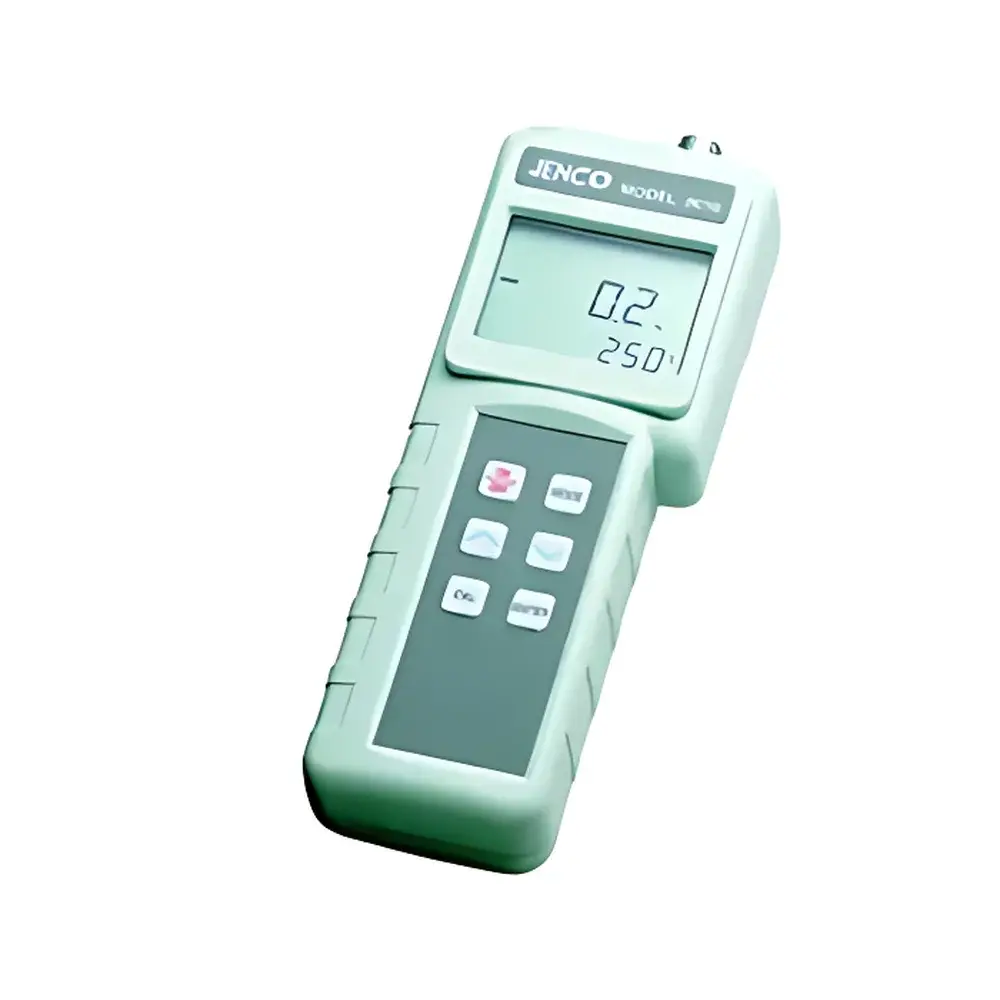
Hach 9010m Portable Dissolved Oxygen Meter
| Origin | USA |
|---|---|
| Type | Imported |
| Model | 9010m |
| Detection Principle | Polarographic DO Sensor |
| DO Range | 0.00–20.00 ppm |
| Air Saturation Range | 0.0–200.0 % |
| Temperature Range | −6.0–46.0 °C |
| DO Resolution | 0.01 ppm |
| Saturation Resolution | 0.1 % |
| Temperature Resolution | 0.1 °C |
| DO Accuracy | ±0.5 % of full scale |
| Saturation Accuracy | ±0.5 % of full scale |
| Temperature Accuracy | ±0.3 °C ±1 digit |
| Pressure Compensation | Adjustable from 600–1100 mbar (default: 1013 mbar) |
| Salinity Compensation | Adjustable from 0.0–40.0 ppt (default: 0.0 ppt) |
| Data Storage | 50 measurement sets |
| Power Supply | 9 V alkaline battery |
| IP Rating | IP67 |
| Dimensions | 70 × 186 × 37 mm |
| Weight | 260 g (without battery) |
| Certifications | CE, RoHS, CMC |
Overview
The Hach 9010m Portable Dissolved Oxygen Meter is an engineered field instrument designed for reliable, on-site quantification of dissolved oxygen (DO) and temperature in aqueous environments. It employs a polarographic Clark-type sensor principle—where molecular oxygen diffuses through a gas-permeable membrane and undergoes electrochemical reduction at a cathode—yielding a current proportional to DO concentration. This method ensures high reproducibility across variable water matrices without requiring frequent recalibration. The device is optimized for applications demanding rapid deployment, low power consumption, and environmental resilience—including wastewater effluent monitoring, aquaculture pond management, source water assessment, and process validation in beverage and pharmaceutical manufacturing. Its microprocessor-controlled architecture integrates automatic temperature compensation (ATC), user-adjustable barometric pressure and salinity correction, and non-volatile memory for calibration and measurement history—all while maintaining compliance with field-deployment requirements under ISO 5814 and ASTM D888 standards for dissolved oxygen measurement.
Key Features
- Polarographic DO sensor with replaceable membrane cap (LD-900-11 electrode) and long-life electrolyte system for stable baseline response
- Simultaneous display of DO (ppm), air saturation (%), and temperature (°C) on a backlit LCD screen
- Automatic temperature compensation using integrated NTC thermistor (−6.0 to 46.0 °C range)
- User-configurable pressure (600–1100 mbar) and salinity (0.0–40.0 ppt) compensation to correct for site-specific hydrostatic and ionic effects
- 50-measurement internal data storage with timestamp-independent recall; calibration constants retained after power loss
- IP67-rated housing providing dust-tight and immersion-resistant operation up to 1 m for 30 minutes
- Low-power design with auto-shutdown (after 10 min inactivity) and battery-low warning indicator
- CE-marked and RoHS-compliant construction meeting EU directive requirements for electromagnetic compatibility and hazardous substance restriction
Sample Compatibility & Compliance
The 9010m is validated for use in freshwater, seawater, wastewater, and process streams with turbidity ≤ 100 NTU and suspended solids < 500 mg/L. It complies with key regulatory frameworks governing environmental and industrial water testing: its measurement methodology aligns with ISO 5814 (water quality — determination of dissolved oxygen — electrochemical probe method) and ASTM D888 (standard test methods for dissolved oxygen in water). While not FDA 21 CFR Part 11–enabled out-of-the-box, audit-ready documentation—including calibration logs, sensor replacement records, and field verification checks—can be maintained manually to support GLP/GMP-aligned quality systems. The CMC certification confirms metrological traceability to national standards in China, supporting cross-border validation workflows.
Software & Data Management
Data retrieval is performed via manual transcription or optional IR interface (not included). Though the 9010m lacks Bluetooth or USB connectivity, its structured 50-entry memory supports sequential review and field-based trend identification. Each stored record includes DO value, saturation percentage, temperature, and measurement sequence number—enabling correlation with sampling location logs. For laboratory integration, users commonly pair the instrument with LIMS-compatible spreadsheets or Hach’s legacy AquaTrack software (v3.x) for batch export and QA/QC reporting. All calibration events—including zero and span points—are retained in non-volatile memory, satisfying minimum record retention expectations under ISO/IEC 17025 Clause 7.7.
Applications
- Environmental field surveys: Stream, river, lake, and estuary DO profiling during EPA Method 360.1–aligned monitoring programs
- Aquaculture operations: Real-time DO optimization in hatcheries and recirculating aquaculture systems (RAS) to prevent hypoxia stress
- Pharmaceutical water systems: Monitoring of purified water (PW) and water-for-injection (WFI) distribution loops per USP
- Food & beverage production: Verification of deaeration efficiency in carbonated beverage lines and fermentation tank aeration control
- Industrial pretreatment: Effluent DO screening prior to biological treatment stages in municipal and industrial WWTPs
FAQ
What type of DO sensor does the 9010m use?
It uses a polarographic (Clark-type) sensor with a gold cathode and silver/silver chloride reference, requiring periodic membrane replacement and electrolyte replenishment.
Does the instrument support automatic pressure compensation?
No—it provides manual pressure input (600–1100 mbar); users must enter local barometric pressure prior to measurement for accurate DO calculation.
Can the 9010m measure in seawater?
Yes—when configured with salinity compensation (0.0–40.0 ppt), it corrects for oxygen solubility depression due to ionic strength.
Is calibration traceable to NIST standards?
While the instrument itself is not NIST-traceable, Hach-certified calibration solutions (e.g., DO Zero Solution 21062–00 and Winkler-based standards) enable traceable field verification.
How often should the DO membrane be replaced?
Typically every 2–4 weeks under continuous use; more frequently in high-fouling or high-sediment environments—verified by drift > ±0.2 ppm over 24 h.
Related Products







