
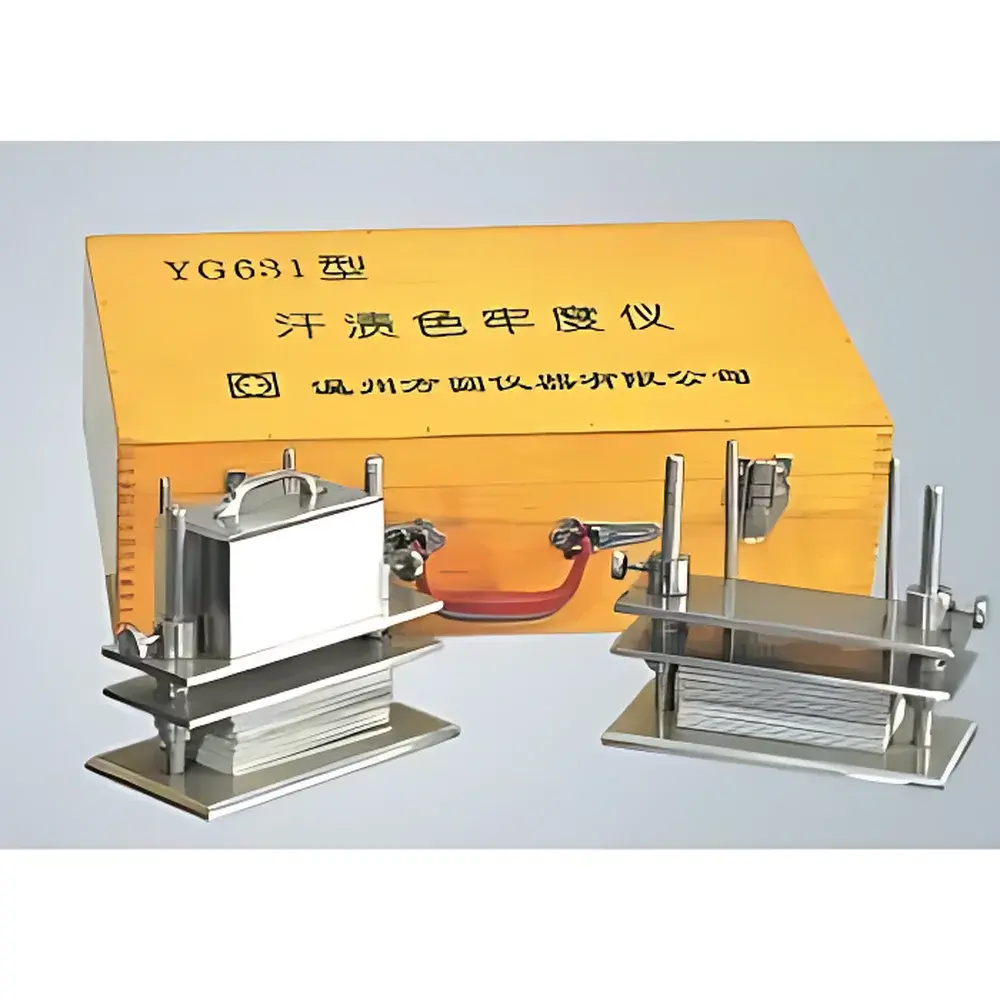
Fangyuan YG631 Acid/Alkaline Sweat Color Fastness Tester
| Brand | Fangyuan |
|---|---|
| Model | YG631 |
| Applied Standards | AATCC 15, GB/T 3922–1995, GB/T 5713–1997, GB/T 5714–1997 |
| Load Force | 50 N / 10 lbf |
| Resin Plate Dimensions | 60 × 115 mm |
| Resin Plate Quantity | 21 pcs |
| Y902 Conditioning Oven Temperature Range | Ambient to 90 °C ±2 °C |
| Timer Range | 0–99 h |
| Chamber Dimensions (L×W×H) | 308 × 330 × 300 mm |
Overview
The Fangyuan YG631 Acid/Alkaline Sweat Color Fastness Tester is a precision-engineered instrument designed for standardized evaluation of color migration and staining resistance in textiles exposed to simulated human sweat—both acidic and alkaline formulations—as defined by major international test methods. It operates on the principle of controlled pressure application combined with standardized solution immersion and thermal conditioning, enabling reproducible assessment of dye stability under physiological stress conditions. The system comprises two core components: the YG631 multi-specimen compression tester and the companion Y902 temperature-controlled conditioning oven. Together, they replicate the combined mechanical, chemical, and thermal stresses encountered during wear, allowing textile manufacturers, quality control laboratories, and third-party testing facilities to validate compliance with regulatory and customer-mandated fastness requirements prior to market release.
Key Features
- Modular dual-unit architecture: YG631 compression tester for specimen loading and force application, paired with Y902 programmable oven for precise thermal conditioning.
- Adjustable load application: Dual-load configuration supports both 50 N (ISO/AATCC-aligned) and 10 lbf (legacy US customary) settings, ensuring compatibility across global test protocols.
- High-density resin plate array: 21 standardized 60 × 115 mm resin plates provide uniform pressure distribution and enable parallel testing of multiple specimens per cycle—maximizing throughput without compromising inter-sample consistency.
- Thermal stability and repeatability: Y902 oven maintains setpoint accuracy within ±2 °C across its full operating range (ambient to 90 °C), critical for simulating realistic perspiration-induced dye migration kinetics.
- Programmable exposure duration: Digital timer allows user-defined test durations from 0 to 99 hours, supporting extended aging studies as required by specific product categories (e.g., sportswear, medical textiles).
- Robust stainless-steel chamber construction: Corrosion-resistant interior and sealed insulation ensure long-term dimensional stability and consistent thermal performance under repeated exposure to saline and pH-adjusted solutions.
Sample Compatibility & Compliance
The YG631/Y902 system accommodates woven, knitted, nonwoven, and coated textile substrates—including yarns, fabrics, garments, and trim components—without modification. Specimens are mounted between standardized multi-layer assemblies (test fabric, adjacent fabric, and interposed sweat solution) per AATCC 15 and GB/T 3922–1995. The instrument meets the mechanical and dimensional specifications outlined in ISO 105-E04 (Color fastness to perspiration), ASTM D1249 (Standard Test Method for Colorfastness to Perspiration), and CNAS-accredited laboratory validation requirements. Its design facilitates full traceability of test parameters (load, time, temperature) in GLP-compliant environments, and documentation support is available for FDA 21 CFR Part 11–aligned audit trails when integrated with validated LIMS platforms.
Software & Data Management
While the YG631/Y902 operates as a hardware-based benchtop system without embedded microprocessor control, it is fully compatible with external digital logging and reporting workflows. Users may integrate calibrated thermocouple probes, load-cell transducers, and time-stamped imaging systems to capture real-time environmental data. All test parameters—including applied force, oven setpoint, dwell time, and ambient humidity—are manually recorded in accordance with ISO/IEC 17025 documentation templates. Comprehensive test reports generated in Excel or PDF format include specimen identification, solution composition (pH 4.3 acid / pH 8.0 alkaline), pass/fail determinations per Grey Scale or Chromatic Transference Scale (ISO 105-A02/A03), and technician signature fields for QA sign-off.
Applications
- Pre-production validation of reactive, vat, and acid dyes on cellulosic, protein, and synthetic fibers.
- Comparative assessment of dye-fixing agents and aftertreatment chemistries under accelerated perspiration stress.
- Regulatory submission testing for OEKO-TEX® Standard 100, GOTS, and bluesign® certification pathways.
- Root-cause analysis of crocking, bleeding, or halo formation in technical apparel subjected to high-sweat-use scenarios.
- Supplier qualification audits requiring documented conformance to brand-specific color fastness thresholds (e.g., ≥ Grade 4 on Grey Scale for acid sweat).
- Academic research into pH-dependent dye hydrolysis kinetics and fiber–dye bond stability mechanisms.
FAQ
What standards does the YG631/Y902 system directly support?
AATCC 15, ISO 105-E04, GB/T 3922–1995, GB/T 5713–1997, GB/T 5714–1997, and ASTM D1249.
Can the YG631 accommodate non-standard specimen sizes?
No—the 60 × 115 mm resin plate geometry mandates use of specimens cut to ISO 105-E04 dimensions (100 × 40 mm); deviation compromises pressure uniformity and invalidates comparative results.
Is calibration certification included with purchase?
Factory calibration verification is provided; users must perform periodic in-house verification using NIST-traceable load cells and PT100 thermometers per ISO/IEC 17025 Clause 6.5.
Does the system require exhaust ventilation during operation?
Yes—alkaline sweat solution (pH 8.0) releases volatile amines; operation must occur in a fume hood or with dedicated HVAC extraction meeting OSHA 1910.1200 requirements.
How is specimen staining evaluated post-test?
Staining is assessed visually under D65 illumination using ISO 105-A02 Grey Scale for Staining and ISO 105-A03 Grey Scale for Colour Change, with minimum acceptable grades specified per end-use category.




