
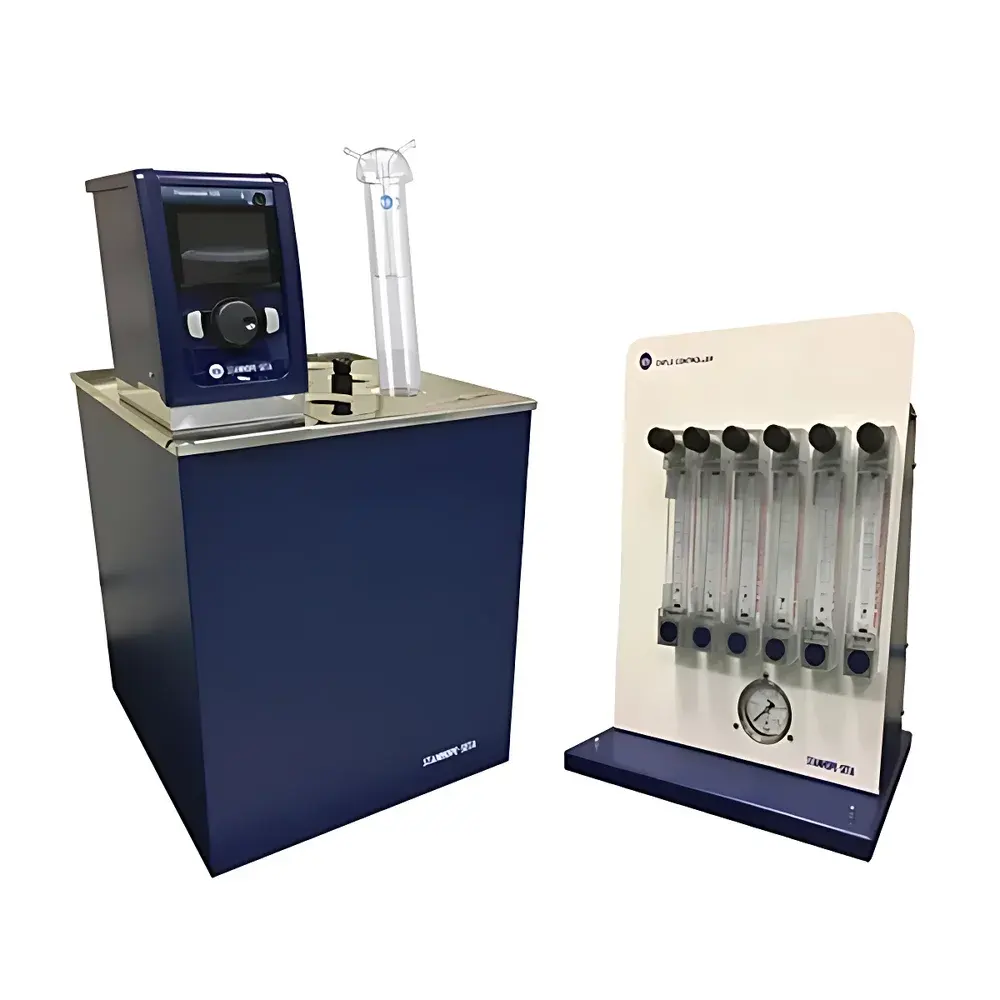
SETA 16900-7 Petroleum Oxidation Stability Tester
| Brand | SETA |
|---|---|
| Origin | United Kingdom |
| Model | 16900-7 |
| Temperature Range | Ambient +5 °C to 120 °C |
| Temperature Stability | ±0.1 °C |
| Test Positions | 6 |
| Bath Type | Liquid Immersion Bath |
| Compliant Methods | ASTM D2274, IP 388, ASTM D4310, ASTM D943, SH/T 0175 |
Overview
The SETA 16900-7 Petroleum Oxidation Stability Tester is a precision-engineered benchtop instrument designed for the quantitative evaluation of oxidative degradation resistance in middle distillate fuels—including diesel, heating oil, and jet fuel—under accelerated, controlled thermal-oxygen stress conditions. It operates on the principle of gravimetric oxidation monitoring: samples are exposed to flowing oxygen at elevated temperatures within sealed reaction vessels immersed in a thermally uniform liquid bath; subsequent measurement of insoluble sludge formation (via filtration and gravimetric analysis) or acid number increase serves as the primary stability indicator. This methodology directly supports predictive assessment of long-term storage behavior and in-service performance, enabling laboratories to comply with internationally harmonized test protocols essential for fuel specification conformance, quality assurance, and regulatory reporting.
Key Features
- Thermally stable liquid immersion bath with PID-controlled heating and forced-circulation design, delivering ±0.1 °C temperature uniformity across all six test positions over the full operating range (ambient +5 °C to 120 °C).
- Six independent, parallel test stations with standardized glass reaction vessels, each fitted with calibrated oxygen inlet tubing, pressure-relief valves, and condenser assemblies per ASTM D2274 and IP 388 requirements.
- Integrated oxygen flow regulation system with mass-flow controllers and digital readout, ensuring precise delivery of 50 ±5 mL/min (standard air-equivalent) or pure oxygen as specified by individual test methods.
- Modular auxiliary kit included: light-tight dark chamber (to prevent photo-oxidative interference), vacuum-assisted filtration manifold with certified glass fiber filters (Whatman GF/A grade), analytical balance interface port, and pre-calibrated volumetric glassware.
- Robust stainless-steel frame and corrosion-resistant bath housing engineered for continuous operation in petroleum QC environments; CE-marked and compliant with IEC 61010-1 safety standards.
Sample Compatibility & Compliance
The 16900-7 accommodates standard 300 mL glass oxidation vessels and supports sample volumes of 50–100 mL, compatible with untreated and additive-treated diesel fuels, biodiesel blends (B5–B20), synthetic hydrocarbon fuels, and industrial heating oils. It is fully validated for execution of ASTM D2274 (“Oxidation Stability of Distillate Fuel Oil by Accelerated Method”), IP 388 (“Determination of Oxidation Stability of Middle Distillate Fuels – Accelerated Method”), ASTM D4310 (“Oxidation Stability of Gasoline”), ASTM D943 (“Oxidation Stability of Inhibited Mineral Oils”), and Chinese national standard SH/T 0175. Instrument configuration and procedural documentation support GLP-compliant operation, including audit-ready record retention for method parameters, operator ID, ambient conditions, and raw gravimetric data.
Software & Data Management
While the 16900-7 is primarily a hardware-integrated manual test platform, it includes structured electronic log templates aligned with ASTM E2500 and ISO/IEC 17025 documentation requirements. Optional integration with laboratory information management systems (LIMS) is supported via RS-232 and USB virtual COM ports for automated timestamping and transfer of bath temperature logs, oxygen flow rates, and test duration metadata. All supplied accessories—including filter weights, blank correction worksheets, and sludge quantification calculators—are provided in editable PDF and Excel formats compliant with FDA 21 CFR Part 11 principles when used with validated electronic signature workflows.
Applications
- Quality control release testing of refinery-produced diesel batches against internal specifications and regional standards (e.g., EN 590, ASTM D975, GB 19147).
- Evaluation of antioxidant package efficacy during fuel formulation development and additive screening studies.
- Stability benchmarking of renewable diesel (HVO) and Fischer–Tropsch synthetic fuels under extended aging protocols.
- Root-cause investigation of field-reported sediment formation, filter plugging, or injector fouling incidents.
- Supporting technical service laboratories in third-party certification and contract testing for OEM fuel approval programs.
FAQ
Does the SETA 16900-7 include calibration certificates for temperature and flow sensors?
Yes—each unit ships with UKAS-traceable calibration certificates for the bath temperature sensor (NIST-traceable RTD) and integrated mass-flow controller, valid for 12 months from date of dispatch.
Can the instrument be operated under inert atmosphere instead of oxygen?
No—the design is optimized for oxidative stress testing per referenced standards; nitrogen purging is not supported, nor is it required by any applicable method.
Is software validation documentation available for GMP-regulated environments?
Instrument-specific IQ/OQ protocols and risk-based validation guides are provided upon request and may be executed in collaboration with qualified third-party validation partners.
What maintenance intervals are recommended for routine operation?
Bath fluid replacement every 6 months, oxygen line filter replacement after 200 test cycles, and annual verification of vessel seal integrity and condenser efficiency per SETA Maintenance Schedule MS-16900-7 Rev.3.
Are consumables such as oxidation vessels and filters supplied with the system?
A starter kit comprising six borosilicate glass reaction vessels, twelve GF/A filter discs, six rubber stoppers with PTFE liners, and one year’s supply of bath fluid (silicone oil, 200 cSt) is included in the base configuration.






