
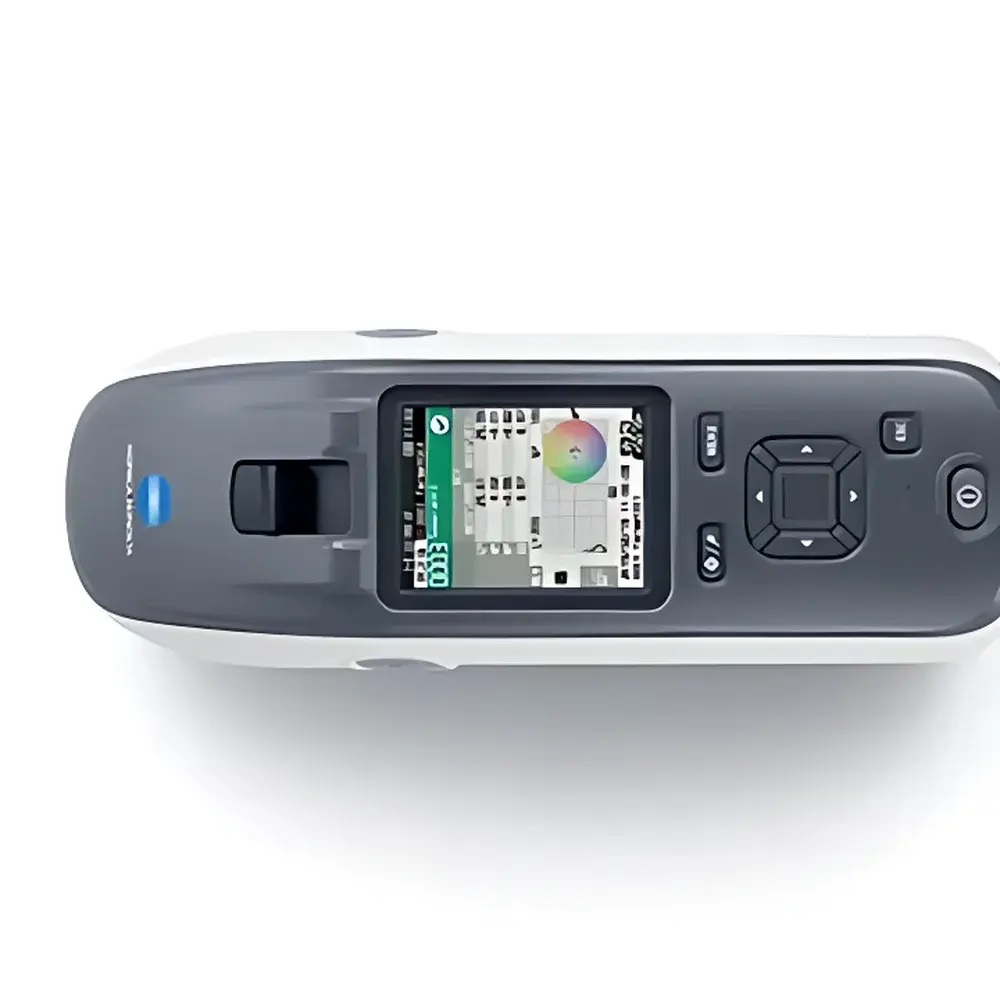
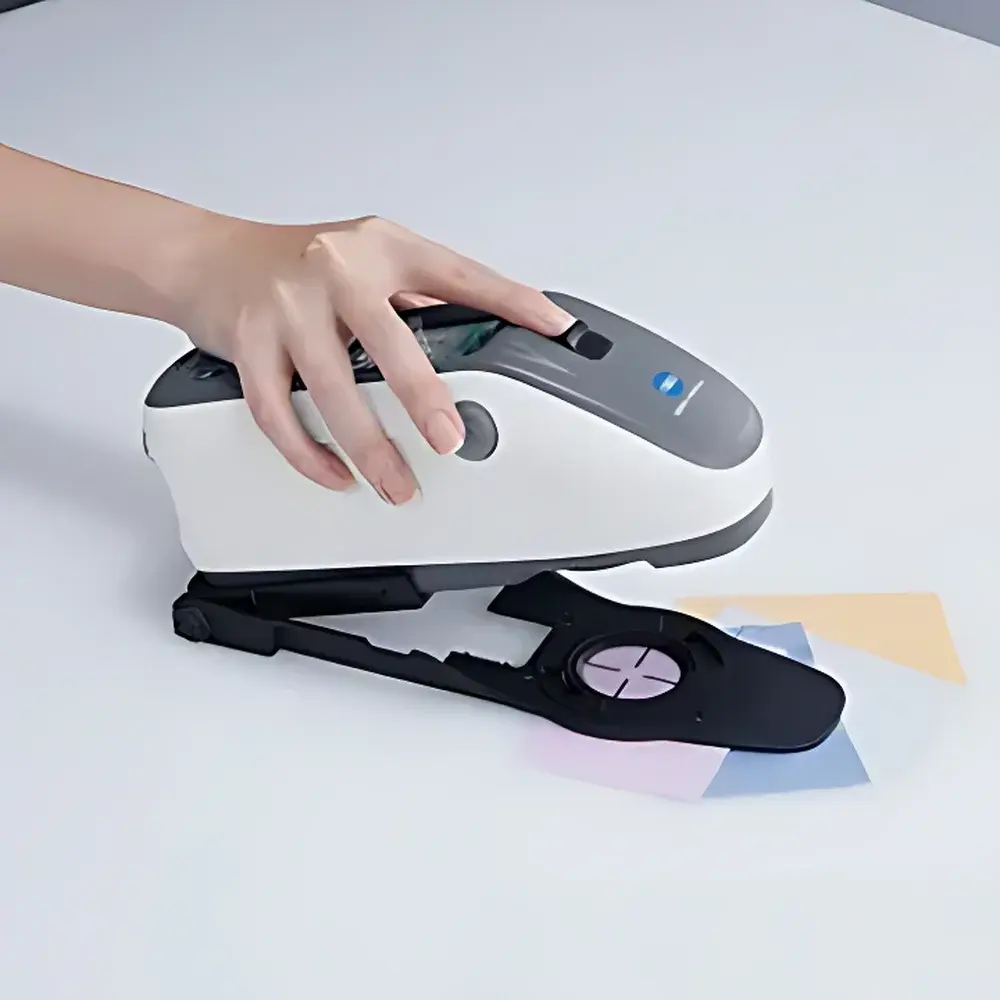
Konica Minolta Portable Spectrophotometer CM-26dG / CM-26d / CM-25d Color Analyzer
| Brand | Konica Minolta |
|---|---|
| Origin | Japan |
| Product Type | Spectrophotometric Colorimeter |
| Instrument Type | Portable |
| Measurement Principle | Di: 8°, De: 8° (Diffuse Illumination / 8° Viewing) with SCI/SCE modes |
| Standard Compliance | ISO 7724-1, CIE No. 15:2004, DIN 5033-7, JIS Z 8722 Condition c, ASTM E1164 (SCI), JIS Z 8741, ISO 2813, ASTM D523-08, ASTM D2457-13 |
| Spectral Range | CM-26dG: 360–740 nm |
| CM-26d/CM-25d | 400–700 nm |
| Spectral Interval | 10 nm |
| FWHM | ~10 nm |
| Aperture Options | MAV (Ø8 mm or Ø12 mm), SAV (Ø3 mm or Ø6 mm) |
| Repeatability | ΔE*ab ≤ 0.02 (CM-26dG), ≤ 0.04 (CM-26d/CM-25d) |
| Gloss Repeatability | ±0.1 GU (0–9.99 GU), ±0.2 GU (10–99.99 GU), ±0.2% of reading (100–200 GU) |
| Inter-instrument Agreement | ΔE*ab ≤ 0.12 (BCRA Series II, MAV SCI) |
| Gloss | ±0.2 GU (0–9.99 GU), ±0.2 GU (10–99.99 GU) |
| Gloss Measurement | 60° geometry, white LED source, 0–200 GU range |
| Display | 2.7" color TFT-LCD with flip-up vertical viewing |
| Data Storage | 1,000 target + 5,100 sample records |
| Battery Life | ~3,000 measurements (SCI/SCE + gloss mode, 10-sec interval, 23°C), ~1,000 with Bluetooth active |
| Interface | USB 2.0, optional Bluetooth SPP module |
| Operating Environment | 5–40°C, ≤80% RH (non-condensing) |
| Dimensions (W×H×D) | ~81×93×229 mm |
| Weight | ~660 g (CM-26dG), ~630 g (CM-26d), ~620 g (CM-25d) |
Overview
The Konica Minolta CM-26dG, CM-26d, and CM-25d are high-precision portable spectrophotometers engineered for reliable, repeatable color and gloss measurement in industrial quality control, R&D, and field applications. These instruments employ a di:8°/de:8° optical geometry—compliant with ISO 7724-1, CIE 15:2004, and ASTM E1164—enabling both Specular Component Included (SCI) and Specular Component Excluded (SCE) measurement modes. This dual-mode capability ensures accurate assessment of both surface appearance (SCE) and total colorant properties (SCI), critical for evaluating pigmented plastics, coatings, textiles, and printed materials under standardized viewing conditions. The CM-26dG extends spectral coverage to 360–740 nm using twin pulsed xenon lamps and a 54-mm integrating sphere, supporting UV-sensitive applications such as fluorescent whitening agent (FWA) evaluation via adjustable UV component control (UV 0% / 100%). The CM-26d and CM-25d utilize single-pulse xenon illumination and optimized silicon photodiode arrays (40- and 32-element, respectively), delivering robust performance across the visible spectrum (400–700 nm) with 10-nm resolution and ~10-nm full-width half-maximum (FWHM). All models integrate a dedicated 60° gloss sensor using a calibrated white LED source, enabling simultaneous color and gloss acquisition in approximately one second—eliminating sequential measurement errors and streamlining QC workflows.
Key Features
- Simultaneous color and 60° gloss measurement in a single press—no repositioning or mode switching required.
- Interchangeable apertures: MAV (Ø8 mm or Ø12 mm) and SAV (Ø3 mm or Ø6 mm) support flexible sampling of textured, patterned, or small-area surfaces.
- High repeatability: ΔE*ab ≤ 0.02 (CM-26dG) and ≤ 0.04 (CM-26d/CM-25d) under standardized white tile testing (30 measurements at 5-sec intervals).
- Tight inter-instrument agreement: ΔE*ab ≤ 0.12 (average across 12 BCRA Series II tiles, MAV SCI), ensuring consistent results across multi-site or multi-shift operations.
- Comprehensive color space support: CIE L*a*b*, L*C*h, XYZ, Yxy, Hunter Lab, Munsell (C), plus specialized indices including WI (ASTM E313-73), YI (ASTM D1925), ISO Brightness (ISO 2470), and CIE Whiteness/Tint.
- Multi-standard gloss compliance: Meets JIS Z 8741, ISO 2813, ASTM D523-08, and DIN 67530 for reflective finish evaluation.
- 2.7-inch color TFT-LCD with flip-up vertical orientation for ergonomic operation in benchtop or handheld configurations.
- Onboard pass/fail judgment, spectral graphing, and simulated color visualization for rapid decision-making without external software.
Sample Compatibility & Compliance
These spectrophotometers accommodate a broad range of opaque and translucent solid samples—including painted panels, plastic injection-molded parts, automotive trim, packaging films, and coated paper—without requiring sample preparation beyond standard calibration. The di:8°/de:8° geometry minimizes directional bias and accommodates moderate surface texture and curvature. All models conform to international regulatory and industry standards essential for auditable quality systems: ISO/IEC 17025-compliant calibration traceability, FDA-aligned data integrity practices (when used with SpectraMagic NX2 software supporting 21 CFR Part 11 audit trails), and GLP/GMP-ready documentation protocols. UV-adjustable measurement (CM-26dG only) satisfies ASTM D6290 for optical brightener quantification and ISO 11475 for daylight simulation in paper and textile grading. Gloss measurements adhere to ASTM D2457-13 for specular reflectance of nonmetallic coatings and ISO 7668 for architectural finishes.
Software & Data Management
Data capture and analysis are supported by Konica Minolta’s SpectraMagic NX2 software—a Windows-based platform designed for laboratory and production environments. NX2 enables full spectral data export (CSV, XML), custom tolerance definition (ellipsoidal, rectangular, or user-defined ΔE limits), statistical process control (SPC) charting, and report generation compliant with ISO 9001 documentation requirements. When configured with digital signature and electronic record controls, NX2 supports 21 CFR Part 11 compliance—including user authentication, audit trail logging, and immutable data archiving. Instruments store up to 1,000 target references and 5,100 sample measurements internally. Data transfer occurs via USB 2.0 mass storage mode or optional Bluetooth SPP connectivity—enabling wireless synchronization with MES or LIMS platforms. Firmware updates and configuration management are performed directly through the software interface, ensuring long-term instrument maintainability and regulatory alignment.
Applications
The CM-26dG/d/25d series serves critical roles across multiple sectors: In automotive manufacturing, it verifies color match consistency between body panels and interior trims under D65 illumination and evaluates gloss uniformity of clear coats per OEM specifications. In packaging, it monitors ink density and substrate whiteness across flexographic and gravure print runs, detecting batch-to-batch variation before customer rejection. In plastics processing, it validates masterbatch dispersion and thermal stability during extrusion trials using ΔE00 tolerancing and spectral difference overlays. In paint formulation labs, researchers leverage SCI mode to isolate pigment contribution from surface effects, while SCE mode assesses final-appearance fidelity on curved substrates. Food packaging QA teams use its Munsell and YI metrics to ensure label legibility and compliance with FDA food-contact material guidelines. Field service technicians rely on its battery life (>3,000 measurements), ruggedized housing, and intuitive UI to conduct on-site audits of retail displays, signage, and architectural façades.
FAQ
What is the difference between SCI and SCE measurement modes?
SCI includes both diffuse and specular reflectance, providing colorimetric data independent of surface texture—ideal for pigment and formulation analysis. SCE excludes specular reflection, simulating human visual perception of surface appearance—used for final product acceptability checks.
Can the CM-26dG measure fluorescent materials?
Yes—the CM-26dG’s extended 360–740 nm spectral range and adjustable UV output enable quantitative assessment of fluorescent whitening agents (FWAs) and optically brightened substrates per ASTM D6290 and ISO 11475.
Is the instrument suitable for GMP-regulated environments?
When paired with SpectraMagic NX2 configured for 21 CFR Part 11 compliance (electronic signatures, audit trails, role-based access), the system meets core data integrity requirements for pharmaceutical packaging and medical device labeling verification.
How is inter-instrument agreement verified and maintained?
Konica Minolta provides factory calibration against BCRA Series II reference tiles and issues NIST-traceable certificates. Users can perform routine verification using supplied white and black calibration standards; deviation logs are retained in instrument memory for internal audit review.
Does the device support custom illuminants beyond the built-in set?
Yes—user-defined illuminants and observer angles (e.g., 2° or 10°) can be imported and applied via SpectraMagic NX2, provided the required spectral power distribution (SPD) data is available in CSV format.




