
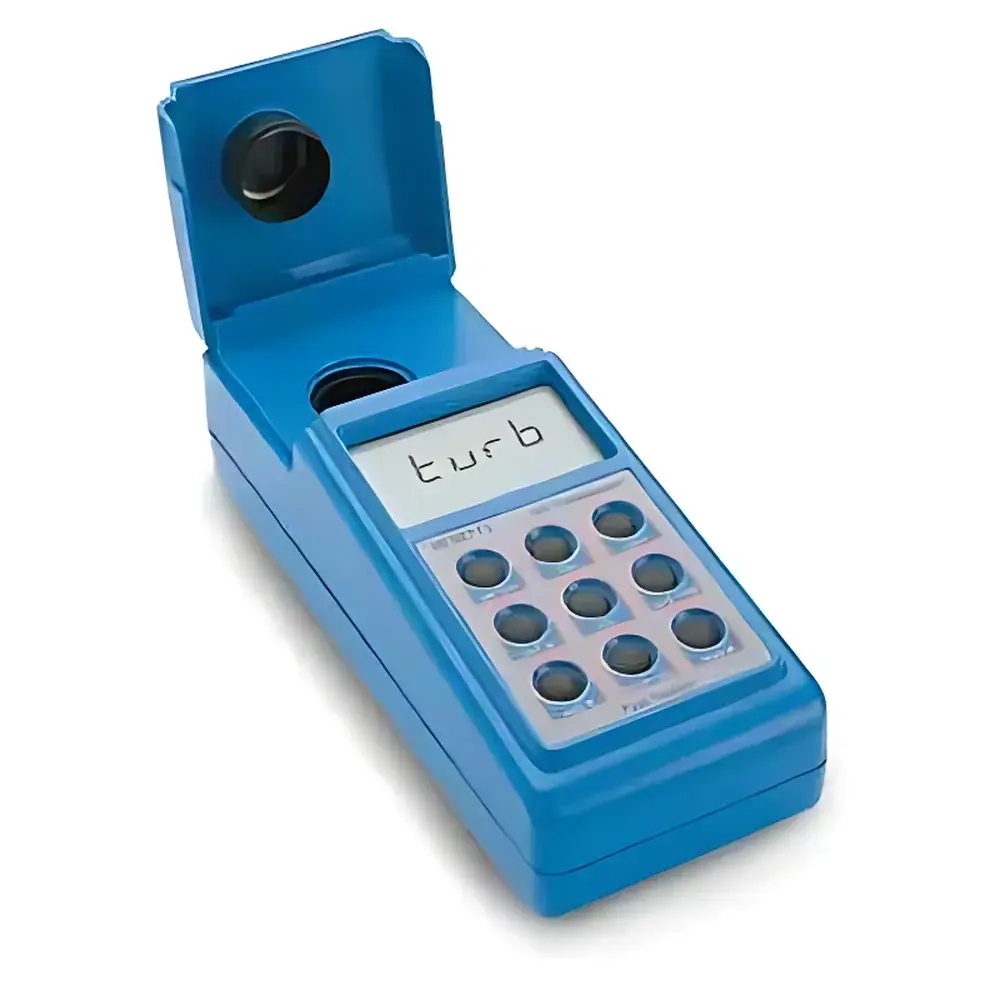
Hanna HI98713 Portable Multi-Range Turbidimeter (ISO 7027 Compliant)
| Brand | Hanna Instruments |
|---|---|
| Origin | Italy |
| Model | HI98713 |
| Instrument Type | Portable Turbidimeter |
| Parameter Type | Single-Parameter |
| Measurement Range | 0.00–9.99 / 10.0–99.9 / 100–1000 FNU |
| Resolution | 0.01 FNU (≤9.99), 0.1 FNU (≤99.9), 1 FNU (≤1000) |
| Accuracy | ±1% of reading ± 0.02 FNU at 25°C |
| Optical Method | Nephelometric (90° scatter) and Ratio (180° backscatter), ISO 7027 compliant |
| Calibration Points | <0.1, 15, 100, 750 FNU (manual, 4-point) |
| Data Storage | 200 measurement records |
| Interface | USB and RS232 |
| GLP Support | Timestamped calibration logs, setup history, user-accessible audit trail |
| Detection Limit | <0.02 FNU |
| Repeatability | ±1% of reading or ±0.02 FNU (whichever is greater) |
| Operating Environment | 0–50°C, ≤95% RH non-condensing |
| Dimensions | 224 × 87 × 77 mm |
| Weight | 512 g |
Overview
The Hanna HI98713 Portable Multi-Range Turbidimeter is an ISO 7027-compliant optical instrument engineered for precise, field-deployable turbidity measurement in drinking water, wastewater, environmental monitoring, and process control applications. It employs dual-angle detection—nephelometric 90° scattering and ratio-based 180° backscatter—to comply strictly with the ISO 7027 standard, ensuring metrological equivalence across laboratories and regulatory jurisdictions. Unlike single-angle instruments, this dual-mode architecture minimizes interference from color, particle size distribution, and refractive index variations—critical for accurate FNU (Formazin Nephelometric Units) reporting in heterogeneous samples such as surface water, clarified effluent, or filtered potable supplies. The instrument operates on the fundamental principle that suspended particulates scatter incident light proportionally to their concentration, morphology, and optical properties; the HI98713 quantifies this scatter intensity using a calibrated tungsten-halogen light source and matched silicon photodetectors. Its multi-range design (0.00–9.99, 10.0–99.9, and 100–1000 FNU) enables high-resolution detection at low turbidities—where regulatory compliance is most stringent—while maintaining linearity and stability up to 1000 FNU without manual range switching.
Key Features
- Automatic range selection with seamless transition between low-, mid-, and high-turbidity modes, eliminating operator error during dynamic sampling
- Dual optical measurement geometry: 90° nephelometry (primary) and 180° ratio mode (secondary), both traceable to ISO 7027 reference methodology
- CAL CHECK™ performance verification system: Validates internal optical calibration curve integrity using certified formazin standards; detects drift in detector sensitivity or LED output before it impacts data validity
- Four-point manual calibration with pre-programmed standards (<0.1, 15, 100, 750 FNU), supporting traceable recalibration per EPA Method 180.1 and ISO/IEC 17025 requirements
- GLP-compliant data management: Each stored measurement includes timestamp, calibration ID, operator ID (if configured), and temperature-compensated FNU value
- Backlit graphical LCD (64 × 128 pixels) optimized for outdoor readability under variable ambient lighting conditions
- Low-power operation via four AA alkaline batteries (15-minute auto-off default); battery life exceeds 200 hours under typical usage
Sample Compatibility & Compliance
The HI98713 is validated for use with aqueous matrices including raw surface water, coagulated/flocculated influent, sand-filtered potable water, UV-disinfected effluent, and tertiary-treated wastewater. It accommodates standard 25-mm round glass vials (HI731319) and accepts optional quartz cuvettes for UV-transparent applications. All measurements adhere to ISO 7027:2016 (Water quality — Determination of turbidity), satisfying mandatory reporting criteria for EU Drinking Water Directive (2020/2184), US EPA Clean Water Act compliance monitoring, and WHO Guidelines for Drinking-water Quality. The instrument’s optical path length (50 mm) and detector spectral response (400–600 nm) are aligned with ISO-defined tolerances. For regulated environments, its GLP logging supports FDA 21 CFR Part 11–aligned audit trails when paired with Hanna’s HI98713 Data Manager software (v3.2+), enabling electronic signature capture and secure export to LIMS.
Software & Data Management
Data transfer occurs via bidirectional USB or RS232 interface to Windows-based PCs running Hanna’s proprietary HI98713 Data Manager software. The software exports CSV- and Excel-compatible files containing full metadata: measurement time/date, calibration status, temperature, FNU value, range used, and operator identifier. Internal memory retains 200 readings with automatic overwrite protection; each record includes embedded calibration verification flags. The software also generates calibration reports compliant with ISO/IEC 17025 Clause 6.4.6 (equipment verification), documenting date, standard lot number, deviation from nominal value, and technician signature. No cloud dependency or subscription model is required—data remains under full user control and resides locally unless explicitly exported.
Applications
- Drinking water utilities: Monitoring filtration efficiency, detecting breakthrough events at rapid sand or membrane filters, and verifying compliance with <0.3 NTU/FNU limits per NSF/ANSI 61
- Wastewater treatment plants: Assessing final effluent clarity prior to discharge, optimizing coagulant dosing, and validating tertiary polishing performance
- Environmental agencies: Field-based assessment of watershed turbidity trends, sediment transport modeling inputs, and stormwater runoff characterization
- Food & beverage QA/QC: Verifying clarity of process water, rinse water, and bottled water products per Codex Alimentarius standards
- Pharmaceutical water systems: Supporting PW (Purified Water) and WFI (Water for Injection) system validation per USP and EU GMP Annex 1
FAQ
What turbidity units does the HI98713 report in, and are they interchangeable with NTU?
The instrument reports exclusively in FNU (Formazin Nephelometric Units), defined by ISO 7027. While numerically equivalent to NTU (Nephelometric Turbidity Units) under ideal conditions, FNU is metrologically distinct—its definition mandates a specific 90° detector geometry and 860 nm ± 30 nm light source. NTU, defined by EPA Method 180.1, uses a white-light source and different detector alignment. Direct unit conversion is not recommended for regulatory submissions.
Can I use third-party formazin standards for calibration?
No. Only Hanna-certified standards (e.g., HI98713-11) are validated for use with the HI98713’s internal calibration algorithm. Non-Hanna standards lack traceability to NIST SRM 2134 and may induce irreversible optical curve drift due to spectral mismatch or particle instability.
How often should CAL CHECK™ verification be performed?
For daily field use, perform CAL CHECK™ every 1–3 months; for lab-based intermittent use, semiannual verification suffices. Always verify after exposure to extreme temperatures (>50°C), mechanical shock, or prolonged storage.
Does the instrument compensate for sample temperature?
Yes—integrated thermistor provides real-time temperature measurement (0–50°C). While turbidity itself is minimally temperature-dependent, the instrument applies minor compensation to detector gain to maintain signal stability across operational ranges.
Is the HI98713 suitable for GLP/GMP-regulated environments?
Yes—when used with documented calibration procedures, timestamped GLP logs, and validated software export workflows, it meets core requirements for instrument qualification under ASTM E2500 and EU Annex 11 for computerized systems.




