
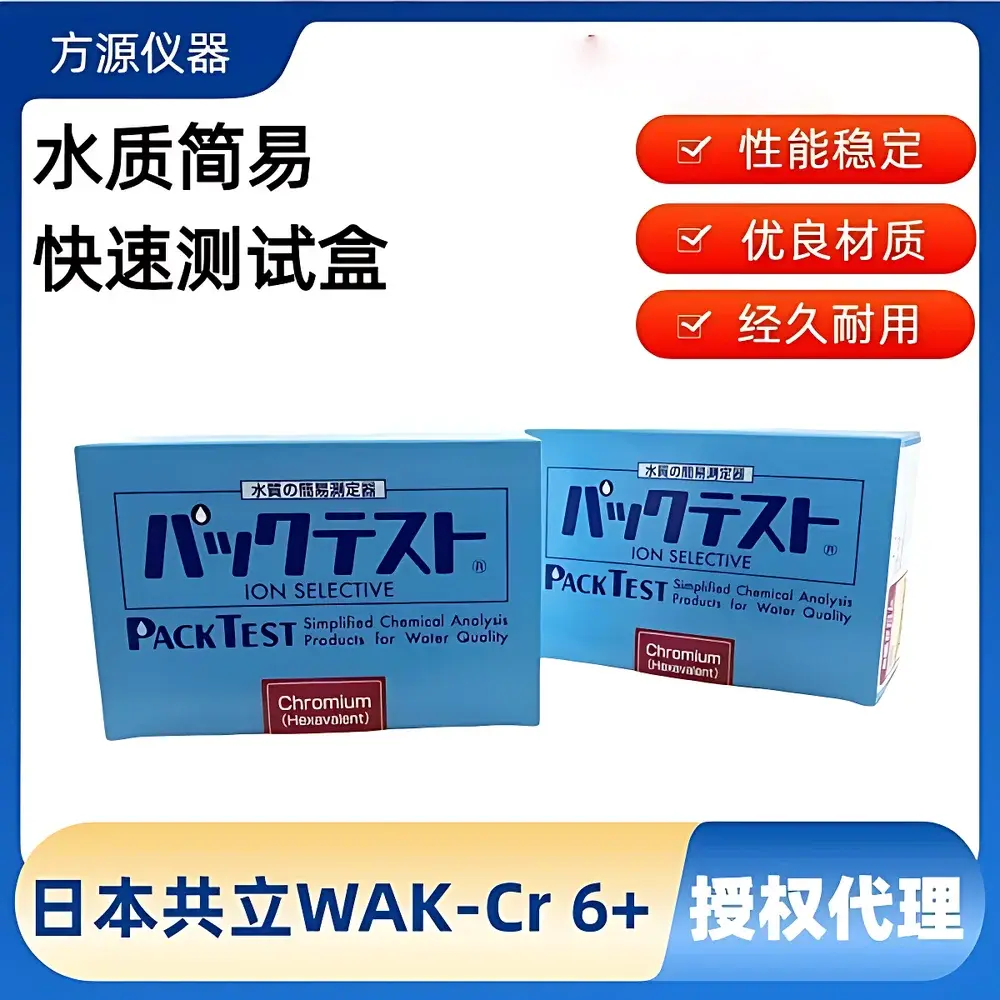
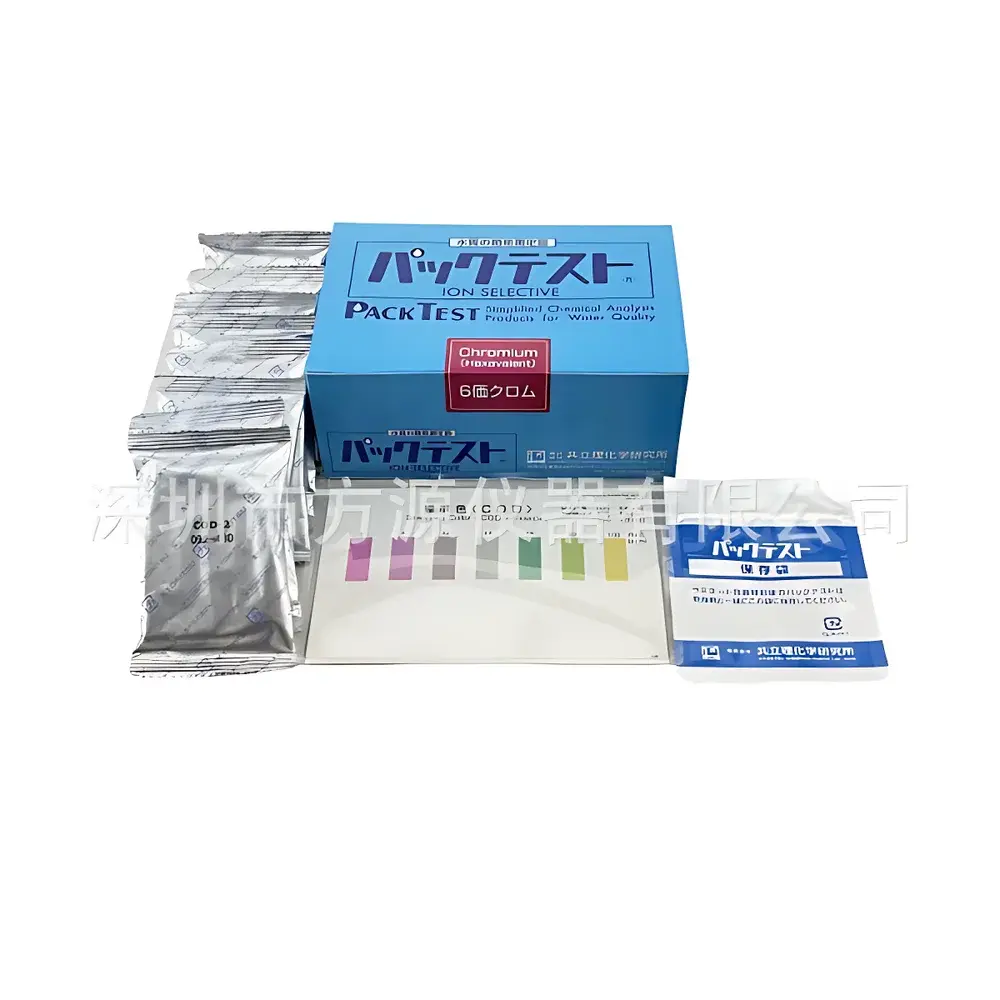
Kyoritsu PACKTEST WAK-Cr6+ Hexavalent Chromium (Cr(VI)) Colorimetric Test Kit
| Brand | Kyoritsu |
|---|---|
| Origin | Japan |
| Model | WAK-Cr6+ |
| Detection Principle | Diphenylcarbazide Colorimetry |
| Measurement Range | 0.05–2 mg/L Cr(VI) |
| Test Capacity | 50 determinations |
| Dimensions (L×W×H) | 165 × 110 × 65 mm |
| Weight | 140 g |
| Shelf Life | Expiry date indicated per batch (e.g., Oct 2024) |
| Compliance | Designed for field-deployable compliance screening per ISO 11885, EPA Method 7196A, and JIS K 0102 |
Overview
The Kyoritsu PACKTEST WAK-Cr6+ is a field-deployable, single-use colorimetric test kit engineered for rapid, semi-quantitative determination of hexavalent chromium (Cr(VI)) in aqueous samples. It operates on the well-established diphenylcarbazide (DPC) reaction principle: Cr(VI) in acidic medium oxidizes DPC to form a stable violet-colored complex with maximum absorbance near 540 nm. The intensity of this color—visually compared against a calibrated chromatic scale—is directly proportional to Cr(VI) concentration within the defined range of 0.05–2 mg/L. This method is recognized in multiple regulatory frameworks, including EPA Method 7196A (Chromium, Hexavalent, Colorimetric), ISO 11885 (Water quality — Determination of selected elements by inductively coupled plasma optical emission spectrometry), and JIS K 0102 (Testing methods for heavy metals in industrial wastewater). While not a replacement for laboratory-grade ICP-MS or IC-ICP-MS quantification, the WAK-Cr6+ serves as a validated first-response tool for screening effluent discharges, surface water monitoring, and routine site inspections where immediate decision-making is required.
Key Features
- Pre-calibrated, factory-sealed reagent strips—no liquid reagent handling or pipetting required.
- Two-minute total assay time from sample immersion to visual interpretation.
- Integrated reference color chart housed in durable, moisture-resistant packaging for field stability.
- Each kit contains 50 individually sealed test strips (10 pouches × 5 strips), minimizing cross-contamination and degradation.
- Compact, lightweight design (140 g) optimized for mobile environmental technicians and plant QA/QC personnel.
- No external power source, instrumentation, or software needed—ideal for remote locations or emergency response scenarios.
Sample Compatibility & Compliance
The WAK-Cr6+ is validated for use with clarified aqueous matrices including industrial wastewater, municipal effluent, surface water, groundwater, and cooling tower water. Turbid or highly colored samples should be filtered (0.45 µm membrane) prior to testing. Interference from strong oxidants (e.g., residual chlorine >0.5 mg/L) or reducing agents (e.g., Fe²⁺, SO₃²⁻) may suppress or overestimate Cr(VI) signal; pretreatment with sulfamic acid or EDTA may be necessary per EPA guidance. The kit supports preliminary compliance verification under ISO 11885 Annex B (screening procedures) and aligns with GLP-aligned documentation practices when used with standardized field logbooks. Batch-specific expiry dates and Lot numbers (e.g., 23162A) ensure traceability for audit readiness.
Software & Data Management
As a non-instrumental, visual-read test system, the WAK-Cr6+ does not interface with digital platforms or require software. However, its standardized format facilitates integration into structured environmental data workflows: results can be recorded manually in LIMS-compatible spreadsheets or entered into electronic field notebooks compliant with 21 CFR Part 11 (when paired with authenticated user logs and timestamped entries). The included instruction manual provides full procedural documentation—including interference mitigation steps, storage conditions (2–30°C, dry), and disposal protocols aligned with local hazardous waste regulations.
Applications
- Routine screening of electroplating, anodizing, and stainless steel passivation rinse waters.
- Field verification of Cr(VI) removal efficiency in ion exchange or reduction-based treatment systems.
- Regulatory pre-screening prior to submission of samples for certified lab analysis (e.g., EPA-certified labs under NPDES permits).
- Environmental due diligence during property transfers or brownfield site assessments.
- Educational demonstrations of redox-based metal detection principles in university environmental chemistry labs.
FAQ
What is the shelf life of the WAK-Cr6+ test strips?
Each batch carries a printed expiration date (e.g., “Exp.Date 2024.10”) based on accelerated stability testing under recommended storage conditions (2–30°C, low humidity, protected from light).
Can this kit detect trivalent chromium (Cr(III))?
No. The diphenylcarbazide reaction is highly selective for Cr(VI); Cr(III) does not produce the characteristic violet complex under standard test conditions.
Is the color chart NIST-traceable?
The chromatic scale is manufactured to Kyoritsu’s internal calibration protocol, verified against Cr(VI) standard solutions prepared per ISO Guide 35 and ASTM E200. Full traceability documentation is available upon request for audit support.
How should used test strips be disposed?
Spent strips contain Cr(VI)-complexed residues and must be treated as hazardous waste per local jurisdiction (e.g., RCRA D007 in the U.S., EU Waste Code 16 04 02*). Do not discard in general waste.
Does temperature affect test accuracy?
Yes. Ambient temperature between 15–30°C is optimal. Below 15°C, reaction kinetics slow; above 30°C, background color development may increase. Pre-equilibration of samples to room temperature is recommended.
Related Products







