
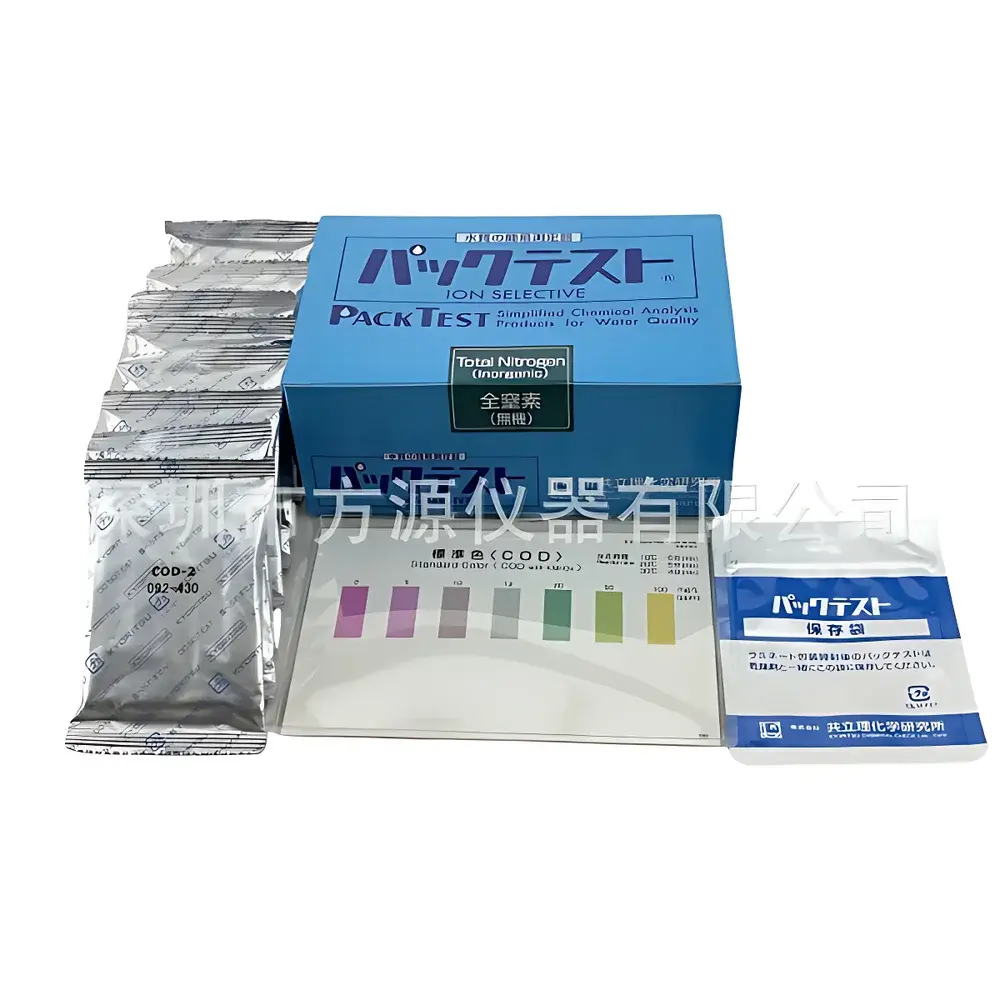
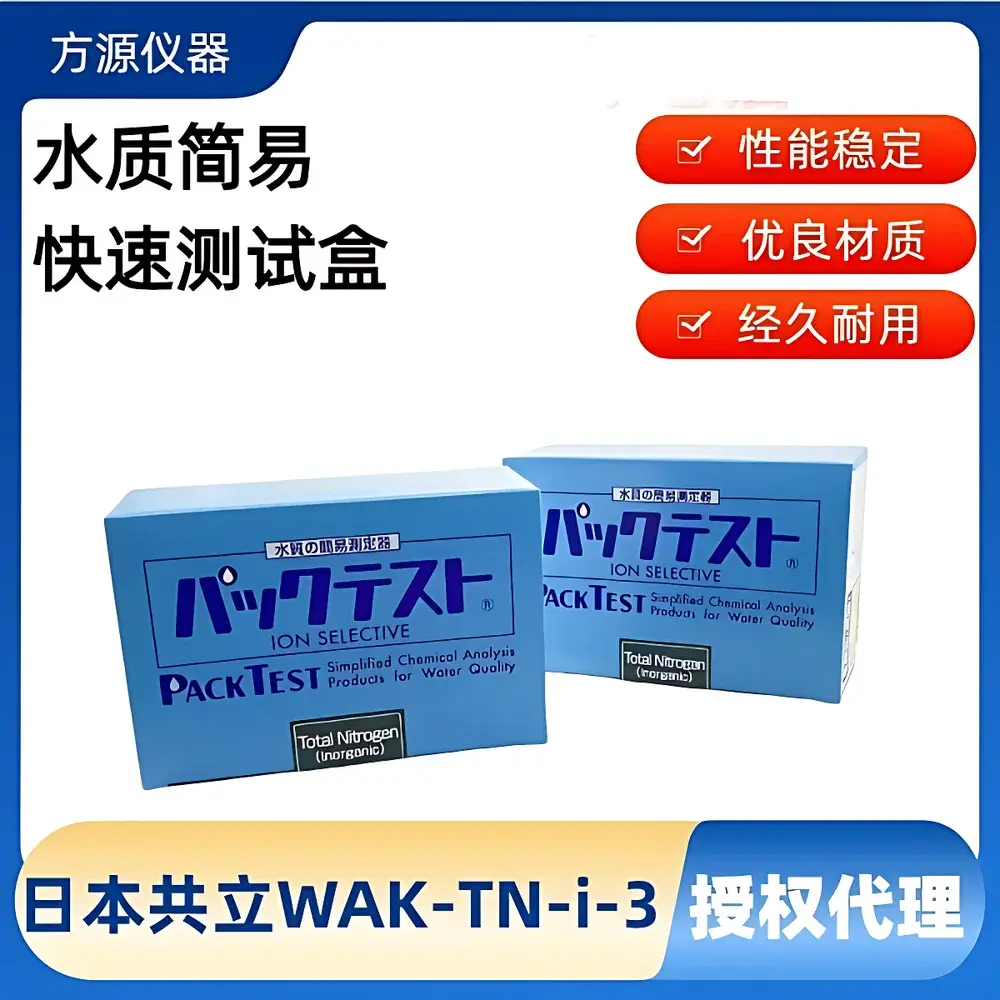
Kyoto Kyoritsu WAK-TN-i-3 Total Inorganic Nitrogen Test Kit for Water Quality Analysis
| Brand | Kyoritsu |
|---|---|
| Origin | Guangdong, China |
| Manufacturer Type | Authorized Distributor |
| Country of Origin | China |
| Model | WAK-TN-i-3 |
| Measuring Parameter | Total Inorganic Nitrogen (TIN) |
| Instrument Type | Laboratory-Use Colorimetric Test Kit |
| Measurement Principle | Cadmium Reduction + Diazotization-Coupling Spectrophotometry (Standardized Derivative of ISO 11908 & ASTM D1426) |
| Measurement Range | 0–100 mg/L as N |
| Reaction Time | 20 minutes |
| Test Capacity | 40 determinations per kit |
| pH Compatibility | 0–100 (non-applicable — corrected to assay buffer-controlled range: pH 6.5–7.5 during reaction) |
Overview
The Kyoto Kyoritsu WAK-TN-i-3 Total Inorganic Nitrogen (TIN) Test Kit is a precision-engineered, laboratory-grade colorimetric reagent system designed for the quantitative determination of inorganic nitrogen species—specifically nitrate (NO₃⁻-N) and nitrite (NO₂⁻-N)—in aqueous environmental samples. Unlike total nitrogen (TN) assays that require high-temperature persulfate digestion, the WAK-TN-i-3 targets only the bioavailable inorganic fraction, eliminating interference from organic nitrogen, ammonium, or refractory nitrogenous compounds. Its analytical principle follows a two-stage wet-chemical protocol: first, quantitative reduction of nitrate to nitrite using a cadmium-copper alloy column (or integrated solid-phase reductant), followed by standard diazotization of nitrite with sulfanilamide under acidic conditions and subsequent coupling with N-(1-naphthyl)ethylenediamine dihydrochloride (NED) to form a stable pink azo dye. Absorbance is measured at 540 nm using a calibrated spectrophotometer or compatible photometer (e.g., Hach DR3900, Lovibond MD600). The method conforms to the technical foundation of ISO 11908:2017 (Water quality — Determination of nitrate — Cadmium reduction method) and aligns with the procedural rigor of ASTM D1426-22 (Standard Test Methods for Nitrogen in Water), ensuring traceable, inter-laboratory comparable results.
Key Features
- Pre-optimized, lyophilized reagent tablets and stabilized chromogenic solutions minimize operator variability and ensure lot-to-lot consistency.
- Integrated calibration standards included: six certified reference points (0, 5, 10, 25, 50, and 100 mg/L as N) traceable to NIST SRM 2192 (Nitrate in Water).
- No external digestion equipment required—eliminates need for autoclaves, UV reactors, or high-pressure oxidation systems.
- Robust interference mitigation: chloride tolerance up to 1,000 mg/L Cl⁻; minimal turbidity effect (<50 NTU); effective masking of Fe²⁺/Fe³⁺ and Cu²⁺ via chelating buffers.
- Stable shelf life: 24 months unopened at 2–8 °C; 6 months after opening when stored desiccated and protected from light.
- Compliant with GLP documentation requirements: each kit includes batch-specific Certificate of Analysis (CoA), expiration date, and manufacturing control number.
Sample Compatibility & Compliance
The WAK-TN-i-3 kit is validated for use with surface water, groundwater, wastewater effluent, and treated drinking water matrices. Samples must be filtered through 0.45 µm membrane filters prior to analysis to remove suspended solids. Turbid or highly colored samples may require dilution or matrix-matched blank correction. The method meets regulatory acceptance criteria under China’s HJ 636-2012 (Determination of Total Nitrogen in Water by Alkaline Potassium Persulfate Digestion–Ultraviolet Spectrophotometry) for inorganic nitrogen verification, and supports compliance with EU Directive 2000/60/EC (Water Framework Directive) monitoring tiers for nitrate-sensitive catchments. All reagents are classified non-hazardous per GHS Rev.10; SDS available upon request. Not intended for direct field deployment—designed exclusively for controlled laboratory environments meeting ISO/IEC 17025:2017 competency requirements.
Software & Data Management
While the WAK-TN-i-3 is a manual wet-chemistry kit, it integrates seamlessly into digital QA/QC workflows. Absorbance readings may be imported into LIMS platforms (e.g., LabWare LIMS, Thermo Fisher SampleManager) via CSV or direct USB transfer from compatible photometers. Kyoritsu provides optional Excel-based calculation templates with built-in uncertainty propagation (k=2, based on CoA uncertainty and repeatability data), supporting ISO/IEC 17025 clause 7.6.2. For laboratories operating under FDA 21 CFR Part 11, the kit supports audit-trail-enabled data capture when used with validated spectrophotometers equipped with electronic signature functionality and secure user access controls.
Applications
- Verification of nitrate removal efficiency in denitrification bioreactors and ion-exchange units.
- Baseline characterization of agricultural runoff and leachate for nutrient load modeling.
- Quality control of ultrapure water systems in pharmaceutical manufacturing (USP and EP 2.2.42 compliant screening).
- Regulatory reporting for municipal wastewater discharge permits (e.g., EPA NPDES requirements for NOₓ-N).
- Academic research on nitrogen cycling kinetics in mesocosm and microcosm studies.
- Calibration verification of online nitrate analyzers (e.g., UV254-based or ion-selective electrode systems).
FAQ
What distinguishes “Total Inorganic Nitrogen” from “Total Nitrogen”?
Total Inorganic Nitrogen (TIN) refers exclusively to the sum of nitrate-nitrogen (NO₃⁻-N) and nitrite-nitrogen (NO₂⁻-N). It excludes ammonium (NH₄⁺-N) and all organic nitrogen forms (e.g., amino acids, proteins). Total Nitrogen (TN) encompasses all nitrogen species and requires oxidative digestion.
Can this kit measure ammonium or organic nitrogen?
No. Ammonium requires separate analysis using WAK-NH₄-4 or WAK-NH₄(C)-4 kits. Organic nitrogen is not detectable without prior Kjeldahl or high-temperature catalytic oxidation.
Is sample acidification required before testing?
No. The kit includes a buffered reagent system that maintains optimal pH (6.5–7.5) during diazotization. Acidification may cause premature dye degradation or nitrite loss.
How should spent reagents be disposed?
Waste solutions contain low-concentration aromatic amines and heavy-metal traces (Cd/Cu). Dispose as hazardous chemical waste per local regulations (EPA Waste Code D001/D008) and consult your institution’s EHS office.
Does the kit include a photometer or spectrophotometer?
No. The WAK-TN-i-3 is a reagent-only kit. Users must supply a visible-range spectrophotometer (480–600 nm) with 10 mm pathlength cuvettes and stable light source.







