
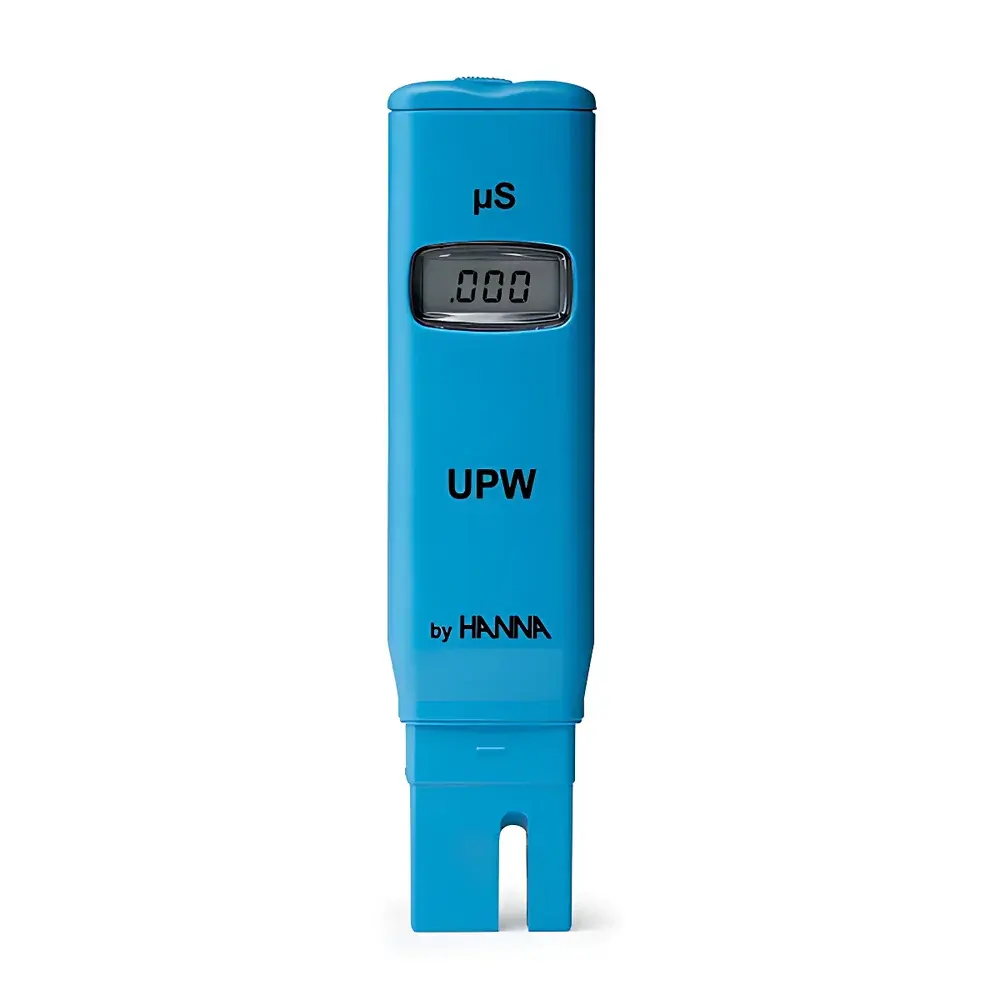
Hanna HI98309 (UPW) Ultra-Low-Range Microprocessor-Based Conductivity (EC) Meter
| Brand | Hanna Instruments |
|---|---|
| Origin | Italy |
| Model | HI98309 (UPW) Ultra-Low-Range Microprocessor-Based Conductivity (EC) Meter |
| Instrument Type | Portable |
| Parameter Type | Single-Parameter |
| Measurement Range | 0.000 to 1.999 µS/cm |
| Resolution | 0.001 µS/cm |
| Accuracy | ±2% F.S. @ 20°C/68°F |
| Calibration | Single-point, factory preset at 84 µS/cm (HI7033 recommended) |
| Temperature Compensation | Automatic, 0 to 50°C, β = 2%/°C |
| Power | 4 × 1.5 V button cells (LR44) |
| Operating Environment | 0 to 50°C, ≤95% RH (non-condensing) |
| Dimensions | 175 × 41 × 23 mm |
| Weight | 95 g |
Overview
The Hanna HI98309 (UPW) is a dedicated ultra-low-range conductivity meter engineered for precise measurement of extremely low ionic concentrations in ultrapure water (UPW) and other low-conductivity matrices. It operates on the two-electrode conductometric principle, where a known AC voltage is applied across a graphite electrode pair, and the resulting current is measured to calculate conductance—converted to conductivity (µS/cm) using cell constant correction and temperature-compensated algorithms. Designed specifically for applications demanding sub-1 µS/cm resolution—such as semiconductor rinse monitoring, pharmaceutical water-for-injection (WFI) verification, and high-purity steam condensate analysis—the HI98309 delivers stable, drift-resistant readings in environments where conventional meters fail due to polarization errors or insufficient sensitivity. Its fixed-cell-constant graphite electrode minimizes fouling and ensures long-term reproducibility without manual cell constant input—a critical advantage in routine QC workflows where operator error must be eliminated.
Key Features
- Ultra-high-resolution measurement down to 0.001 µS/cm with full-scale accuracy of ±2% at 20°C—validated per ISO 7888 and ASTM D1125 guidelines for low-conductivity water testing.
- Integrated two-electrode graphite sensor with optimized surface geometry and low-noise shielding, eliminating the need for frequent recalibration or cell constant entry.
- Automatic temperature compensation (ATC) over 0–50°C using the standardized β = 2%/°C linear coefficient, compliant with USP requirements for purified water and water for injection.
- Factory-calibrated at 84 µS/cm using NIST-traceable HI7033 standard solution; single-point calibration protocol supports rapid field verification without multi-standard handling.
- Compact, lightweight housing (95 g) with IP67-rated sealing against moisture and particulate ingress—suitable for cleanroom gowning environments and mobile lab use.
- Low-power design powered by four LR44 button cells, delivering >200 hours of continuous operation; battery replacement requires no tools and preserves calibration memory.
Sample Compatibility & Compliance
The HI98309 is validated for direct immersion measurement in ultrapure water (UPW), distilled water, deionized water, steam condensate, and low-ionic-strength cleaning solutions used in PCB manufacturing and laundry process control. It meets the electrical conductivity acceptance criteria defined in ASTM D5127 (Standard Guide for Ultrapure Water Used in the Electronics Industry) and aligns with ISO 3696 Class 1 water specifications. While not intended for high-TDS samples (>5 µS/cm), its design prevents electrode polarization artifacts common in traditional platinum sensors when measuring below 0.1 µS/cm. The instrument complies with CE marking directives (2014/30/EU EMC, 2011/65/EU RoHS) and supports GLP-compliant documentation through user-defined ID entry and timestamped calibration logging.
Software & Data Management
As a standalone portable meter, the HI98309 does not feature Bluetooth, USB, or PC connectivity. However, its internal non-volatile memory retains the last calibration date, temperature reading, and measurement mode—accessible via the LCD interface. All calibration events are time-stamped and stored independently of battery power, satisfying basic audit-trail requirements under FDA 21 CFR Part 11 for non-networked instruments. For laboratories requiring electronic records, users may manually transcribe readings into LIMS or Excel-based QA templates; the consistent 0.001 µS/cm resolution enables traceable digitization without rounding loss. Hanna’s HI7033 calibration standard is supplied with a Certificate of Analysis referencing NIST SRM 3199, ensuring metrological traceability.
Applications
- Monitoring rinse water resistivity in semiconductor wafer fabrication lines (e.g., post-etch and post-CMP stages).
- Verification of purified water systems in pharmaceutical manufacturing per EU GMP Annex 1 and USP .
- Steam purity validation in hospital sterilization autoclaves and central utility plants.
- Quality control of bottled mineral water and spring water during bottling line release testing.
- Field assessment of deionizer and reverse osmosis system performance in laboratory water purification loops.
FAQ
Why is the HI98309 limited to 1.999 µS/cm maximum range?
This intentional design constraint optimizes signal-to-noise ratio and minimizes stray capacitance effects inherent in ultra-low-conductivity measurements—extending the dynamic range downward rather than upward ensures superior repeatability below 0.5 µS/cm.
Can I use this meter for seawater or wastewater samples?
No. The HI98309 is not suitable for samples exceeding 2 µS/cm. High-ionic-strength matrices cause electrode saturation and inaccurate ATC response; use HI98308 or HI98312 for broader-range applications.
Is the graphite electrode replaceable or serviceable?
The electrode is permanently integrated and not user-replaceable. Hanna recommends periodic cleaning with HI70300 electrode cleaning solution and visual inspection for coating or abrasion before each use.
Does the meter comply with FDA 21 CFR Part 11?
While it lacks electronic signature capability, its calibration memory retention, time-stamping, and non-volatile storage meet the “electronic record” definition under Part 11 Subpart B for non-networked devices used in GxP environments.
What is the recommended recalibration frequency?
Per ISO/IEC 17025:2017 Clause 7.7.1, recalibrate before each analytical session or at least daily when used in regulated environments; more frequently if ambient temperature fluctuates beyond ±2°C or if readings deviate from historical baselines.





