
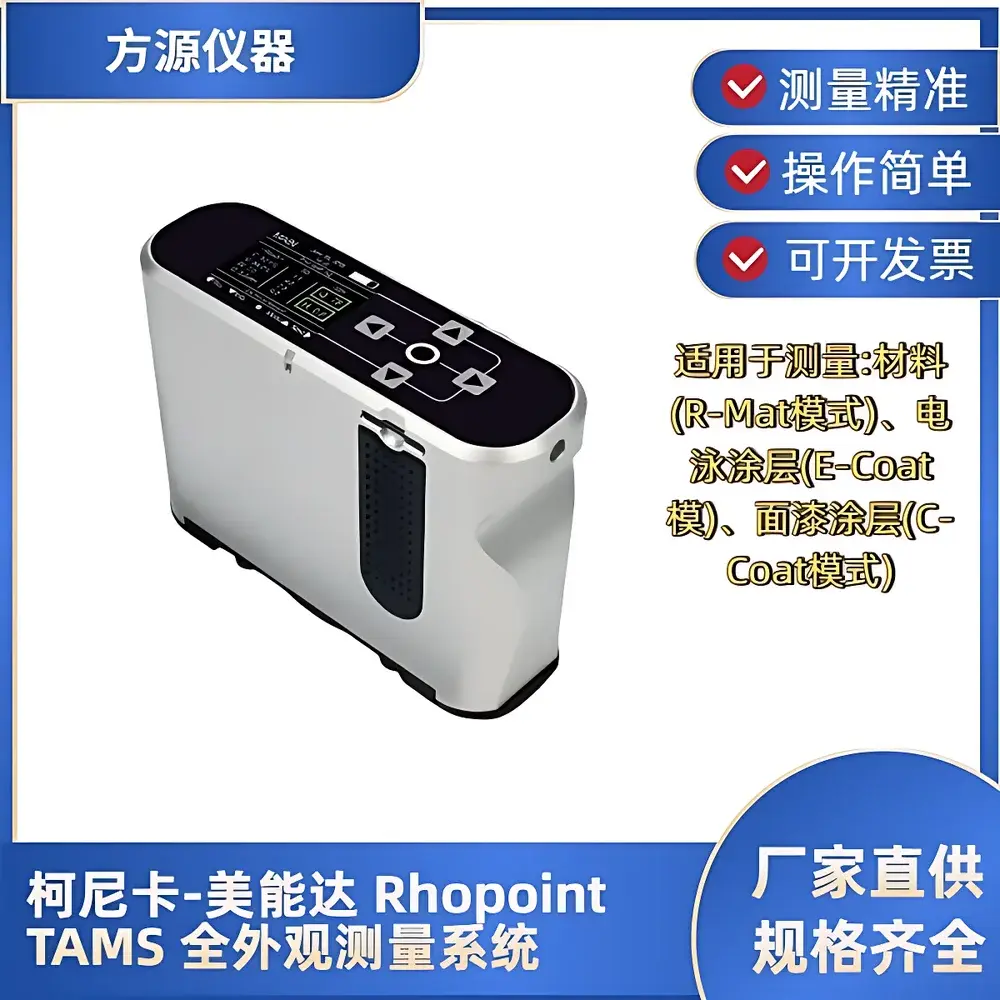
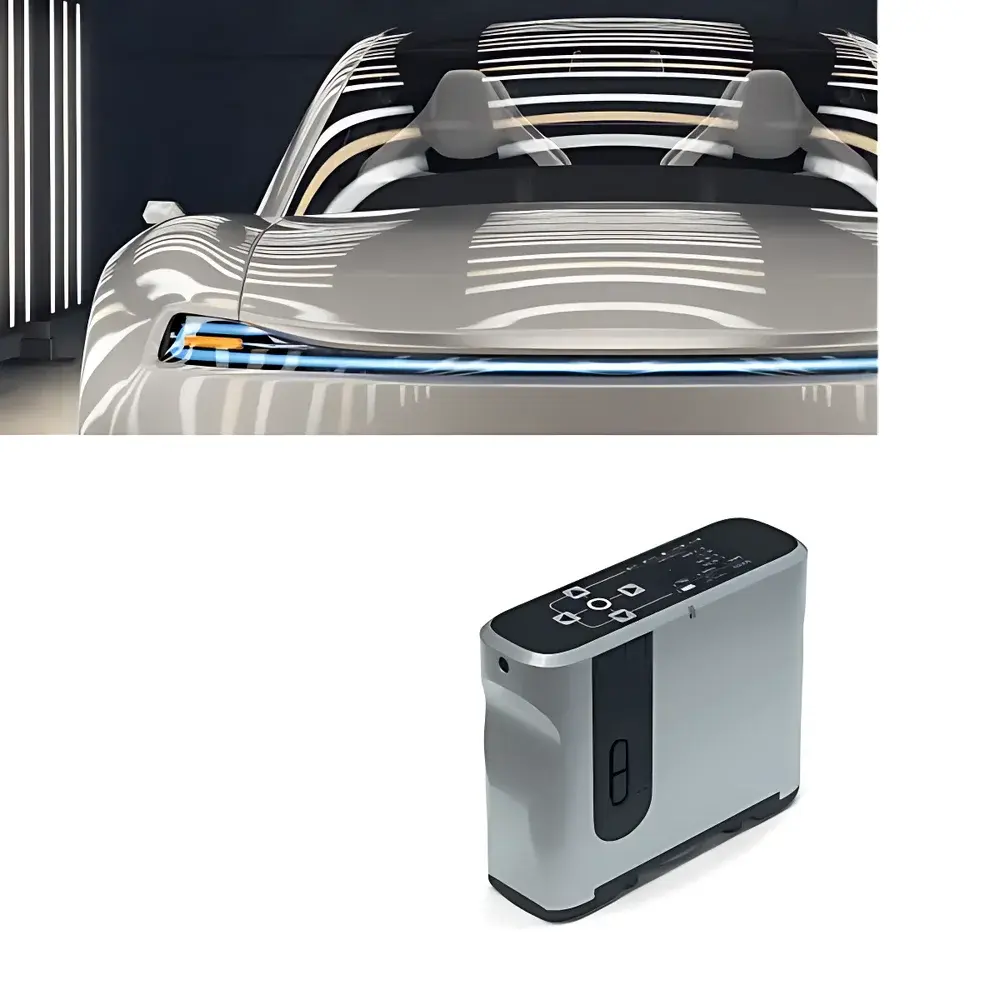
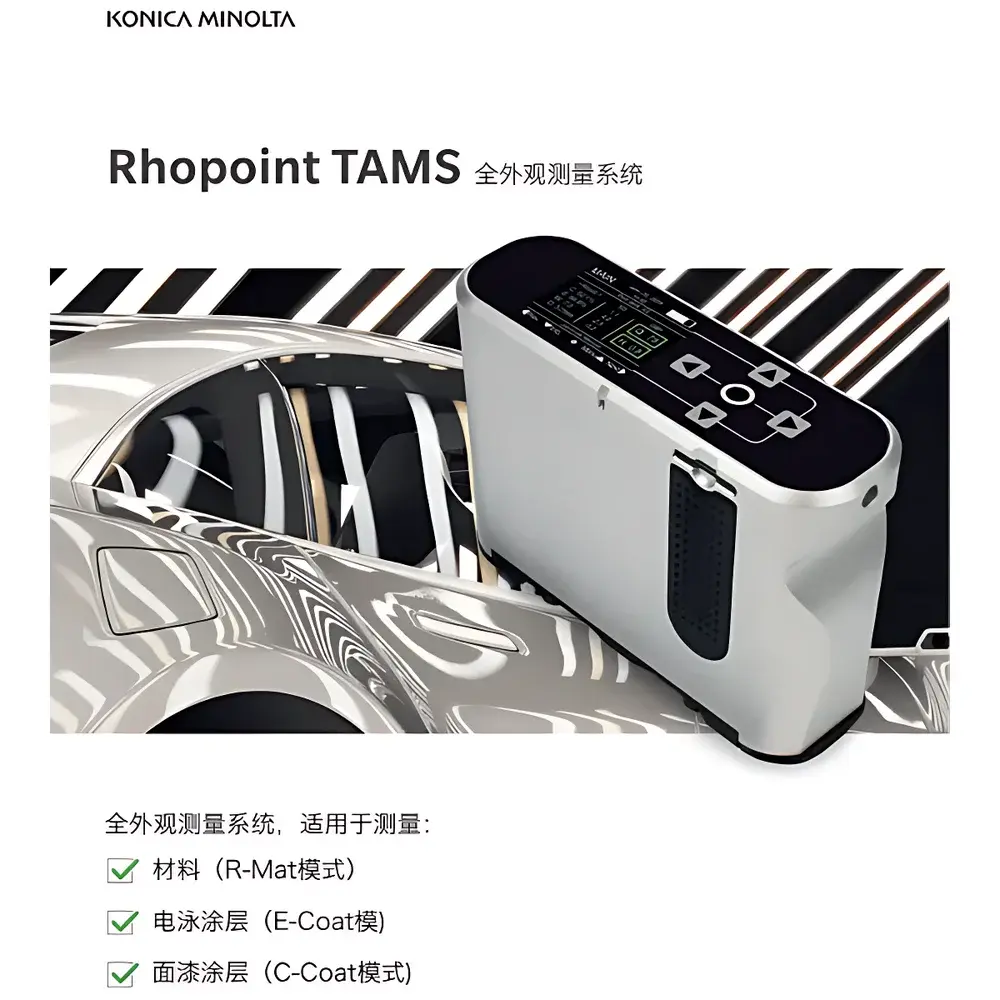
Konica Minolta Rhopoint TAMS Total Appearance Measurement System for Electrophoretic Coating and Topcoat Surfaces
| Brand | Konica Minolta |
|---|---|
| Origin | Japan |
| Manufacturer Type | Authorized Distributor |
| Origin Category | Imported |
| Model | Rhopoint TAMS |
| Product Type | Spectrophotometric Color & Texture Analyzer |
| Instrument Type | Benchtop |
| Measurement Principle | Phase Measuring Deflectometry (PMD) + Multi-Angle Spectrophotometry |
| Compliance | ISO 16610, DIN EN ISO 4287, DIN EN ISO 25178, ASTM D7113 |
| Data Export Format | *.res, CSV, PNG, TIFF |
| Software Compatibility | OptiMap Reader v5.2+, Rhopoint Analysis Suite |
Overview
The Konica Minolta Rhopoint TAMS Total Appearance Measurement System is a benchtop spectrophotometric and topographic analyzer engineered for quantitative, non-contact evaluation of surface appearance in electrophoretic coating (e-coat) and automotive topcoat applications. Unlike conventional profilometers or confocal microscopes that rely on point-scanning or slow raster-based acquisition, the TAMS integrates Phase Measuring Deflectometry (PMD) with multi-angle spectral reflectance measurement to simultaneously capture both geometric texture parameters (e.g., Sa, Sq, Sz) and colorimetric attributes (L*a*b*, ΔE00, DOI, RI, WV) across a 50 × 50 mm field of view. This dual-mode architecture enables traceable, ISO-compliant assessment of how e-coat formulation, cure conditions, and substrate roughness (steel, aluminum, galvanized steel) influence final film formation—particularly fill-in behavior, leveling kinetics, and hiding power. The system operates under ambient laboratory lighting without vacuum or sample fixation, delivering repeatable measurements in ≤5 seconds per field—making it suitable for in-line process validation, R&D benchmarking, and cross-functional QA/QC workflows.
Key Features
- Phase Measuring Deflectometry (PMD) engine calibrated to ISO 16610-21 for areal surface texture analysis, delivering Sa, Sq, Sdr, and other ISO 25178-2 parameters with sub-micron vertical resolution
- Integrated 6-angle spectrophotometer (25°/45°/75°/110°/125°/150° illumination) compliant with ASTM D7113 and ISO 18314-2 for directional reflectance, distinctness of image (DOI), and waveform visibility (WV)
- Benchtop form factor with motorized Z-stage and auto-focus; no sample preparation or contact required
- Real-time visualization of height maps, false-color texture overlays, and spectral reflectance curves within unified GUI
- Traceable calibration using NIST-traceable ceramic tiles and certified roughness standards (Ra 0.1–5.0 µm)
- Compliance-ready audit trail with user authentication, electronic signatures, and 21 CFR Part 11–compatible data logging (optional)
Sample Compatibility & Compliance
The TAMS accommodates flat or gently curved panels (radius ≥300 mm) up to 300 × 300 mm in dimension and 50 mm in thickness—including bare metal substrates (cold-rolled steel, AA5xxx/6xxx aluminum), phosphated/zinc-coated surfaces, electrophoretic primers, and solvent- or water-borne basecoats/clearcoats. All measurement protocols align with international standards governing automotive finish quality: DIN EN ISO 4287 (profile-based Ra, Rz), DIN EN ISO 25178-2 (areal Sa, Sq, Ssk), ISO 16610-21 (filtration and noise separation), and ASTM D7113 (multi-angle gloss and appearance). Raw height map data is exported in Rhopoint’s native *.res format—fully compatible with third-party metrology software (e.g., MountainsMap®, Gwyddion) via ASCII conversion. System validation documentation supports GLP and IATF 16949-aligned internal audits.
Software & Data Management
Rhopoint OptiMap Reader v5.2+ serves as the primary analysis platform, enabling batch processing of *.res files, statistical process control (SPC) charting (X-bar/R, Cpk), and comparative overlay of texture vs. color trends across production lots. The embedded Rhopoint Analysis Suite provides automated reporting templates aligned with OEM appearance specification sheets (e.g., Ford WSS-M2P175-B, GMW14872, VW TL226). All measurement metadata—including instrument ID, operator, timestamp, environmental temperature/humidity, and calibration status—is embedded in each export. Optional database integration (SQL Server or Oracle) supports centralized data governance, version-controlled method storage, and role-based access control per ISO/IEC 17025 requirements.
Applications
- Quantifying e-coat fill-in efficiency over stamped steel substrates with controlled Ra profiles (0.4–1.6 µm)
- Correlating topcoat leveling performance with resin molecular weight distribution and solvent blend volatility
- Validating process window robustness during oven ramp rate optimization (e.g., 10–20°C/min)
- Root-cause analysis of orange peel, cratering, or mottling via spatial frequency decomposition of Sa maps
- Supplier qualification against Tier-1 OEM appearance specifications for body-in-white (BIW) and Class-A panels
- Accelerated aging studies tracking texture evolution (Sdr, Vmc) and color shift (ΔE00, Δb*) under QUV exposure
FAQ
Does the TAMS require optical calibration before each measurement session?
No—system-level calibration is performed quarterly using certified reference standards; daily verification uses onboard ceramic tile checks.
Can the TAMS measure curved automotive body panels?
Yes, for radii ≥300 mm; optional motorized tilt stage extends compatibility to moderate compound curves.
Is raw height map data exportable for finite element analysis (FEA)?
Yes—ASCII XYZ point clouds and Gaussian-filtered Sa maps are exportable at user-defined grid densities (up to 2048 × 2048 points).
How does TAMS differ from traditional confocal laser scanning microscopes?
TAMS uses PMD, not laser triangulation—enabling faster acquisition (≤5 s), larger FOV, and immunity to specular reflection artifacts common on high-gloss coatings.
Does the system support FDA 21 CFR Part 11 compliance?
Yes—when configured with Rhopoint Secure Mode, including electronic signatures, audit trails, and role-based permissions.





