
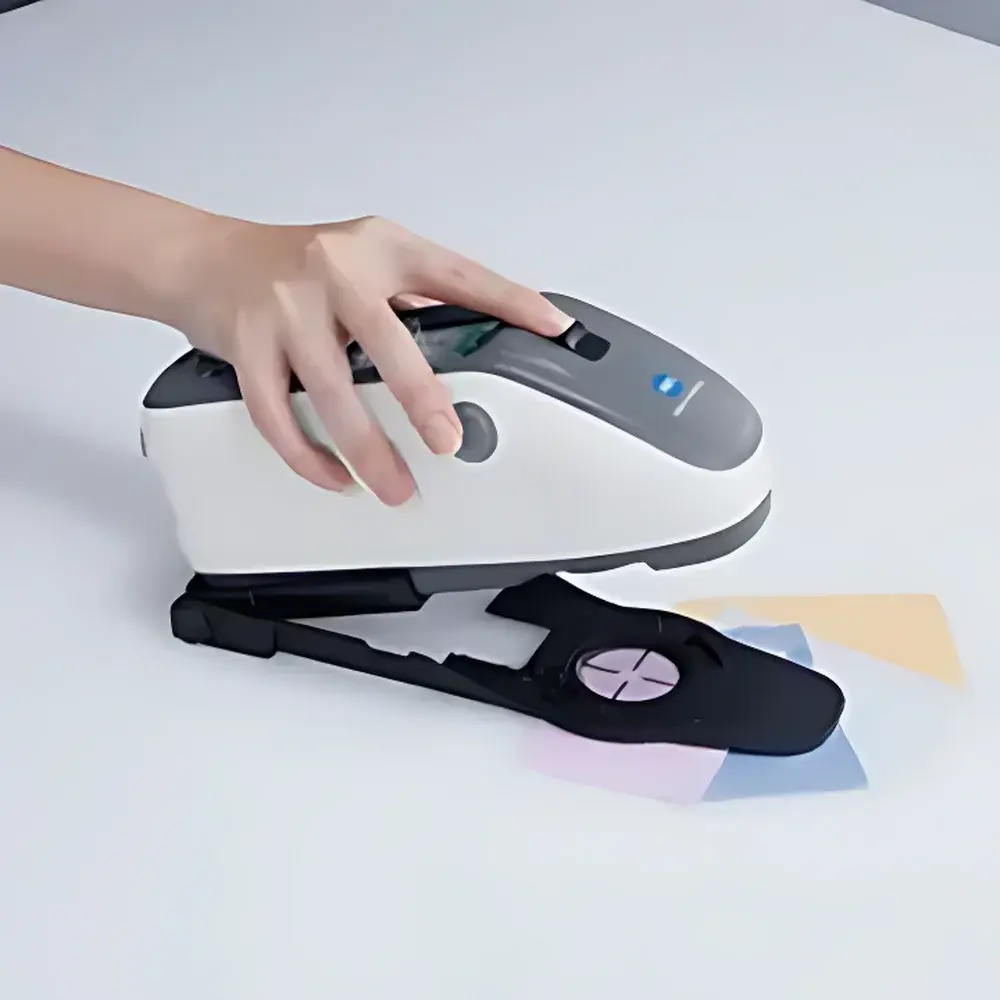
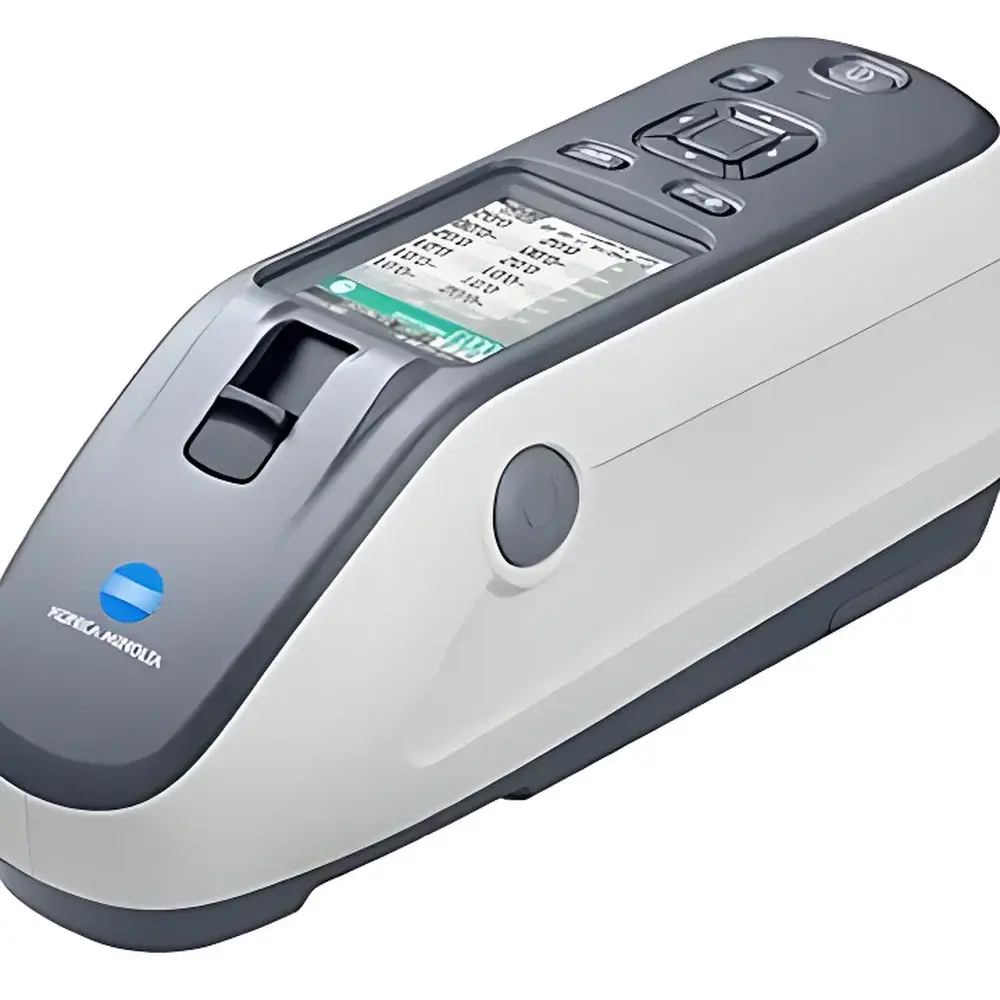
Konica Minolta CM-23d Portable Spectrophotometer
| Brand | Konica Minolta |
|---|---|
| Origin | Japan |
| Model | CM-23d |
| Illumination/Observation Geometry | di:8°/de:8° (Diffuse Illumination/8° Viewing) |
| Measurement Modes | SCI (Specular Component Included) / SCE (Specular Component Excluded) |
| Compliance | ISO 7724-1, CIE No.15:2004, DIN 5033-7, JIS Z 8722 Condition c, ASTM E1164 (SCI) |
| Integrating Sphere Diameter | Ø54 mm |
| Detector | Dual-row 32-element silicon photodiode array |
| Dispersion Element | Diffraction grating |
| Spectral Range | 400–700 nm |
| Wavelength Interval | 10 nm |
| FWHM | ~10 nm |
| Reflectance Range | 0–175% |
| Display Resolution | 0.01 |
| Light Source | Pulsed xenon lamp ×1 (with UV-cut filter) |
| Illumination Aperture | Ø12 mm |
| Measurement Aperture | Ø8 mm |
| Repeatability | ΔE*ab ≤ 0.08 (SD, 30 measurements on white calibration tile at 5 s intervals post-calibration) |
| Inter-instrument Agreement | ΔE*ab ≤ 0.4 (mean of 12 BCRA Series II tiles, MAV/SCI, vs. Konica Minolta reference standard under standard conditions) |
| UV Adjustment | Fixed 0% (400 nm UV-cut filter) |
| Standard Observers | 2° and 10° |
| Illuminants | A, C, D50, D65, F2, F6, F7, F8, F10, F11, F12, ID50, ID65 (dual-illuminant comparison supported) |
| Color Spaces | L*a*b*, L*C*h*, CMC (1:1), CMC (2:1), Yxy, XYZ, Munsell (C), MI, WI (ASTM E313-73), YI (ASTM D1925), Opacity, User-defined parameters |
| Color Difference Formulas | ΔE*ab (CIE 1976), ΔE94 (CIE 1994), ΔE00 (CIE 2000), CMC (l:c) |
| Measurement Time | ~0.7 s (SCI or SCE mode) |
| Minimum Measurement Interval | ~1.5 s |
| Memory Capacity | 1,000 target + 1,700 sample data sets |
| Battery Life | ~3,000 measurements (10 s interval, 23°C, no Bluetooth) |
| Viewfinder | Integrated white LED |
| Display | 2.7″ TFT color LCD |
| Languages | English, Japanese, German, French, Italian, Spanish, Simplified Chinese, Portuguese, Russian, Turkish, Polish |
| Interfaces | USB 2.0, Bluetooth SPP (optional module CM-A219) |
| Power | Removable Li-ion battery (CM-A235), USB bus power, AC adapter (AC-A305J/L/M) |
| Charging Time | ~6 h |
| Operating Environment | 5–40°C, ≤80% RH (non-condensing at ≤35°C) |
| Storage Environment | 0–45°C, ≤80% RH (non-condensing at ≤35°C) |
| Dimensions | 81(W) × 93(H) × 229(D) mm |
| Weight | ~620 g |
Overview
The Konica Minolta CM-23d Portable Spectrophotometer is an engineering-grade handheld color measurement instrument designed for high-precision, repeatable spectral reflectance analysis in industrial quality control, R&D laboratories, and field applications. Based on the fundamental principle of diffraction-grating-based spectrophotometry, the CM-23d captures full spectral data across the visible range (400–700 nm) at 10 nm intervals, enabling traceable color quantification compliant with international metrological standards. Its di:8°/de:8° optical geometry—implemented via a 54 mm integrating sphere—supports both SCI (total reflectance including specular component) and SCE (diffuse-only reflectance) measurement modes, making it suitable for evaluating both matte and glossy surfaces without geometric bias. The instrument employs a pulsed xenon lamp with integrated 400 nm UV-cut filtering to ensure stable, flash-based illumination free from thermal drift, while dual-row 32-element silicon photodiode arrays deliver high signal-to-noise ratio and robust spectral fidelity. With a repeatability of ΔE*ab ≤ 0.08 and inter-instrument agreement of ΔE*ab ≤ 0.4 (per BCRA Series II validation), the CM-23d meets the stringent requirements of ISO/IEC 17025-accredited labs and supports GLP/GMP-aligned workflows where measurement traceability and audit readiness are essential.
Key Features
- Diffraction grating spectrophotometric engine with 10 nm spectral resolution and ~10 nm FWHM for high-fidelity spectral acquisition
- Integrated 54 mm integrating sphere with selectable SCI/SCE modes for consistent evaluation of textured, coated, or high-gloss substrates
- Pulsed xenon light source with UV-cut filter ensures spectral stability and eliminates aging-related lamp drift
- Ø8 mm measurement aperture and Ø12 mm illumination area optimized for small-area sampling and edge-sensitive materials
- 2.7″ TFT color LCD with multilingual UI (11 languages) and real-time spectral graphing, color difference mapping, and pass/fail flagging
- Onboard storage for 1,000 target references and 1,700 sample measurements, with USB 2.0 and optional Bluetooth SPP connectivity for secure data export
- Compliance-ready architecture supporting FDA 21 CFR Part 11–compatible software integration (via SpectraMagic NX) for electronic signatures and audit trail generation
Sample Compatibility & Compliance
The CM-23d accommodates a broad range of non-emissive solid and semi-solid samples—including plastics, paints, textiles, ceramics, paper, and automotive finishes—provided they fit within the Ø8 mm measurement area and exhibit surface flatness sufficient for reproducible contact. Its 0–175% reflectance range allows accurate assessment of highly reflective or fluorescent-enhanced materials. Regulatory compliance is embedded at the hardware and firmware level: all optical and geometric specifications conform to ISO 7724-1 (colorimetric methods), CIE Publication No.15:2004 (colorimetry fundamentals), DIN 5033-7 (German national standard for color measurement), JIS Z 8722 Condition c (Japanese industrial standard), and ASTM E1164 (spectrophotometric measurement practice). The device supports dual-standard observer angles (2° and 10°) and 13 standardized illuminants—including D65 (daylight), A (incandescent), and F-series fluorescents—enabling cross-industry comparability per ISO/TR 11664-5 and ASTM D2244.
Software & Data Management
Data acquisition and reporting are fully supported by Konica Minolta’s SpectraMagic NX software—a Windows-based application validated for use in regulated environments. SpectraMagic NX provides comprehensive tools for statistical process control (SPC), tolerance definition (ellipsoidal, rectangular, or custom ΔE limits), batch reporting, and spectral database management. When configured with appropriate security settings, the software satisfies FDA 21 CFR Part 11 requirements, including role-based user access, electronic signature capture, and immutable audit trails for all measurement, calibration, and configuration events. Raw spectral data (31-point or interpolated 10 nm spectra) are stored in industry-standard formats (e.g., .qtx, .csv, .spc), facilitating import into third-party analytics platforms such as MATLAB, JMP, or LabVIEW. Firmware updates and calibration file management are performed via USB; Bluetooth operation (using optional CM-A219 module) enables wireless synchronization with mobile QA checklists or cloud-based LIMS endpoints.
Applications
The CM-23d serves critical functions across multiple verticals requiring objective, portable color verification. In automotive manufacturing, it validates paint match consistency across body panels and trim components under controlled lighting. In packaging and printing, it verifies ink formulation adherence and substrate-dependent color shift (e.g., CMYK-to-Pantone translation). Within food and pharmaceutical production, it supports appearance-based release testing—monitoring tablet coating uniformity, capsule shell hue, or label print accuracy against master standards. Textile mills deploy the instrument for shade sorting across dye lots, while plastics compounders use it to monitor pigment dispersion stability during extrusion. Its ruggedized housing (IP52-rated dust/moisture resistance), battery-powered portability, and rapid 0.7 s measurement cycle make it equally effective for supplier audits, incoming inspection, and in-line process monitoring where benchtop spectrophotometers are impractical.
FAQ
What calibration standards does the CM-23d require?
The instrument ships with a certified white calibration tile (CM-A283 kit) traceable to NIST or JCSS standards. Annual recalibration of the tile and instrument is recommended per ISO/IEC 17025 guidelines.
Can the CM-23d measure transparent or translucent materials?
No—it is designed exclusively for opaque or diffusely reflecting surfaces. Transmission or haze measurements require dedicated transmission-mode instruments such as the CM-3600A or CM-700D.
Is the UV adjustment configurable?
UV output is fixed at 0% via a hard-mounted 400 nm cutoff filter; no variable UV compensation is available on this model.
Does the CM-23d support networked data collection?
Yes—when paired with the optional Bluetooth module (CM-A219) and SpectraMagic NX, it can feed real-time measurements into local networks or cloud-hosted QA dashboards via intermediary gateways.
How is inter-instrument agreement verified during installation qualification?
Konica Minolta provides a BCRA Series II verification set (12 tiles) and IQ/OQ documentation templates aligned with ISO 13655 and ASTM E2539 for formal validation in GxP environments.





