
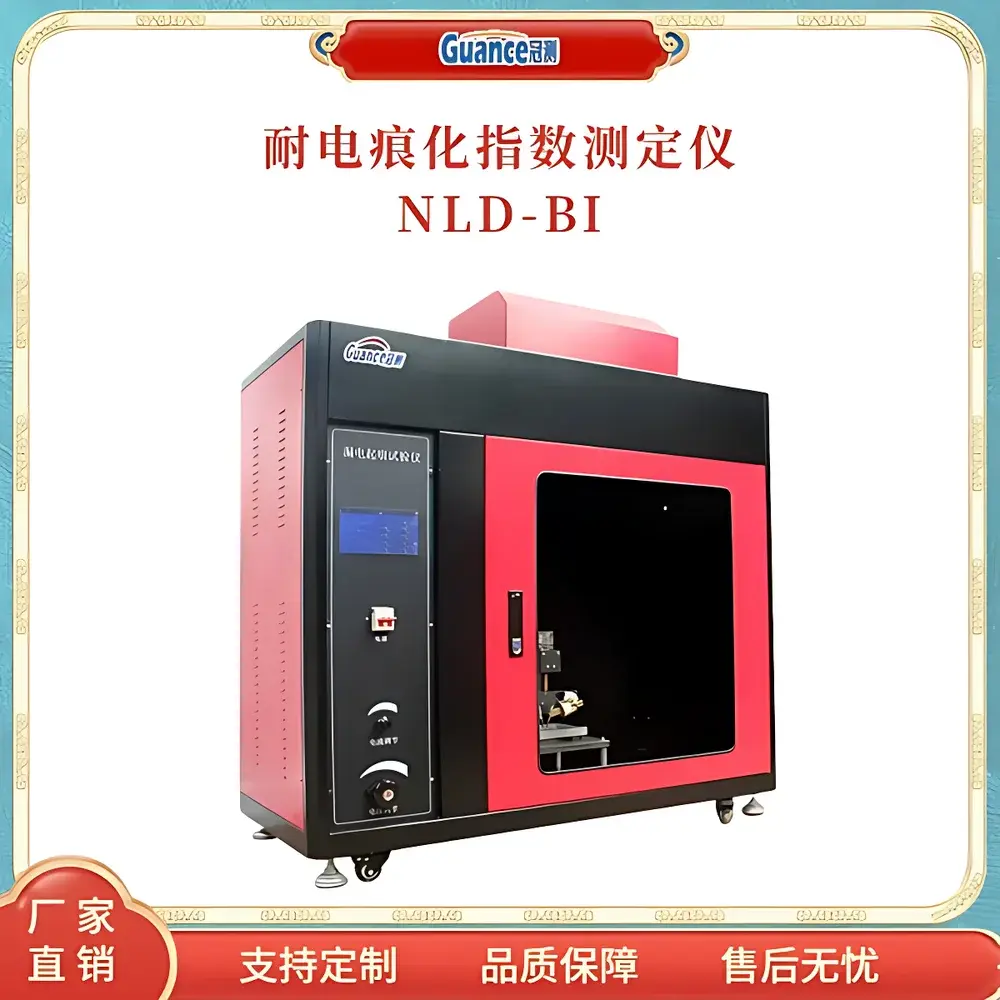
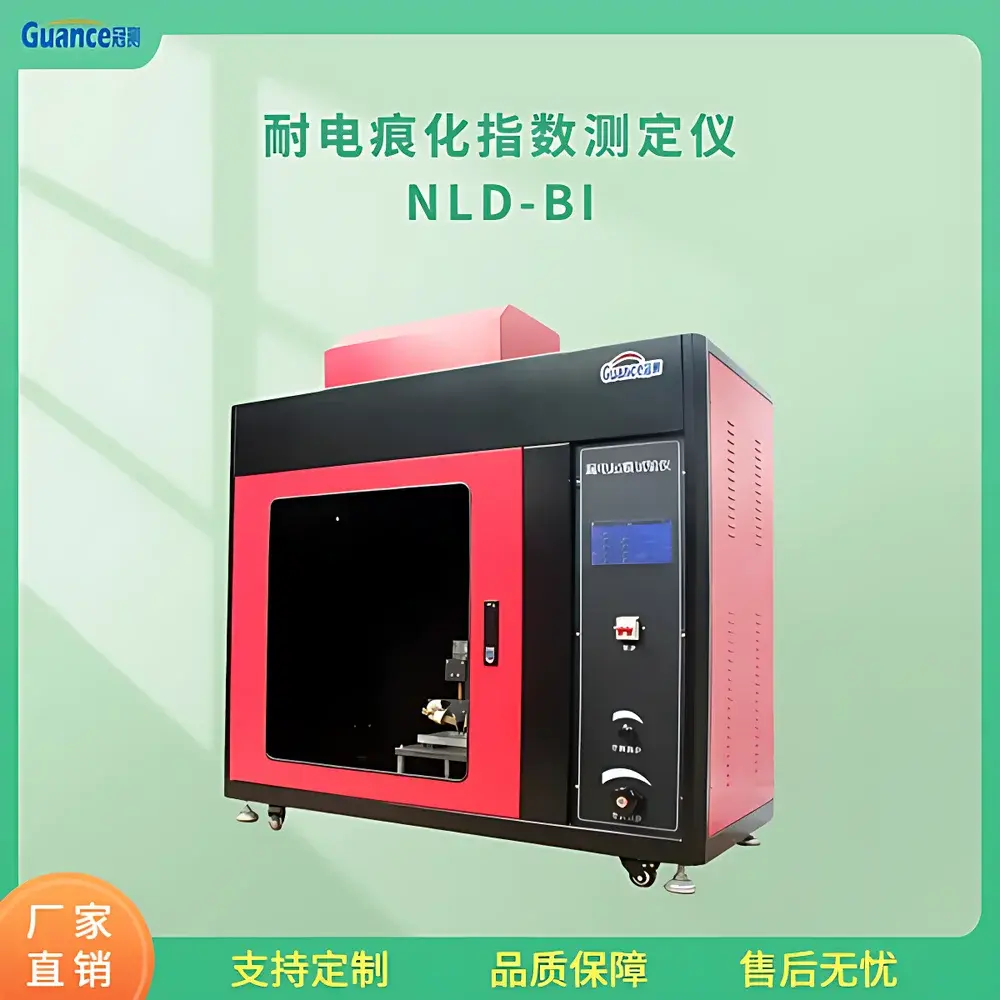
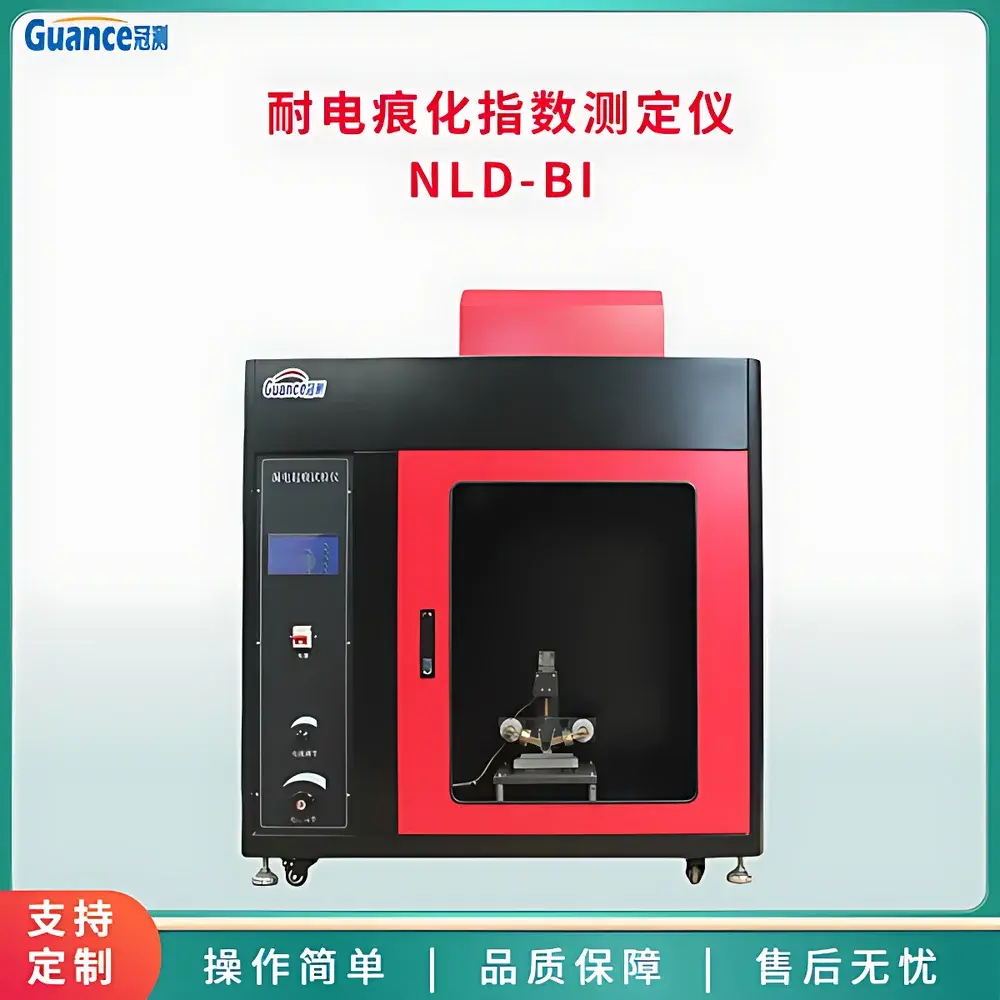
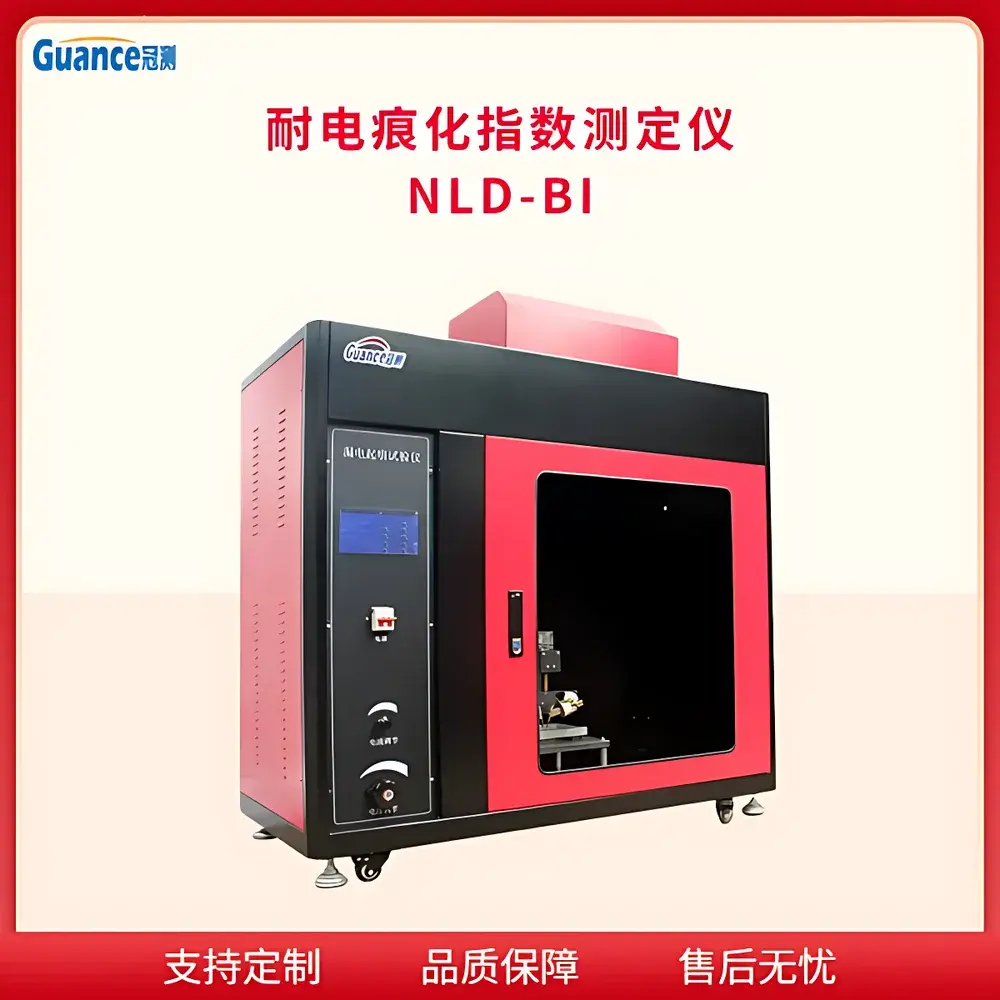
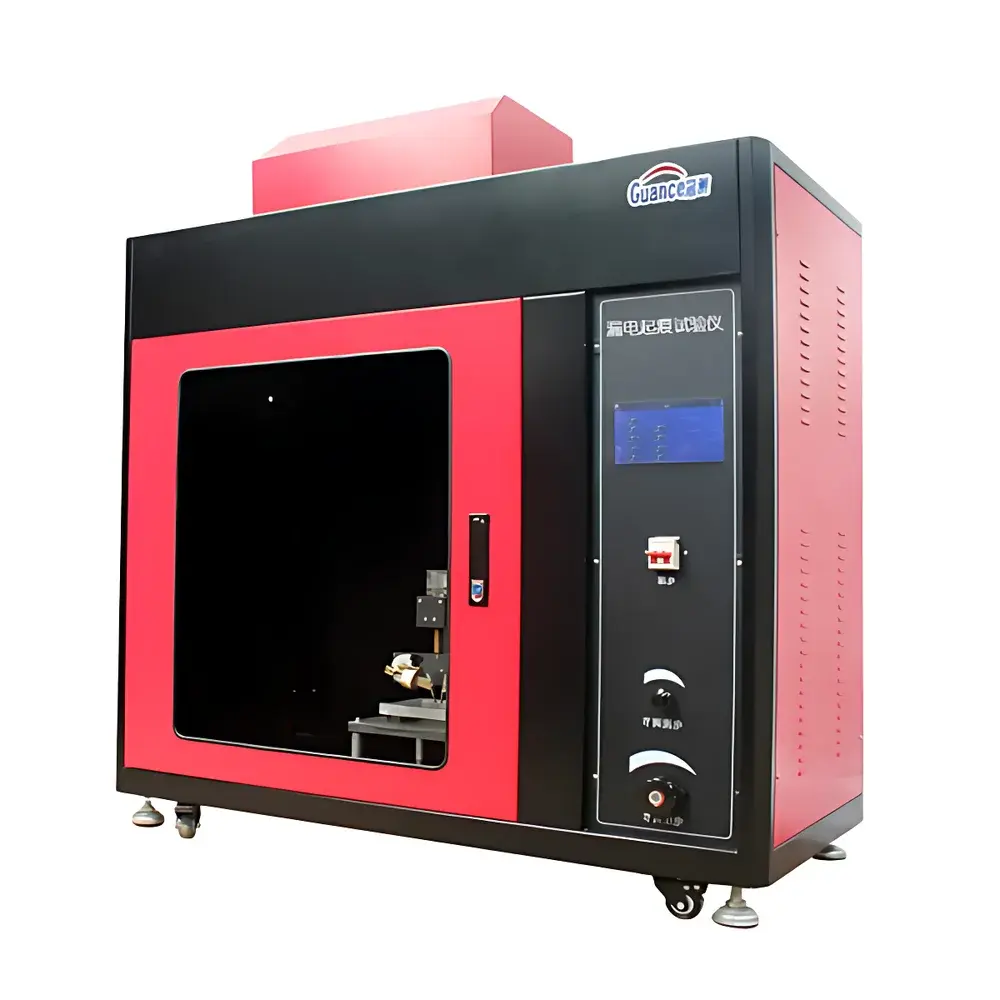
GuanCe Instruments NLD-BI3 Universal Tracking Index Tester for Electrical Insulating Materials
| Brand | GuanCe Instruments |
|---|---|
| Model | NLD-BI3 |
| Type | Electronic Universal Testing Machine |
| Voltage Range | 100–600 V AC (48–60 Hz) |
| Electrode Material | 99% Pure Platinum (tips), Copper (holders) |
| Electrode Dimensions | (2.0 ± 0.1) mm × (5.0 ± 0.1) mm × (40 ± 5) mm |
| Electrode Tip Geometry | 12 mm length, 30° ± 2° bevel |
| Electrode Spacing | 4.00 ± 0.01 mm, 60° ± 5° included angle |
| Electrode Force | 1.00 ± 0.01 N |
| Test Solution Resistivity | A-solution: 3.95 ± 0.05 Ω·m (0.1% NH₄Cl) |
| B-solution | 1.98 ± 0.05 Ω·m |
| Droplet Height | 35 ± 5 mm (adjustable) |
| Droplet Interval | 30.00 ± 0.01 s (digital preset, 50-droplet time: 24.5 ± 2 min) |
| Droplet Count Range | 1–9999 (digital display & preset) |
| Airflow Velocity in Test Chamber | 0.2 m/s |
| Short-Circuit Current Threshold | 0.50 A ± 10%, sustained for 2.00 ± 0.2 s |
| Voltage Drop Limit | ≤8% at 1.0 ± 0.1 A load |
| Power Supply | 220 V, 0.6 kVA, 50–60 Hz |
| Ambient Operating Conditions | 0–40 °C, RH ≤80%, non-corrosive, low-vibration environment |
| Combustion Chamber Volume | >0.5 m³ (approx. 900 × 590 × 1050 mm), black matte background, illuminance ≤20 lux |
| Exhaust Port Diameter | Ø100 mm |
| Touchscreen Interface | 7-inch color HMI with PLC control, on-screen real-time monitoring of voltage, current, droplet count, chamber status, and pass/fail logic |
Overview
The GuanCe Instruments NLD-BI3 Universal Tracking Index Tester is an engineered solution for determining the Comparative Tracking Index (CTI) and Proof Tracking Index (PTI) of solid electrical insulating materials in accordance with IEC 60695-11-10 and GB/T 4207–2003. It operates on the principle of controlled electrolytic contamination under high-voltage stress: standardized conductive solution (NH₄Cl-based) is dispensed in precise droplets onto the surface of a test specimen positioned between two platinum-tipped electrodes. Under applied AC voltage (100–600 V, 48–60 Hz), localized leakage currents initiate progressive carbonization—forming conductive “tracks” that may ultimately bridge the electrode gap and cause failure. The number of droplets required to induce tracking—or the maximum voltage at which no tracking occurs after 50 droplets—constitutes the CTI or PTI value. This test directly informs material selection for end-use applications where insulation integrity must be maintained in humid, contaminated environments—such as outdoor connectors, transformer housings, PCB substrates, and EV battery enclosures.
Key Features
- Integrated 7-inch color touchscreen HMI with embedded PLC logic for fully programmable test execution, eliminating manual intervention during voltage ramping, droplet timing, and fault detection.
- Precision-machined platinum electrodes (99% purity) with certified geometry: 2.0 ± 0.1 mm width, 5.0 ± 0.1 mm thickness, 40 ± 5 mm length; tip bevel 30° ± 2°, fixed spacing 4.00 ± 0.01 mm at 60° ± 5° angle; applied force controlled to 1.00 ± 0.01 N via calibrated spring mechanism.
- Droplet delivery system with digital timer resolution of ±0.01 s, factory-calibrated for 30.00 s interval (50-droplet cycle: 24.5 ± 2 min), height adjustable from 30–40 mm to ensure consistent impact energy per ASTM/IEC alignment requirements.
- Real-time closed-loop monitoring of leakage current (0–2.0 A range, ±0.01 A resolution), voltage stability (±1 V), chamber airflow (0.2 m/s verified per IEC 60695-11-10 Annex B), and door interlock status—all displayed and logged on-screen.
- Fail-safe protection architecture: automatic circuit interruption within 2.00 ± 0.2 s if current exceeds 0.50 A ± 10%; voltage drop limited to ≤8% at 1.0 ± 0.1 A short-circuit load; redundant thermal cutoffs and isolated high-voltage section.
- Low-noise, anti-backflow exhaust system (Ø100 mm duct) with post-test purge mode, ensuring complete removal of combustion byproducts while maintaining laminar airflow during testing.
Sample Compatibility & Compliance
The NLD-BI3 accommodates flat, rigid specimens up to 130 mm × 130 mm × 12 mm (L × W × H), including thermoplastics (e.g., PBT, PA66-GF), thermosets (epoxy, phenolic), elastomers, and laminated composites. Specimen mounting fixtures ensure uniform electrode contact pressure without edge deformation. All test parameters—including solution resistivity (A-solution: 3.95 ± 0.05 Ω·m; B-solution: 1.98 ± 0.05 Ω·m), background illumination (≤20 lux), and chamber volume (>0.5 m³ with matte black interior)—conform strictly to IEC 60695-11-10:2022 and GB/T 4207–2003. The instrument supports full audit trails for GLP-compliant laboratories and integrates seamlessly into QA workflows requiring traceability per ISO/IEC 17025.
Software & Data Management
No external PC software is required: all test protocols, parameter presets, and result logs reside onboard the HMI’s non-volatile memory. Each test record stores timestamp, operator ID (optional input), voltage setpoint, droplet count at failure, final current reading, and pass/fail determination per IEC-defined criteria. Data export is supported via USB flash drive in CSV format for integration with LIMS or statistical process control platforms. The system retains ≥1,000 test records with automatic overwrite management and supports password-protected user roles (Operator, Technician, Administrator) to meet FDA 21 CFR Part 11 access-control expectations.
Applications
- Qualification of polymer compounds for UL 746A/746B recognition and CTI-based material grouping (e.g., UL PLCC ratings).
- R&D screening of flame-retardant additives’ impact on tracking resistance—notably halogen-free systems where char formation competes with conductive path development.
- Production line verification of incoming raw materials and molded components prior to assembly into high-reliability power electronics.
- Failure analysis of field-failed insulators to correlate environmental exposure (salt fog, industrial dust + humidity) with observed tracking morphology.
- Validation of conformal coatings and potting compounds used in aerospace avionics and railway signaling equipment.
FAQ
What standards does the NLD-BI3 fully comply with?
It meets the mechanical, electrical, and procedural requirements of IEC 60695-11-10:2022, IEC 60112:2022, GB/T 4207–2003, and UL 746A Annex D.
Can the instrument differentiate between CTI and PTI determinations?
Yes—CTI is derived from voltage step-down testing (fixed droplet count, variable voltage), while PTI uses fixed voltage with increasing droplet count until failure; both modes are selectable via touchscreen menu.
Is calibration certification provided with shipment?
Each unit ships with a factory calibration report covering electrode geometry verification, droplet timing accuracy, voltage output linearity (100–600 V), and current sensing fidelity (0–2.0 A).
How is solution resistivity monitored during extended testing?
The system does not measure in-line resistivity; users must verify solution conductivity prior to each test batch using a calibrated conductivity meter per Clause 6.2 of IEC 60695-11-10.
Does the NLD-BI3 support automated reporting for ISO/IEC 17025 accreditation?
Yes—onboard CSV export includes all raw data points, timestamps, operator entries, and system self-check results required for accredited test reports.
Related Products



