
English Product Name
| Brand | OK |
|---|---|
| Origin | Imported |
| Manufacturer Type | Authorized Distributor |
| Temperature Range | RT+10°C to 200°C / 300°C |
| Temperature Uniformity | ±2°C |
| Temperature Stability (Fluctuation) | ±0.5°C |
| Air Exchange Rate | 2–100 cycles/hour |
| Adjustable Air Exchange Time | 1 min – 99 h |
| Internal Chamber Dimensions (L×W×H, mm) | 450×450×500 to 800×1000×1000 |
| Power Consumption | 4.0–9.0 kW |
| Controller | LED Digital PID + SSR Microcomputer Controller |
| Temp. Set/Display Resolution | 0.1°C |
| Timer Range | 1–9999 min |
| Rotating Turntable Diameter | Φ250–Φ700 mm |
| Safety Protections | Over-temperature, leakage current, short-circuit, motor overheat, over-current |
| Compliance | ASTM D5423-09 (Type II), ASTM D5374-93(2005), UL 1581, GB, VDE, JIS, IEC |
Overview
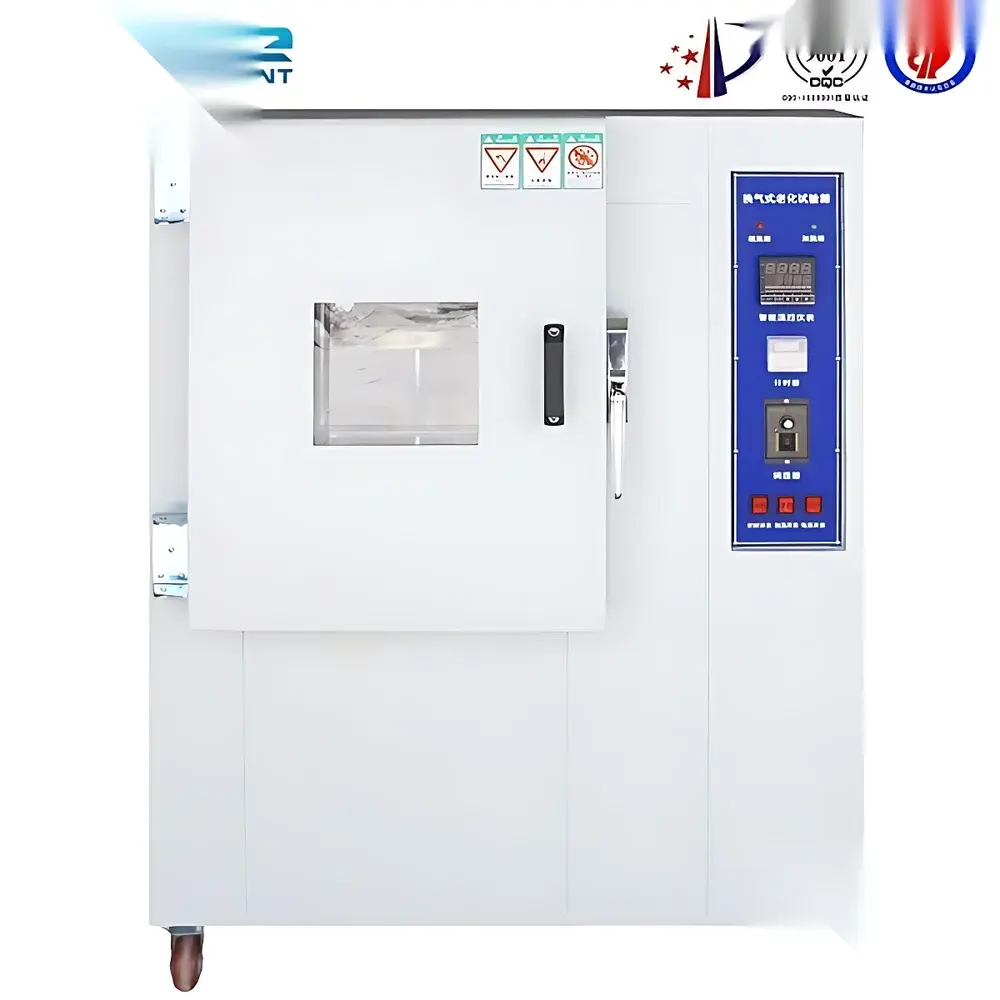
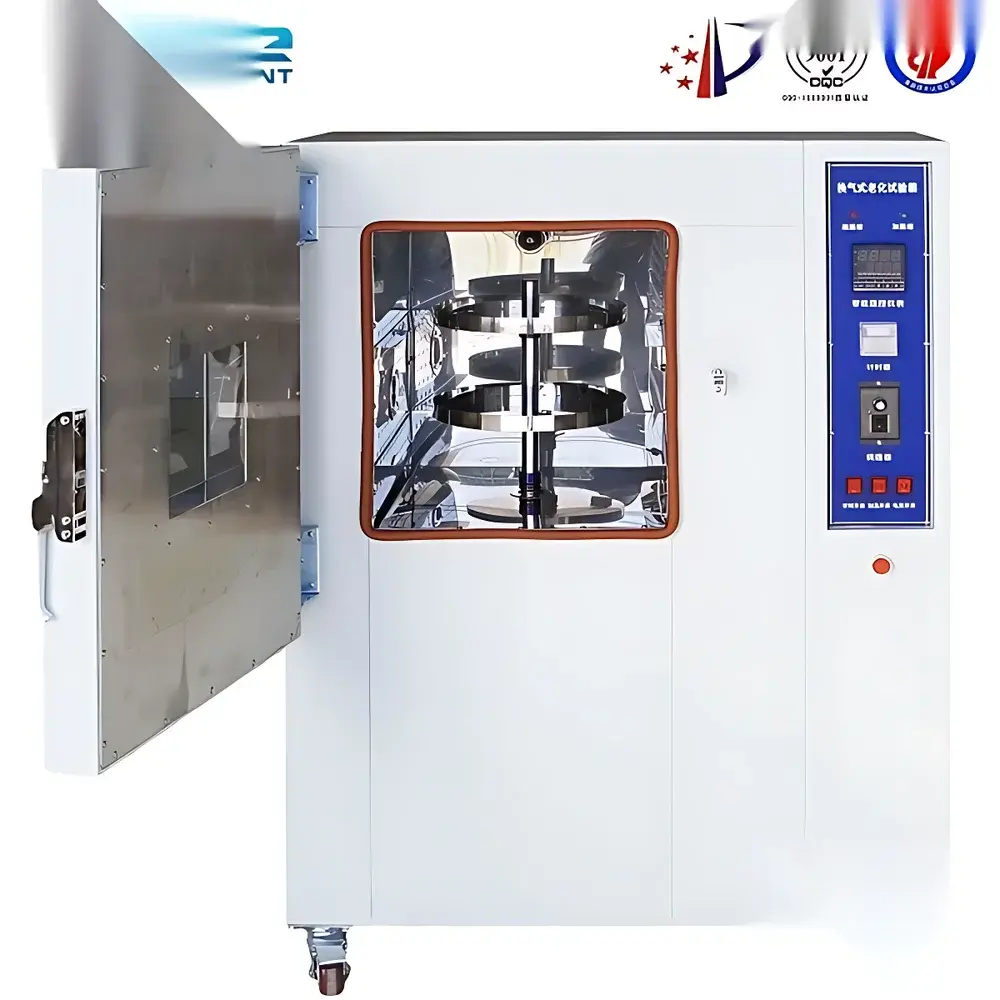
The OK-HQ Series Natural Ventilation Thermal Aging Test Chamber is an engineered environmental test system designed for accelerated thermal aging evaluation of polymeric and elastomeric materials under controlled atmospheric exchange conditions. Unlike forced-convection ovens, this chamber operates on a natural ventilation principle—relying on buoyancy-driven airflow and precisely regulated inlet/outlet apertures—to maintain a defined air exchange rate while minimizing turbulence-induced thermal gradients. It conforms to the operational definition of Type II laboratory ovens specified in ASTM D5423-09, which mandates calibrated air replacement without mechanical recirculation of exhaust air. This architecture ensures representative aging kinetics for insulation materials, wire & cable sheaths, rubber compounds, textiles, and plastic films—particularly where oxidative degradation under ambient-air exposure is the primary failure mode. The chamber supports both static and rotational sample configurations, enabling uniform thermal stress application across heterogeneous or layered specimens.
Key Features
- Precision-engineered air exchange control system with independent adjustment of intake and exhaust orifices, enabling reproducible air turnover rates from 2 to 100 cycles per hour.
- Stainless steel (SUS304) interior chamber with argon-arc welded seams and mirror-finish surface—resistant to oxidation, corrosion, and residue accumulation at elevated temperatures.
- Exterior cabinet fabricated from A3 cold-rolled steel with electrostatic powder coating for structural rigidity and long-term aesthetic integrity.
- High-efficiency thermal insulation using ultra-fine glass fiber cotton (≥100 mm thickness), reducing standby heat loss and improving energy efficiency.
- Horizontal forced-air circulation system with high-temp-rated low-noise centrifugal blower and symmetrical baffle plates—ensuring temperature uniformity ≤ ±2°C across the working volume.
- Integrated rotating turntable (diameter options: Φ250–Φ700 mm) with adjustable speed and centering mechanism for uniform thermal exposure of cylindrical or asymmetrical samples.
- Digital PID + SSR microcomputer controller with 0.1°C resolution, programmable timer (1–9999 min), and real-time display of setpoint, actual temperature, and elapsed time.
- Large observation window with tempered glass and integrated LED lighting—enabling non-intrusive visual monitoring without thermal disturbance.
- Standard 50 mm diameter test port on left side wall, fitted with silicone gasket for seamless integration with external power supplies, data loggers, or environmental sensors.
Sample Compatibility & Compliance
The OK-HQ chamber accommodates rigid, flexible, and fibrous specimens—including insulated wires, rubber hoses, PVC/PET films, leather strips, and textile laminates—without requiring vacuum sealing or inert gas purging. Its natural ventilation design aligns with industry-standard aging protocols that simulate real-world ambient-air exposure during service life. The system meets the dimensional, thermal, and airflow requirements of ASTM D5423-09 (Type II), ASTM D5374-93(2005), UL 1581 Section 1060, IEC 60811-201, VDE 0472-811, JIS C 3005, and GB/T 2951.12. All models are compatible with GLP-compliant documentation workflows when paired with validated calibration records and audit-trail-enabled data acquisition systems.
Software & Data Management
While the base configuration features a standalone LED controller, optional RS485/Modbus RTU interface enables integration with PC-based logging software (e.g., LabVIEW, MATLAB, or custom SCADA platforms). Users can export time-stamped temperature logs, air exchange cycle counts, and runtime statistics for traceability. When deployed in regulated environments (e.g., ISO 17025-accredited labs or GMP manufacturing sites), the system supports 21 CFR Part 11-compliant electronic records when used with validated third-party data management solutions—including user access control, electronic signatures, and immutable audit trails.
Applications
- Evaluation of thermal-oxidative stability in electrical insulation materials per UL 1581 and IEC 60811-201.
- Aging studies of automotive rubber components (hoses, seals, bushings) under SAE J2236-relevant conditions.
- Pre-screening of polymer formulations for shelf-life estimation in packaging and medical device applications.
- Comparative assessment of antioxidant efficacy in PVC, EPDM, and silicone compounds.
- Accelerated weathering pre-conditioning prior to UV or humidity exposure testing.
FAQ
What distinguishes natural ventilation aging from forced-air convection ovens?
Natural ventilation relies on passive air exchange via calibrated openings, preserving oxygen partial pressure and avoiding localized overheating caused by high-velocity airflow—critical for simulating long-term ambient aging.
Can the chamber operate continuously at 300°C?
Yes—models rated for 300°C maximum include upgraded heating elements, high-temp insulation, and reinforced door gaskets; continuous operation requires adherence to manufacturer-specified duty cycles and maintenance intervals.
Is calibration certification included with shipment?
A factory-assembled NIST-traceable temperature calibration report is provided; field recalibration services and IQ/OQ documentation packages are available upon request.
How is air exchange rate verified and validated?
Users may perform in-situ verification using calibrated anemometers and tracer gas (e.g., CO₂) decay methods per ASTM E741; chamber-specific air exchange coefficients are supplied in the technical manual.
Does the turntable support load balancing for irregular samples?
Yes—the turntable shaft is dynamically balanced, and mounting fixtures accommodate asymmetric geometries up to 15 kg; maximum eccentric mass must not exceed 0.5 kg·m to maintain rotational stability.
Related Products



