
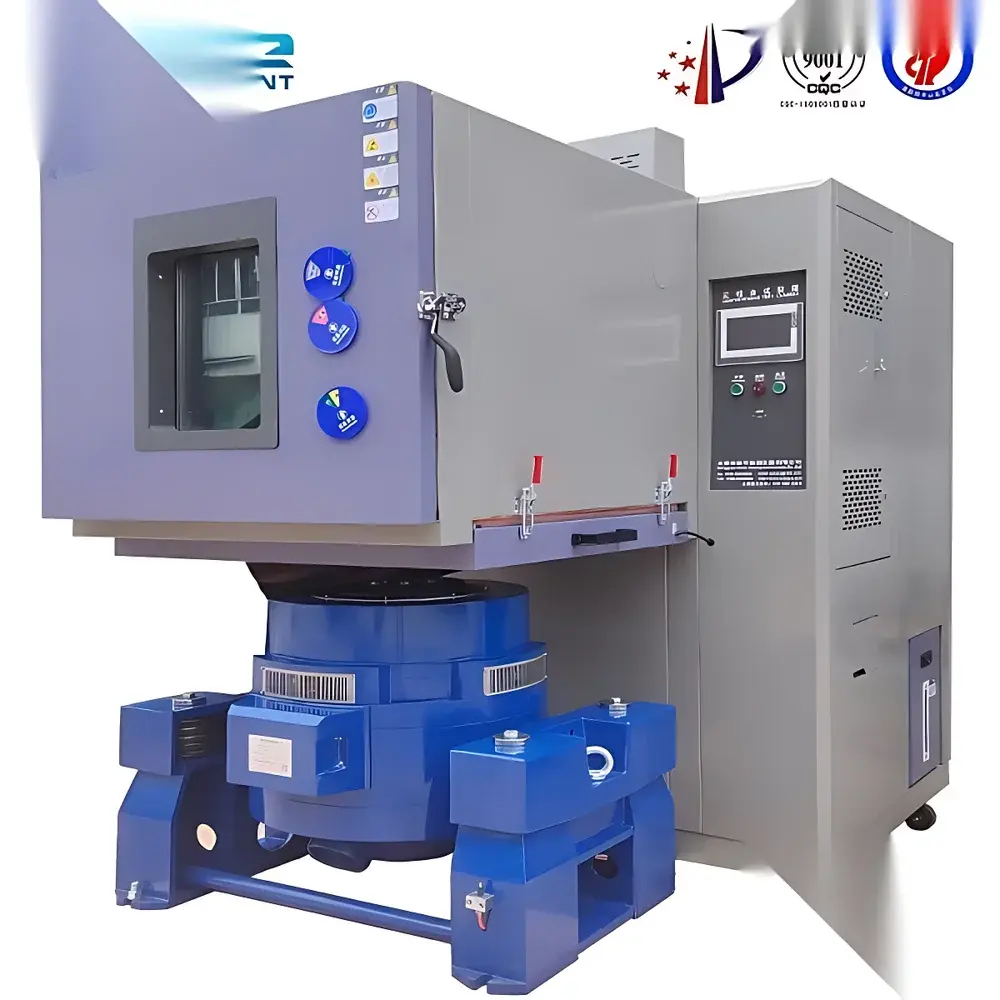
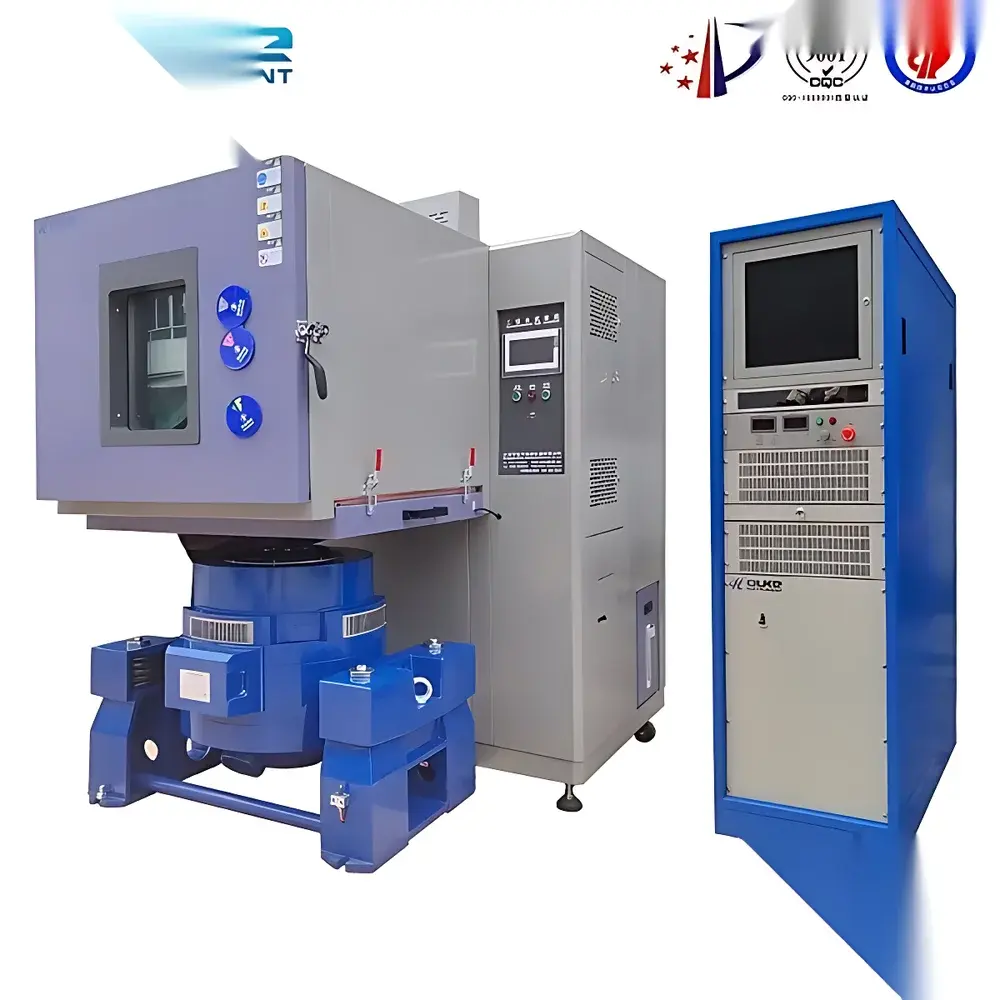
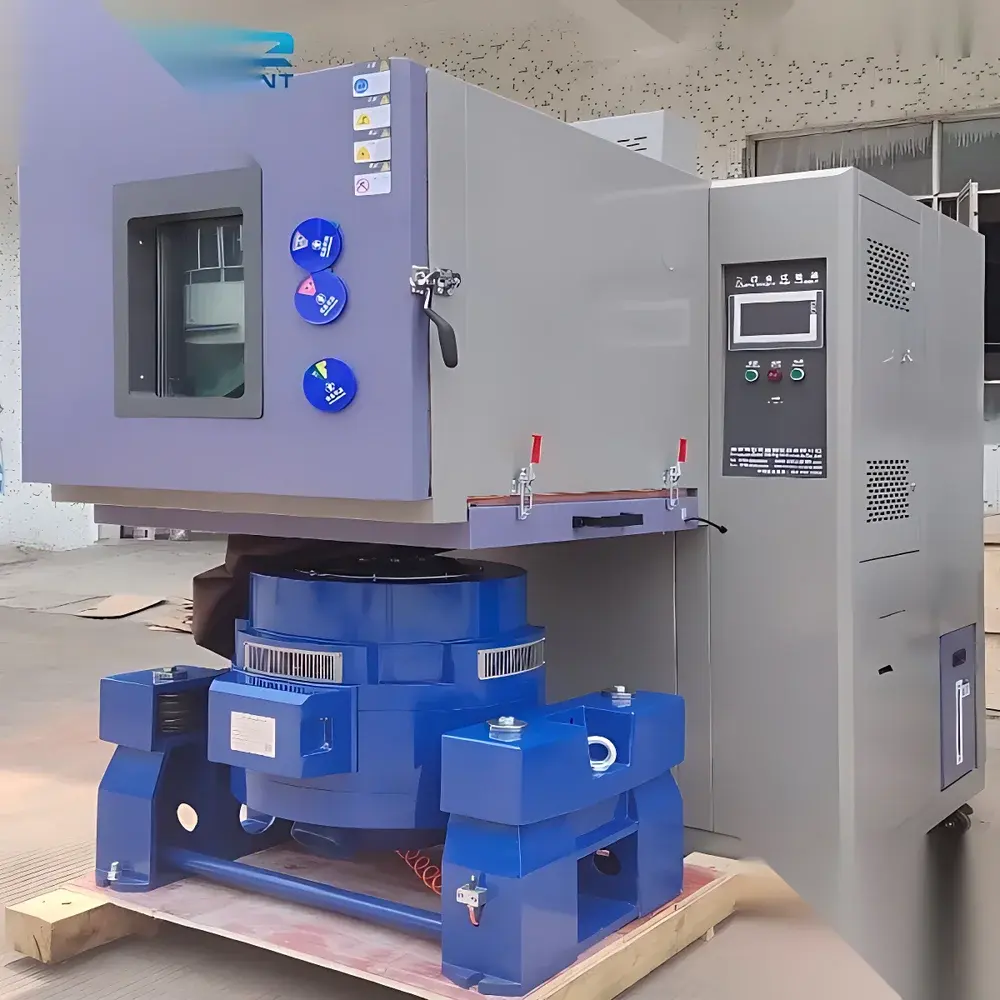
Combined Temperature-Humidity-Vibration Environmental Test System
| Key | Platform Dimensions (mm): 250×250 |
|---|---|
| Payload Capacity (kg) | 50 |
| Max Acceleration | 650 g |
| Max Stroke | 1800 mm |
| Max Slew Rate | 7.4 m/s² (HS) |
| Minimum Shock Duration (ms) | 1, 2, 3 / 2 (Optional) |
| Air Pressure Requirement | 6–8 kg/cm² |
| Frequency Range (Programmable) | 1–400 Hz |
| Frequency Resolution | 0.01 Hz |
| Frequency Accuracy | ±0.1 Hz |
| Vibration Waveform | Sinusoidal |
| Max Displacement (p-p) | 0–5 mm |
| Programmable Segments | 15 segments per profile, each with independent frequency/time settings |
| Control Mode | Sweep, Fixed Frequency, Random (optional), Time-Controlled |
| Power Supply | 220 V ±20%, 5 A |
| Motor Power | 2.2 kW |
| Compliance | Designed for ASTM D999, ISO 13373-1, IEC 60068-2-6, IEC 60068-2-64, MIL-STD-810H Method 514.8 |
Overview
The Combined Temperature-Humidity-Vibration Environmental Test System is an integrated reliability validation platform engineered for simultaneous or sequential application of thermal, hygrothermal, and mechanical vibration stressors. It operates on the principle of controlled sinusoidal excitation—generated via electromagnetic shaker technology—synchronized with precision climate conditioning in a single test chamber. This triaxial environmental simulation enables replication of real-world field conditions such as transport-induced resonance, operational vibration under thermal cycling, or humidity-accelerated fatigue at resonant frequencies. Unlike standalone vibration or climatic chambers, this system maintains traceable, time-correlated control over all three domains—ensuring that temperature gradients, relative humidity profiles, and acceleration spectra are applied in accordance with defined test standards. Its architecture supports both deterministic (sine sweep, fixed-frequency) and statistically representative (programmed multi-segment) vibration profiles, making it suitable for qualification testing, design verification, and accelerated life modeling in electronics, automotive components, aerospace subsystems, and medical device packaging.
Key Features
- Triple-domain synchronization: Independent yet coordinated control of temperature (−70°C to +180°C), relative humidity (10–98% RH), and vertical/horizontal vibration (1–400 Hz, up to 650 g peak acceleration)
- Modular shaker platform options: Four standard table sizes (250×250 mm to 800×800 mm) with corresponding payload capacities (50–105 kg) and acceleration capabilities calibrated per ISO 5344
- High-fidelity motion control: 0.01 Hz frequency resolution, ±0.1 Hz accuracy, programmable 15-segment sine profiles with user-defined dwell, sweep rate, and amplitude ramping
- Robust electrodynamic actuator: 2.2 kW motor with 1800 mm maximum stroke and 7.4 m/s² slew rate—optimized for high-cycle fatigue testing and shock pulse generation (1–3 ms duration, optional half-cycle mode)
- Integrated environmental chamber: Stainless steel interior, forced-air circulation, PID-controlled refrigeration/heating, and corrosion-resistant humidification system compliant with IEC 60068-3-5
- Fail-safe interlock architecture: Real-time monitoring of air pressure (6–8 kg/cm² supply), thermal limits, vibration overload, and chamber door status with automatic abort and event logging
Sample Compatibility & Compliance
This system accommodates test specimens ranging from PCB assemblies and sensor modules to full-scale enclosures and automotive ECUs. Specimen mounting is facilitated via T-slotted aluminum platforms with M6/M8 threaded inserts, compatible with industry-standard fixtures and slip tables. All configurations meet structural integrity requirements per ASTM D4728 (vibration of packaged products) and thermal-hygric performance criteria outlined in ISO 16750-4 (road vehicles) and JEDEC JESD22-B103 (mechanical shock). The control software supports audit-ready documentation aligned with GLP and GMP environments—including electronic signatures, change history, and 21 CFR Part 11–compliant data archiving. Calibration certificates traceable to NIST or PTB standards are available upon request for each subsystem (vibration, temperature, humidity).
Software & Data Management
Control and analysis are executed via a Windows-based HMI with deterministic real-time OS kernel, ensuring sub-millisecond timing fidelity across all synchronized axes. The software suite includes preconfigured test templates for MIL-STD-810H Method 514.8 (vibration), ISO 16750-4 (temperature cycling with vibration), and IEC 60068-2-64 (broadband random vibration). Raw acceleration, temperature, and humidity data are acquired at ≥10 kHz sampling rate and stored in IEEE-compliant .tdms format. Post-test analysis tools support FFT spectral decomposition, transmissibility mapping, PSD integration, and pass/fail threshold overlay against reference spectra. Export options include CSV, MATLAB .mat, and PDF reports with embedded metadata (operator ID, calibration date, environmental setpoints, anomaly flags). Remote access and multi-user role management (admin/operator/viewer) are supported via TLS-encrypted Ethernet interface.
Applications
- Transportation simulation: Replicating road, rail, and air cargo vibration spectra while subjecting packages to thermal shock during transit
- Electronic reliability screening: Identifying solder joint fatigue, connector fretting, and MEMS resonance-induced drift under combined thermal-vibrational stress
- Material interface validation: Assessing adhesive bond durability, gasket compression recovery, and thermal interface material (TIM) performance under cyclic loading
- Package integrity testing: Evaluating seal integrity, cushioning effectiveness, and structural deformation of shipping containers exposed to humidity-swelling and resonant vibration
- Design verification: Correlating finite element models with physical response at critical frequencies identified via modal analysis and shaker excitation
- Process qualification: Validating reflow soldering profiles, conformal coating adhesion, and potting compound cure stability under dynamic thermal-hygric loads
FAQ
What standards does this system support for combined environment testing?
It natively implements test profiles defined in IEC 60068-2-6 (sinusoidal vibration), IEC 60068-2-30 (damp heat cyclic), and MIL-STD-810H Method 514.8 (vibration), with configurable coupling logic for concurrent execution.
Can the system perform random vibration while maintaining temperature and humidity setpoints?
Yes—random vibration capability is available as an optional upgrade with dedicated power spectral density (PSD) controller and broadband shaker amplification, fully synchronized with climate regulation.
Is remote operation and data export compliant with FDA 21 CFR Part 11?
The software includes electronic signature workflows, audit trail generation, and encrypted database storage—fully configurable to meet Part 11 requirements for regulated industries.
What maintenance intervals are recommended for the shaker and climate subsystems?
Shaker armature alignment and suspension inspection every 500 operating hours; refrigerant charge and humidity sensor calibration annually; full system metrology verification every 12 months per ISO/IEC 17025 guidelines.
How is specimen temperature uniformity ensured during active vibration?
Chamber airflow is dynamically modulated using variable-frequency fans and baffle-controlled laminar flow paths—validated to maintain ±2°C uniformity across the test volume at all vibration frequencies and amplitudes.



