
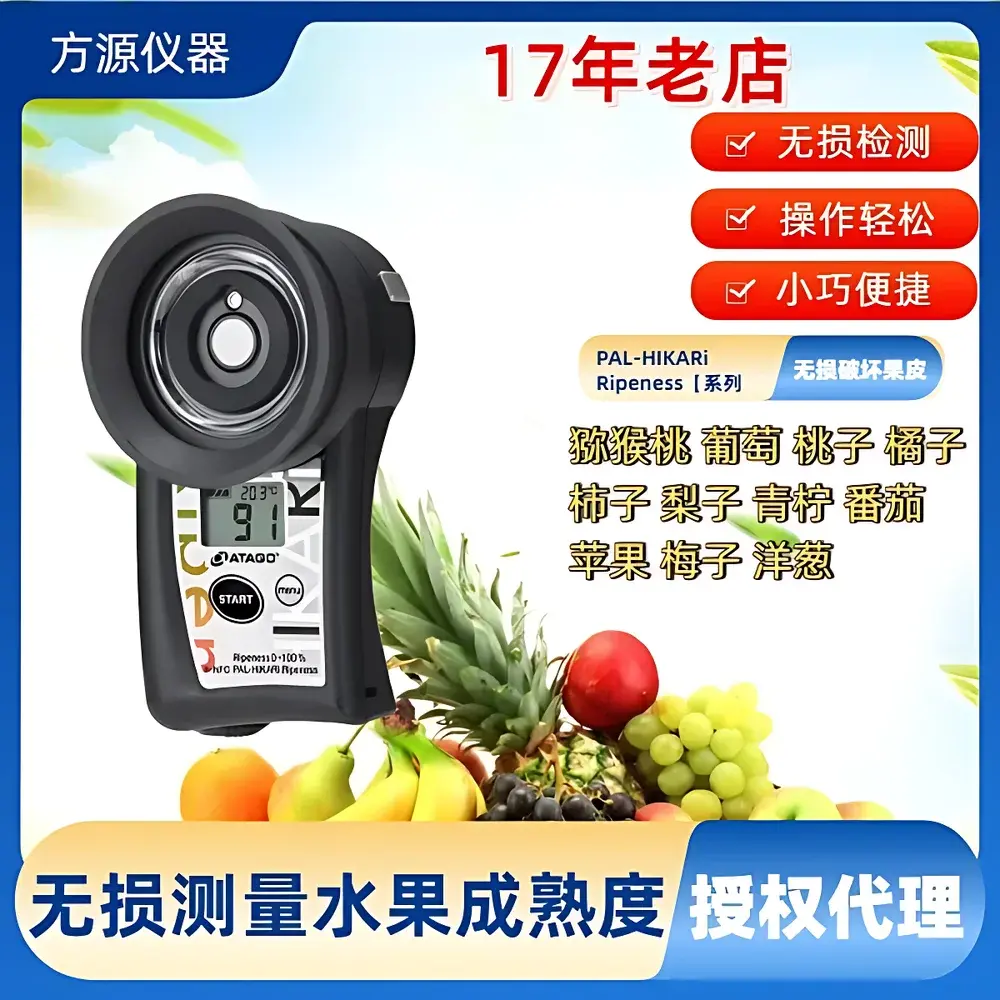
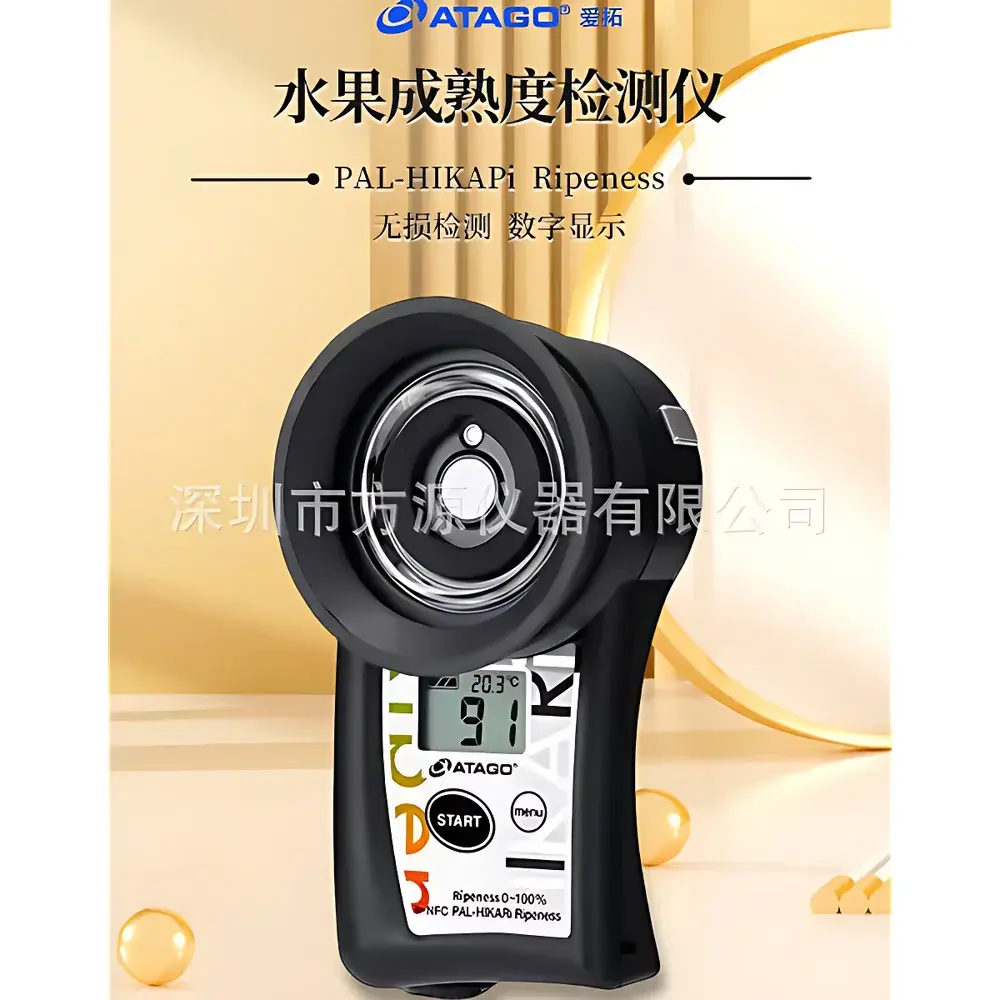

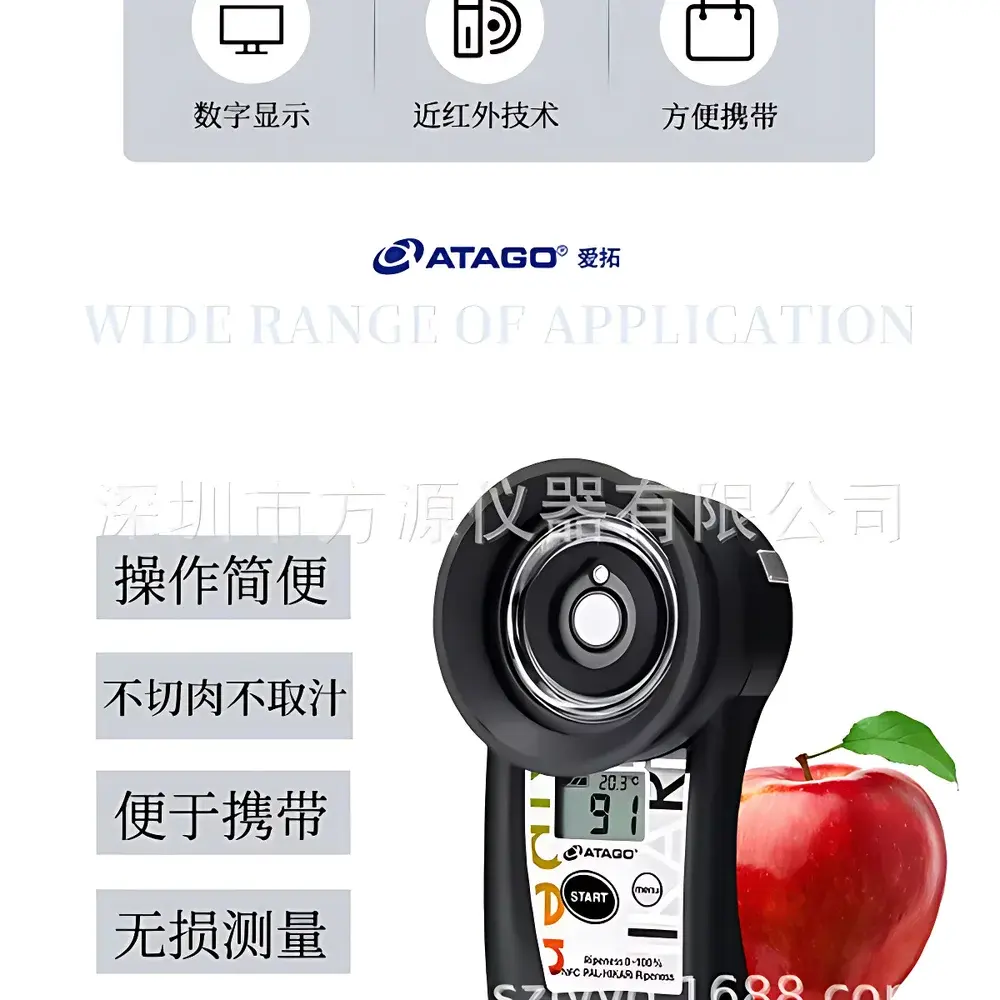
ATAGO PAL-HIKARi Ripeness Portable Fruit Maturity Meter
| Brand | ATAGO |
|---|---|
| Origin | Japan |
| Model | PAL-HIKARi Ripeness |
| Instrument Type | Portable |
| Parameter Type | Single-parameter (Ripeness Index, 0–100%) |
| Measurement Range | 0–100% (Ripeness Scale) |
| Resolution | 0.1% Brix-equivalent |
| Accuracy | ±5% (relative to reference maturity index) |
| Compliance | Designed for field-deployable non-destructive assessment in horticultural QC and post-harvest logistics |
Overview
The ATAGO PAL-HIKARi Ripeness is a handheld, non-invasive optical instrument engineered for rapid, on-site estimation of fruit physiological maturity based on near-infrared (NIR) absorption characteristics correlated with sugar accumulation, chlorophyll degradation, and cell wall softening. Unlike conventional refractometers that measure soluble solids content (Brix) as a proxy for ripeness, the PAL-HIKARi Ripeness employs proprietary spectral algorithms trained on empirical harvest-index datasets across multiple species—including kiwifruit, grape, peach, citrus, persimmon, pear, lime, tomato, apple, plum, and onion—to deliver a unitless, standardized Ripeness Index ranging from 0% (immature) to 100% (commercially optimal). The device operates without sample preparation, skin puncture, or juice extraction, preserving fruit integrity for subsequent storage, grading, or retail evaluation. Its core principle relies on diffuse reflectance spectroscopy at specific NIR wavelengths (700–1000 nm), where changes in pigment concentration and tissue water status produce reproducible spectral shifts directly linked to developmental stage.
Key Features
- Non-destructive measurement: Direct contact scanning through intact fruit skin—no cutting, squeezing, or calibration fluids required.
- Species-specific calibration modes: Preloaded algorithms for 12 major horticultural commodities, each validated against industry-standard maturity markers (e.g., firmness, ethylene evolution, titratable acidity).
- Rugged portable design: IP65-rated enclosure, rubberized grip, and shock-absorbing housing suitable for orchard, packinghouse, and cold-chain environments.
- Real-time display: Backlit LCD showing Ripeness Index (%) alongside concurrent Brix-equivalent value (0.1% resolution) and measurement stability indicator.
- Battery-powered operation: Rechargeable Li-ion battery supports >3,000 measurements per full charge; auto-power-off after 3 minutes of inactivity.
- One-button operation: Intuitive interface requiring no software training—ideal for field technicians, quality auditors, and harvest supervisors.
Sample Compatibility & Compliance
The PAL-HIKARi Ripeness is validated for use on fruits with smooth-to-slightly-ridged epidermis and minimal surface wax or russeting (e.g., ‘Hayward’ kiwifruit, ‘Thompson Seedless’ grape, ‘O’Henry’ peach, ‘Navel’ orange, ‘Fuyu’ persimmon, ‘Bartlett’ pear, ‘Eureka’ lime, ‘Beefsteak’ tomato, ‘Gala’ apple, ‘Satsuma’ plum, and ‘Red Globe’ onion). It is not intended for highly fibrous, hairy, or deeply fissured surfaces (e.g., pineapple, mango, or mature pomegranate). While not a regulatory compliance device per se, its measurement protocol aligns with Good Agricultural Practice (GAP) and Good Manufacturing Practice (GMP) principles for raw material incoming inspection. Data output meets traceability requirements under ISO 22000 and HACCP frameworks when integrated into documented sampling plans.
Software & Data Management
The instrument stores up to 1,000 measurement records internally (timestamp, fruit type, Ripeness Index, Brix-equivalent, operator ID). Data export is supported via USB-C connection to Windows/macOS systems using ATAGO’s free PC Link software (v3.2+), which enables batch export to CSV or Excel formats. Audit trail functionality includes user-defined batch IDs, location tags, and optional digital signature fields—supporting basic 21 CFR Part 11 readiness when paired with organizational electronic record policies. No cloud synchronization or remote firmware updates are implemented; all calibration and algorithm updates require authorized service center intervention.
Applications
- Harvest timing optimization: Determining optimal picking windows to balance shelf life, flavor development, and transport resilience.
- Post-harvest sorting: Segregating lots by maturity grade prior to cold storage or controlled-atmosphere treatment.
- Supply chain quality monitoring: Verifying consistency of ripeness profiles across shipments from multiple orchards or regions.
- Research & breeding programs: High-throughput phenotyping of maturity-related traits in cultivar trials.
- Retail readiness assessment: Validating ripeness claims on pre-packaged fresh produce in distribution centers.
FAQ
How does the PAL-HIKARi Ripeness differ from a standard Brix refractometer?
It measures a composite maturity index—not just sugar content—by analyzing spectral responses associated with multiple biochemical and structural changes during ripening.
Can it be used on green or unripe fruit?
Yes; the 0–100% scale is anchored to species-specific immature and fully ripe reference points, enabling quantitative tracking across the entire developmental continuum.
Is calibration required before each use?
No daily calibration is needed; the device performs automatic internal reference checks at startup. Full recalibration is recommended annually or after impact exposure, performed only by ATAGO-authorized service centers.
Does surface moisture affect readings?
Excess surface water must be gently blotted prior to measurement, as standing water alters NIR reflectance; dew or light mist does not significantly interfere if wiped.
What is the warranty coverage?
ATAGO provides a 12-month limited warranty covering materials and workmanship under normal use conditions, excluding damage from misuse, unauthorized modification, or environmental extremes beyond IP65 specifications.






