
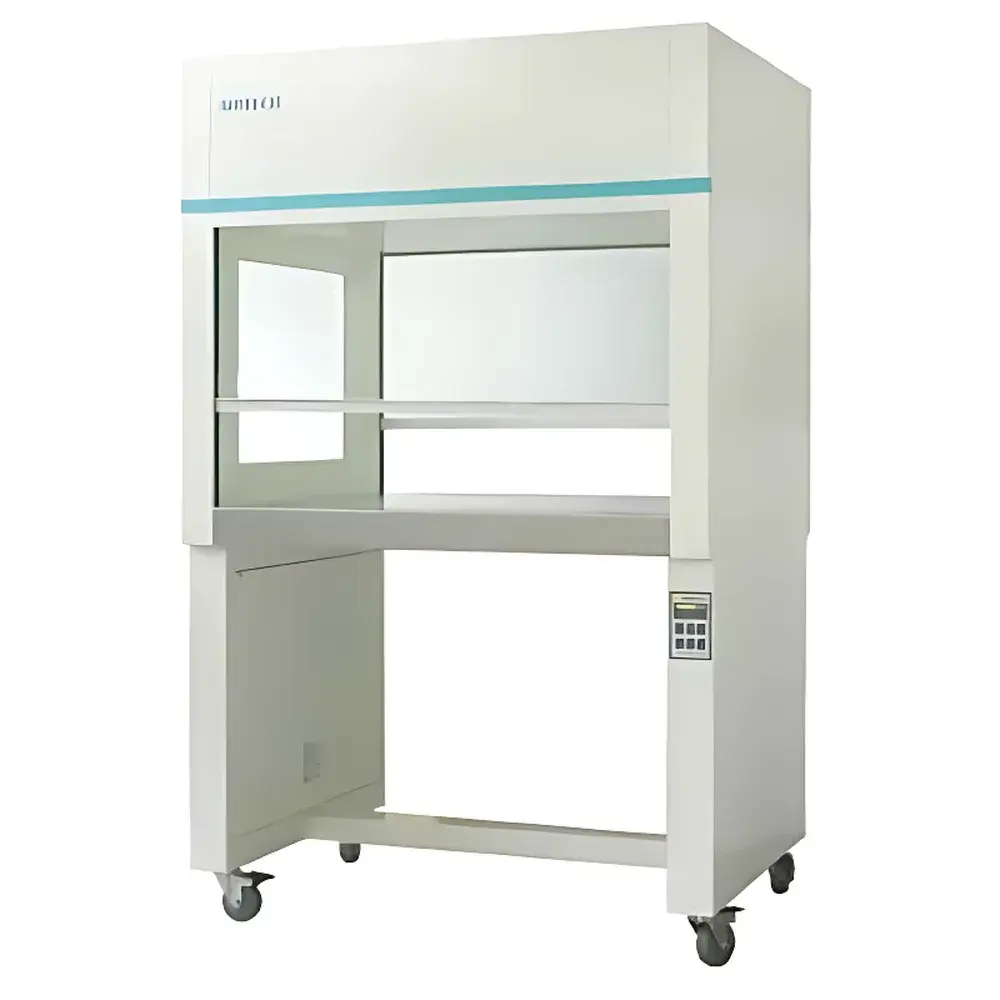
SuJing Antai SW-CJ-1FD Vertical Laminar Flow Clean Bench
| Brand | SuJing Antai |
|---|---|
| Origin | Jiangsu, China |
| Model | SW-CJ-1FD |
| Instrument Type | Vertical Laminar Flow Clean Bench |
| Cleanliness Class | ISO Class 5 (equivalent to Fed. Std. 209E Class 100) |
| Noise Level | ≤62 dB(A) |
| User Configuration | Single-user, front-access only |
| Average Air Velocity | 0.3–0.6 m/s (adjustable) |
| Vibration (half-peak) | ≤3 µm |
| Illuminance | ≥300 lx |
| Power Supply | AC 220 V / 50 Hz |
| Power Consumption | 0.4 kW |
| Net Weight | 150 kg |
| Work Area Dimensions (W×D×H) | 870 × 700 × 520 mm |
| Overall Dimensions (W×D×H) | 990 × 720 × 1600 mm |
| Work Surface Material | Imported Stainless Steel (AISI 304) |
| Microbial Count | ≤0.5 CFU/plate·hour (90 mm Petri dish) |
Overview
The SuJing Antai SW-CJ-1FD is a vertically oriented laminar flow clean bench engineered for precision-controlled, particle-free local environments in laboratories requiring ISO Class 5 (Fed. Std. 209E Class 100) air cleanliness. It operates on the principle of unidirectional, downward laminar airflow—generated by a high-efficiency centrifugal blower and conditioned through a HEPA filter (≥99.99% @ 0.3 µm)—to sweep airborne contaminants away from the work surface and out through the front grille. This configuration isolates the operator from sample exposure while protecting specimens from ambient particulate and microbial contamination. Designed for routine aseptic procedures, the SW-CJ-1FD serves as a foundational containment solution—not for hazardous materials (which require biosafety cabinets), but for non-hazardous applications where sterility, low bioburden, and consistent airflow integrity are critical. Its structural architecture prioritizes operational stability, acoustic performance, and ergonomic accessibility, meeting baseline requirements for GLP-compliant labs and QC environments in pharmaceutical, biotech, and academic research settings.
Key Features
- Vertically aligned laminar airflow path with adjustable velocity (0.3–0.6 m/s) via soft-touch voltage control, enabling real-time optimization for varying procedural demands (e.g., media pouring vs. cell handling).
- ISO Class 5-certified airflow uniformity across the full 870 × 700 mm work area, validated per ISO 14644-3 protocols using calibrated anemometry and particle counters.
- Front-access single-user configuration with semi-enclosed work chamber design, minimizing cross-contamination risk from lateral drafts and reducing operator fatigue during extended use.
- Electropolished AISI 304 stainless steel work surface—corrosion-resistant, non-porous, and compatible with standard laboratory disinfectants (e.g., 70% ethanol, hydrogen peroxide vapor).
- Integrated LED illumination system delivering ≥300 lx at working height, with uniform distribution verified across the entire work plane per IEC 60598 standards.
- Low-noise operation (≤62 dB[A] at 1 m), achieved via vibration-damped fan mountings and acoustically treated enclosure panels—critical for shared lab spaces and auditory-sensitive workflows.
- Robust mechanical construction (150 kg net weight) ensures minimal displacement under typical bench-top loading, with half-peak vibration amplitude maintained at ≤3 µm during steady-state operation.
Sample Compatibility & Compliance
The SW-CJ-1FD is intended for non-hazardous, non-toxic samples including microbiological cultures, tissue explants, sterile reagents, and pharmaceutical intermediates. It complies with ISO 14644-1:2015 (cleanroom classification), ISO 14644-3:2019 (testing methods), and aligns with USP environmental control recommendations for compounding aseptic preparations. While not certified to NSF/ANSI 49 or EN 12469 (as it lacks inward airflow and negative pressure containment), its design supports adherence to internal SOPs referencing ASTM E2918-13 (standard guide for clean bench validation). The unit does not provide personnel or environmental protection against biohazards; users must confirm suitability against institutional biosafety committee guidelines prior to deployment.
Software & Data Management
The SW-CJ-1FD operates as a standalone electromechanical system without embedded firmware, network connectivity, or digital data logging capabilities. All operational parameters—including fan speed, illumination status, and power state—are managed manually via front-panel controls. For laboratories requiring audit-ready documentation, integration with external environmental monitoring systems (e.g., Vaisala viewLinc, SensiNet) is supported via optional analog output modules (0–10 V or 4–20 mA) for real-time airflow velocity and temperature tracking. Calibration records, preventive maintenance logs, and periodic ISO 14644-3 verification reports should be retained per GLP Annex 13 and FDA 21 CFR Part 11 compliant archive policies.
Applications
- Aseptic transfer of bacterial/fungal cultures in clinical microbiology and quality control labs.
- Preparation of sterile culture media and dilution series in food safety and environmental testing facilities.
- Handling of primary cells and stem lines in academic and contract research organizations (CROs).
- Compounding of non-hazardous sterile preparations in hospital pharmacy satellite units operating under USP .
- Assembly and inspection of microfluidic devices and optical components sensitive to sub-micron particulates.
- Supporting ISO/IEC 17025-accredited testing where background particle counts must remain below 3,520 particles/m³ (≥0.5 µm).
FAQ
Does the SW-CJ-1FD meet ISO Class 5 requirements?
Yes—it is validated to deliver sustained vertical laminar flow achieving ≤3,520 particles/m³ (≥0.5 µm), conforming to ISO 14644-1:2015 Class 5 and Fed. Std. 209E Class 100.
Can this unit be used for handling infectious agents?
No. It provides product protection only. Biosafety Level 1–2 agents require a certified Class II biological safety cabinet with inward airflow and HEPA-filtered exhaust.
What maintenance intervals are recommended?
HEPA filter integrity testing every 6 months; prefilter replacement every 3 months; full airflow uniformity and particle count revalidation annually per ISO 14644-3.
Is electrical certification provided for international markets?
The unit ships with CE-marked components and complies with IEC 61000-6-3 (EMI) and IEC 61000-6-2 (immunity); regional adaptations (e.g., UL/cUL, PSE) require factory-configured variants.
How is user training delivered?
Installation qualification (IQ) and operational qualification (OQ) documentation is supplied; on-site technician-led startup verification and SOP alignment support available upon request.



