

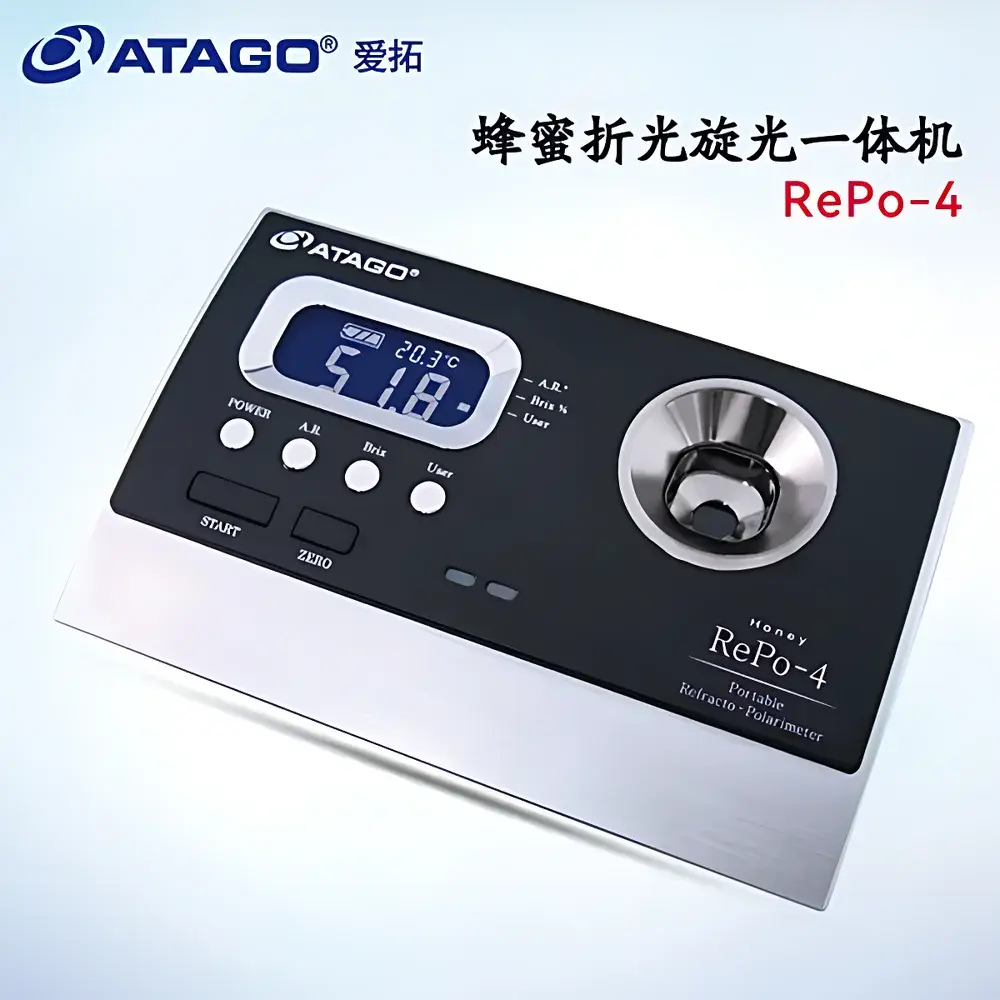
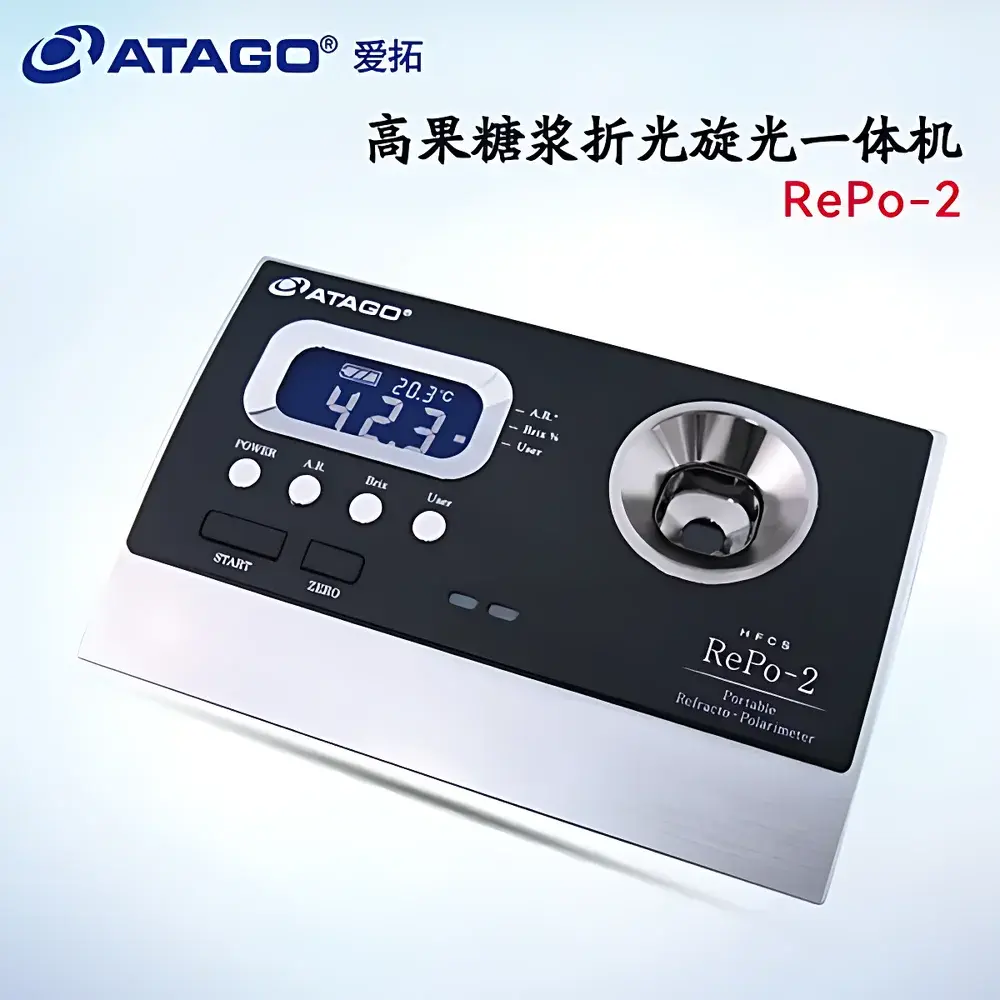
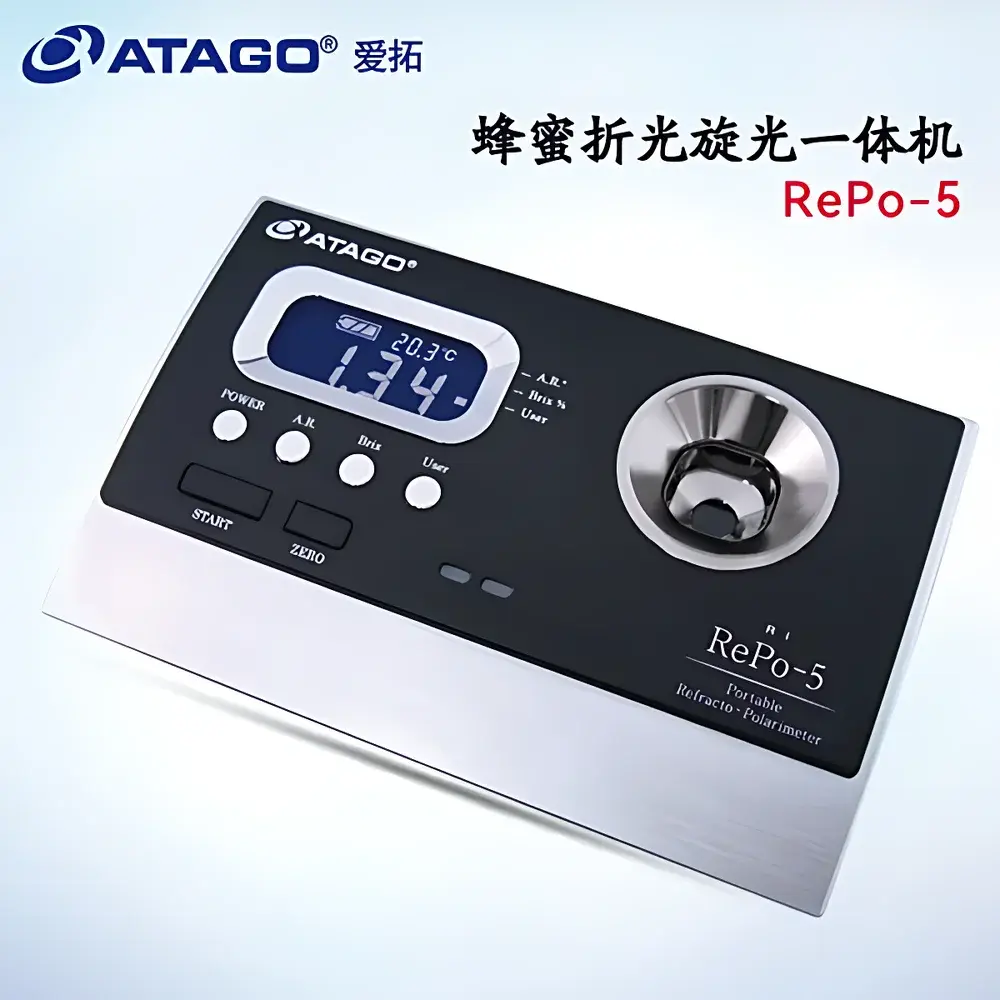
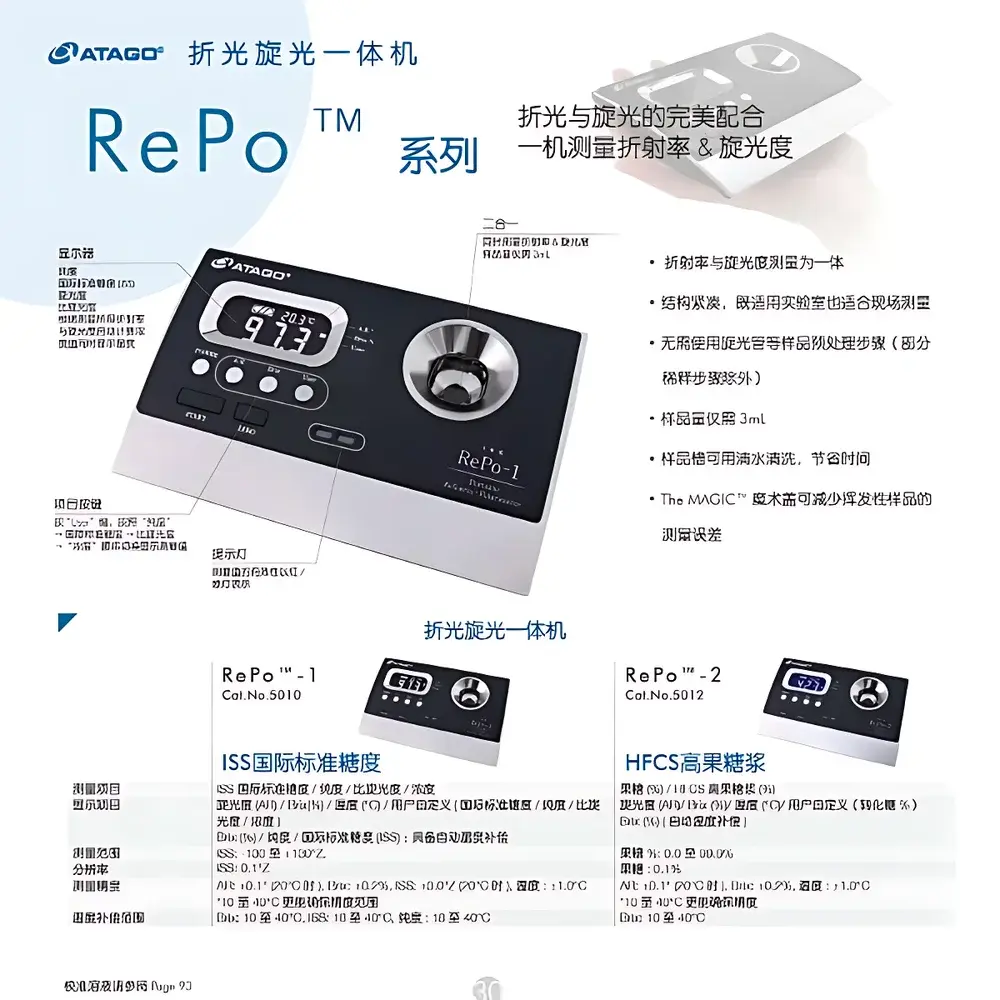
ATAGO RePo™ Series Integrated Refractometer-Polarimeter
| Brand | ATAGO |
|---|---|
| Origin | Japan |
| Model | RePo™-1 / RePo™-3 / RePo™-4 / RePo™-5 |
| Measurement Range (AR) | –130° to +130° |
| Resolution (AR) | 0.01° |
| Accuracy (AR) | ±0.10° |
| Light Source | LED @ 589 nm (D-line equivalent) |
| Temperature Range | 10.0–40.0 °C |
| IP Rating | IP67 |
| Dimensions | 10.1 × 16.0 × 3.8 cm |
| Weight | 325 g (host unit only) |
| Power | 4 × AAA alkaline batteries |
| Measurement Time | 12 s |
| Brix Range | 0.0–85.0 % |
| Refractive Index Range (RePo™-5) | 1.3306–1.5050 |
| RI Resolution | 0.0001 (at 20 °C) |
| RI Accuracy | ±0.0002 (at 20 °C) |
| Compliance | USP <788>, EP 2.2.42, JP XVII, ISO 21543, ASTM D1218, ASTM E1222 |
Overview
The ATAGO RePo™ Series Integrated Refractometer-Polarimeter is a compact, handheld dual-parameter optical analyzer engineered for simultaneous, real-time measurement of optical rotation (α), refractive index (nD), and Brix concentration in a single instrument. Based on the fundamental principles of polarimetry—where plane-polarized light rotates upon passage through optically active chiral media—and Abbe refractometry—where critical angle deviation determines refractive index—the RePo™ platform delivers traceable, laboratory-grade metrology in a field-deployable form factor. Unlike conventional benchtop polarimeters requiring temperature-controlled cells and manual sample loading, the RePo™ series integrates thermally stabilized optics, LED-based 589 nm illumination (spectrally aligned with the sodium D-line), and auto-compensated algorithms compliant with pharmacopeial standards (USP , EP 2.2.42, JP XVII). Its IP67-rated enclosure ensures operational integrity in humid, dusty, or splash-prone environments—including sugar refineries, honey processing lines, pharmaceutical cleanrooms, and QC laboratories conducting raw material verification.
Key Features
- True dual-mode operation: Simultaneous acquisition of specific optical rotation (°), refractive index (nD), Brix (%), and temperature (°C) without instrument reconfiguration.
- Modular model architecture: RePo™-1 (general-purpose), RePo™-3 (inverted sugar quantification), RePo™-4 (honey moisture & fructose profiling), and RePo™-5 (pharmaceutical-grade refractive index and specific rotation per USP/EP monographs).
- High-reproducibility optical path: Precision-machined quartz cuvette interface with standardized 100 mm and 200 mm cell options; automatic temperature compensation applied to both Brix and RI readings across 10–40 °C.
- Robust portable design: 325 g mass, battery-powered (4 × AAA), 12-second measurement cycle, and IP67 ingress protection enabling use in production floors, field inspections, and mobile labs.
- Traceable calibration support: Pre-aligned with NIST-traceable sucrose and quartz control standards; supports user-defined calibration curves for proprietary formulations (e.g., honey blends, syrup mixtures, API solutions).
Sample Compatibility & Compliance
The RePo™ series accommodates aqueous, alcoholic, and viscous liquid samples requiring ≤3 mL volume (filled to marked line). Compatible matrices include cane/beet sugar syrups, honey, fruit juices, pharmaceutical excipient solutions, and chiral active pharmaceutical ingredients (APIs) in ethanol/water systems. All models comply with international regulatory frameworks governing analytical instrumentation: FDA 21 CFR Part 11 (audit trail-ready firmware architecture), GLP/GMP data integrity requirements (time-stamped, non-editable result logs), and pharmacopeial methods for optical rotation (USP , EP 2.2.42) and refractive index (USP , JP XVII). The RePo™-5 variant meets ISO 21543 for refractometric purity assessment and ASTM D1218 for hydrocarbon refractivity testing.
Software & Data Management
Data output is via alphanumeric LCD display with no external software dependency; however, optional USB-C connectivity (via accessory dock) enables export of CSV-formatted reports containing timestamp, sample ID, AR, nD, Brix, Temp, and operator code. Firmware supports configurable pass/fail thresholds, statistical summary (mean, SD, CV%) over sequential measurements, and GLP-compliant electronic signatures. Audit trails record all calibration events, parameter changes, and firmware updates—fully compliant with FDA 21 CFR Part 11 Annex 11 requirements for regulated environments. No cloud storage or third-party SaaS integration is implemented, preserving data sovereignty and minimizing cybersecurity exposure.
Applications
- Sugar industry: Rapid verification of sucrose purity, inversion degree (RePo™-3), and crystallization endpoint monitoring.
- Honey authentication: Quantification of fructose/glucose ratio and moisture content (RePo™-4) per Codex Alimentarius Standard 12-1981.
- Pharmaceutical QC: Identity testing of chiral APIs (e.g., levofloxacin, ibuprofen lysinate), excipient concentration checks, and USP optical rotation compliance screening.
- Food & beverage R&D: Brix-temperature correlation modeling, formulation consistency tracking, and shelf-life stability studies under variable thermal conditions.
- Academic research: Teaching polarimetric theory, chiral kinetics experiments, and validation of HPLC-derived enantiomeric excess values.
FAQ
What is the maximum optical rotation range supported by the RePo™ series?
The RePo™ platform supports up to ±130° optical rotation, expandable to ±25.00° and ±50.00° using standardized 100 mm and 200 mm sample cells respectively.
Does the instrument require external temperature control?
No. Internal thermistor feedback and algorithmic compensation ensure accuracy across 10–40 °C ambient conditions; calibration is validated at 20 °C per ISO 8655.
Can the RePo™-5 be used for pharmacopeial refractive index testing?
Yes. RePo™-5 conforms to USP , EP 2.2.6, and JP XVII refractive index specifications, including resolution (0.0001) and accuracy (±0.0002 at 20 °C).
Is user calibration possible without factory service?
Yes. Field calibration uses supplied sucrose standard solutions (10%, 30%, 50% w/w) and certified quartz rotatory standards; procedure documented in EN ISO/IEC 17025-compliant manual.
How is data integrity maintained during audits?
All measurements generate immutable records with embedded timestamps, firmware version, calibration status, and operator ID—meeting ALCOA+ (Attributable, Legible, Contemporaneous, Original, Accurate, Complete, Consistent, Enduring, Available) principles.
Related Products



