
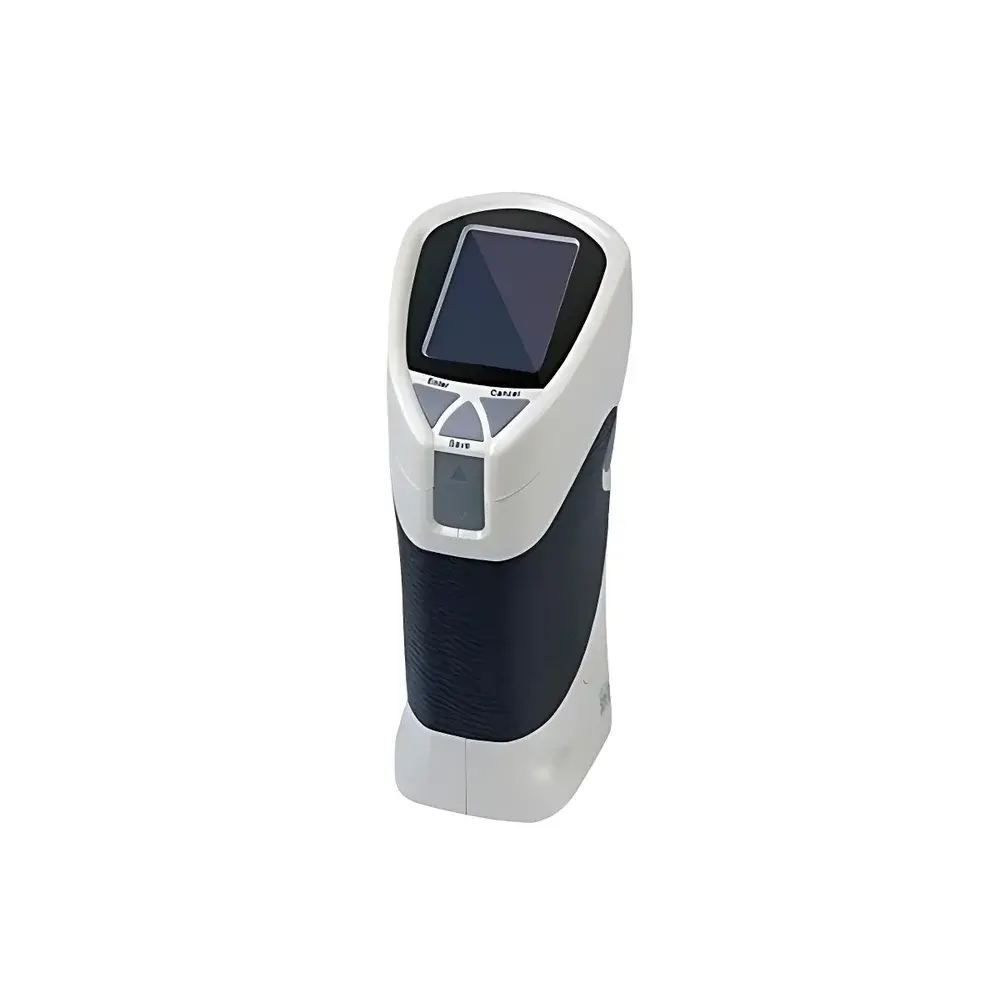
CS-200 Portable Spectrophotometric Color Difference Meter
| Origin | Shenzhen, China |
|---|---|
| Manufacturer Type | Authorized Distributor |
| Origin Category | Domestic (China) |
| Model | CS-200 |
| Product Type | Spectrophotometric Colorimeter |
| Instrument Type | Portable |
| Optical Geometry | d/8° integrating sphere (with specular component included, SCI) |
| Light Source | Tungsten Halogen Lamp |
| Spectral Range | 400–700 nm (CIE 10° Standard Observer, CIE D65 Illuminant) |
| Repeatability | ΔE*ab ≤ 0.08 (SD, n=80 on certified white calibration tile) |
| Aperture | Ø8 mm |
| Display Resolution | 0.01 ΔE*ab |
| Standard Sample Storage | 100 reference sets (100 test samples per reference) |
| Measurement Time | ~0.5 s |
| Power Supply | 4×AA 1.5 V alkaline/Ni-MH batteries or DC 5 V adapter |
| Interface | USB 2.0, Bluetooth 4.2 |
| Weight | 550 g |
| Dimensions | 77 × 86 × 210 mm |
| Compliance | Certified per JJG 595–2019 (Chinese National Metrological Verification Regulation for Colorimeters) |
Overview
The CS-200 Portable Spectrophotometric Color Difference Meter is an ISO/IEC 17025-aligned color measurement instrument engineered for high-reproducibility spectral reflectance analysis in industrial quality control environments. Based on the d/8° integrating sphere optical geometry with specular component included (SCI), it conforms to CIE 15:2004 and ASTM E308–22 standards for colorimetric data acquisition. The tungsten halogen light source ensures stable spectral output across the visible range (400–700 nm), calibrated against CIE D65 illuminant and 10° standard observer conditions. Designed for routine use in paint, plastics, textiles, coatings, and packaging manufacturing, the CS-200 delivers traceable L*a*b*, L*C*h, XYZ, and RGB color space values — enabling quantitative evaluation of chromatic deviation, whiteness (Hunter & Ganz), and yellowness (ASTM E313–22 YI) under controlled metrological conditions.
Key Features
- Integrated d/8° sphere optics with SCI mode for consistent measurement of textured, glossy, and matte surfaces without geometric bias
- High-stability tungsten halogen illumination system with thermal regulation to minimize drift during sequential measurements
- Repeatability validated at ΔE*ab ≤ 0.08 (standard deviation over 80 repeated readings on NIST-traceable white tile)
- Multi-point averaging function: supports up to 9 spatially distributed readings per sample, automatically computing mean L*a*b* and combined ΔE*ab
- Dual-language interface (English/Chinese) compliant with IEC 62366–1 usability requirements for industrial instrumentation
- Ergonomic handheld form factor (550 g, 77 × 86 × 210 mm) with tactile button layout optimized for gloved operation in production settings
- On-device storage for 100 reference standards, each supporting 100 associated test records — sufficient for multi-shift QC workflows
- Real-time display resolution of 0.01 ΔE*ab units, meeting minimum discernible difference thresholds defined in ISO 12647–2 for print process control
Sample Compatibility & Compliance
The CS-200 accommodates flat, curved, and semi-transparent materials via its fixed 8 mm aperture and optional transparent sample port. Its SCI configuration enables accurate color assessment of coated substrates, injection-molded parts, laminated films, and powder-coated metal panels — all without requiring surface preparation beyond standard cleaning. Metrological compliance includes full adherence to JJG 595–2019 (People’s Republic of China National Verification Regulation for Colorimeters), ensuring validity for internal audits and third-party calibration traceability. While not FDA 21 CFR Part 11–certified out-of-box, audit-ready data export (via timestamped CSV/Excel reports from PC software) supports GLP/GMP documentation requirements when deployed within validated laboratory procedures.
Software & Data Management
The bundled PC application provides secure, version-controlled color database management compatible with Windows 10/11. It supports bidirectional synchronization via USB 2.0 or Bluetooth 4.2, preserving full metadata (operator ID, timestamp, ambient temperature/humidity tags if logged externally). Export formats include ANSI-compliant .csv, ISO-standard .cie, and industry-specific .qtx for integration with ERP/QMS platforms such as SAP QM or MasterControl. All measurement sessions retain immutable audit trails — including calibration history, white/black tile verification logs, and user-initiated reference updates — satisfying ISO/IEC 17025 clause 7.7 record retention mandates.
Applications
- Batch-to-batch color consistency verification in automotive OEM paint shops and Tier-1 suppliers
- Whiteness/yellowness trending in paper, pulp, and textile dyeing facilities per ISO 11475 and ASTM E313
- In-line color release testing for plastic resin compounds prior to extrusion or molding
- Supplier qualification audits where objective ΔE*ab thresholds (<1.0 for Class A finishes) must be enforced contractually
- Internal color standardization across geographically dispersed manufacturing sites using synchronized reference libraries
- R&D formulation support for pigment dispersion optimization and metamerism screening under multiple illuminants
FAQ
What calibration standards are required for daily verification?
A certified white calibration tile (provided with instrument) and black trap must be used before each shift or after ambient temperature changes exceeding ±5°C.
Does the CS-200 support inter-instrument agreement (IIA) protocols?
Yes — built-in instrument-to-instrument transfer functions enable L*a*b* value alignment across fleets using common master reference tiles traceable to NIM (National Institute of Metrology, China).
Can measurement data be integrated into LabVantage or Thermo Fisher SampleManager?
Direct API integration is not supported; however, standardized .csv exports with header-defined fields (e.g., “Sample_ID”, “L*_avg”, “ΔE*_max”) are compatible with most LIMS ingestion modules.
Is the halogen lamp user-replaceable?
No — the lamp is factory-aligned and sealed within the optical module; replacement requires return to authorized service center per JJG 595–2019 maintenance guidelines.
How is traceability maintained during firmware updates?
Each firmware revision is digitally signed and logged with cryptographic hash; calibration coefficients remain unchanged unless explicitly reloaded via authenticated PC software session.



