
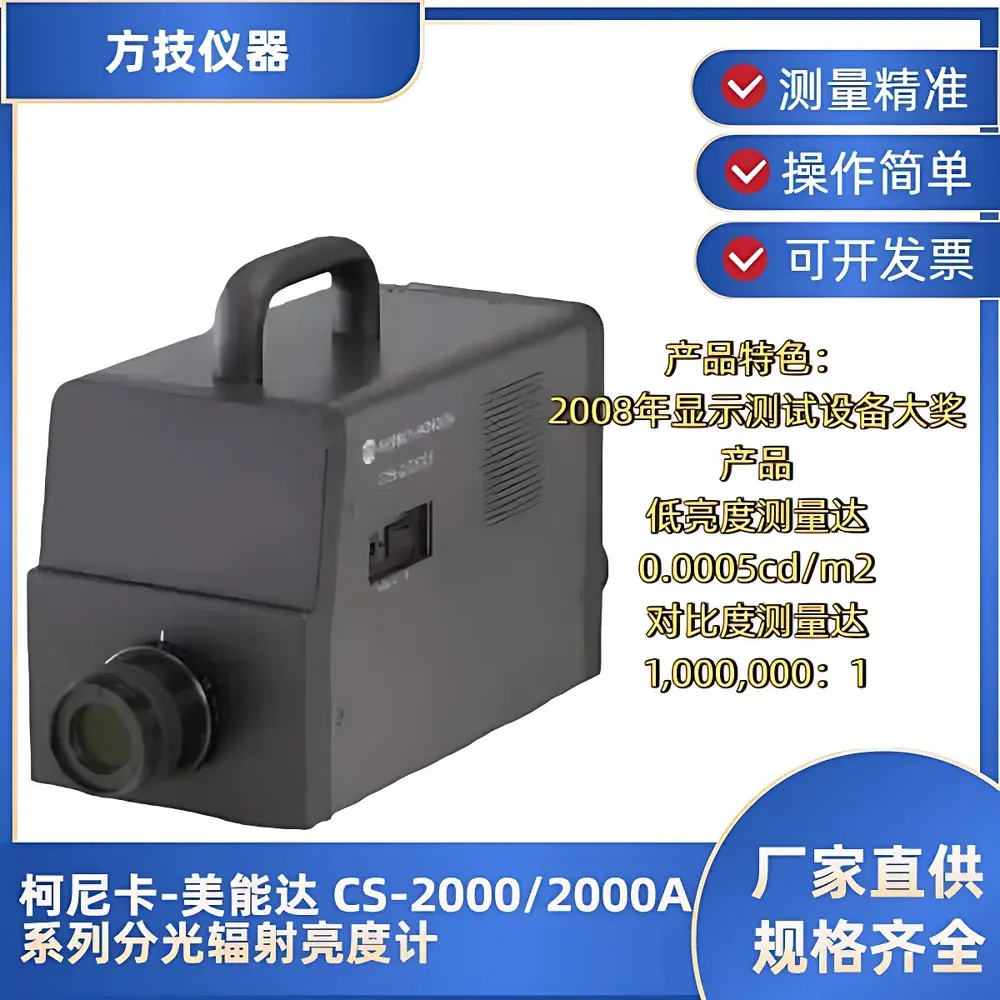
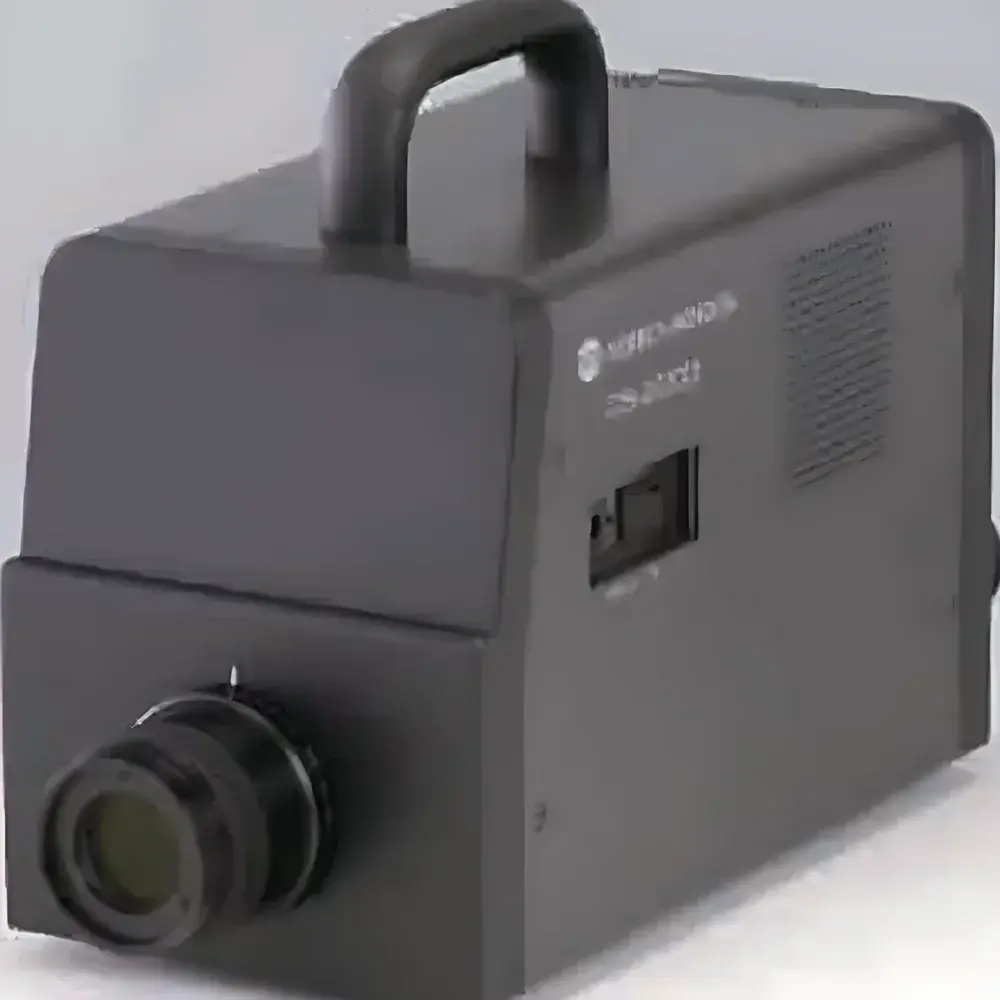
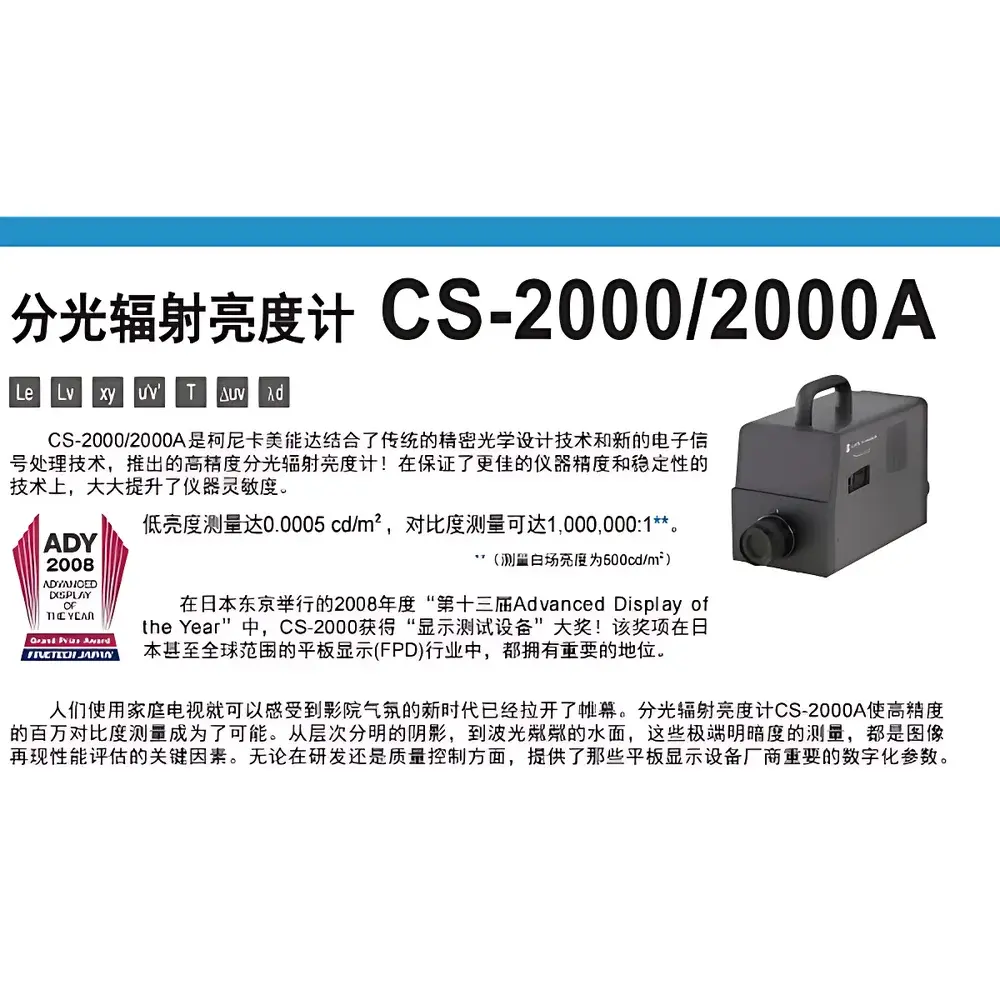
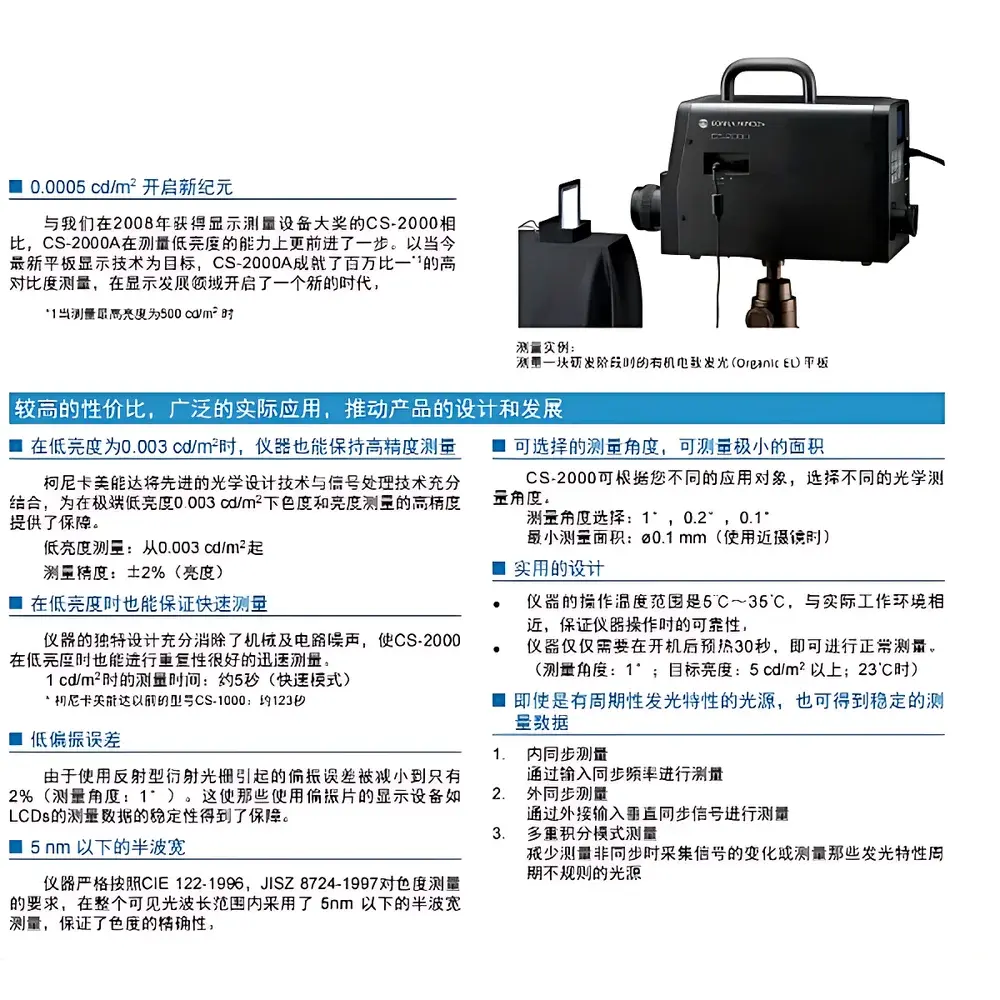
Konica Minolta CS-2000/CS-2000A Spectroradiometer
| Brand | Konica Minolta |
|---|---|
| Origin | Japan |
| Model | CS-2000 / CS-2000A Spectroradiometer |
| Wavelength Range | 380–780 nm |
| Wavelength Resolution | 0.9 nm/pixel |
| Spectral Bandwidth (FWHM) | <5 nm |
| Wavelength Accuracy | ±0.3 nm (at Hg-Cd lamp calibration lines: 435.8, 546.1, 643.8 nm) |
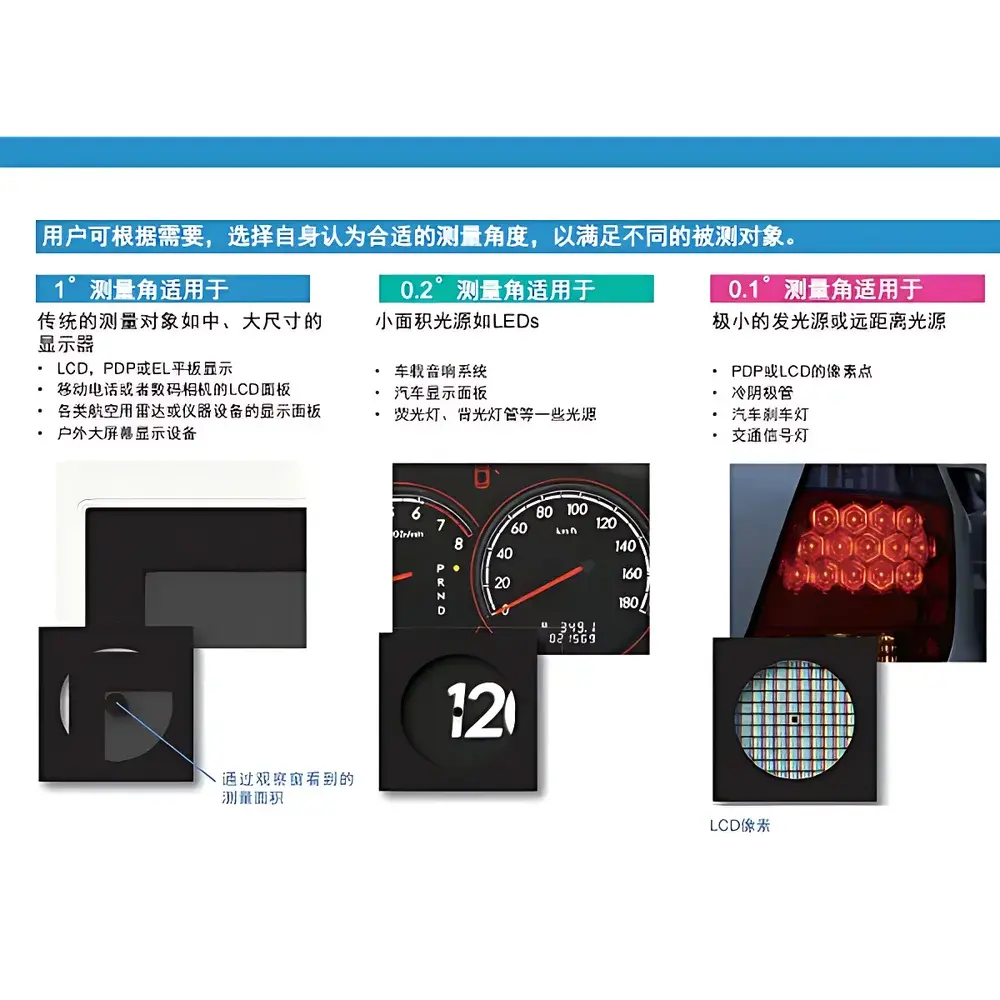
| Measurement Angles | 1°, 0.2°, 0.1° (interchangeable optical attachments) |
| Luminance Range (Illuminant A) | CS-2000: 0.003–5,000 cd/m² (1°), 0.075–125,000 cd/m² (0.2°), 0.3–500,000 cd/m² (0.1°) |
| CS-2000A | 0.0005–5,000 cd/m² (1°), 0.0125–125,000 cd/m² (0.2°), 0.05–500,000 cd/m² (0.1°) |
| Minimum Measurable Spot Size | ∅5 mm (standard), ∅1 mm (with close-up lens |
| Minimum Measurement Distance | 350 mm (standard), 55 mm (with close-up lens) |
| Radiant Exitance Detection Limit | 1.0×10⁻⁹ W/(sr·m²·nm) |
| Luminance Accuracy (Illuminant A) | ±2% |
| Chromaticity Accuracy (Illuminant A) | x,y ±0.001 (≥0.05 cd/m² for CS-2000A |
| Chromaticity Repeatability (2σ, Illuminant A) | x,y ≤0.0006 (e.g., 0.1–0.2 cd/m² and 2.5–5 cd/m² ranges) |
| Polarization Error | ≤2% (1°, 400–780 nm), ≤3% (0.1°/0.2°, 400–780 nm) |
| Integration Time | 5 ms–120 s (Normal mode) |
| Interface | USB 1.1, RS-232C |
| Operating Environment | 5–35°C, ≤80% RH (non-condensing) |
| Power Supply | 100–240 V AC, 50/60 Hz |
| Power Consumption | ~20 W |
| Dimensions (main unit) | 158 × 262 × 392 mm (W×H×D) |
| Lens | ∅70 × 95 mm |
| Weight | 6.2 kg |
Overview
The Konica Minolta CS-2000 and CS-2000A are high-precision spectroradiometers engineered for absolute spectral radiance and luminance measurement of self-luminous displays, light sources, and optical components. Based on a double-grating monochromator architecture with thermoelectrically stabilized CCD detection, these instruments deliver calibrated spectral data across the visible range (380–780 nm) at 0.9 nm/pixel resolution and <5 nm full-width-at-half-maximum (FWHM) spectral bandwidth. Unlike filter-based photometers, the CS-2000/2000A measures the complete spectral power distribution (SPD) — enabling traceable calculation of CIE tristimulus values (XYZ), chromaticity coordinates (x,y and u′,v′), correlated color temperature (CCT), dominant wavelength, excitation purity, and scotopic luminance. The system supports three interchangeable field-of-view optics (1°, 0.2°, and 0.1°), allowing precise targeting of micro-scale emission areas — critical for OLED, microLED, and miniLED display pixel-level characterization, as well as LED chip binning and automotive lighting validation.
Key Features
- Double-grating monochromator design with low stray-light performance (<0.05% at ±10 nm from peak), ensuring high-fidelity spectral separation and minimal spectral crosstalk.
- Thermoelectrically cooled linear CCD array (2048 pixels) for stable dark-current suppression and low-noise signal acquisition — essential for low-light measurements down to 5×10⁻⁴ cd/m² (CS-2000A, 0.1° mode).
- Three user-selectable measurement angles (1°, 0.2°, 0.1°) with mechanical aperture alignment and factory-traceable angular response correction per configuration.
- Calibration traceable to NMIJ (National Metrology Institute of Japan) standards, with dual-wavelength verification using Hg-Cd lamp lines (435.8 nm, 546.1 nm, 643.8 nm) and documented uncertainty budgets per ISO/IEC 17025 requirements.
- Polarization error compensation validated across the full spectral range (≤2% for 1°, ≤3% for 0.1°/0.2°), minimizing measurement bias in polarized emission sources such as LCD backlights or AR-coated LEDs.
- Flexible integration time control (5 ms–120 s) with automatic exposure optimization and real-time signal-to-noise monitoring — supporting both rapid production-line verification and high-dynamic-range R&D profiling.
Sample Compatibility & Compliance
The CS-2000/2000A is optimized for non-contact measurement of planar and curved emissive surfaces, including OLED panels, AMOLED smartphone displays, automotive headlamps, signage modules, and projection systems. Its minimum spot size — as small as ∅0.1 mm (with 0.1° lens and close-up adapter) — enables pixel-level uniformity mapping and Mura defect quantification. The instrument complies with key international photometric and radiometric standards, including CIE S 014-2/E:2022 (spectroradiometry), JIS Z 8722 (colorimetry), and ISO 13406-2 (display ergonomics). Data integrity meets GLP/GMP documentation requirements: all measurements include embedded metadata (date/time, operator ID, calibration ID, integration time, lens configuration), and raw spectral files (.csd) retain full 16-bit digitized intensity values for post-acquisition reprocessing. While not FDA 21 CFR Part 11-certified out-of-the-box, audit trails and electronic signature support can be implemented via CS-S10w software in validated laboratory environments.
Software & Data Management
The bundled CS-S10w professional software provides full instrument control, spectral visualization, and standardized photometric reporting. It calculates and exports CIE 1931 xy, CIE 1976 u′v′, CCT, Duv, luminance (cd/m²), luminous flux (lm), dominant wavelength, excitation purity, and scotopic/photopic ratio — all based on user-defined illuminants or measured SPDs. Batch processing supports automated multi-point grid scans, pass/fail thresholding against specification limits (e.g., Δu′v′ ≤ 0.003), and CSV/PDF report generation compliant with internal QA protocols. Raw spectral data is stored in vendor-neutral .csd format (ASCII-based, human-readable header + binary intensity array), facilitating third-party analysis in MATLAB, Python (via provided SDK), or industry-standard tools like LightTools and ASAP. USB 1.1 and RS-232C interfaces ensure compatibility with legacy manufacturing SCADA systems and automated test stands.
Applications
- Display R&D: Pixel-level luminance and chromaticity uniformity mapping for next-generation emissive displays; verification of wide-color-gamut performance (DCI-P3, Rec. 2020); aging and burn-in studies under controlled drive conditions.
- LED Manufacturing: Binning by spectral shape and CCT shift; radiant efficiency (W/sr·m²·nm) validation; compliance testing against ENERGY STAR, IEC 62471 (photobiological safety), and TM-30-15 metrics.
- Automotive Lighting: Headlamp beam pattern homogeneity assessment; adaptive driving beam (ADB) pixel activation verification; interior ambient lighting chromaticity stability over temperature.
- AR/VR Optics: Microdisplay brightness and color fidelity evaluation at near-eye distances; waveguide exit pupil characterization under collimated viewing conditions.
- Regulatory & Certification Labs: Support for ISO/IEC 17025 accredited testing of luminaires, signage, and medical visualization equipment where spectral accuracy and inter-laboratory reproducibility are mandatory.
FAQ
What distinguishes the CS-2000 from the CS-2000A?
The CS-2000A features enhanced low-light sensitivity — extending the minimum measurable luminance to 5×10⁻⁴ cd/m² (0.1° mode) versus 3×10⁻³ cd/m² for the CS-2000 — achieved through improved optical throughput and lower-noise detector electronics. Both models share identical spectral resolution, angular options, and software platform.
Is NIST traceability available for calibration certificates?
Konica Minolta calibration services are traceable to NMIJ (Japan’s national metrology institute), which maintains mutual recognition agreements (CIPM MRA) with NIST. Upon request, customers may obtain NMIJ-issued calibration reports with expanded uncertainties aligned to ISO/IEC 17025.
Can the CS-2000/2000A measure pulsed or modulated light sources?
Yes — when synchronized with external trigger signals via the RS-232C port or hardware trigger input (optional), the instrument supports gated integration for PWM-driven LEDs, flicker analysis, and high-speed display refresh rate characterization.
How is angular response characterized and corrected?
Each optical attachment undergoes point-spread function (PSF) mapping using a collimated tunable laser source. Angular responsivity curves are embedded in firmware and applied in real time during measurement to correct for off-axis sensitivity roll-off per CIE TR 168:2015 guidelines.
Does the system support automated multi-point scanning?
Yes — CS-S10w includes scripting functionality (VBScript-compatible) and API access for integration with motorized XY stages, enabling programmable raster scans, statistical uniformity analysis (e.g., min/max/mean/std dev per region), and export of spatial chromaticity heatmaps.



