
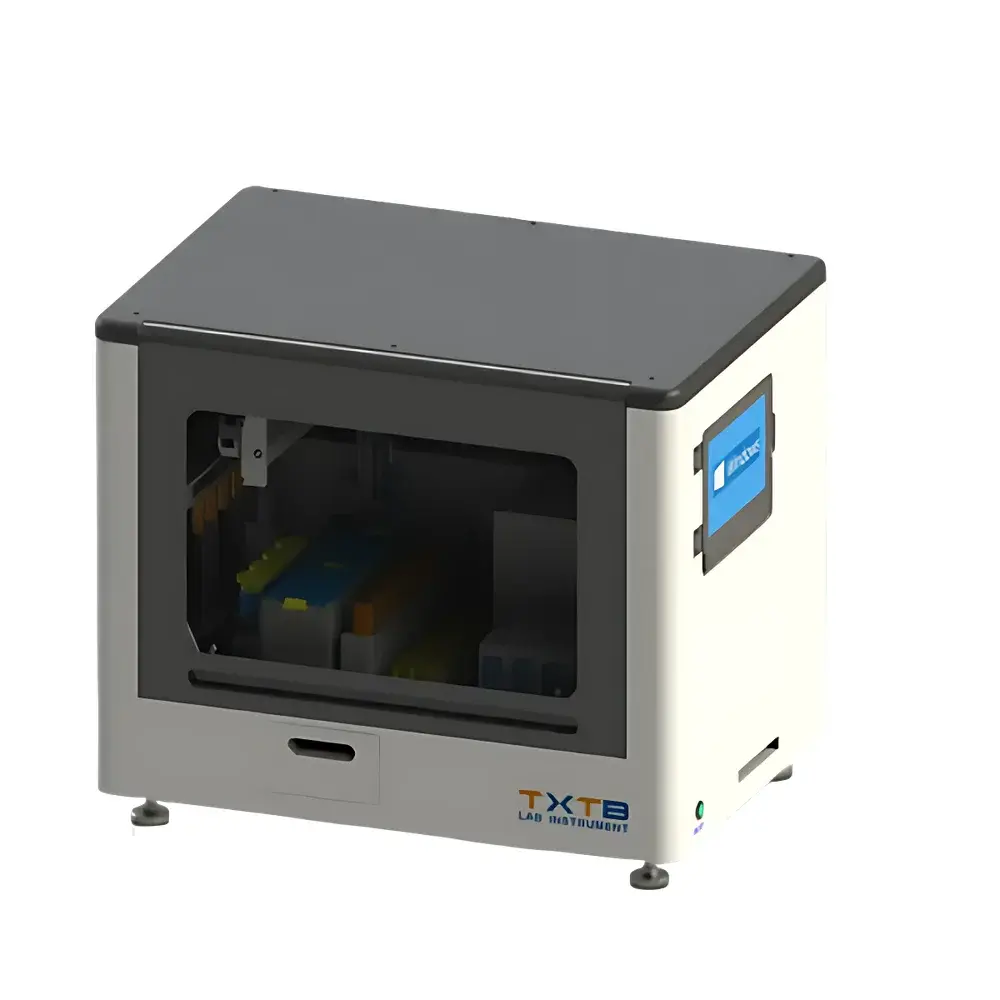
Tongxintianbo TON-IVB Fully Automated Mycotoxin Quantitative Analyzer
| Brand | Tongxintianbo |
|---|---|
| Origin | Beijing, China |
| Model | TON-IVB |
| Power Supply | 220 V / 50 Hz |
| Dimensions | 400 × 380 × 270 mm |
| Rated Power | 500 W |
| Sample Throughput | 1–4 samples per run |
| Sample Preparation | Automated magnetic stirring (programmable timing) + positive-pressure filtration |
| Liquid Handling | Disposable TIP pipette tips |
| Detection Method | Time-resolved fluorescence immunochromatography (TRFIA) |
| Compliant Standards | LS/T 6143–2023, LS/T 6112–2015, LS/T 6114–2015, KJ 201702, KJ 202201, KJ 202106 |
| Analytes | Aflatoxin B₁ (LOD: 0.5 µg/kg, Range: 0–75 µg/kg), Deoxynivalenol (LOD: 25 µg/kg, Range: 0–5000 µg/kg), Zearalenone (LOD: 5 µg/kg, Range: 0–1000 µg/kg), Ochratoxin A (LOD: 1 µg/kg, Range: 0–500 µg/kg), T-2 Toxin (LOD: 25 µg/kg, Range: 0–5000 µg/kg), Fumonisins (LOD: 50 µg/kg, Range: 0–5000 µg/kg) |
| Recovery Rate | 80–125% |
| Coefficient of Variation (CV) | ≤12% |
Overview
The Tongxintianbo TON-IVB Fully Automated Mycotoxin Quantitative Analyzer is an integrated benchtop instrument engineered for high-throughput, regulatory-compliant quantification of six major mycotoxins in grain, oilseed, and processed food matrices. It operates on the principle of time-resolved fluorescence immunochromatography (TRFIA), leveraging europium-doped nanofluorescent microspheres conjugated to pathogen-specific monoclonal antibodies. Unlike conventional ELISA or lateral-flow colloidal gold assays, TRFIA delivers enhanced signal stability, reduced background interference, and superior quantitative linearity—critical for meeting ISO/IEC 17025 validation requirements in accredited food testing laboratories. The system automates the entire pre-analytical workflow—including solvent-assisted extraction, magnetic stirring with programmable duration, positive-pressure membrane filtration, and precise capillary transfer to proprietary dual-test-line immunostrips—minimizing operator-dependent variability and eliminating manual pipetting errors. Designed for routine use in grain elevators, edible oil refineries, cereal processing facilities, third-party contract labs, and national food safety surveillance programs, the TON-IVB ensures traceable, auditable, and repeatable results aligned with international method harmonization frameworks.
Key Features
- Fully automated sample preparation: Integrated magnetic stirrer with adjustable speed and timer, coupled with positive-pressure filtration module for consistent particulate removal and filtrate clarity.
- Discrete liquid handling: Single-use disposable TIP tips prevent cross-contamination between runs; tip ejection is motorized and synchronized with assay protocol.
- Dual-test-line TRFIA detection: Simultaneous quantification of two analytes per strip (e.g., AF-B₁ + DON) via independent T1/T2 lines, with built-in C-line control for assay validity confirmation.
- Onboard calibration and curve fitting: Preloaded standard curves per analyte conform to LS/T and KJ series methods; user-customizable curves support matrix-matched calibration.
- Embedded QC tracking: Automatic logging of reagent lot numbers, operator ID, environmental temperature/humidity, and instrument self-diagnostic status at each run.
- Robust mechanical architecture: All fluidic pathways are chemically resistant (PP, PTFE, borosilicate glass); no consumable pumps or valves requiring scheduled replacement.
Sample Compatibility & Compliance
The TON-IVB supports direct analysis of ground cereals (corn, wheat, rice, barley), oilseeds (soybean, peanut), milled products (flour, bran), and intermediate food matrices (breakfast cereals, pet feed). Sample homogenization and extraction follow AOAC Official Method guidelines adapted for immunoassay compatibility. Each assay kit includes matrix-matched reference standards and recovery controls validated per ISO 5725-2 precision criteria. Instrument compliance extends to Chinese national standards LS/T 6143–2023 (aflatoxin B₁), LS/T 6112–2015 (zearalenone), LS/T 6114–2015 (ochratoxin A), and KJ-series rapid detection protocols issued by the China National Center for Food Safety Risk Assessment (CFSA). Data output formats meet GLP documentation requirements, including electronic signatures, audit trails, and exportable CSV/PDF reports compliant with FDA 21 CFR Part 11 Annex 11 principles.
Software & Data Management
The embedded Windows-based operating system hosts a dedicated analytical suite supporting multi-user role assignment (administrator, analyst, reviewer), password-protected method libraries, and encrypted local database storage. All measurement data—including raw fluorescence intensities (T1, T2, C), calculated (T1+T2)/C ratios, concentration interpolations, and pass/fail flags—are timestamped and linked to sample IDs, batch logs, and environmental metadata. Audit trail functionality records every parameter modification, report generation, or user login event with immutable timestamps. Export options include structured CSV for LIMS integration, PDF analytical certificates, and XML files compatible with national food safety information platforms (e.g., China’s Food Safety Traceability System). Remote firmware updates and diagnostic telemetry are supported via secure TLS 1.2 communication channels.
Applications
- Grain procurement screening at state reserve depots and commercial elevators to enforce GB 2761–2023 mycotoxin limits.
- In-process quality control in edible oil refining lines where aflatoxin carryover poses critical risk.
- Regulatory surveillance by provincial CDCs and market supervision bureaus conducting routine monitoring of retail grains and flours.
- Contract testing services delivering ISO/IEC 17025-accredited reports for export certification (e.g., EU Regulation (EC) No 1881/2006).
- Research applications in agricultural extension centers evaluating fungal resistance traits in breeding programs.
FAQ
What regulatory standards does the TON-IVB validate against?
The instrument and its associated test kits are verified per LS/T 6143–2023, LS/T 6112–2015, LS/T 6114–2015, KJ 201702, KJ 202201, and KJ 202106—covering method specificity, LOD/LOQ, recovery, repeatability, and ruggedness as defined in CNAS-CL01:2018.
Can the system quantify multiple mycotoxins simultaneously in one sample?
Yes—each run processes up to four samples, and each test strip enables dual-analyte detection (e.g., AF-B₁ + DON) using spatially resolved T1/T2 lines. Full six-analyte profiling requires sequential strip loading per sample.
Is method transfer support available for laboratory accreditation?
Tongxintianbo provides full validation documentation packages—including IQ/OQ/PQ protocols, uncertainty budgets, and inter-laboratory study reports—to facilitate ISO/IEC 17025 accreditation under Clause 5.4.5.
How is data integrity ensured during long-term deployment?
All measurements are cryptographically signed upon acquisition; the audit trail captures user actions, system events, and environmental parameters with SHA-256 hashing and write-once-read-many (WORM) storage logic.
What maintenance intervals are recommended?
No routine calibration is required. Preventive maintenance consists of quarterly verification of stirrer torque, filtration pressure consistency, and optical alignment using NIST-traceable fluorescent standards—documented in the onboard service log.





